by Elizabeth Hines | Aug 1, 2018 | Blog, Content Marketing, Marketing
The Fronetics blog will be taking a brief summer vacation.
Starting today, the Fronetics blog will be taking a little hiatus. Don’t worry — it’s only for 2 weeks! We are working on some exciting things behind the scenes and can’t wait to share them with you.
We’ll be back with our regular posting schedule beginning Wednesday, August 15. If you find yourself missing us while we’re away, feel free to check out our ever-growing list of resources for supply chain and logistics marketers.
Or feel free to browse through our recent posts. We’ve been covering some really interesting stuff lately. There’s a little something for everyone — whether you’re looking for industry marketing trends or DIY content marketing guides. Here are a few favorites:
We hope you have a safe, wonderful, and relaxing end of summer, and we look forward to having you back in two weeks!


by Elizabeth Hines | Jul 25, 2018 | Blog, Content Marketing, Logistics, Marketing, Social Media, Strategy, Supply Chain
Here are 4 components of an effective lead-nurturing campaign that will entice your potential customers and have them moving down the sales funnel.
Your content marketing objectives really come down to one basic goal: to generate a high number of quality leads. These leads will help drive tomorrow’s revenue and increase sales. In fact, 85% of B2B marketers say lead generation is their most important content marketing goal.
As more and more buyers discover brands before they are ready to purchase, an essential function of any marketing department is lead nurturing. That is, moving leads through the sales funnel by leveraging what’s known about their needs and online behavior.
Marketo, a marketing software company, describes lead nurturing as being “personalized, adaptive, and able to listen and react to buyer behavior in real time.”
We know that marketers need to focus their lead nurturing strategy on multi-channel engagement. This includes utilizing email, social media, blogs, and video to interact with potential customers. A multi-channel lead nurturing strategy is essential for companies looking to optimize their user experience and bring in high-quality leads.
With so many variables contributing to a productive lead-generation campaign, it can be challenging to pinpoint what differentiates a successful campaign from a mediocre one. Here are four tools that will help you deliver a series of targeted messages across multiple touch points and platforms to help solidify your lead-nurturing strategy and increase your quality leads.
4 building blocks of an effective lead-nurturing campaign
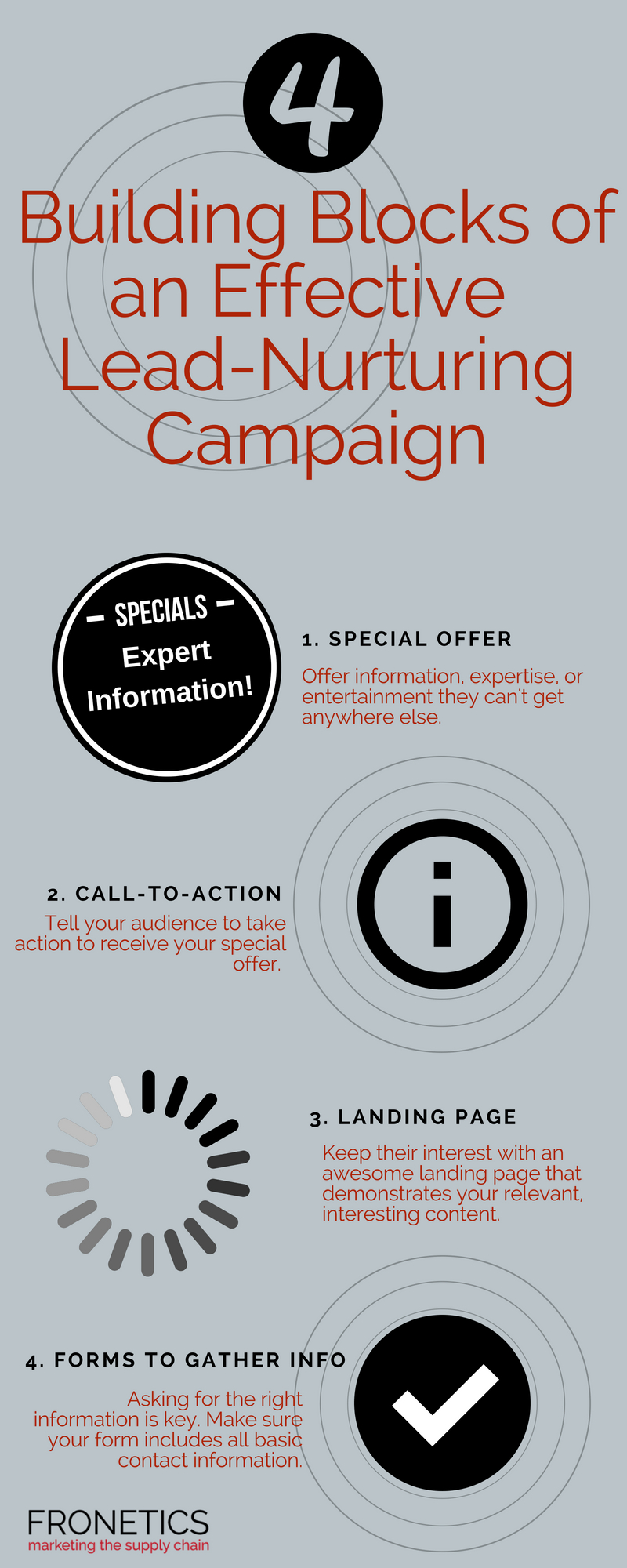
(Made with Canva)
Takeaway
Successful lead nurturing is really about utilizing all the tools at your disposal to meaningfully connect with your leads in order to build trust and establish credibility. Using these four key points, marketers can start building on their lead-generation efforts as they guide potential customers on their journey to becoming a client.
And don’t forget: Asking for the right information is key! If you want to nurture high-quality leads, you need to make sure you’re capturing relevant, helpful information along the sales journey.
Related posts:
by Elizabeth Hines | Jul 17, 2018 | Blog, Content Marketing, Logistics, Marketing, Strategy, Supply Chain
The first step in an effective lead generation campaign is creating valuable offers to convince website visitors to entrust you with their contact information.
Welcome to part one of my series on effective lead generation.
In this four-part series, I’ll guide you through the four most crucial components of the creating an effective lead-generation and lead-nurturing campaign. And I’ll help you tailor your strategic marketing objectives to generate a high volume of quality leads.
Today, we’re looking at how to create valuable offers, the first step in converting a website visitor into a lead.
Offering value
To generate a lead, you need to convince visitors on your website to give you their contact information — and this takes work. You can’t simply expect them to generously hand over their personal information. (Don’t we all get enough emails?!) This means you need to tempt them with something they really want, which you give them in exchange for their contact info.
You may be asking, what will my audience find valuable? And this is where your content comes into play.
One of the fundamental principles of content marketing is that your expertise is just as valuable as your products and services. Well-written, high-quality content is always more effective at generating leads than an overt sales pitch.
Creating valuable offers
When designing your content, keep these three questions in mind:
1. What does my audience need?
It might seem like a basic consideration. But before you jump with both feet into creating an offer, take a step back and really consider the needs of your audience.
This is a good time to check out other industry blogs, social media, and online forums like Quora. What kinds of questions are your prospective buyers asking? What problems are they facing, and how can you help them?
2. How do I best serve the information I’m presenting?
Once you have a clear, well-researched idea of what your audience needs, think about what format best serves the content you’ll be offering them.
Depending on how your information should be structured, valuable content offers could be industry reports, guides, infographics, free consultations, product demonstrations, discounts, or webinars. You’ll often find that you can repurpose your existing content into an exclusive new, valuable offer.
3. How do I let my audience know that my offer is valuable?
So you’ve figured out what your audience needs, and created and structured a content offer to meet that need. Now it’s time to let your audience in on the secret.
The higher the perceived value of an offer, the more irresistible it becomes. And a big part of what we perceive to be valuable is about exclusivity and high demand.
To create this feeling of exclusivity and demand, use elements like:
- Limited-time offers
- Limited quantities
- X number of people have seized this offer
- Content that matches current trending topics
- A title that hooks interest
When you create an offer that your target audience perceives as truly valuable, your lead-generation efforts will begin to grow exponentially.
What tips do you have for creating valuable offers? Want to learn more about the crucial components of the creating an effective lead-generation and lead-nurturing campaign? Here’s the rest of the posts in our series:
Related posts:

by Elizabeth Hines | Jul 16, 2018 | Blog, Content Marketing, Logistics, Marketing, Strategy, Supply Chain
Updated December 11, 2024
Whether you’re selling manufacturing solutions, logistics services, or technology, your supply chain lead generation strategy must address specific industry pain points like inventory optimization, transportation costs, and supplier relationship management.
While content marketing works across industries, supply chain decision-makers have unique needs. Procurement managers, logistics directors, and supply chain VPs face complex challenges:
- Multi-stakeholder buying committees
- Long sales cycles (often 12-18 months)
- High-value purchasing decisions
- Complex technical requirements
- Regulatory compliance concerns
- Integration with existing systems
Let’s explore how to adapt the four core components of lead generation specifically for supply chain audiences.
The 4 Essential Components of Supply Chain Lead Generation
1. Creating High-Value Supply Chain Offers
Supply chain professionals seek concrete solutions to operational challenges. Effective offers include:
Industry Reports:
- Annual logistics cost benchmarking studies
- Regional supplier capability assessments
- Port congestion and capacity forecasts
- Last-mile delivery performance analysis
Technical Resources:
- Warehouse automation ROI calculators
- Transportation management system comparison guides
- Inventory optimization modeling templates
- Supplier risk assessment frameworks
Educational Content:
- Supply chain sustainability certification programs
- LEAN logistics implementation playbooks
- Digital twin technology adoption guides
- Blockchain in supply chain webinar series
2. Supply Chain-Specific Calls-to-Action (CTAs)
Customize your CTAs to resonate with supply chain roles:
For Procurement:
- “Download Supplier Evaluation Template”
- “Access Vendor Management Toolkit”
- “Calculate Potential Sourcing Savings”
For Logistics:
- “Benchmark Your Warehouse Costs”
- “Map Your Distribution Network”
- “Optimize Your Fleet Performance”
For Supply Chain Technology:
- “Compare TMS Features”
- “Schedule WMS Demo”
- “Download Integration Roadmap”
3. Converting Landing Pages for Supply Chain Professionals
Design landing pages that address industry-specific concerns:
Technical Validation:
- Integration capabilities with ERP systems
- API documentation
- Security certifications
- Compliance standards met
Operational Proof:
- Industry-specific case studies (e.g., automotive, retail, pharmaceuticals)
- Performance metrics (e.g., inventory reduction, on-time delivery improvement)
- Implementation timelines
- ROI calculations
Social Proof:
- Logos of recognized supply chain brands
- Industry awards and certifications
- Partnership badges (SAP, Oracle, etc.)
- Client testimonials from supply chain leaders
4. Strategic Form Fields for Supply Chain Lead Qualification
Capture information crucial for supply chain lead scoring:
Company Profile:
- Annual freight spend
- Number of distribution centers
- Current transportation modes
- Manufacturing locations
- System landscape
Project Context:
- Current supply chain challenges
- Priority initiatives
- Decision timeline
- Budget range
- Required integrations
Role Information:
- Position in supply chain organization
- Purchase authority level
- Technology decision-making role
- Geographic responsibility
Supply Chain Lead Nurturing Strategies
Once you’ve captured leads, nurture them with industry-specific content:
Early Stage:
- Educational content about supply chain trends
- Industry benchmark reports
- Thought leadership webinars
Middle Stage:
- Technical specification sheets
- Implementation guides
- Customer success stories
Late Stage:
- Custom ROI analysis
- Pilot program proposals
- Integration assessment reports
Measuring Supply Chain Lead Generation Success
Track these key metrics:
- Lead-to-opportunity conversion by industry vertical
- Sales cycle length for different solution types
- Implementation success rates
- Customer lifetime value by segment
- ROI achieved by solution category
Next Steps in Your Supply Chain Lead Generation Journey
Over the coming weeks, we’ll explore advanced topics including:
- Supply chain buyer persona development
- Industry-specific content strategies
- Technical validation frameworks
- ROI calculation methodologies
Sign up for updates to get these insights and more on generating and nurturing qualified leads in the manufacturing, distribution, and logistics sectors.
Related posts:

by Elizabeth Hines | Jul 12, 2018 | Blog, Content Marketing, Logistics, Marketing, Supply Chain
Meta descriptions help boost your SEO, driving more traffic to your posts and more quality leads on your website.
You’re trying your best to become an expert in SEO optimization. You’re working hard to create valuable content, finding visually pleasing images to accompany your posts (and adding alt text), and using internal and external links throughout. But many of us marketers fail to acknowledge the importance of a strong, interesting meta description.
What is a meta description?
According to Wordstream, a meta description (sometimes called a meta description attribute or tag) is an HTML element that describes and summarizes the contents of your page for the benefit of users and search engines. Broken down into laymen’s terms, this means that meta descriptions are a short snippet of text that appears on a search engine results page (SERP) under your page title to describe to readers exactly what your content is about.
Why are meta descriptions important?
A strong meta description can draw visitors to your content. As they scroll through organic search results, your meta description is their first glance at what they can expect from your page, making it a very visible part of search marketing. A compelling meta description gives you a brief overview of what the content is about, as well as a convincing reason to click on the link to your page.
Sounds pretty simple, right? Writing persuasive meta descriptions can actually be quite challenging.
The character-count limit, which depends on your content management platform, keeps your descriptions to not much longer than a tweet. It’s a lot of pressure for marketers to come up with short but captivating snippets as to why a reader should click on your page. Hence why most marketers tend to glance over this key factor in SEO optimization.
Here are five tips to help you start writing better meta descriptions and increasing your click-through rates quickly.
5 tips for writing better meta descriptions
1. Keep it to 155 characters.
According to Moz’s research team, the optimal character length for meta descriptions is 150-160 characters. Anything longer and most search engines will cut off your description.

As you can see above, longer descriptions that get cut off don’t give readers a full picture of what your page is about. It’s important to keep to the optimal character count, giving readers a clear understanding of why they need to visit your page.
2. Read, read, and read again: no grammatical errors.
This seems pretty straight forward, but grammatical errors in a short description are bad. Really bad. Make sure you go back and read (and reread) your meta descriptions before you post them. And don’t be afraid to ask your coworkers to double check your work — sometimes it’s hard to see errors in your own writing. Your descriptions are a direct reflection of your content and therefore need to be flawless.
3. Don’t shy away from offers.
We’ve all seen a meta description that adds “30-day trail free” at the end. And why not? Essentially, a meta description is a hook for visitors to click on your page. Incentives are a great way to help your page stand out from the competition. Including short call-to-actions or offers in your description lets visitors know what’s waiting for them when they visit your site. It’s a great way to boost your content and get the most value from your meta descriptions.
4. Beware of Google AdWords.
Google AdWords is a form of paid advertising that prioritizes paid ads over organic search results. This is great if you’re paying for advertising. But if you’re like many marketers, you’re hoping to be at the top of the search results because you’re working hard to optimize your content. Because Google now posts the top four search results through AdWords, your content has to work harder to get to the top of the search results lists, making your meta descriptions more important than ever.
Focus on writing descriptions that provide value and invite readers to click on your site, other than trying to sell yourself. A more natural, inviting meta description will help you stand out against the paid ads also appearing in the search results.
5. Test and change.
As with all aspects of content marketing, your efforts should never be stagnant. It’s imperative that you track, test, and change your game plan according to how well — or, in some cases, how poorly — the efforts turn out.
This absolutely applies to your meta descriptions as well. Don’t be afraid to search your keywords and compare competitors’ meta descriptions against your own. Adapt what you’re doing to what is driving the best results. Do descriptions with offers gain more visits? Are your descriptions coming across as uninviting? Make adjustments along the way until you find what works best for you.
Have you given much thought to your meta descriptions? What tricks have you used?
Related posts: