by Elizabeth Hines | Oct 8, 2018 | Blog, Content Marketing, Logistics, Marketing, Social Media, Strategy, Supply Chain
Social media’s ability to exponentially grow brand awareness and introduce your content to unseen audiences can’t always be measured in dollars.
One of the hardest parts about implementing a social media strategy is struggling to measure its success. While most B2B marketing professionals agree that a social media presence is crucial to any content marketing strategy, it can be hard to justify the investment when you can’t quantify the results.
“Social media is not just a spoke on the wheel of marketing. It’s becoming the way entire bicycles are built,” says Ryan Lilly, author.
This doesn’t mean that your business shouldn’t be diving — head first — into social media. With over 3.1 billion people using social media, businesses have to recognize the importance of social media as a part of a robust marketing strategy.
Marketers need to start thinking about social media success in terms of potential, instead of immediate dollars.
Social media: the reach
One of the most valuable aspects of social media is the ability to engage with new audiences, all the time. That means you not only have access to a new customer base, but to their connections as well.
When your followers engage with your brand on social media, they also engage with their own personal network. This organic reach is one of the most beneficial aspects of social media — and it’s not easy to put a dollar amount on. The potential to nurture leads and ultimately impact sales are huge, but it won’t happen overnight.
Here’s Kettie Laky, Social Media Director at Fronetics, to share why you need to frame social media success in terms of potential, and not just dollars.
Video: Measure social media success in terms of potential, not just dollars.
It’s time we start thinking about social media success in this new way: in terms of potential and expanding value, rather than just immediate dollar amounts. How have you worked to measure the success of your social media strategy?
Related posts:


by Elizabeth Hines | Oct 3, 2018 | Blog, Content Marketing, Data/Analytics, Logistics, Marketing, Social Media, Supply Chain
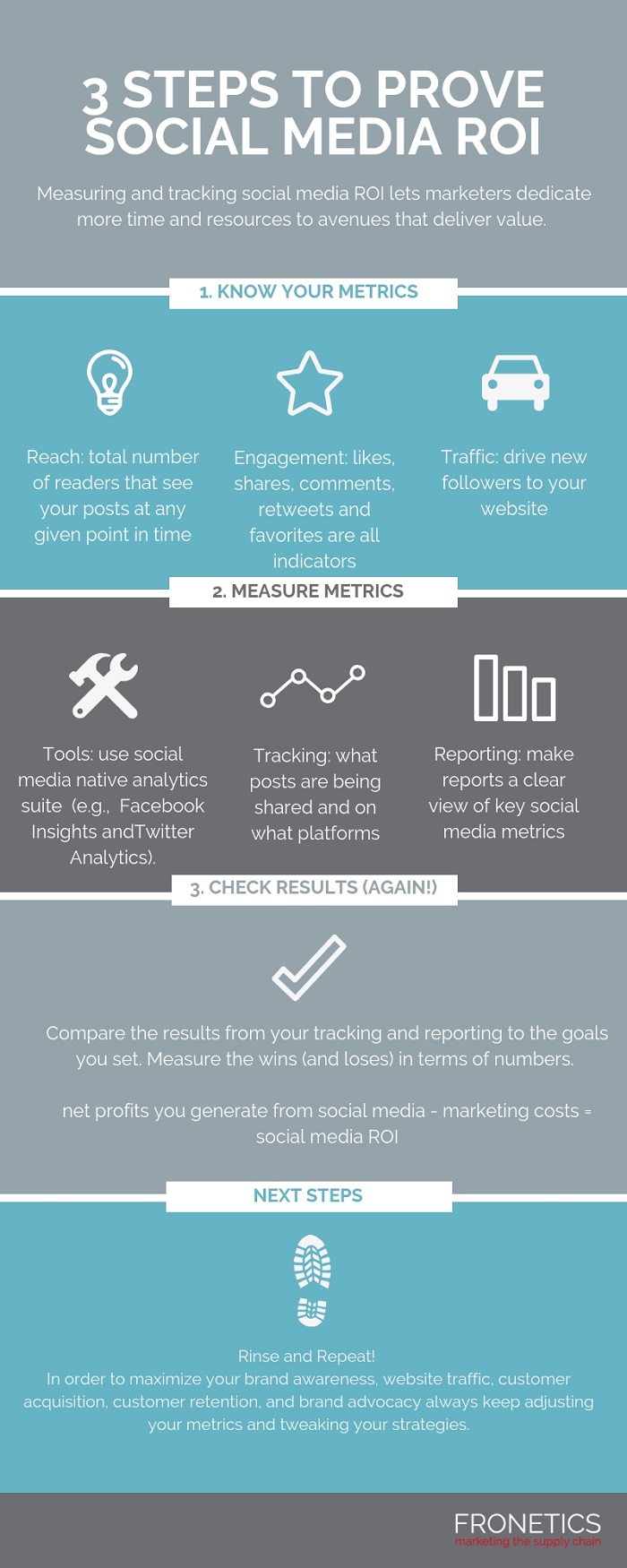
Use these three steps to calculate your social media ROI and prove the value of your investment.
As supply chain and logistics businesses are finally recognizing the merits of content marketing, and more specifically social media platforms, many are looking into implementing a program at their companies. But it doesn’t take much research to realize what an enormous investment it is. And how difficult it can be to prove social media ROI.
We understand the time and money it takes to successfully implement and manage a social media strategy as a part of your content marketing plan. Many companies we talk to need help convincing management that it’s a worthwhile investment. To that we say, use data!
But what data should you use? How do you quantify certain benefits, like growth in brand awareness? And do you really have to keep track of all the hours you spend managing social media, crafting new tweets, etc.?
Here are three simple steps to start proving your social media ROI.
Infographic: 3 steps to prove social media ROI
(Made with Canva)
Final thoughts
Once you’ve calculated ROI for your social media platforms, it’s time to think strategically about optimizing your content marketing resources in terms of allocation and timing. Having hard data helps you answer questions about which initiatives are most fruitful, what language engages your audience best, when your efforts are most likely to pay off.
Ultimately, this data-driven approach lets you continually adapt to the needs of your audience, ensuring an ongoing, robust ROI.
Have you had to prove your social media ROI? What strategies did you use?
Related posts:


by Elizabeth Hines | Sep 20, 2018 | Blog, Content Marketing, Logistics, Marketing, Social Media, Supply Chain
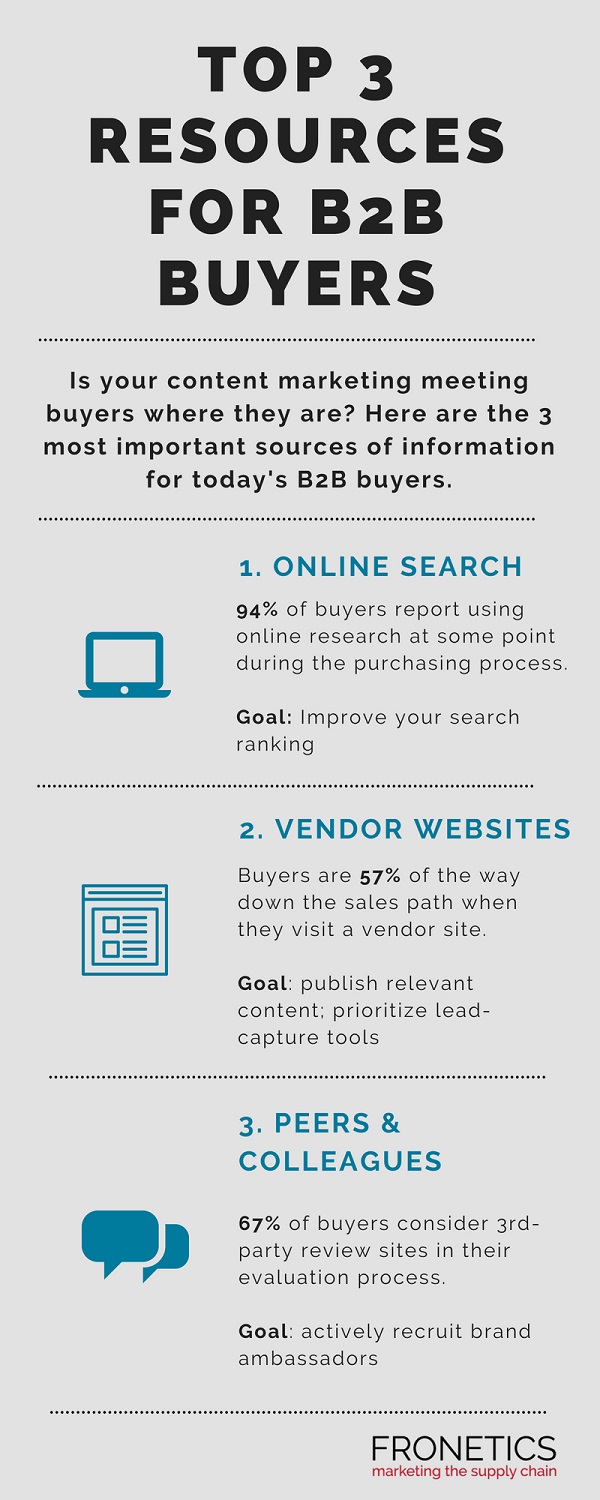
Online searches, vendor websites, and peer recommendations are the top 3 resources for B2B buyers.
As a marketer, it’s not enough to just know about the B2B buyer’s process. Your success rides on your ability to understand how your buyers are getting their information — and, more specifically, where they’re getting the information they need to make a purchasing decision.
So where are they getting most of their information? I can tell you, it’s no longer from sales reps.
In our digital era, buyers are heading straight to the internet to gain valuable insight before making purchases. Thanks in large part to social media, mobile technologies, and the world wide web, buyers are becoming increasingly self-sufficient. In fact, 70% of the buyer’s journey is complete before a buyer even reaches out to sales. This means they have already spent a fair amount of time educating themselves with the enormous amount of information available to them on the internet.
Is your content marketing meeting buyers where they are? Here are the three most important sources of information for B2B buyers.
Infographic: 3 top resources for B2B buyers
(Made with Canva)
Takeaway: Get in early
Listen, your prospects are forming their opinions about your business and your products based on what they find on the web, and early on.
This new reality may seem daunting, given how much of the purchase decision-making process occurs before you have the opportunity to engage with a potential client. But in reality, this changing climate offers serious opportunities for businesses to demonstrate their expertise, without turning buyers off with overt sales pitches.
To make the most of the potential purchaser’s experience with your business, content is key.
A robust content marketing program builds brand awareness, establishes trust and rapport with prospects, and generates traffic to your website. Thoughtfully generated and curated content catches the attention of buyers and keeps them interested in your business through the time of purchase.
With a well-thought-out, data-driven content marketing strategy, you’ll be ready to meet digital natives where they are.
Related posts:


by Elizabeth Hines | Sep 17, 2018 | Blog, Content Marketing, Logistics, Marketing, Social Media, Strategy, Supply Chain
Today’s B2B buyers are mostly digital natives who get the majority of their purchasing information from online searches, vendor websites, and peer recommendations.
From a content marketing perspective, knowing where your buyers get their information is critical to an effective strategy. So what are most important sources of information for today’s B2B buyers? 20 years ago, you might have named things like product info sheets or sales reps. But not anymore.
B2B buying has completely evolved, thanks in large part to the increasing percentage of digital natives who now make up the B2B purchasing landscape.
Is your content marketing strategy meeting buyers where they are? Here are the three most important sources of information for B2B buyers.
3 top sources of information for B2B buyers
1. Online search
Not only is an online search the first move for 62% of B2B buyers, 94% of buyers report using online research at some point during the purchasing process. And this isn’t a surprise, when you consider that, according to a study of millennial buyers by Merit, “some 73% of 20 to 35 year olds are involved in product or service purchase decision-making at their companies.”
So what does this mean for your business? Gone are the days when a simply thinking about keyword rankings was enough to boost your SEO. In our four-part series on writing for SEO, we address how search engines and the search landscape have changed over the past several years. Improving your search ranking can seem like a complex process, but in the end it all boils down to one thing: quality content, presented in a clear and compelling manner.
2. Vendor websites
So buyers conduct their online search. And if you’ve done your content marketing homework, they find your business. How does your website stack up?
According to Bain’s global customer insights chief Eric Almquist, by the time they reach your website, buyers “will have already formed a strong opinion about many aspects of the value expected from a vendor.” For this reason, your website should “provide a wealth of information on these types of value, with details on where… products have been successful.”
Your website should be one of your primary assets. If you don’t give visitors plenty of easy, attractive opportunities to convert on your website, content marketing won’t generate leads for you. Your content should be organized and clear, presented with the goal of helping your potential customers. And opportunities for conversion should be everywhere.
3. Peers and colleagues
As digital natives step into purchasing roles in the supply chain, they’ve “brought their consumer habits to the B2B world,” says Almquist. This means that a big part of the purchasing process involves review sites, where purchasers seek the opinion of their peers and colleagues. “Reviews will tell the buyer how a vendor performs on many ease-of-doing-business elements long before the buyer has actual experience with that vendor.”
This aspect of content marketing can seem daunting for many businesses because of the perception that what’s on these sites is completely out of your control. But with the right strategy in place, review sites are actually a big opportunity for your business.
For a start, vendors “should encourage customers who are advocates of the company to provide reviews on relevant sites.” It’s also important to take an active role on these sites, responding to customer reviews — even the occasionally inevitable bad ones.
Says Almquist, “First impressions matter as much as ever in B2B markets. Today though, that first look comes through websites, user forums, and quick case studies, not flesh-and-blood sales pitches.”
With a well-thought-out, data driven content marketing strategy, you’ll be ready to meet digital natives where they are.
What sources of information for B2B buyers do you focus on?
Related posts:

by Elizabeth Hines | Sep 12, 2018 | Blog, Content Marketing, Logistics, Marketing, Strategy, Supply Chain
Here are the top three resources digital natives are using to research solutions and how your B2B business can prepare to meet them online.
Knowing where your buyers do research when making purchasing decisions is crucial to any marketing strategy. Digital natives, a new generation of younger buyers, have completely revolutionized the purchasing landscape for B2B vendors. Their biggest resource? The world wide web.
A study of millennial buyers by Merit found that 73% of employees ages 20-35 years old are involved in product or service purchase decision-making at their company. In fact, one-third reported they are the sole decision maker for their department.
What does this mean for B2B marketers?
These younger, and typically more technologically advanced, buyers expect they can find the information they need about your brand online through an organic search. Your company needs to have any and all content available at the push of a button.
But the work doesn’t stop there. Once a buyer finds your brand, you hope they make the leap to visit your website, meaning your site needs to be one of your most appealing assets. If you don’t give visitors plenty of easy, attractive opportunities to convert on your website, content marketing won’t generate leads for you.
But online searches and vendor website aren’t the only resources digital natives are using to make purchasing decisions. This younger generation also relies heavily on recommendations from peers and colleagues.
Like recommendations from friends and family in their personal lives, the opinion of other buyers becomes very important. A big part of the purchasing process involves B2B review sites, where purchasers seek the opinion of their peers and colleagues.
Here’s Elizabeth Hines, creative/editorial director at Fronetics, to discuss the top resources for B2B buyers and how you can be prepared to meet them online.
Video: top 3 resources for B2B buyers
Final thoughts
Though the purchasing landscape has changed over the past decade, B2B marketers have the tools to get in front of the right buyers. These tools including knowing what resources buyers are using and how to use these assets to your advantage. With a documented strategy and high-quality, informative content, you’ll be ready to meet digital natives where they are.
Related posts: