by Elizabeth Hines | May 23, 2019 | Blog, Content Marketing, Marketing
Measuring brand awareness is a notoriously difficult task. Here are our favorite tools to help you refine your efforts.
Highlights:
- Tools for measuring brand awareness fall into two categories: social analytics tools and social mention tools.
- Our top 3 social analytics tools: Qualtrics, Ahrefs, and Brandwatch.
- Our top 3 social mentions tools: Netvibes, Mention, and Buffer Reply.
We often hear from our clients that measuring brand awareness is one of the slipperiest tasks when it comes to digital marketing. It’s a notoriously difficult marketing element to track, and not having an accurate picture can also make it difficult to evaluate the success of your overall digital marketing efforts, as well as to calculate ROI.
Luckily, there are tools that can help. Broadly, these tools for measuring brand awareness fall into two categories: social analytics tools and social mention tools.
- Social analytics tools are designed to help you determine the times your actions get the most engagement, as well as more detailed user demographics and interactions with your brand.
- Social mention tools track overall mentions for your brand, letting you see everywhere your brand has been mentioned and helping you determine which platforms are performing best for your content.
Here are our top three favorite tools in each category for measuring brand awareness.
Top 3 social analytics tools for measuring brand awareness
1) Qualtrics
Qualtrics boasts that it is “software to help turn customers into fanatics, products into obsessions, employees into ambassadors, and brands into religions.” While supply chain companies will likely raise an eyebrow at such lofty claims, this tool really has the potential to perform for B2B customers. Ideal for complex supply chain business, Qualtrics offers a variety of tools that measure buyer experience, brand experience, product experience, and employee experience.
2) Ahrefs
Ahrefs isn’t exactly a new kid on the block when it comes to measuring brand awareness. The company started in 2011, and has continued to update and add new features regularly, keeping it on the cutting edge of SEO tools. It’s one of the best backlink analysis tools available. Perfect for just about any business, the platform notably helps you analyze why your competitors are ranking in particular areas and what you can do to outrank them.

3) Brandwatch
Some of the most successful brands in the world have been empowered by Brandwatch, which is arguably the leader in social intelligence. The robust analytics features include insights within millions of online conversations, as well as optimized target influencer and other paid social campaigns. It also boasts its Vizia platform, which shares insights with decision-makers throughout your organization, promoting aligned efforts.
Top 3 social mention tools for measuring brand awareness
1) Netvibes
Netvibes lets you easily monitor all your digital assets, as well as customize them based on the insights it provides. Not only can you follow your social networks for brand mentions, you can create alerts for breaking news or publications on key topics. Additionally, you can gain valuable insights by filtering your mentions by author, date, location, language, company, and even more.
2) Mention
Mention lets you monitor your campaigns anywhere online, and “scour the web, social media, and more for powerful market insights.” The platform offers real-time monitoring, letting you get live updates as you launch a campaign, for example. You can create custom insights, involving everything from social media, forums, blogs, and virtually every bit of the web.
3) Buffer Reply
We’re including Buffer Reply because it’s unusual in its focus. While other tools give you access to all your mentions on the web, Buffer Reply lets you hone in on a specific target client or demographic. The platform shows you everything you need to know about the client you’re talking to, each time they’ve mentioned or interacted with your brand. We recommend using it in conjunction with a broader tool like Google Alerts.
Related posts:
by Elizabeth Hines | May 8, 2019 | Blog, Content Marketing, Logistics, Manufacturing & Distribution, Marketing, Strategy, Supply Chain
Brand awareness is key in optimizing your content marketing efforts but can be challenging to quantify. Here are four metrics to help you measure brand awareness.
Highlights:
- Use tools, like SharedCount, to track the number of times a piece of your content has been shared across different social media platforms.
- Use the analytics from blog share bars to track the popularity of your posts and help shape content for your editorial calendar.
- Taking the time to measure brand awareness will ultimately help you in optimizing your digital marketing efforts.
Video transcript:
I’m Katie Russell and I’m a marketing strategist here at Fronetics. Today I’m going to talk to you about four ways to measure brand awareness for your packaging company.
Brand awareness is the extent to which customers – both potential and current – are able to recognize your brand. It is key in optimizing your digital marketing efforts, but it can be hard to quantify. Here are four metrics to help you start measuring brand awareness for your packaging company.
1. Social media reach
Social media reach is the total number of people that your content can reach across social media platforms. Use tools like SharedCount to track the number of times a piece of your content has been shared across different social media platforms, like Facebook, Instagram, and even LinkedIn. This can help you figure out what platforms perform best for your content and can also help you shape the kind of content that you’re putting on social media platforms.
2. Brand mentions
How people talk about your packaging company online? If they are, you need to know about it. Try tracking tools like Google Alerts or Hootsuite to make sure that you know every single time someone talks about your packaging brand or any of your products or services.
3. Blog shares
Here are Fronetics, we talk a lot about the importance of having a blog that posts valuable and informative content to your readers. What’s also important is giving your readers the ability to share this content. It’s as easy as adding a share tool to the side of your blog posts. This helps you reach a larger audience and gain views from people that normally wouldn’t see your content. You can also use the analytics from these share bars to track the popularity of your posts and help shape content for your editorial calendar.
4. Search volume
Use tools like Google Adwords or Moz to track searches for your brand, products, even your blog and social media posts. It can help in refining your keywords that you use throughout your content to know specifically what people are searching for when they’re searching for your packaging brand.
Taking the time to measure brand awareness will ultimately help you in optimizing your digital marketing efforts and will also help increase leads. IF you need more information or need help getting started measuring your brand awareness, visit us at fronetics.com.
Related posts:
by Elizabeth Hines | May 1, 2019 | Blog, Content Marketing, Logistics, Manufacturing & Distribution, Marketing, Social Media, Supply Chain
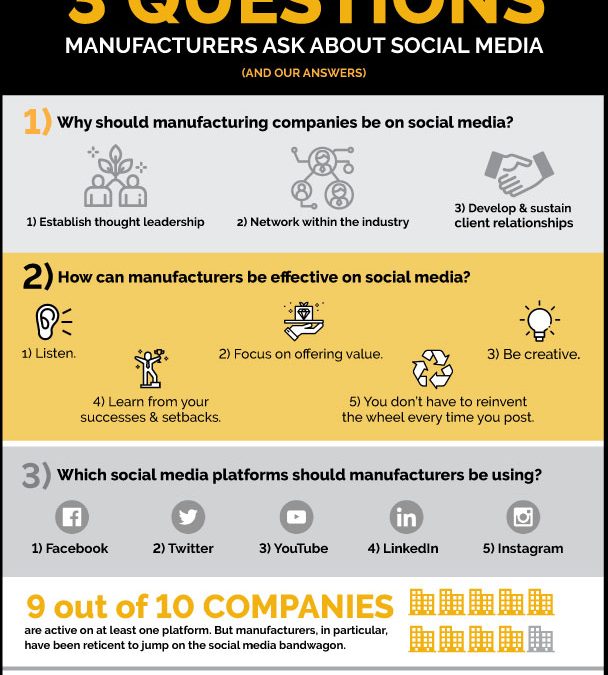
We get many queries from manufacturers about social marketing — mostly, why and how should I use it — so here are our answers to the most-popular questions manufacturers ask about social media.
Highlights:
- Facilitate networking opportunities, thought leadership, and prospect/client relationships.
- Consider using popular platforms like YouTube and Instagram to engage users and drive website traffic.
- Don’t use social media to push your products.
(Made with Canva)
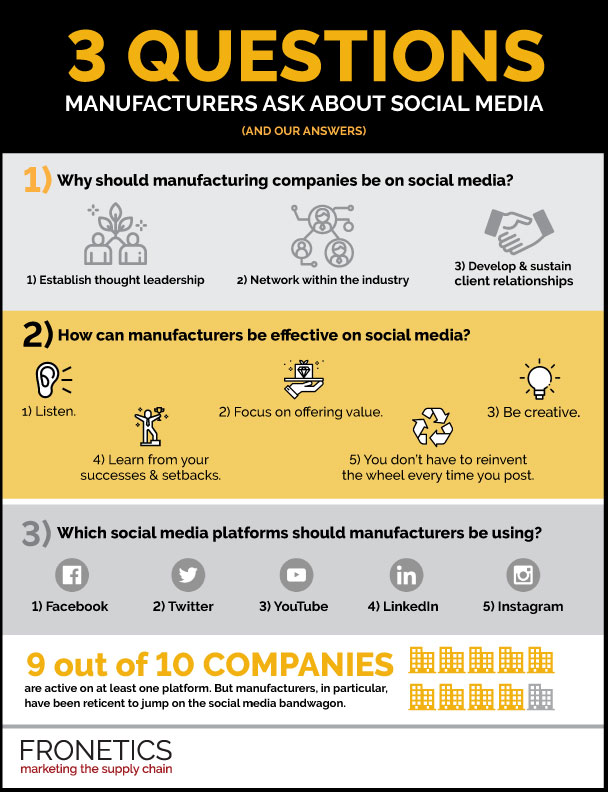
B2B operations have increasingly embraced social media as a strategic marketing tool. In fact, 9 out of 10 companies are active on at least one platform. But manufacturers, in particular, have been reticent to jump on the social media bandwagon.
If your manufacturing operation isn’t making use of social media as a tool to engage with your audience, you’re missing out on big lead generation potential. Manufacturers like the Dow Chemical Company, ArcelorMittal, and CAT Products are among those that have figured out how to harness the power of social media.
To help you launch or refine your efforts, we’ve put together the following answers to the most-popular questions manufacturers ask about social media.
Why should manufacturing companies be on social media?
There are three major reasons that manufacturing brands should be all over social media:
- Establish thought leadership
- Network within the industry
- Develop and sustain client relationships
Notice that none of these involve selling products. As with content marketing in general, good social media marketing isn’t about pushing your products.
To make the most of social media as a marketing tool, abandon the idea that it’s about blatant sales pitches. Instead, approach it from the perspective that it’s an inherently social tool – that is, its value for manufacturers is in its potential to establish and expand thought leadership and to cultivate meaningful and fruitful relationships within your industry and among prospects and clients.
Which social media platforms should manufacturers be using?
Not all social media platforms are created equal. Each requires its own strategy, content format, and media. We recommend that manufacturers consider these five platforms:
1) Facebook
Facebook is an excellent place to share content with a wide segment of your audience, to promote engagement (through likes, comments, and shares), and to engage with peers and prospects. Not only that, the savviest marketers are using Facebook to understand their industry better – everything from strategies of peer brands to a fuller picture of your target buyer persona to the informational or product needs of your prospects.
2) Twitter
Twitter’s format is about brief, pithy content, used to engage with and inform your audience. This is an ideal place to let customers know what you’re planning next, to establish your corporate personality, and to let your audience in on a slice of your day-to-day operations and values.
3) YouTube
Video marketing for manufacturers is skyrocketing. With video being the most popular form of content online today, YouTube is an obvious choice for marketers. Whether it’s “how to” videos, footage of your operations, or interviews with subject-matter experts, your brand should be using YouTube to drive search traffic and educate prospects.
4) LinkedIn
B2B marketers unequivocally rank LinkedIn as the most effective network for lead generation, follower engagement, and traffic to their websites. An ideal place to engage with industry leaders, LinkedIn is also great for distributing content to a focused audience.
5) Instagram
The popularity of this highly visual platform has continued to skyrocket – it’s currently the second-most-used social media platform (up from fourth just two years ago). And believe it or not, this picture-based network is a powerhouse for B2B brands. We’ve written extensively about how brands can leverage Instagram and Instagram Stories. Suffice it to say, this is a perfect place to post your most engaging visual content and actively engage with followers.
How can manufacturers be effective on social media?
As with any content marketing effort, a well-thought-out social media strategy is a big part of success. As you create and begin to implement your strategy, start with these five tips.
1) Listen.
Before you post even a single piece of content, start by listening to your audience. In the days before social media, marketers had it much harder when it came to determining audience needs and preferences. Use these platforms to research your target prospects, as well as how competitors are engaging followers. Make note of the questions your target audience has, frustrations or challenges they express, and what types of content they engage with.
2) Focus on offering value.
You’d be surprised how many manufacturers neglect to place a premium on simply being useful with their social media content. It’s not complicated: If you post relevant, valuable content for your target audience, you’ll boost engagement, grow brand awareness, and generate and convert more leads.
3) You don’t have to reinvent the wheel every time you post.
One of the great things about social media is that it rewards not only content creation, but content curation. While you do want to be posting original content most of the time (experts recommend about 60%), a good chunk of your posting activity should include curating relevant content from third parties to share with your followers.
4) Be creative.
Separating yourself from your competitors can be a challenge, but it’s one worth striving toward. Start by asking yourself what makes your operation unique, what’s special about your process, what industry-leading expertise does your executive team have, what unusual perspective can you offer? Next, start breaking these four rules.
5) Learn from your successes and setbacks.
There are many tools out there to help you track the results of your social media efforts. Determine the right KPIs for your business and keep track of your results relentlessly. These metrics will allow you to study your impact and frequently tailor your strategy accordingly.
It’s time for manufacturers to fully embrace the marketing potential of social media. Whether you create and implement your own strategy, or decide to outsource your social media efforts, social media is a powerful set of tools that manufacturers should be harnessing.
Are there other questions manufactures ask about social media that we missed? Let me know in the comments.
Related posts:

by Elizabeth Hines | Apr 9, 2019 | Blog, Content Marketing, Marketing, Social Media, Video Marketing
If you’re trying to build a YouTube audience, you’ll need equal parts strategy, creativity, concision, and valuable subject matter. Highlights: Strategy and creativity are top priorities. Keep content short and sweet for maximum impact. Offer value to your audience...
by Elizabeth Hines | Apr 3, 2019 | Blog, Content Marketing, Manufacturing & Distribution, Marketing, Supply Chain
Here’s why manufacturing marketers should skip the sales pitch and create content that prioritizes the needs of their target audience.
Highlights:
- Research indicates that only about half of manufacturing marketers are prioritizing their audience’s needs when creating content.
- Inbound marketing (like content marketing) is more effective than outbound marketing for B2B businesses.
- A documented strategy will help you get started creating focused, quality content.
One statistic is sticking out to me in the Content Marketing Institute’s Manufacturing Content Marketing 2019: Benchmarks, Budgets, and Trends report. According to the research, half (51%) of manufacturing marketers reported that they always or frequently prioritize their sales/promotional message over their audience’s informational needs when creating content for content marketing purposes.
Let’s think about that for a second.
A preponderance of manufacturing content marketers are, unfortunately, missing the point.
We’ve written before about why inbound marketing, like content marketing, is more effective for the supply chain than more traditional outbound marketing techniques. And while it’s true that “the supply chain is increasingly seeing the value of moving to an inbound marketing strategy,” the CMI’s research suggests that it’s taking some marketers a long time.
Why you should be putting your audience’s informational needs first
Why should you be emphasizing your audience’s informational needs over your promotional goals when creating content?
The short answer is: because your audience prefers it. One of the basic premises of content marketing is the recognition that, increasingly, your customers want much more from you than your product. For manufacturing marketers, this means that customers want value separate from and outside of the sales funnel.
Enter content marketing. Creating effective marketing content relies on accepting that your business has much more to offer than its primary products and services. In fact, your most valuable commodity, as we’ve often said before, isn’t any material or service — it’s the knowledge, expertise, and informed, unique perspectives you have to offer.
Strategize to put customers first
To successfully adjust your content marketing efforts to put your customers’ informational needs first, the first step is having a well-defined, measurable strategy — and documenting it. This means defining precisely who you’re trying to reach and developing a complete target buyer persona(s).
Once you’ve defined exactly who you’re trying to reach, it’s time to identify the unique questions, needs, and challenges this target buyer faces. Chances are, your business has not only the products to meet those needs, but also the information to answer question and offer valuable insights.
One of the benefits of a documented strategy, with clearly stated objectives, is that it allows you to set up metrics and evaluate your successes and shortfalls. This is where you can start listening to your target buyers. You can even solicit responses from them via email and social media that will allow you to target and hone your efforts in the future.
Meeting manufacturing marketers’ challenges
The CMI’s research reinforces the fact that manufacturing marketers face unique challenges. The top reported challenge was “creating content that appeals to multi-level roles within the target audience.”
According to Achinta Mitra, founder of Tiecas, an industrial marketing consultancy, “Buying decisions are made by a committee and very rarely, if ever, by an individual. Some of these stakeholders may never interact with your content or visit your site.”
Essentially, there are various types of buyers with various needs — meaning their content needs are different. Mitra advises bringing “subject matter experts to the forefront, and letting marketing do the heavy lifting in the background.” He bases his advice on the belief that “one engineer to another is a powerful concept for earning trust, gaining credibility, and winning the mindshare of engineers and industrial professionals.”
If you’re thinking beyond downloads when creating content, and truly prioritizing quality information, your content will function broadly throughout the complex manufacturing buyer’s journey.
Related posts: