by Elizabeth Hines | Feb 12, 2019 | Blog, Marketing, Social Media, Supply Chain
Transparency in your supply chain through social media outlets can give a look inside your company in a way that your customers are craving.
Highlights:
- Customers have been demanding more visibility into supply chains of the products they purchase.
- Through social channels like Twitter , LinkedIn , and Facebook, companies are greatly enhancing their two-way communication with customers and sharing information with their stakeholders.
- The top reason that supply chain companies are choosing to participate in social media is to increase the visibility of their company.
Supply chain management is such a complicated web of factors that most companies choose to keep operations behind the scenes and unveil a finished product with an intense marketing roll-out.
But what if that’s backwards and an outdated approach to marketing? (Hint: It is.)
The complexity of supply chain management
There is no question that SCM can be deeply and frustratingly complex. Consider TechTarget’s definition of SCM: “the broad range of activities required to plan, control and execute a product’s flow, from acquiring raw materials and production through distribution to the final customer, in the most streamlined and cost-effective way.”
With so much intense analysis at every step, the details your supply chain management (SCM) team considers can seem endless, and the impressive knowledge they hold is certainly not something most people can understand.
Or can they? What if that mindset – the one that thinks that your SCM is so complex that it wouldn’t interest or be able to be grasped by your customers – is wrong?
In fact, what if it’s so wrong that you are missing something important? Customers today want to understand your supply chain.
Transparency in your supply chain
A common misconception is that most customers are interested in a final product. Of course, your final product better be outstanding, but there are other factors fueling today’s buyers, business-to-business (B2B) customers included.
For a few years now, customers have been demanding more visibility into supply chains of the products they purchase. For example, they want to ensure sustainable practices around the earth’s scarce resources, to know where their food is sourced, and to confirm ethical pay and conditions for any laborers involved. B2B buyers are no exception. They want their vendors to be more than just a final product too, and are constantly searching for value outside the sales funnel.
Transparency with social media
What if you shared what fueled your daily SCM decisions with your customers, stakeholders, and suppliers? Not every last complex detail…but some of them, and the intangibles too:
- What drives SCM decisions besides cost?
- Who is your SC team?
- Where are you sourcing?
- Why do you do things as you do during production?
Transparency of SCM through social media outlets can give a look inside your company in a way that your customers are craving. Through social channels like Twitter , LinkedIn , and Facebook, companies are greatly enhancing their two-way communication with customers and sharing information with their stakeholders.
Of course, the benefits of social media to SCM don’t stop there.The supply chain needs social media for enhanced customer communication, increased industry education, and an ability to socially monitor the market. Social media has the capability to empower your supply chain in multiple ways.
According to a survey we conducted, the top reason that supply chain companies are choosing to participate in social media is to increasing the visibility of their company (95%). Don’t simply focus on your final product(s) and leave out your supply chain! When you make your supply chain transparent to your customers and stakeholders, everyone wins.
This post originally appeared on EBN Online.
Related posts:

by Elizabeth Hines | Jan 17, 2019 | Blog, Content Marketing, Logistics, Marketing, Supply Chain
Blogging should be a central part of your content marketing strategy. Here are our top tips for creating and sustaining a successful supply chain blog in 2019.
Highlights:
- Blogging needs to be a central part of your content marketing strategy.
- Focus on quality over quantity.
- Make all posts mobile-friendly.
It’s the start of a new year and the perfect time to start setting goals and strategizing how to achieve them. Hopefully, blogging is a big part of your strategy for 2019 — after all, supply chain companies should make blogging a central part of their content marketing strategy for all kinds of reasons.
Making your supply chain blog stand out from the pack isn’t always easy. That’s why we created the infographic below. Read on for our top 5 supply chain blogging tips for 2019.
5 tips for your supply chain blog
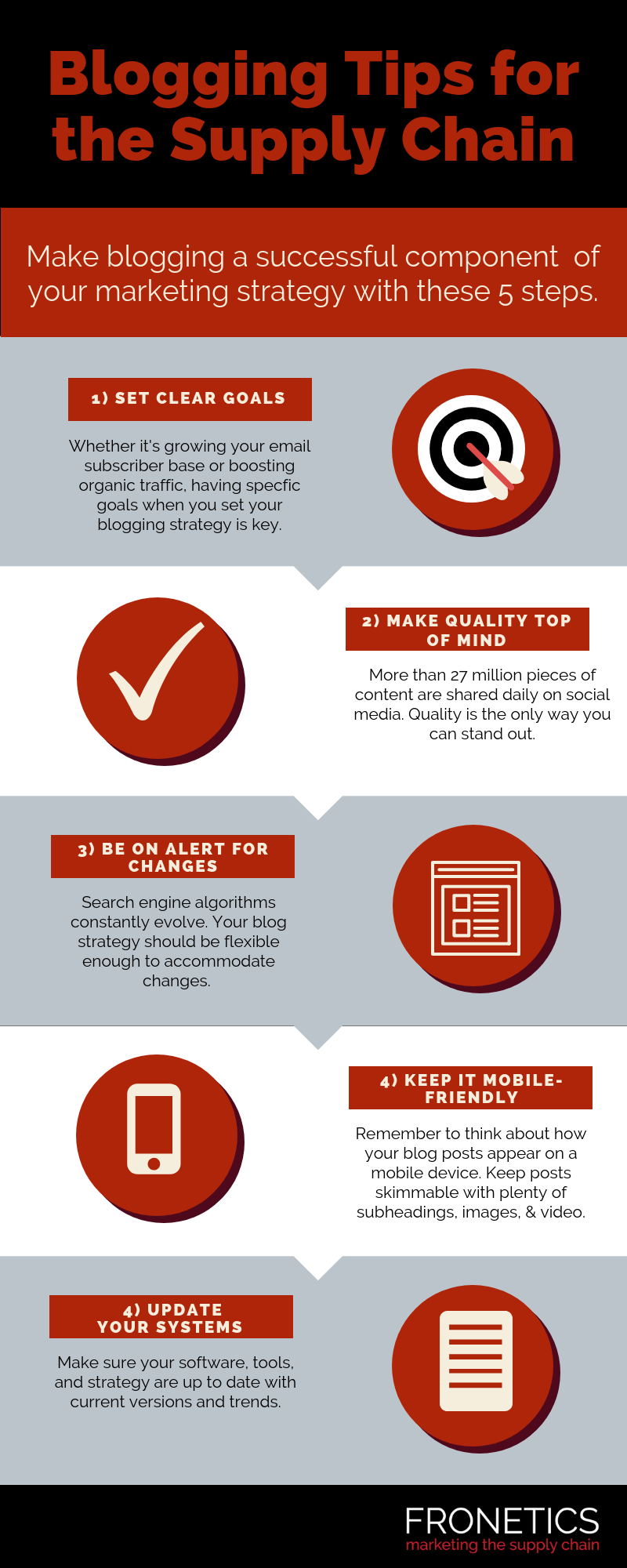
(Made with Canva)
1. Set clear goals
We know, this one sounds obvious. But you’d be surprised how often marketers overlook this seemingly simple step or settle for general, vague goals. It’s true that blogging can have all kinds of positive impacts for the supply chain, but that doesn’t mean that you should just be blogging without a clear, documented set of goals specific to your business.
Whether it’s growing your email subscriber base, boosting organic traffic, or generating more qualified leads, having specific goals in mind when you set your blogging strategy is key. For one thing, it lets you target your efforts and generate content that is focused on achieving a specific result or set of results. Furthermore, having objectives allows you to be far more effective in evaluating your results, including measuring blogging ROI, and tweak your strategy accordingly.
What are your top three goals for your supply chain blog in 2019? Let us know in the comments!
2. Make quality top of mind
Ponder this for a minute: At last count, users share 27 million pieces of new content on social media every single day. Twenty-seven million. In a world of skyrocketing quantity, quality is ever-more important. There’s a huge amount of pressure on supply chain marketers to produce a constant stream of content, but the sad truth is, if you’re not producing high-quality, substantive content, you’re wasting time and energy.
For supply chain companies in particular, it’s crucial that every piece of your content be well-researched, clearly written, focused, and trustworthy. We know that producing consistently high-quality content isn’t easy, but, trust us: if you invest the time and energy to make your content stand out, you will see the results. To get you started or keep you focused, check out our guide to creating good content for logistics and supply chain marketers.
3. Be on the alert for changes
Particularly when it comes to search engine optimization (SEO), changes happen fast these days. In August of 2017, Google updated its algorithm, continuing a set of changes we’ve been watching for a while now. Voice searches are becoming increasingly prevalent, and researchers estimate that by 2020, 50% of all searches will be voice queries.
As these changes continue to happen, it’s crucial that your strategy is lithe and flexible, ready to adapt to a quickly shifting climate. This means keeping abreast of conversations going on in the industry, following blogs you trust and respect, as well as tracking your own results, and being alert to changing trends.
4. Keep it mobile-friendly
You don’t need researchers to tell you: people are increasingly receiving and reading content on their phones. Whether it’s social media, emails, or blogs, mobile usage continues to skyrocket as devices become more and more ubiquitous and user-friendly.
What does this mean for supply chain blogs? Of course, your website needs to have a visually attractive and accessible mobile version, but it’s also helpful to think about your blog posts in terms of how they appear on a phone. Keep your posts skimmable, with plenty of subheadings to orient the reader, and absolutely include video whenever possible.
5. Make sure your systems are up to date
We keep coming back to the reality of the rate of change these days. It can be exhausting and overwhelming for marketers to keep pace. Take the opportunity of the new year to make sure all your blogging-related tools are updated and running the current software.
As you’re keeping your tools fresh, it’s also a good time to make sure your procedures are running smoothly and are at a pace with the current marketing climate. This means evaluating responsibilities and results within your team, ensuring that your editorial calendar is serving you well, and taking a look at your data collection and reporting methods.
Bonus: What not to do in 2019
These might seem obvious, but again, you’d be surprised how may marketers fall victim to these blogging “don’ts.” We figured it bore repeating.
- Don’t: attempt to post content that doesn’t reflect your business’ “comfort zone.” Stick to what you know, and do it well.
- Don’t: copy and paste text or images from other blogs. Using other content for ideas is great. Copying it verbatim is verboten.
- Don’t: post at irregular intervals. Creating a content schedule and sticking it is key to establishing a loyal following and boosting your credibility.
What goals do you have for your supply chain blog this year?
Related posts:


by Elizabeth Hines | Jan 9, 2019 | Blog, Content Marketing, Logistics, Marketing, Supply Chain
Email subject lines can make or break an email marketing campaign. Read on for our dos and don’ts for creating an effective subject line.
Email marketing is an unquestionably effective content marketing tactic for B2B businesses. But too often, marketers lose out on potential benefits by focusing too much on internal details while overlooking the importance of the subject line.
It may seem silly, but think about it: When you see an email pop up in your inbox, how do you decide whether or not to open it? If you’re like 47% of all email recipients, you decide to open it based on the subject line alone. And furthermore, if you’re like a whopping 69% of email recipients, you report it as spam purely based on the subject line.
Here are some email subject line dos and don’ts.
7 email subject line dos and don’ts
1. Do: be specific; Don’t: be vague
It’s tempting to think that the mystery of a vague subject line will pique the interest of the recipient. But think again. An overly vague teaser is simply annoying and uninteresting. Make sure that the subject line gives an accurate preview of what recipients will find when they open the email.
2. Don’t: send incessant reminders
While it’s great to stay in the forefront of your prospects’ minds, sending too many reminders about the same subject or offer is just plain annoying. Not only that, if your audience doesn’t mark you as spam, their email system might automatically do so anyway.
3. Do: send regular messages at strategic times
It’s true that constant reminders are not your friend — but that doesn’t mean you shouldn’t be sending out regular messages to the various segments of your email list. Just make sure your subject lines show variation based on the content, or else your recipients will think they’re receiving the same message over and over again.
4. Don’t: Use all capital letters
If you’re sending someone a message in all capitals, it’s the equivalent of yelling at them. Too many marketers think that the caps-lock is a sure way to capture a reader’s attention. In fact, it’s much more likely that they will send you straight to the trash.
5. Do: Personalize
Personalizing marketing emails increases open rates, click-throughs, and revenue. But it’s not as simple as just addressing recipients by name. We’ve written in detail about how to personalize marketing emails, but suffice it to say that personalized subject lines mean that users are 22% more likely to open your emails. The more information you track in your email database, the easier it will be to target your emails to your readers, making them feel that they are being personally addressed.
6. Don’t: Be sloppy
You’d be surprised how often people make these 5 email subject line mistakes. For example, misspellings, poor grammar, and excessive use of punctuation can make your open rates plummet. Check out our list — and don’t fall into the trap!
7. Do: Use Psychology
If you’re not up on the latest internet jargon, we’ve got one for you: FOMO, the “fear of missing out,” can be a powerful motivator of user behavior. While vague subject lines won’t work, using phrases like “last day to enter…” or “don’t miss out…” make your readers more likely to open your emails, simply because of FOMO.
A bad email subject line is a sure way to cripple otherwise well-thought-out email marketing tactics. But a good subject line can boost engagement, increase open and click-through rates, and spell more conversions.
Related posts:

by Elizabeth Hines | Dec 13, 2018 | Blog, Content Marketing, Logistics, Marketing, Supply Chain
These are the top 10 most-viewed supply chain and logistics posts of 2018.
Our goal throughout the year is to provide our readers with the latest news and happenings in the supply chain and logistics industry, with a focus on content marketing. We hope to educate and enlighten our readers with industry insight, tips, and trends to stay ahead of the competition.
This year we’ve taken a deeper look at supply chain and logistics companies that have experienced the highs (Google, Amazon) and lows (Tesla, KFC) of running supply chain and logistics businesses. These posts have highlighted how we can all learn a thing (or two) from their accomplishments and, of course, their mistakes.
Here’s a look at our most popular supply chain and logistics posts this year.
Top 10 supply chain and logistics posts in 2018
1. 10 Must-Follow Supply Chain and Logistics Blogs in 2018
What are your favorite supply chain and logistics blogs? Fronetics wants to tell you about some of our favorite blogs that we follow. Read full post
2. Drawing Lessons from Tesla’s Supply Chain Issues
This guest post from Argentus Supply Chain Recruiting examines Tesla’s recent supply chain woes. Argentus also shares the biggest takeaways to help you prevent similar blunders. Read full post
3. Top 3 Logistics and Supply Chain Blogs of 2018
We love hearing what blogs you enjoy reading and find valuable. There are lots of great industry options, so we know it’s not easy to narrow down your favorites. We had lots of great responses, but only Women in Trucking held its spot on our list of the top logistics and supply chain blogs from last year. Read full post
4. KFC Ran Out of Chicken in the UK: What Supply Chain Lessons Can We Learn?
There’s another unfortunate entry in the annals of Supply Chain failures that burst into the wider world of business and pop culture: More than half of the UK’s Kentucky Fried Chicken stores closed because they ran out of chicken this year. Argentus Supply Chain Recruiting examines the lessons we can learn from the restaurant chain’s blunder. Read full post
5. How Google Does Supplier Diversity
In 2014, Google launched a supplier diversity program to ensure that its staff had the ability to search large and small vendors when purchasing products or services. The tool it developed has helped Google employees create relationships with small businesses, defined as U.S.-based companies with $15 million or less in annual revenue and 50 or fewer employees. Google felt these companies often have a specialized and innovative product or service but might never be discovered simply because of their size. Read full post
6. Infographic: Influencer Marketing and the Supply Chain
Influencer marketing is a form of marketing in which marketers identify individuals that have influence over potential buyers and create marketing campaigns and activities around these influencers. Why is this so effective? Because buyers trust influencers talking about your products and services more than they trust you talking about yourself. Read full post
7. Valentine’s 2018 Supply Chain Infographic
Consumers spent a near-record $19.2 billion on Valentine’s Day 2018, up from $18.2 billion in 2017. According to NRF’s annual survey, over half of the country participated (55%) in the romantic holiday, spending just over $140 on average. Read full post
8. Five Go-To Supply Chain Websites
Following leading websites is a great way to keep up with the latest news and information about happenings in the supply chain and logistics industry. Here are our five favorite supply chain websites. Read full post
9. Video: Why Inbound Marketing is Better than Outbound Marketing for Supply Chain Marketers
Marketers are constantly coming up with new and trendy ways to attract leads. With endless platforms available to us, it can be overwhelming for even the most seasoned marketers to know where they need to focus their efforts. Outbound marketing used to be the ‘go to’ for generating leads, but this is simply no longer the case. Marketers across industries have found that inbound marketing has many advantages over traditional marketing practices. Read full post
10. 5 Email Marketing Trends Supply Chain and Logistics Marketers Need to Know
More people are using email than ever before (close to 3.8 billion worldwide). Fronetics works with supply chain and logistics businesses every day, so we have a first-hand understanding of how email marketing can be successful in these industries. Read full post
Related posts:


by Elizabeth Hines | Dec 12, 2018 | Blog, Content Marketing, Logistics, Marketing, Social Media, Supply Chain
Our most-viewed social media posts confirm there’s only one thing that stays the same with social platforms: they’re always changing.
Today, more than ever, companies are turning to social media to engage with customers and reach new audiences. But staying current with updates and new technologies is no easy task for marketers.
2018 was the year of video. From the soaring popularity of Insta Stories and Snapchat to the continued success of YouTube, users want to watch content (over reading it). In fact, video is the most popular form of content being consumed online today — and it shows no sign of slowing down.
Here are the top 10 social media posts in 2018, including why (and how ) to start implementing video into your content marketing strategy.
Top 10 social media posts in 2018
1. 10 Social Media Statistics for B2B Marketers 2018
Social Media Examiner’s 10th annual study, 2018 Social Media Marketing Industry Report, surveyed more than 5,700 marketers from across the world in a variety of industries — including manufacturing, industrial goods, and a variety of other B2B verticals. Here are some of the most relevant social media statistics from that survey for supply chain and logistics marketers. Read full post
2. An Example of Successful Social Media in Supply Chain Management
Sometimes, a success story can be a powerful motivator. FIFA and Adidas have been extremely successful in using social media in supply chain management. Here’s how it works for these organizations and why your business should consider it. Read full post
3. 10 Tips for Using Instagram for Business
Recent research on social media use shows that 66% of brands now use Instagram. It’s the second-most used platform by businesses, up from fourth in 2017. If you’re considering using Instagram for your business, which you should be, here are some tips for getting started. Read full post
4. Video: Social Media Trends for 2018
As always, good content will be as important as ever. With over one million new-data-producing social media users each day, high-quality content is the only way to stand out from the masses. But we also think you should pay attention to a few social media trends that we have highlighted in the following video. We’re certainly planning to adjust our strategy and those of our clients to consider these things. Read full post
5. 4 Things Your Business Should Do in Light of Facebook News Feed Changes
Mark Zuckerberg once again rocked the world on January 11 — at least for businesses — when he announced that Facebook News Feed was evolving to include less public content, meaning content from Pages of businesses, brands, and media. The algorithm now prioritizes posts from friends and family (over public posts) and those that “spark conversations and meaningful interactions between people.” Here’s how you should change what you’re doing in response. Read full post
6. Infographic: Social Media Statistics Your Business Needs to Consider When Publishing Content
A strong social media presence is key to successful marketing in 2018. Social media is simply unavoidable these days. So, you jumped on board and you’re posting and tweeting. You’re creating content. You’re learning about search engine optimization and how to improve your rankings. But you’re still not reaching the audiences you were hoping to attract. What’s going wrong? Read full post
7. What Supply Chain and Logistics Marketers Need to Know About Organic Reach on Facebook
In a recent social media news post, we mentioned that Facebook was experimenting with an Explore Feed feature. You may or may not have heard about how this might affect businesses’ ability to achieve organic reach on Facebook. Read full post
8. Facebook Boosts Local News, Twitter Launches Sponsored Moments, and More Social Media News
Updates to the most popular sites have included longer character counts, more advanced conversational skills with chatbots, and new tools for easier sharing. All of these changes are working to improve user experience and help keep users active on the biggest sites. Read full post
9. Facebook Updates News Feed, Instagram Allows User to Send Live Videos, and More Social Media News
I’m sure by now you have heard about the updates to Facebook’s News Feed that are having major impacts on business pages’ organic reach. But the changes don’t stop there. Twitter, Snapchat, and Instagram are trying to follow Facebook’s lead and enhance their user experience. Through updates that include video counts, enhanced data collection, and recommended posts, social media is working overtime to make sure its active users are staying active. Read full post
10. 5 Ways to Improve Your YouTube Marketing Strategy
I’ve written a lot about YouTube and how the supply chain should be leveraging it as a marketing tool. Of course, I don’t recommend just creating videos at random and throwing them up on your channel. Like any content or platform, you should approach YouTube strategically. Read full post
Related posts: