
by Elizabeth Hines | May 6, 2020 | Blog, Content Marketing, Covid-19, Current Events, Marketing, SEO, Strategy, Supply Chain
So much to say, so little time. Supply chain marketing during Covid-19 — leaning in is better than backing out.
Turmoil does not quite begin to describe the situation that supply chain companies have experienced lately. The Covid-19 pandemic threw in just a few weeks the finely calibrated, just-in-time supply chains into a state of disarray. In the midst of the struggle to get product from Point A to Point B — while also ensuring the health and safety of employees — many companies had little choice but to adopt an all-hands-on-deck approach.
We saw it ourselves as our clients were suddenly buried in challenges that only weeks earlier had posed no issues at all — securing electronic parts overseas, locating warehouse space, finding freight forwarders, moving product out of port, and more.
If supply chain marketing during Covid-19 had to take a backseat during the initial phase of the crisis, beware of staying quiet for too long. Letting your marketing channels sit idle for an extended period, or drastically scaling back at a time when communication matters more than ever, is not a risk-free strategy.
Let us explain why:
Covid-19 supply chain marketing: Lean in or risk losing ground
Go silent — or stay strong
In the wake of the first shockwaves of the Covid-19 pandemic, supply chain companies understandably had to devote extensive resources to regain their footing. Few industries felt the impact as deeply as the supply chain. For some, the disruption opened up a flood of new business, sending the entire organization scrambling to keep up. For others, it meant every budget line item had to be scrutinized.
At the same time, we noted another challenge brewing for busy organizations: Maintaining a strong online presence during a tumultuous time. How do instill confidence in current customers and gain new leads if you say little or nothing at all?
After the first flurry of crisis-related marketing emails that many of us received (“We are here to help”), some companies — overwhelmed by the scope of work — let their social media accounts go silent and blog pages seized being updated.
The risk? Taking a break or withdrawing altogether could put your organization in a worse position later.
A McKinsey study underscores this point — conventional downturn strategies can actually hamper recovery. The performance analysis of 700 high–tech companies during two decades of market contractions showed “making obvious moves (for instance, cutting costs) as well as counterintuitive ones (such as increasing sales and marketing expenditures) quickly can improve a company’s position when the recovery begins.”
Interestingly, the best-performing companies increased their marketing and advertising spend relative to their competitors, but also compared to their own spending when times were better. However, from our perspective, the issue is far from just spend but identifying the most effective marketing channels and tactics at a time when resources may be scarce.
Weaken SEO — or make it soar
The risk of cutting back on supply chain marketing during Covid-19 also extends to search engine optimization (SEO). Rather than a one-time project, SEO needs constant attention to hum. It is the foundation of your effort to improve the quality and quantity of unpaid website traffic by increasing the visibility of your site or page to search engine users.
SEO and content go together
The completion of a well-designed website is only the beginning. If there is anything SEO demands more than anything else, it is content. You simply cannot ace one without the other. New, key-word optimized content is what makes SEO tick. Google Search has for years used a freshness algorithm to index pages. This means fresh content gets rapidly indexed and lands higher in search rankings than older content.
Backlinks — other reputable sites linking to your content — are also crucial to building SEO. When you provide up-to-date, insightful content, chances increase others will notice and link back to your site, especially during a time when so many are online searching for information. The same goes for backlinks and traffic to your site generated by social media.
So, what is the risk of going quiet?
The short of it: SEO can suffer. If content was the backbone of your marketing strategy before the pandemic hit, your organization has likely established a history of domain authority and is, as a result, in a better position to weather the storm. But not even the best of sites can escape the reality of what matters to search engines. Although you can still squeeze juice out of old keywords, lack of new content puts your organization at a disadvantage when search engines evaluate your pages in competition with countless others.
So much to say — can you find the time?
In many respects, supply chain marketing during Covid-19 comes down to this: Who would you want to do business with during a time of great uncertainty? What signals do you want to send to your audience? What do you want to tell them? As challenging as it may be, leaning in is better than backing out.

by Elizabeth Hines | Oct 8, 2019 | Blog, Content Marketing, Logistics, Marketing, Supply Chain
Digital marketing helps increase brand awareness, convert leads, and drive measurable business value. But that doesn’t mean it’s always easy to execute. Here are 4 digital marketing failures and how to get back on track. Highlights: While digital marketing is...

by Elizabeth Hines | Oct 2, 2019 | Blog, Content Marketing, Logistics, Marketing, Social Media, Supply Chain
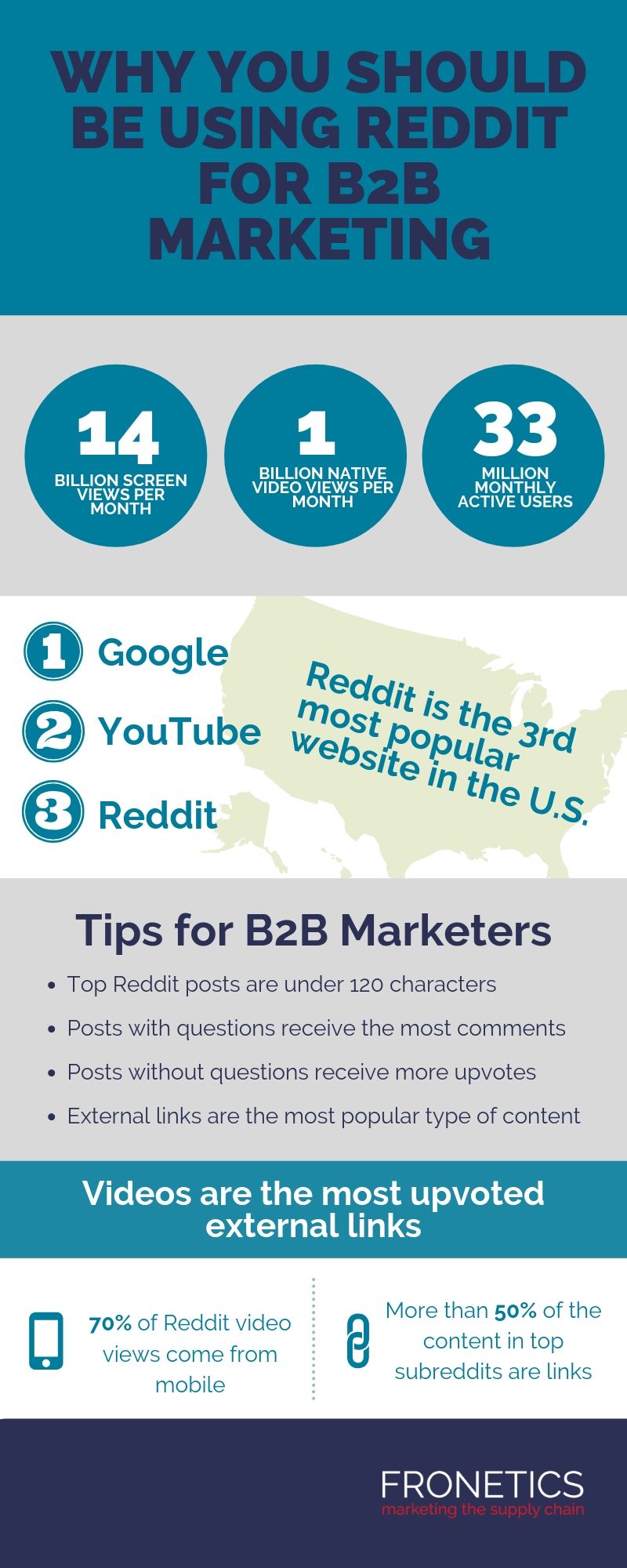
Our infographic gives you everything from the basics to the specifics of using Reddit for B2B marketing.
Highlights:
- Reddit is a social platform made up of thousands of individual forums where users can post content and vote on its relevance and value.
- The first rule of Reddit: avoid overt brand promotion and sales pitches.
- Creating your own subreddit is the best way to make Reddit a high-value marketing channel.
Reddit calls itself the “frontpage of the internet.” And for good reason. The social networking site boasts over 300 million active users, as well as 140,000 active communities and a whopping 14 million pageviews per month. However, when it comes to using Reddit for B2B marketing, it’s still a relatively untapped channel.
Our infographic is your ultimate guide to using Reddit for B2B marketing. Read on to find out more about this platform and how you can put it to work for your business.
What is Reddit?
Since the site was founded in 2005, Reddit’s user base has skewed young. However, as millennials come of age and rise to positions of influence within the B2B purchasing landscape, Reddit is becoming an increasingly effective way to reach your target audience.
At its most fundamental level, Reddit is a social sharing website built around users submitting links, pictures, and text, which the community can then vote on. Similarly to Quora, the content that’s voted as best rises to top visibility, while downvoted content becomes less visible.
The structure of the site resembles an intricate message board, divided up into hundreds of thousands of subfolders, called “subreddits,” which function as specific forums. Imagine just about any topic you can think of, and there’s probably a subreddit for it. In fact, for thinking about Reddit for B2B marketing, the following subreddits could be of interest:
If you’re looking for industry discussion on a specific marketing topic, it’s likely you can find a relevant subreddit. While each subreddit has different moderators and regulations, there’s one common thread that runs through the entire site: there is a premium placed on authentic content and interactions – and a disdain for overt self-promotion.
(Made with Canva)
Using Reddit for B2B marketing in 5 steps
Now that we’ve covered the basics about what Reddit is and how it works, let’s talk about how to make it part of your marketing strategy.
Step 1: Determine your target subreddit(s).
In the same way that a good digital marketing strategy begins with identifying your target audience, determining your target subreddits is the starting point for successfully using Reddit for B2B marketing. While the massive quantity of subreddits can be overwhelming, consider the following three questions to zero in on the right subreddits for your business:
- Does the subreddit relate to your business’ brand or products, as well as any specific keywords that shape your digital marketing strategy?
- How large is each subreddit’s audience? (Note: bigger isn’t necessarily better. A larger audience has the potential to generate more traffic, but it’s easier to establish your brand’s presence in a smaller subreddit.)
- How much engagement does the subreddit generate?
Once you’ve determined a few relevant subreddits with various audience sizes and high engagement, you’re ready to begin posting.
Step 2: Post links… to websites other than your own.
Before you start wondering why we’re encouraging you to promote other pages, there’s another facet of Reddit to consider. The platform takes the idea of Karma to a literal level. On Reddit, your reputation is referred to as your “Karma score,” and it’s determined by your level of positive participation on Reddit, measured by the number of upvotes you receive. As your Karma score rises, your posts become more visible.
One of the most effective ways to boost your Karma score, particularly when you’re starting out, is to post links to content that the subreddit community finds relevant and generate conversation. It’s important to make sure you don’t repost content that another member of your subreddit has already posted, as duplicates can hurt your Karma score.
Step 3: Share valuable content… that’s not a sales pitch.
When posting content to your target subreddits, the path to success is quite simple. Post content that offers value to the community. This means engaging in discussions, asking and answering questions, and, at all costs, avoiding blatant sales pitches.
Sam Holzman of ZoomInfo explains it this way: “Sharing a link to a product page will signal that you’re a marketer who wants to promote products, not an engaged community member. On the other hand, a blog post about the benefits of a particular product will be more useful to your fellow community members and, as a result, is more likely to be upvoted and commented on.”
Step 4: Advertise on Reddit.
While blatant sales pitches on Reddit are a sure way to a low Karma score, the platform does offer its own native advertising. Similar to Facebook and Twitter, Reddit Advertising is a relatively inexpensive way to boost the visibility of your content on the platform. However, it’s important to note that Reddit doesn’t offer the type of analytics as Facebook and Twitter.
Sponsored posts on Reddit appear at the top of targeted subreddits for a specified duration. You pay for duration as well as the number of impressions you receive. Sponsored posts look like any other Reddit posts. Advertising on the platform isn’t necessary for success, but it can help establish a visible presence, particularly at first.
Step 5: Create a subreddit.
Creating a subreddit isn’t easy – it requires a significant time investment to start and maintain. However, doing so is the best way to turn Reddit into an extremely valuable marketing channel. Once you’ve established your presence, creating a branded subreddit gives your customers and prospects a forum to interact, with you and with each other.
Particularly at the outset, you’ll likely need to promote your subreddit on other platforms. Post links to it on your other digital assets, and you could even offer an incentive for engaging on your subreddit.
Your branded subreddit is also an ideal place to offer customer service. Holding exclusive Q&As, referred to on Reddit as AMAs (“Ask Me Anything”), is another effective strategy to drive traffic and engagement on your subreddit.
The bottom line on Reddit for B2B marketing
Reddit is a rich resource for marketers and a fertile ground for marketing your brand and products. The platform is best thought of as a place to share and engage with high-quality, valuable content, rather than as a place for overt promotion. Effectively using Reddit for B2B marketing requires an investment of time and energy, but the results can be well worth the effort.
Related posts:

by Elizabeth Hines | Oct 1, 2019 | Blog, Content Marketing, Logistics, Marketing, Supply Chain
Consumers are more likely to trust content generated by their peers, which means higher conversion rates at a lower cost for your brand. Is your brand benefitting from user generated content?
Highlights:
- User generated content is content created by users of a specific brand or on a specific platform.
- Images and video of real people using your products or talking about your services will create trust and loyalty for your brand.
- Don’t be afraid to engage with your audiences over social media, respond to comments, and answer questions.
Video transcript:
I’m Katie Russell, a marketing strategist here at Fronetics, and today I wanted to talk to you about user generated content. Also known as UGC, user generated content is one of the hottest topics in digital marketing right now, but there are many businesses that don’t know how to use this tool to their advantage.
Let’s start with the basics.
What is UGC?
User generated content is content created by users of a specific brand or on a specific platform. It’s highly effective and comes at little or no cost to your business.
With that said, a lot can qualify as UGC including: comments on your blog, testimonials on your website, social media posts, blog articles, videos, Instagram stories, The list goes on and on. What it comes down to is that UGC is really any form of content that comes from a customer or a user.
So, what are the benefits of UGC?
Authenticity
We know that consumers are more likely to trust content generated by their peers, which means higher conversion rates at a lower cost for your brand. This also means the content is authentic and genuine reviews from buyers. Does it get any better than that?
Inexpensive
Since your brand is not generating the content, you don’t have to invest in the time and resources to create it.
What’s hot in UGC right now?
Visual content
Visual content is by far the most popular among audiences, so visual UGC is a no brainer. Images and video of real people using your products or talking about your services will create trust and loyalty for your brand.
Snackable content
We all know that the attention span for content is extremely short these days. When reposting UGC, focus on short, funny and positive content. Content that leaves users feeling informed and entertained will perform best for your brand.
Enlisting influencers
Whether it’s a famous celebrity or a micro-influencer that’s respected within your industry, brands involving influential people in their marketing campaigns can expect higher ROI from UGC.
Don’t forget to follow-up
Once you’ve grabbed the attention of your community with a successful UGC campaign, it’s up to you to capitalize on the momentum. Don’t be afraid to engage with your audiences over social media, respond to comments, answer questions. Have questions about starting a UGC campaign as a part of your digital marketing strategy? Visit us at fronetics.com.
Related posts:


by Elizabeth Hines | Sep 24, 2019 | Blog
Although content is extremely important, it’s only effective if it gets in front of the right audience. Here’s everything you need to know about content distrubution.
Highlights:
- Content distribution is the act of promoting content to online audiences in multiple media formats through various channels.
- Don’t fall victim to the “spray and pray” strategy where you post every piece of content anywhere and everywhere to increase the chances of achieving your desired results.
- Kick things off by looking at how each channel you want to use matches with the audience, your goals, and the priorities outlined in your overall content marketing plan.
Video transcript:
I’m Katie Russell, a marketing strategist here at Fronetics, and today we’re going to be talking about content distribution 101.
Content distribution is a term that’s often thrown around in marketing circles without any specifics attached. Given the growing popularity of content marketing, brands run the risk of having content lost in the shuffle. Here’s what you need to know to start implementing a successful content distribution strategy.
What is content distribution?
First off, what is content distribution? Content distribution is the act of promoting content to online audiences in multiple media formats through various channels.
There are three main components in the process for enabling your brand to build (and grow) communities of loyal, engaged consumers:
- Evaluate your distribution options
- Develop and document your strategy
- Promote your content
Evaluate your distribution options
Let’s start with evaluate your distribution options. Don’t fall victim to the “spray and pray” strategy where you post every piece of content anywhere and everywhere to increase the chances of achieving your desired results. You want to make sure your content is getting in front of the right people, with the right messaging.
Whether you are new at content marketing or a seasoned expert wanting to make the biggest splash possible, you need to decide which channels make the most sense for distribution. Some channels are more appropriate for your content than others, so you want a clear understanding of the unique value proposition of each, and how strongly those benefits align with your audience, brand voice, and goals.
Develop and document your strategy
Once you’ve generated a list of the most viable distribution options, building a strategy is the next step. Kick things off by looking at how each channel you want to use matches with the audience, your goals, and the priorities outlined in your overall content marketing plan. Resources and content types will help establish your editorial strategy. Make sure to document the details of your distribution decisions, so the information can be referenced easily, updated as necessary, and shared throughout your company.
Promote your content
Simply posting your content and waiting for your ideal audience to magically discover it won’t cut it. Make sure you are:
- optimizing your content with keywords, backlinks and calls to action
- repurposing and repackage top performing content
- consider sponsored content on social media sites
Want more information on how to successfully implement a content distribution strategy? Visit us at fronetics.com.
Related posts:
