by Elizabeth Hines | Jun 29, 2016 | Blog, Content Marketing, Marketing, Social Media
Participating in social media is not about earning followers; it’s about building relationships.
Posting content to social media is a great way to earn followers. But a follower doesn’t necessarily equal a customer. That’s why it’s important to keep in mind that participating in social media is not only about earning a large following; it’s about building relationships with those people.
An article published in Entrepreneur says it best, “Content equals marketing; conversation equals a relationship.” Using social media to converse with people and form relationships is what will ultimately drive sales.
Research from Social Sprout shows that social media messages to brands from customers rose 110% between 2014 and 2015. And that number keeps going up.
So, don’t just hand out your content like a business card and walk away. Customers increasingly expect businesses to converse with them through social networking, so it is critical that your business is online and ready to respond.
Here are five tips to build relationships on social media:
1) Be the person representing a brand.
Represent your company, but be a real person to whom your customers can relate. Do not appear as a brand who is a person; show up as a person who has a brand.
2) Be a real person.
Be personable and real. Open yourself up to conversations that show a bit of the real you. Nothing builds a relationship better than making a genuine connection. In other words, be a real person, not a personality.
3) Show who you are.
In addition to sharing information and knowledge related to your business, don’t be afraid to sprinkle in a bit of what matters to you in your posts. Photos of bring-your-child-to-work day, pets who regularly visit the office, or even your extra-large coffee during a particularly busy week tell a story that your followers can relate to. These kinds of things are excellent starting points for conversation!
4) Show that you care.
To build a relationship of trust, people need to feel that you care about what is important to them. Go beyond just liking, retweeting, or leaving an encouraging message on your followers’ posts. Actually put yourself out there and respond, invite dialog, and demonstrate that they are someone you value.
5) Be a regular.
Show up on a regular basis to interact with your audience and answer questions. And make sure to respond quickly when someone reaches out to you. Don’t underestimate the power of being there when a customer needs you. Remember 7 in 8 messages go unanswered for 72 hours, so if you can be the brand that is always there, you’re head-and-shoulders above the crowd.
Related posts:
by Elizabeth Hines | Jun 22, 2016 | Blog, Customer Service, Logistics, Strategy, Supply Chain
Today’s customers expect value, quality, and speed. Focusing on how your can deliver on those promises is what will win you business.
Remember that great advice: focus on yourself, not on what others are doing. According to an article in Harvard Business Review, the greatest challenge your company faces today is not keeping up with your competitors, but keeping up with your customers’ expectations.
This is not to discount the importance of watching business trends and monitoring the competition. But, your primary focus should be on what your customers need and expect and if you are providing it.
What do customers expect?
In today’s digital age, your customers’ expectations wash away traditional boundaries. According to a report in The Economist Group, customers compare and contrast their digital experiences across all industries, even those that offer totally different products or services.
Do you stand out above the crowd? Ask yourself this:
- Do you offer value, quality, and speed? Customers used to be willing to trade off one to get the other. Those days are gone. Today’s customer dictates that they want it all: lowest price, good quality, and fast delivery.
- Do you offer what the “big guy” does in terms of product, service, and ease, but with the care of a small business people trust? The size of your business does not matter in a digital marketplace. But, you must offer the scope, scale, and influence associated with being big, while maintaining the creativity and personal service characteristic of smaller businesses.
- Do you focus on helping customers to meet their objectives and needs? Do you share a purpose? According to an article in Harvard Business Review, what you provide ideally is not something you are going to do to them, or for them, but with them. It’s a journey you take together.
- Do you offer an intuitive sales funnel? Customers expect you to be where they are, deliver what they want, when they want it, and how they want it. If they are shopping your site, leave, and come back later, they want to pick up where they left off. They demand intuitive ease and ultimate convenience while they shop.
- Do you offer personalized customer experiences? Remember what happened every time Norm entered that television bar called Cheers? Your customers want you to know their name when they return, as well as their unique individual preferences, and they also want you to make relevant recommendations for products or services they may like.
- Do your social media interactions inform and help customers? Your posts should not deliver a sales pitch. Social media content should be educational, entertaining, or support the needs and interests of your audience.
There are new rules businesses must follow today in creating the ideal digital journey for their customers. Focus your attention on exceeding customer expectations and answering to their unique needs, not on your competition.
Related posts:

by Elizabeth Hines | Jun 20, 2016 | Blog, Current Events, Marketing, Social Media, Strategy
The $26.2-billion acquisition could result in the customer-targeting solution(s) B2B marketers have been waiting for.
Microsoft announced on June 13 that it would purchase LinkedIn for $26.2 billion, a deal set to close by the end of 2016. Though LinkedIn will operate “as a fully independent entity within Microsoft,” the union will strengthen their shared mission to “connect the world’s professionals to make them more productive and successful.”
Both Sadya Nadella and Jeff Weiner’s letters to their employees beam with excitement over the possibilities for product synergies. “Think about it: How people find jobs, build skills, sell, market and get work done and ultimately find success requires a connected professional world,” writes Nadella. “It requires a vibrant network that brings together a professional’s information in LinkedIn’s public network with the information in Office 365 and Dynamics.”
Obvious opportunity lies in enhancing Microsoft’s existing solutions to improve user experience. For example, videos from Lynda.com, a website for training videos that LinkedIn bought in 2015, could be accessible throughout the Office suite, such as an Excel document.
But for B2B marketers, the most exciting possibilities involve “new opportunities … for monetization through individual and organization subscriptions and targeted advertising,” as Nadella puts it.
New opportunities for monetization
Jenny Sussin, a Gartner research director, proposes that LinkedIn’s value to Microsoft lies in its algorithms and user data. Successful integration into Microsoft’s existing products could be a game-changer for the B2B sphere, in terms of targeting customers.
First let’s consider the algorithms, two of which Sussin claims were the main attraction for Microsoft. “No. 1 was the algorithm that creates the connection graph, the social networking graph,” she says. “No. 2 was the algorithm that determines the information most valuable and most actionable to you.” Essentially, with this acquisition, Microsoft has the ability to map how professionals are connected and determine what content is most relevant to each individual user.
Secondly, LinkedIn has the most comprehensive, up-to-date personal data about its 433+ million global users of any professional network. And that data has not been available to other companies — LinkedIn even refused access to Google for ad sales — until now. The value of this information to any B2B organization is indisputable.
Now consider that there are 1.2 billion users of Office and 4.4 million users of Dynamics CRM. Microsoft can now combine the information it knows about those professionals with LinkedIn’s user data, map their relationships, and offer customized content within these products. Imagine being able to reach your target customer within the very tools s/he uses most every day.
And those are just two of Microsoft’s products. Skype, Yammer, MSN: there is no shortage of targeted advertising opportunities.
Taking on Google?
Perhaps the most exciting of these secondary properties for B2B marketers is Bing, Microsoft’s search engine. Bing Ads are attractive to marketers because of the low cost per conversion. The problem, of course, is volume, as Google dominates the market share.
But with LinkedIn’s data and algorithms, Bing could become “what search is sorely lacking today for B2B targeting,” says Marketing Mojo CEO Janet Driscoll Miller.
“Search marketing is great for determining intent — for understanding what a person wants,” Miller explains. “But social media platforms, like LinkedIn, tell us who the person is. Marrying the two pieces of data — who and what — brings us to the sweet spot of marketing and targeting an ideal audience. LinkedIn provides us with demographic targeting based on business and professional user information.”
Targeting could include factors like company size (e.g., spending capabilities), so marketers would not waste impression dollars advertising products that are far beyond the buyer’s price point. Fold in other LinkedIn solutions, like Lead Accelerator, to improve retargeting, and Bing Ads could really compete.
Google may have a leg up in terms of search volume, but without detailed data on users’ professional demographics, Bing could corner the market as the most effective B2B ad targeting platform.
Cause for caution
While the marriage of LinkedIn and Microsoft’s capabilities shows great promise, hold off on celebrating just yet.
Part of LinkedIn’s value to Microsoft derives from user-provided information. And part of Microsoft’s value to B2B marketers lies in its products’ ubiquity. But what if people stopped contributing their personal details to LinkedIn because of the way it was being used across the Microsoft suite? And what if businesses stopped using Microsoft products over privacy or data security concerns?
Here’s why those are both real concerns: Nadella suggests that your LinkedIn newsfeed could show relevant articles based on the projects you’re working on offline. Taking information from my desktop?! That’s problematic from both a personal and proprietary standpoint. Issues around invasion of privacy and the breech of secure business information could present major roadblocks to success.
How would you feel if a software product you researched yesterday appeared in your Outlook today? If, while preparing a PowerPoint for a client meeting, a pop-up suggested you contact a connection in your LinkedIn network who is an expert on the topic? With the deal projected to close before the end of the year, users reactions to these concerns over the next few months could be telling.
Related posts:

by Elizabeth Hines | Jun 15, 2016 | Blog, Marketing, Strategy
B2B organizations are leveraging review sites to increase organic traffic and conversion rates. Here’s how.
Consumers regularly turn to review sites to research products and services before they buy. But did you know that businesses can leverage this behavior to increase organic traffic and drive conversions?
B2B organizations are joining third-party review sites precisely for benefits like these. In fact, such memberships are becoming an integral part of some marketing strategies.
Let’s take a look at it works.
Review sites inform buying decisions
Buyers value the opinions of peers and colleagues. In fact, B2B buyers rank it among their top three resources for information about solutions, along with experts and web searches.
It makes sense: User reviews offer an unbiased, credible experience regarding a company’s product or services, so potential customers do not have to rely exclusively on information the organization provides. What’s more, reviewers often share more than just opinions; they frequently include related tips or good-to-knows, which offer extra value for the reader.
Experts equate review sites to short-form versions of case studies, which 83% of B2B buyers report as important when comparing vendors. Reviews offer real-life experiences with the product or service, but are much quicker to read and easy to consume in aggregate than case studies. They are also written from a buyer’s perspective, which resonates much more than, say, technical language and specifications.
Value for businesses
More succinct than a case study and just as credible, user reviews offer compelling testimonials that can attract customers at any point in the buying cycle. Here are a few ways organizations can leverage them to their advantage.
1) Use them as content.
Reviews make excellent lead-nurturing content. A business could share a positive review on social media or integrate it into a blog post. Negative reviews, too, give an organization a chance to address questions or concerns through content. Either way, reviews give insight into what customers are talking about, and this can help inform your content strategy.
2) Build brand awareness.
As more buyers turn to review sites to research products, companies who are members of the review site benefit from having their name in the mix. Even if a potential customer is researching a competitor, that person will likely come across your business name in comparison. That kind of exposure is invaluable as buyers are actively creating their vendor short lists — especially if you have very positive reviews.
3) Build customer trust.
Participating on a business-review site promotes the transparency customers crave. It tells them you are willing to let your customers share the bad as well as the good for all to see. Additionally, positive reviews can boost an organization’s Google seller rating, which appears next to the business name in AdWords ads. The seller rating gives readers insight into how the business rates for quality service before that person ever visits the website and, if the rating is high, establishes instant credibility. And more credibility equals more click-throughs.
4) Increase organic traffic.
Search engines favor reviews, meaning search engine algorithms increase the search ranking of sellers who have favorable ratings on review sites. Consider that 60% of organic clicks go to the top three search results, and that the vast majority of readers won’t search beyond the first page of results. Any boost from positive reviews can increase your organic traffic potential.
5) Drive conversions.
Many organizations are finding reviews enormous valuable for their business in the late stages of the buyer’s journey. Password-management startup Dashlane, for example, reported a 14.5% increase in conversion rates when reviews were added to paid ad landing pages. Because reviews hold such credibility and resonate so strongly with customers, they make for excellent closing content.
Here are a few B2B review platforms to consider joining as part of your marketing strategy.
- G2 Crowd: Offers online reviews on B2B marketing services as well as business software.
- GetApp: Allows users to search for industry topics as well as specific products.
- IT Central Station: Described as a “Yelp or TripAdvisor for enterprise technology.”
- TechnologyAdvice: Allows users to perform side-by-side comparisons of solutions within a particular category.
- Trustpilot: A community where users can interact with one another regarding particular solutions they use.
- TrustRadius: Authenticates each reviewer and validates every review through its research team prior to publishing.
Related posts:

by Elizabeth Hines | Jun 8, 2016 | Blog, Marketing, Social Media, Strategy
This is part one of a three-part series on LinkedIn for B2B. See part two, How to Hire Talent through LinkedIn, and part three, 10 Ways to Gain LinkedIn Followers.
LinkedIn is the most popular social network for B2B companies. Here’s what you need to know to get started.
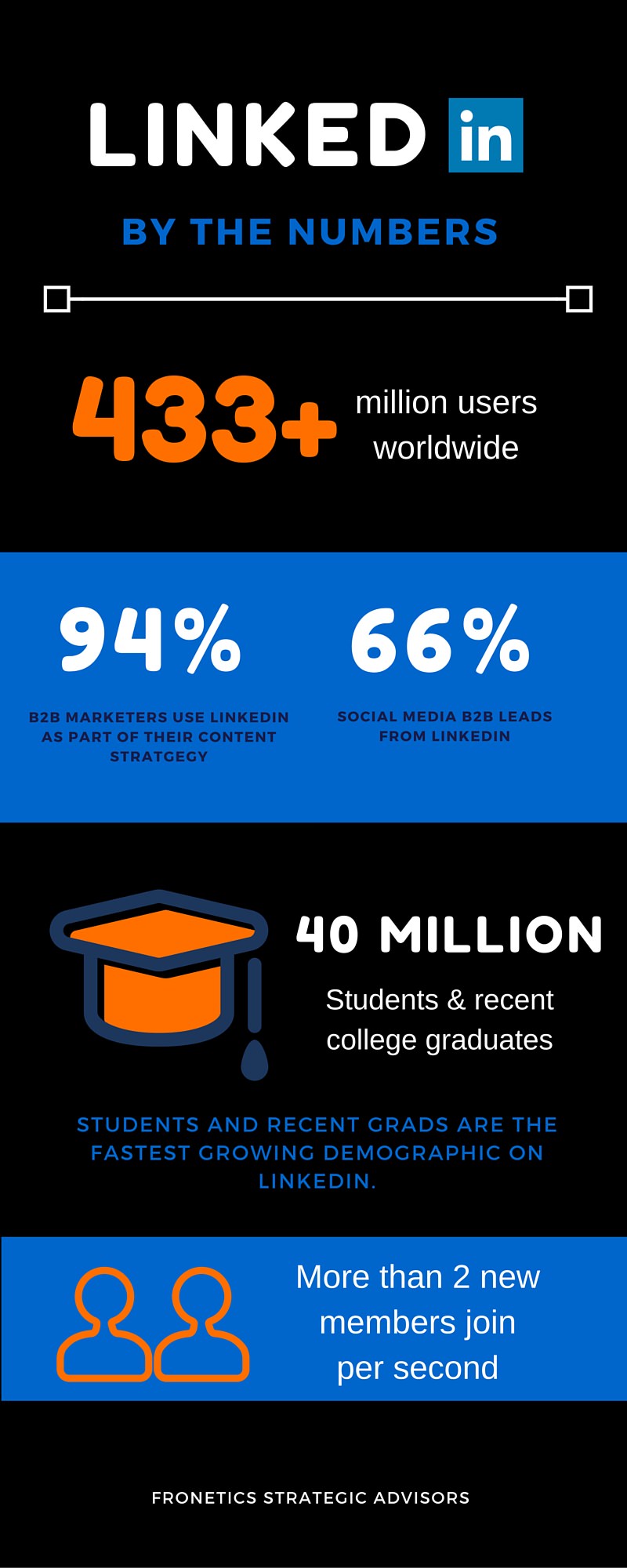 Chances are your business is on LinkedIn. B2B companies overwhelmingly report it as the most important social network to their business. But there’s a big difference between being on LinkedIn and being active on LinkedIn — and the latter can have a big impact on your bottom line.
LinkedIn has grown to be much more than a professional networking site. Leveraging all of its functions can help you generate leads, recruit premium talent, and establish your business as a trusted source of knowledge in your industry.
Here is a basic overview of LinkedIn for those businesses who are looking to optimize their presence on this most popular B2B social networking platform.
What is LinkedIn?
LinkedIn is a business-oriented social networking site with more than 433 million users in over 200 countries. It was launched in 2003, and was purchased by Microsoft in June 2016.
Individual users can create profiles highlighting their skills and employment history and “connect” with others. They can also:
- Search and apply for jobs
- Ask for introductions to people in their contacts’ networks (called second- and third-degree connections)
- Endorse connections for their skills and write them recommendations
- Follow companies and Influencers to receive updates on their activities
- See who has viewed their profile
- Share content and updates
- Like, comment on, and share other users’ content and updates
- Send private messages to other users
LinkedIn is free to join, but there are also several subscription options for job seekers, recruiters, marketers, and sellers that offer premium benefits and solutions.
LinkedIn for B2B employers
Businesses can create profiles on LinkedIn, as well as share content, make connections, and see analytics detailing who engages with their company. Getting set up is a little different from creating an individual profile, however. Here’s what you need to know.
The company page
Employers can create a company page. Company pages have four main sections.
- Home: displays the business overview, updates/shared content, friends and colleagues connected to the business, Showcase pages, and links to other affiliated company pages
- Careers (paid subscription required): facilitates interactions with job seekers
- Analytics: provides metrics and identifies trends on your updates, followers, and visitors
- Notifications: offers a daily overview of the updates and page performance
For tips on optimizing your company page, check out our free resource, A Visual Guide to Creating the Perfect LinkedIn Company Page.
Gaining followers
Once a business has a company page, employees can add it to their personal profiles, indicating that they work there (or have in the past). By doing so, they automatically become followers of the company and will receive its updates in their newsfeeds. When they follow the business or like, comment on, or share its content, all of their followers see this action, motivating others to do the same.
Users can also find and follow your company by typing in the business name in the search box at the top of the website.
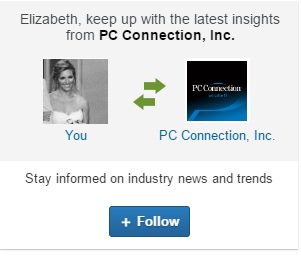
Companies can help attract their target audience to follow them by using Follow Ads. Follow Ads appear throughout LinkedIn and can be targeted to users in specific industries, companies, and regions. They invite users to click the “Follow” button and join your page. Here is what it looks like:
There are other types of ads designed to attract followers and drive users to your company page. Learn more on LinkedIn Ads.
Other features to know
Groups
Groups connect users from across LinkedIn with common interests and provide forums for related discussion. While company pages cannot join groups or participate in group discussions, individual members can share your company content in these forums. Your employees who launch, administer, and participate in groups related to your business or industry can help get your business name and content in front of like-minded professionals this way.
If you manage a group related to your business or industry, you can also feature it on your company page — up to three groups per company page or two groups per showcase page. Note that you would have to be the company page administrator and a member of the group you would like to add.
Showcase pages
Showcase pages are subunits of a company page that highlight a brand, business unit, or initiative within your business. If you have multiple business units, for example, users can choose to follow the showcase pages of just those that interest them. Your business can tailor the content and messages you share on each showcase page to better engage the demographic specific to that segment. The idea is to help businesses segment their audiences so they can build long-term relationships through content distribution. Read more about showcase pages.
LinkedIn Pulse
LinkedIn Pulse is the network’s publishing platform. Users can write blog posts to publish on Pulse by choosing “Pulse” under the “Interests” dropdown menu, or by choosing “Publish a post” from the homepage. There’s no limit on word count, and you can upload rich media like photos, videos, tweets, podcasts, and presentations to supplement your post.
Posts published to Pulse are search-engine friendly, and authors’ networks receive notification when they publish. While you can’t post on Pulse as a company page, you can post content from employee authors on your company page.
Influencers
Launched in 2012, the Influencers program encompasses less than 1,000 of the world’s top business leaders, thinkers, and innovators who contribute regular content on Pulse. Bill Gates, Arianna Huffington, and Richard Branson are a few examples. A team of LinkedIn editors select Influencers and work with them to create content around issues and topics on which they can provide a unique perspective as leaders in their industries and geographies.
Related posts: