by Elizabeth Hines | Jul 9, 2018 | Blog, Content Marketing, Logistics, Marketing, Social Media, Supply Chain
Here are our most-viewed supply chain and logistics blog posts from this year as of July 1, 2018.
Throughout the year, we regularly write blog posts to help our readers stay on top of the latest news and happenings in the supply chain and logistics industries, particularly in regards to content marketing. We hope these posts provide insight, tips, and insider information on how to stay head of your competitors with the consistent publication of quality content.
We’ve covered some great stuff this year, from new trends (like chatbots) to questions that clients ask year after year (like how is the industry using social media?). Here’s a look at our most popular posts so far this year.
Top supply chain and logistics blog posts from 2018 (so far)
1. 10 Must-Follow Supply Chain and Logistics Blogs in 2018
These 10 blogs are all rich with industry news and the latest trends to keep you in the know. They cover a wide range of topics, from research to strategy, and feature some of the top thought leaders in the field. Read more.
2. 5 Must-Read Books for Supply Chain Leaders
One of the best ways to sharpen your leadership skills is by learning from other leaders’ experiences. Leadership books, especially those focused on the supply chain and logistics industries, give valuable insight into the trials and triumphs of your industry peers’ encounters. Read more.
3. Top 3 Logistics and Supply Chain Blogs of 2018
You voted, and the results are in! LTX Solution is your number one favorite blog of the year, with “Ellen’s Blog” of Women In Trucking and Apex Capital Blog coming in second and third. What remained consistent from previous years is the quality of the content and the consistency of posting by the three winners. Read more.
4. 7 Supply Chain & Logistics Professionals to Follow on LinkedIn
LinkedIn, with almost 500 million users, is the #1 networking site for professionals. Following LinkedIn members gives you access to their profiles, as well as any original or third-party posts they publish on their newsfeeds. Here are 7 supply chain and logistics professionals to follow for top posts and articles in your industry. Read more.
5. B2B Marketing Trend 2018: Influencer Marketing
One of 2018’s fastest growing marketing trends is influencer marketing. Companies will increase their influencer marketing budget to keep up with the competition. 86% of B2C marketers used influencer marketing in 2017, and 92% of marketers that tried it found it to be effective. B2B marketers, on the other hand, have been slower to adopt this new marketing trend. Read more.
6. 6 Reasons Your Supply Chain Employees Are Looking for New Jobs
With the rising demand for professionals in Supply Chain Management and Procurement, there’s a lot of employment activity, especially in short-term contracts. This guest post from Argentus covers the subtler reasons that star performers in these functions get the desire to make a move. It’s not out of a desire for more money as often as you might think. Read more.
7. Drawing Lessons from Tesla’s Supply Chain Issues
A great article last month from CIPS’ industry magazine Supply Management dove into some of Tesla’s Supply Chain woes, discussing how the company, still considered a visionary in the industry, has gotten into some challenges, as well as some optimistic scenarios for how it can get out of it. Read more.
8. Top 10 Social Media Analytics Tools
Analyzing your social media performance is critical to a successful marketing effort, especially in light of recent changes to Facebook’s News Feed. You need the tools to determine what’s working and what isn’t, as well as the best time to post your content for your target audience. Read more.
9. KFC Ran Out of Chicken in the UK: What Supply Chain Lessons Can We Learn?
More than half of the UK’s Kentucky Fried Chicken stores recently closed because they ran out of chicken. A few weeks later, reports are that a number of stores are still closed, with front-line workers being encouraged to take holidays as the company sorts out its deliveries and tries to account for the failures. This guest post from Argentus provides a look at what caused the issues and what supply chain lessons can be learned. Read more.
10. Writing for SEO: Topic Clusters and Pillar Content (NOT Keywords)
I’ve been hinting — more like, emphasizing — in our recent Writing for SEO series that trying to rank for certain keywords in each blog post you publish is a practice on the way out. You may have been wondering what you’re supposed to do instead. This post on topic clusters and pillar content is your answer. Read more.
What supply chain and logistics blog posts have you most enjoyed this year? Are there any topics you’d like us to cover? Please reach out to us and let us know!
Related posts:

by Elizabeth Hines | Jul 5, 2018 | Blog, Content Marketing, Current Events, Logistics, Marketing, Social Media, Supply Chain
The latest social media statistics show growth of Instagram, social messaging bots, and video content.
We joke around here that one thing that will always stay the same is that social media will always be changing. 2018 has been a remarkable example of that thus far, particularly in regards to platforms like Facebook.
Every so often, we like to take a step back and look at what the data is telling us about where social media is heading and what that might mean for B2B marketers.
Social Media Examiner’s 10th annual study, 2018 Social Media Marketing Industry Report, surveyed more than 5,700 marketers from across the world in a variety of industries — including manufacturing, industrial goods, and a variety of other B2B verticals. It offers a really comprehensive view of what’s going on in social media in our industry and beyond.
I’ve pulled out 10 social media statistics from this report that I want to talk about in more depth. I think they say a lot about where social media is headed and what supply chain and logistics marketers should be paying attention to.
10 social media statistics for B2B marketers
1) For 64% of marketers, social media management is just one of their job responsibilities.
This one blows me away, knowing how much time and effort it takes to run a company’s social media program. Only about one-third (36%) of marketers manage social media full time. The other two-thirds have to do that on top of their other responsibilities. That’s crazy!
Supply chain, it’s time to recognize how important social media is for your business and dedicate the appropriate resources to social media management. If you can’t afford to hire someone to do it full time, consider outsourcing this task.
2) Only 44% of marketers agree they can measure their social media ROI.
Only 10% of survey respondents “strongly agree” and 34% “agree” with the statement, “I am able to measure the return on investment (ROI) for my social media activities.”
Again, I’m kind of blown away. As a firm that relies on data and analytics to inform our processes and strategies, including social, it seems irresponsible to not know if your efforts are effective.
Ok, on one hand, it’s actually really difficult to measure social media ROI. That’s in large part because so many of the benefits are intangible. You should really be thinking of social media investment in terms of potential, not dollars.
BUT there are some ways to calculate social media ROI and all your content marketing efforts. Here are a few resources:
3) 75% of marketers have seen a decline in organic Facebook reach over the last year or don’t know if they have.
A significant 52% of marketers surveyed said they saw their Facebook reach decline in the last year. Plus, 23% of marketers surveyed were unsure if it had or not — probably not a good sign. Yet 91% of B2B marketers are still using Facebook. Something’s not adding up for me here.
As we’ve written about a lot recently, businesses need to be keeping a close eye on Facebook in light of all the recent changes. While we at Fronetics are not ready to write off Facebook for business completely yet, it’s time to start doing things a little differently.
Here are four things your business should do in light of Facebook News Feed changes, for example. Stay tuned to the Fronetics blog as we continue to gather information and offer suggestions.
4) 87% of marketers rank more exposure for their businesses as the primary benefit of their social media efforts.
Building brand awareness is a key benefit of social media use for business. The Social Media Examiner survey respondents said that increased traffic was the second major benefit, with 78% reporting positive results. These top two benefits have remained virtually unchanged for 4 years.
That’s because, increasingly, more B2B buyers are using social media in their purchasing research. If your business is not on social media, you’re missing an opportunity to get your brand name in front of these buyers.
5) 78% of marketers who have used social media for 2 years or more report increased traffic to their websites.
Also to note, 83% of those who have used social media for 5 or more years “strongly agree” or “agree” that traffic has increased to their websites because of social media activity.
I wanted to pull these social media statistics out because they reinforce the time-honored truth that content marketing (including social media management) is a long-term solution — not an overnight fix. The benefits, especially in terms of metrics like traffic, grow exponentially over time.
You have to allow time for prospects and customers to find you and for your audience to grow organically. Use your social media platforms as a means to distribute meaningful information to your target audience, to communicate with customers and prospects, and to share thought leadership, and it will pay off.
6) 66% of marketers are now using Instagram.
In 2016 and 2017, we answered a lot of questions about Snapchat. Founder of the Content Marketing Institute Joe Pulizzi named Snapchat one of the next big trends in content marketing for 2017. Everyone thought this platform was going to be our new social media darling.
Instead, Instagram has surpassed Twitter and LinkedIn to be the second-most-used social media platform. (It was fourth in 2017.) Use is up dramatically from 54% in 2017. Those are numbers worth paying attention to.
We don’t have a lot of supply chain and logistics clients that currently use Instagram, but we know it to be a great platform for brand building, especially in terms of recruiting and developing corporate culture. Stay tuned for more on Instagram for the supply chain in the near future!
7) 63% of marketers use video content in their social media marketing.
One content marketing trend everyone got right? The growing prevalence of video.
Not only do nearly two-thirds of marketers use video content in their social media marketing, 23% use live video. What’s more, 77% plan to increase video content and 63% plan to increase live video in the next year.
Here are some helpful resources to get you started:
8) 70% of marketers want to learn more about messenger bots.
Here’s a big takeaway from the survey: Everyone’s talking about messenger bots/social messenger apps. While adoption is still pretty low (only 15% are using Facebook messenger bots now), 51% of survey respondents plan to include them in future marketing.
It’s time to start reading up on social marketing automation tools like chatbots and social messenger apps. We’ve got a lot of information about these things scheduled on our blog in the next few months, so keep coming back for more information on how these tools apply to supply chain and logistics marketing.
9) 39% of marketers are working with influencers.
Influencer marketing is another trend we’ve been talking about lately. It makes sense: Buyers value the opinions of peers and colleagues. In fact, B2B buyers rank it among their top three resources for information. And, in general, 82% of Americans seek recommendations when making a purchase of any kind.
Here’s my original post on influencer marketing for the supply chain. Keep in mind, influencers can be your executives, employee brand ambassadors, and any other experts and thought leaders associated with your brand.
For some more information, start with these 3 Tips for Creating an Influencer Marketing Strategy for the Supply Chain.
10) Only 21% of B2B marketers are using LinkedIn ads.
Social media advertising is another huge trend right now. Yet, this social media statistic tells an interesting story.
Though LinkedIn is considered the business social media network, less than one-fourth of B2B marketers are using it to advertise. Compare that to 66% of B2B marketers that use Facebook ads.
There are many reasons for this, of course. LinkedIn advertising is quite expensive, whereas Facebook advertising is relatively inexpensive, for one. But, as Facebook continues to elude businesses, might this be an opportunity to rethink this strategy?
If you’re interested, I recommend reading the whole 44-page report from Social Media Examiner. There are a ton of really interesting social media statistics that offer great insight into how marketers are using social media and how it’s changing — both over the the last few years and in the short-term.
What social media statistics are most interesting to you?
Related posts:

by Elizabeth Hines | Jun 25, 2018 | Blog, Content Marketing, Logistics, Marketing, Social Media, Strategy, Supply Chain
Aiming to deliver value outside the sales funnel allows your business to build long-term relationships with customers, rather than focusing on a single sale.
Congratulations! You closed the deal. You hammered out the terms and set up the billing. But, according to marketing experts Mark Bonchek and Vivek Bapat, now the real work of growing revenue begins.
Successful 21st century businesses focus on what happens after they close a sale, not the transaction itself. That’s because consumers — and B2B customers — have higher expectations than ever before. They read reviews, listen to webinars, and download white papers before they buy, and they expect a better experience after.
Purchase brands vs. usage brands
Bonchek and Bapat describe two types of brands: “purchase brands” and “usage brands.” The usage brands “focus on the moments of truth that happen after the transaction, whether in delivery, service, education or sharing.” As a result, they command greater loyalty and higher prices than competitive brands that are content to end their relationship with an invoice.
What does that mean for you as a supplier? You need to shift your focus from persuading people to buy, to persuading them to become a committed advocate for your brand.
“Be” the B2B customer
B2B accounts are complicated. They have many decision makers and many points of contact. You may have a sales team with multiple reps and sales support people on one account.
With so much going on, it’s important to “be” the customer. Try to identify and understand the people who depend on your product or service to get their work done every day. Those are the people you need to impress.
“What is the likelihood that you would recommend Company X to a friend or colleague?” According to Bain & Company, this is the one question that most closely correlates to customer satisfaction. “High scores on this question correlated strongly with repurchases, referrals and other actions that contribute to a company’s growth.”
And what makes people recommend a product or service? Success while they’re using it.
Social media: An important part of the B2B relationship
Bonchek and Bapat say, “The purchase and usage mindsets are equally, or even more, relevant for B2B brands. Business solutions tend to have longer life cycles than consumer products and there is an even greater opportunity to deliver value outside the sales funnel.“
So yes, you may have to tweet. And stay present on LinkedIn. Because your customers look there to follow trends and find good information to help run their businesses. Industry forums, YouTube, and Instagram are also great places to provide value beyond the sale.
Don’t worry if you’re not a creative genius. Most of us aren’t. Do try to talk about issues that are relevant and maybe even unsettling to your industry. If your customers are having a problem, chances are other businesses have the same concerns and vice versa.
You probably have an opinion, maybe even a solution. Use social media to share it with a larger audience, your users will thank you for it.
How do you deliver value outside the sales funnel?
Related posts:


by Elizabeth Hines | Jun 7, 2018 | Blog, Content Marketing, Logistics, Marketing, Social Media, Supply Chain
Supply chain and logistics marketers need to incorporate social advertising into their content market strategy (and budget) to stay on top of marketing’s biggest driver.
The way audiences use social media channels is constantly changing. As marketers, we need to make sure we’re adapting to these changes. One of the biggest changes we’ve seen so far in 2018 is the increased use of social advertising.
Social advertising is a paid form of paid digital advertising on social media platforms. For example, the advertising platforms provided by Google, Twitter, and Facebook involve “targeting and presenting ads based on relationships articulated on those same services.” Oftentimes, social advertising is one part of a larger marketing strategy.
Sounds easy enough to implement, right? Well, there are so many options and so many more users. If you’re taking the time and money to invest in social advertising, you need to ensure that you’re using the right platforms and getting in front of your target audiences.
In Social Media Examiner’s new report, it’s hard to dispute that social advertising is anything but powerful. With over 3.5 billion internet users worldwide, it’s easy to see the reach ads on social media platforms can have. Facebook alone has over 2 billion daily active users. 2 billion! That’s a lot of opportunities for distributing your content and gaining new followers.
Here are some powerful statistics to prove the weight of social advertising and why it’s worth your time and pennies.
Infographic: A look at social advertising for B2B marketers
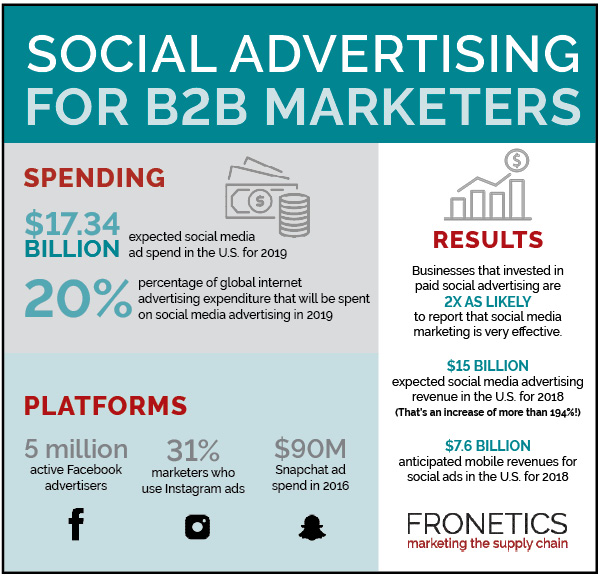
(Made with Canva)
Key takeaway
For the first time in years, Social Media Examiner’s report revealed that marketers are more focused on lead generation than cultivating a loyal fan base. What does this mean for you? The focus has shifted from engagement to metrics and automation.
As marketers, we need to watch for increased use of chatbots and other marketing automation tools that can help supply chain marketers become more efficient and more successful in earning and converting leads.
Related posts:
SaveSave
SaveSave

by Elizabeth Hines | Jun 6, 2018 | Blog, Content Marketing, Leadership, Logistics, Marketing, Supply Chain, Talent
Organizations that promote corporate social responsibility (CSR) are reaping the benefits of their good deeds, including increased brand awareness and employee satisfaction.
Corporate social responsibility is a hot topic these days. Generally speaking, it’s a pretty broad term to describe how a company is working to improve its community. Companies can demonstrate CSR in lots of different ways, including donations, employee volunteering, implementing environmentally safe processes, and more.
These efforts, whether large or small, say a lot about your organization. Companies that consistently demonstrate their commitment to CSR initiatives are recognizing their ability to help their community and acting on that knowledge.
And the public is taking notice. 55% of consumers are willing to pay more for products from socially responsible companies. What does that mean for you? It means that corporate social responsibility is as good for your community as it is for your own brand.
Here are four major benefits of corporate social responsibility.
4 benefits of corporate social responsibility.
1. Increased employee satisfaction
The way a company treats its community says a lot about how a company treats its employees. People that feel respected and supported in their jobs are often more productive and satisfied at work. Giving your employees opportunities to volunteer, especially during working hours, creates a sense of community within your organization, as well as a connection to the surrounding community. Employees will gain motivation and pride in their work through these personal-development opportunities.
Employees that are actively involved in the community are also acting as brand ambassadors. The more engaged and invested they are in your organization, and the greater community, the more productive they will be. In fact, companies with highly engaged employees saw 21% better business profitability. What could be better than happy employees promoting your brand while helping their neighbors?
2. Improved public image
In today’s digital era, companies that demonstrate corporate social responsibility are gaining exposure — and praise — for their involvements. Your brand’s reputation can only benefit from good deeds in your community. Think about it: Consumers feel good when they buy products and services from companies that are helping their community.
Don’t miss the opportunity to publicize your CSR initiatives and spread the word about your community involvement. Tweet, post, and share your social programs. Letting the public know about your good deeds will only work to increase your brand’s public image.
3. Increased customer loyalty
In a 2016 Neilson survey, 56% of participants said “a brand being known for its social value” was a top purchasing driver. And 53% of participants said “a brand with community commitment” was a leading purchasing driver.
Customers are more likely to be loyal to your brand if your corporate values align with their personal ones. What’s more, millennials — the largest population, over baby boomers, by 2019 — are driving the market these days. According to Forbes contributor Sarah Landrum, millennials prefer to do business with “corporations and brands with pro-social messages, sustainable manufacturing methods, and ethical business standards.” CSR programs work to showcase your corporate values and demonstrate that team work, community involvement, and engagement are at the top of your core values.
4. Increased creativity
Want your employees to start thinking outside of the box? Want to increase innovation in your company? CSR initiatives encourage your employees to try new things and get re-energized about their jobs.
Through this social involvement, employees will feel empowered to start contributing to the bigger picture. They might come up with new ideas about products or internal processes or innovate new problem-solving solutions. When you demonstrate your company’s values and passions through community giving, employees will feel encouraged (and supported) to develop new and better ways to do their jobs.
CSR is a win/win.
A commitment to corporate social responsibility is no longer optional. Companies need to understand that CSR affects their internal (employee engagement, productivity, turnover rate) and external (increased sales, customer loyalty, brand awareness) growth. By creating and participating in CSR initiatives, companies have the opportunity showcase their core values and create trust among your employees and your buyers.
What corporate social responsibility initiatives have you implemented?
Related posts:
SaveSave