by Elizabeth Hines | Oct 11, 2018 | Blog, Content Marketing, Current Events, Logistics, Marketing, Social Media, Supply Chain
Consider these chatbot platforms for supply chain operations that can help you create artificial intelligence bots to interact with your prospects.
Chatbots are on the lips of every marketer these days hoping to automate some of their processes. These artificial intelligence computer programs are designed to conduct conversations, simulating how a human would interact. If you haven’t already, check out this introduction to chatbots for the supply chain.
There are countless options for platforms that let you create and customize chatbots. Here are the 5 most important chatbot platforms for supply chain operations to know and consider integrating into their websites.
5 chatbot platforms for supply chain operations
1. Chatfuel
Chatfuel is a great option for marketers who lack programming experience, as it does most of the hard work for you. Reportedly used by companies including MTV, TechCrunch, BuzzFeed, British Airways, and Adidas to create their chatbots, Chatfuel provides easy-to-use resources with a simple user interface that lets you create a chatbot in less than 15 minutes.
2. ChatScript
ChatScript is a four-time winner of the Loebner Prize for the most human-like artificial intelligence. While it doesn’t require advanced programming knowledge, it provides an open-source framework for developers to build and deploy chatbots.
3. Facebook Bots for Messenger
Facebook’s Bots for Messenger is a tool that allows businesses to build chatbots for Facebook’s Messenger platform (which is currently used by nearly a billion people). Its three main capabilities are its send/receive API, generic message templates, and the ability to customize the welcome screen users first see when interacting with your bot.
4. Botsify
A popular chatbot platform, Botsify lets anyone create bots easily without needing to write any code. It provides templates with a range of drag-and-drop functionalities. Additionally, it boasts human takeover ability to ensure a smooth transition from a bot to a human at the appropriate point in the sales funnel.
5. Flow XO
This platform offers the templates and tools necessary to create a talking bot, and lets you run and test functionalities with a built-in test console. Flow XO also offers a provision for you to connect with your customers over voice and chat when required in the conversation.
While email marketing continues to be a key tactic, marketing via messaging apps is becoming more and more expected. These chatbot platforms for supply chain operations offer ease, convenience, and a positive customer experience. They’re worth considering!
Related posts:

by Elizabeth Hines | Oct 9, 2018 | Blog, Content Marketing, Logistics, Marketing, Social Media, Supply Chain
Instagram for business is a rising trend. Here’s how to use the platform to connect with your audience in a personal way.
Recent research on social media use shows that 66% of brands now use Instagram. It’s the second-most used platform by businesses, up from fourth in 2017.
If you’re considering using Instagram for your business, which you should be, here are some tips for getting started.
How to use Instagram for business: 10 tips
1) Be authentic
Brands often fall into the trap of using stock photography and images or overly staged promotional pictures. The ethos of Instagram is all about authenticity and personality. Let your audience get an up close and personal glimpse into your company’s culture.
2) Go live
Live video is the “it” trend in social media marketing, with 61% of marketers reporting that they plan on adding it to their overall strategy. Audiences love real-time content, and it lets them feel a genuine, human connection — the creation of which sometimes poses a challenge for B2B marketers.
3) Keep up the pace
Instagram is one of the easiest social media platforms to post on. That means you can quickly snap photos wherever you are — say, at a conference or event, or even on your way into the office — and publish it instantly. This is great for reaching the coveted millennial audience, which seems to have an unquenchable thirst for consuming content, particularly images and graphics.
4) Get in the “in crowd”
As with every social media channel, what you post is important. But it’s just as important that you participate in the wider conversation going on within your industry. This means replying to your community when they leave responses and interacting with peer businesses and influencers’ posts.
5) Use the link in your bio
A frequent challenge for new Instagram users is that the platform doesn’t allow you to link from the captions of posts. You get once chance to link, and it’s in your bio. You can vary the link as you promote specific content or product offers, and you can even use tools like Linktree to create a custom link that includes a page with additional links.
6) Be a storyteller
Instagram is all about visual storytelling. Your posts should do more than promote your brand — they should be drawing in your audience with narrative told through a visual format. Instagram Stories are an ideal way to engage your audience!
7) Try a takeover
Taking over the Instagram account of a partner company or customer is a great way to draw attention from an existing and relevant audience, providing mutual benefits to both parties.
8) Get personal
Go in deep and personal with your customers by answering their questions via 10-second videos. You let your viewers feel like they’re being heard. Plus, short videos are ideal for reposting.
9) Deliver special offers
Instagram is a great way to give special offers to your followers who tune in to your Stories. The time-sensitive feature (Stories expire after 24 hours) urges prospects to engage with your Story and act quickly before the offer expires.
10) Out of ideas? Just ask!
Survey your followers by posting a graphic of some options for future content or offers but leave it open-ended as well. Be sure to respond to suggestions in direct messages or comments. You may get some great ideas you never would have considered!
How do you use Instagram for business?
Related posts:

by Elizabeth Hines | Oct 3, 2018 | Blog, Content Marketing, Data/Analytics, Logistics, Marketing, Social Media, Supply Chain
Use these three steps to calculate your social media ROI and prove the value of your investment.
As supply chain and logistics businesses are finally recognizing the merits of content marketing, and more specifically social media platforms, many are looking into implementing a program at their companies. But it doesn’t take much research to realize what an enormous investment it is. And how difficult it can be to prove social media ROI.
We understand the time and money it takes to successfully implement and manage a social media strategy as a part of your content marketing plan. Many companies we talk to need help convincing management that it’s a worthwhile investment. To that we say, use data!
But what data should you use? How do you quantify certain benefits, like growth in brand awareness? And do you really have to keep track of all the hours you spend managing social media, crafting new tweets, etc.?
Here are three simple steps to start proving your social media ROI.
Infographic: 3 steps to prove social media ROI
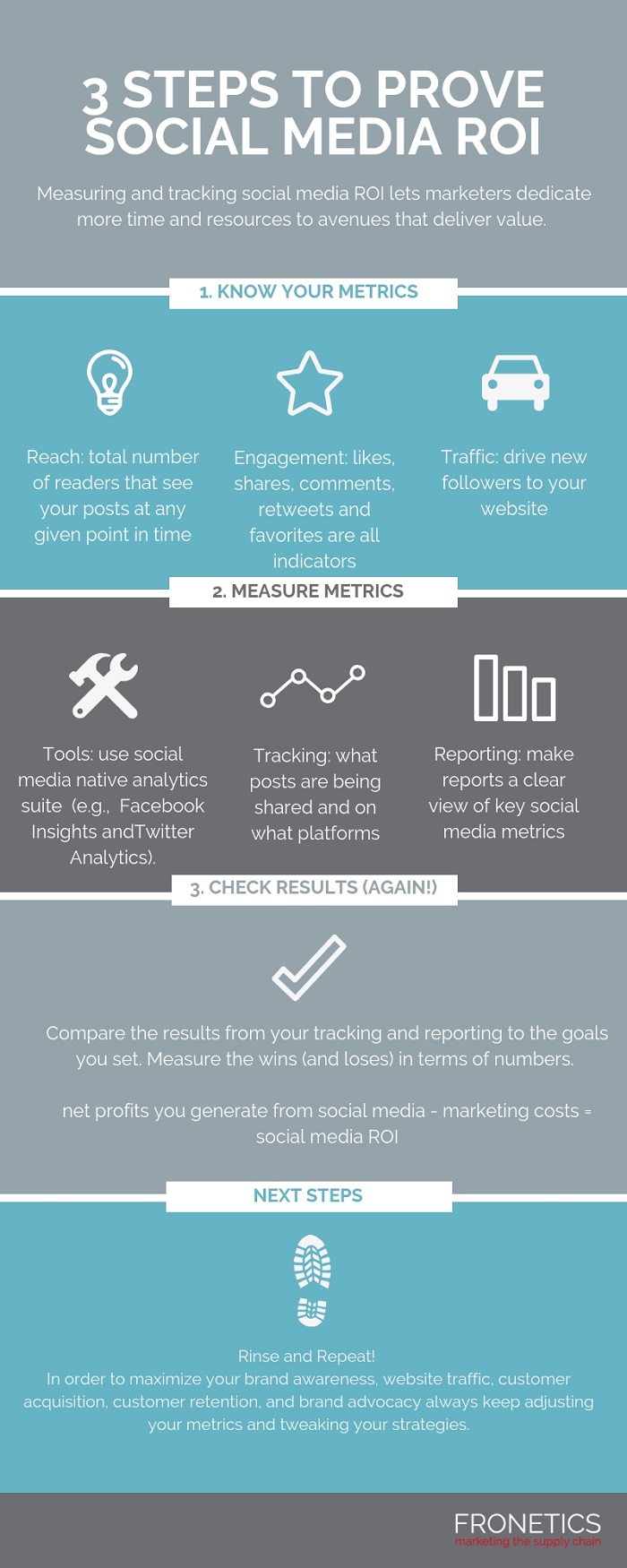
(Made with Canva)
Final thoughts
Once you’ve calculated ROI for your social media platforms, it’s time to think strategically about optimizing your content marketing resources in terms of allocation and timing. Having hard data helps you answer questions about which initiatives are most fruitful, what language engages your audience best, when your efforts are most likely to pay off.
Ultimately, this data-driven approach lets you continually adapt to the needs of your audience, ensuring an ongoing, robust ROI.
Have you had to prove your social media ROI? What strategies did you use?
Related posts:

by Elizabeth Hines | Sep 12, 2018 | Blog, Content Marketing, Logistics, Marketing, Strategy, Supply Chain
Here are the top three resources digital natives are using to research solutions and how your B2B business can prepare to meet them online.
Knowing where your buyers do research when making purchasing decisions is crucial to any marketing strategy. Digital natives, a new generation of younger buyers, have completely revolutionized the purchasing landscape for B2B vendors. Their biggest resource? The world wide web.
A study of millennial buyers by Merit found that 73% of employees ages 20-35 years old are involved in product or service purchase decision-making at their company. In fact, one-third reported they are the sole decision maker for their department.
What does this mean for B2B marketers?
These younger, and typically more technologically advanced, buyers expect they can find the information they need about your brand online through an organic search. Your company needs to have any and all content available at the push of a button.
But the work doesn’t stop there. Once a buyer finds your brand, you hope they make the leap to visit your website, meaning your site needs to be one of your most appealing assets. If you don’t give visitors plenty of easy, attractive opportunities to convert on your website, content marketing won’t generate leads for you.
But online searches and vendor website aren’t the only resources digital natives are using to make purchasing decisions. This younger generation also relies heavily on recommendations from peers and colleagues.
Like recommendations from friends and family in their personal lives, the opinion of other buyers becomes very important. A big part of the purchasing process involves B2B review sites, where purchasers seek the opinion of their peers and colleagues.
Here’s Elizabeth Hines, creative/editorial director at Fronetics, to discuss the top resources for B2B buyers and how you can be prepared to meet them online.
Video: top 3 resources for B2B buyers
Final thoughts
Though the purchasing landscape has changed over the past decade, B2B marketers have the tools to get in front of the right buyers. These tools including knowing what resources buyers are using and how to use these assets to your advantage. With a documented strategy and high-quality, informative content, you’ll be ready to meet digital natives where they are.
Related posts:

by Elizabeth Hines | Sep 6, 2018 | Blog, Content Marketing, Current Events, Logistics, Marketing, Social Media, Strategy, Supply Chain
Digital natives are changing the landscape for B2B purchasing. Here’s what you need to know about the new B2B buyer.
Long gone are the days of men and women sitting around a conference table listening to a sales pitch over a free lunch. Today’s B2B buyers are younger, more technologically savvy, and more independent — they’re a generation of digital natives. And they’re making waves across the B2B buying landscape and changing how marketers must work to reach new customers.
Who are digital natives?
The term digital native describes a person that grows up in the digital age, rather than acquiring familiarity with digital systems as an adult. So, unlike the previous generation, digital natives grew up understanding how to work a computer and a mobile phone instead of picking up these skills (slowly) in our 20s, 30s, or even later.
Having grown up in a time of rapid technological advancement, digital natives are very comfortable online. These skills have carried over to their professional careers, as millennials descend upon the workforce. Organic searches have become the starting point for researching products and services, instead of looking for specific brands.
Ch-ch-changes
This new reality means marketers trying to reach new customers must make big changes in the way they target and engage today’s buyers. Marketers have had to shift their focus from outbound marketing to inbound tactics, like content marketing, to engage and connect with their target audiences.
Here’s what you need to know about digital natives and how their tech-savvy ways have changed the B2B purchasing process.
Infographic: How digital natives are changing B2B purchasing
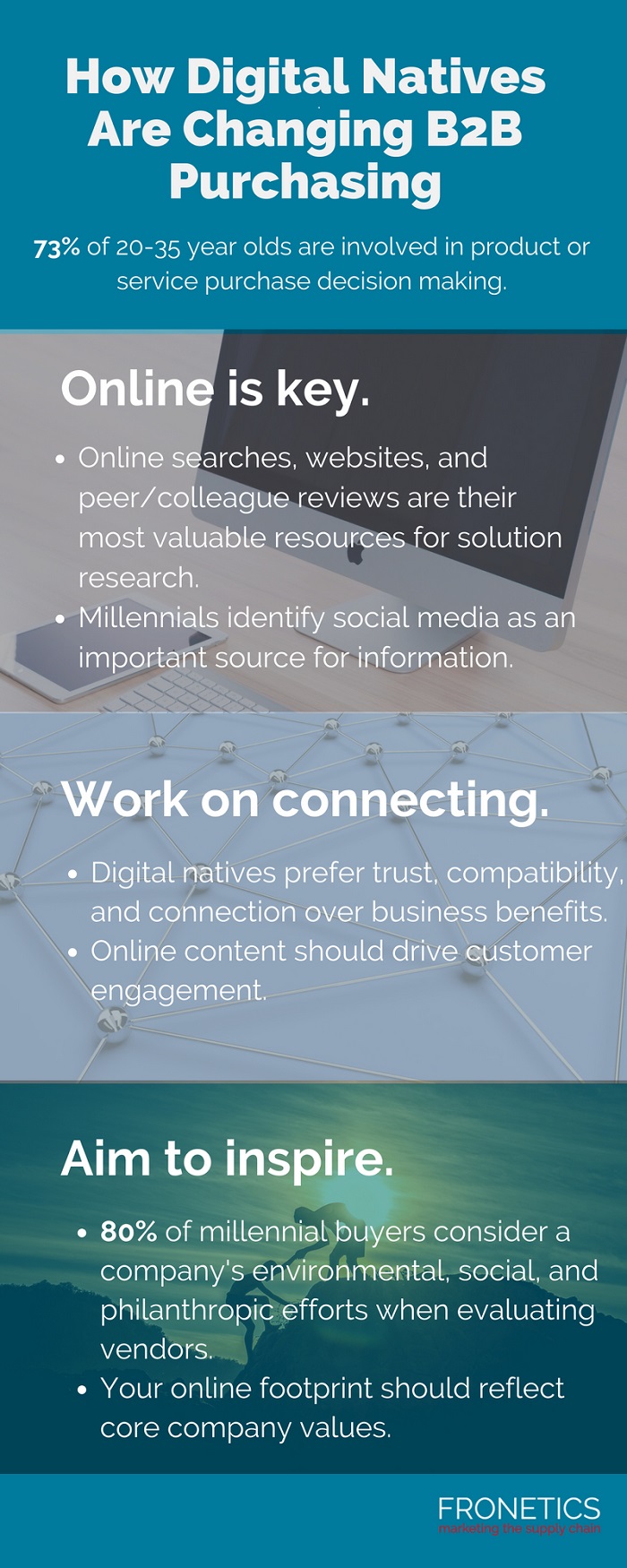
(Made with Canva)
Final thoughts
With so much content available on the internet, first impressions are everything. Your website needs to be informative and visually pleasing. Your social media posts need to be engaging. Your blog posts need to be enlightening. Make sure your online presence accurately depicts who you are as a brand and what you stand for. Digital natives will be more likely to find and connect with you.
Have digital natives had an impact on your business? Tell us about it.
Related posts: