by Elizabeth Hines | May 12, 2014 | Blog, Content Marketing, Marketing, Social Media, Strategy
Adam Robinson of freight logistics company Cerasis wrote a series of posts which outlined the company’s social media and content marketing strategy and the successes the company has achieved through the execution of their strategy. The series also included how-to guides: how to create a social media and content marketing strategy and how to execute a social media and content marketing strategy. Robinson’s series is a must read for companies interested in learning the potential business value of a social media and content marketing strategy and for companies wondering the steps they need to take to create and execute a successful strategy.
Two sentences in Robinson’s series stand out:
“It all comes down to strategy!”
“Now, if you have the resources to be on every social media platform, you should, but only if you do it well!”
Sage advice.
Without a strategy it is unlikely that your company will be successful. Social media and content marketing can be effective tools for attracting new customers and retaining current customers; however, it is unlikely that your company will reap these benefits if you do not have a strategy in place. A 2014 study shows just how important strategy is. The study found that 60 percent of companies with a documented strategy in place consider their efforts to be effective as compared to 11 percent of companies with no documented strategy in place.
A successful strategy takes into consideration your company’s strengths, resources, limitations, and goals. Another component of success – doing things well. For some companies it is possible (and makes sense) to be on every social media platform. For many companies a well-executed strategy means focusing on one or two platforms. Don’t spread yourself thin, make your company show up strong!
It is also important to remember that if you need help, there is help available. It is possible to obtain training in social media and content marketing and it is possible to outsource these functions.
This article also appeared on DC Velocity.
by Jennifer Hart Yim | May 8, 2014 | Blog, Marketing, Social Media, Strategy, Supply Chain
This is the third in a series of blog posts written by Adam Robinson, Director of Marketing at Cerasis. Founded in 1997, Cerasis is a top freight logistics company and truckload freight broker.
Now that you know about how to create a strategy, you have to execute it. This means content creation, content curation, and using the best tools possible to be effective.
#1: Content Planning
Categorize Target Audience By
- Industry: For example, we knew that within our target audiences, we had the following industry categories: Manufacturing, Distribution, Supply Chain, Logistics, Transportation
- Job Function: Next you then need to understand who are the buyers and what are their personas? Once you do this, you can weave in messaging into your content that speaks to all of them. At Cerasis, we knew our job titles were: C-suite, Managers, Employees
Create Content to speak to categories
Now that you have the categories, it’s time to create and plan for content. When you are coming up with topics, make sure you write the categories down and start creating headlines and doing research in those categories. You will notice on the Cerasis blog that there are broad categories like you see from the ones stated above, but over time we started shifting towards creating sub categories of those broad categories (e.g. Reshoring under manufacturing, or inbound logistics under logistics).
Ways to Generating Content Ideas
- Internal Interviews and Brainstorms
- Use an RSS aggregator such as feed.ly so you can curate articles and start to better understand the marketplace
- Be active in Social and Notice Most Shared
Using a Calendar
Whether you are doing one post (or more) per day or just one per week, a calendar is vital to long term success. If you don’t know what you are writing about each day, it is really easy for you to NOT write it and NOT achieve your goals. Content marketing is an ongoing project plan, and you can use tools such as Asana to have multiple people share the same workspace and work through the content.
Look out for Guest Bloggers
Another great idea for scaling content marketing and not burning out is to reach out to influential bloggers to guest blog for you. Or these can be other companies who are noncompetitive but share a similar target audience. We have had several guest bloggers that line up nicely and are relevant to our content categories. However, don’t take anyone that doesn’t add value to your readers. Think like a publisher and protect yourself from those spammy guest bloggers. You also must be proactive in networking and reaching out in social platforms as you establish relationships online such as on LinkedIn and Twitter.
#2: Content Creation
This is really where most companies get stuck. At Cerasis we leverage our employees and interviews to help get content written. You can also use great ghost writing services if you would like, but I would urge you that you write in house, as you know your authentic voice. The key is to stick to a regular schedule. Sporadic posts are going to find it difficult to build an audience. Think about your TV guide and the schedule of shows. You don’t always have to watch it the day it airs, but at least you know that it will be there.
#3: Content Distribution
If a tree falls in the woods, and no one is there to hear it, does it really make a sound? This old adage is very true when it comes to content and social media marketing. If you are not posting your content in any of the social media channels or online communities, then you are not going to be effective either. Even with search engines out there crawling your new content, search engines are now favoring social signals from sites like LinkedIn, Twitter, and Google+.
We recommend the following tools to use to distribute your content:
- Oktopost: This is a fantastic platform for distributing content as well as analyzing your performance. Their strong suite is the ability to post into multiple LinkedIn groups and mimic the categorization of your content through tagging of your groups. You can also post to many platforms such as Facebook, Twitter, LinkedIn pages, profiles, and groups, Google+ and more. Our favorite feature is the Autoposter. This feature allows you to load up a cache of content and set a schedule in the future so you don’t have to use resources to post every day. In one sessions you could set up a 30 day posting schedule right in the platform and view on a calendar!
- Buffer: This platform is great for content curation. You can load in your social profiles and then set pre-determined times on any day. We really love buffer for mostly Twitter, since Twitter is much like a newspaper where you go to find all the latest news and articles on topics of interest to you. Each morning we load up our RSS aggregator, feed.ly, and buffer all the best articles for our audience.
- Feed.ly: We love feed.ly as it allows to mimic (again) our content categorization but for other sources! It’s also a great way to find other blogs and influencers in your space you can network with and potentially guest blog for. All you have to do is search for content by keyword, add them in the respective category and bam, in one platform you have your own customized newspaper from which you can curate content. It’s got the buffer app loaded in so you can easily add articles to your buffer. This is also a great way to find new ideas for content and keep you up to date on your industry!
- Tweetdeck: This platform is owned and maintained by Twitter, but allows you to not only post to and monitor your account, but also allows you to monitor industry hashtags, such as #manufacturing or #logistics so you can start to follow and interact with those in your target audience. It’s a great tool and we recommend using it!
by Jennifer Hart Yim | May 6, 2014 | Blog, Content Marketing, Marketing, Social Media, Strategy
This is the first in a series of blog posts written by Adam Robinson, Director of Marketing at Cerasis. Founded in 1997, Cerasis is a top freight logistics company and truckload freight broker.
The purpose of this series of blog posts is to give others in our industry and especially those in the manufacturing industry, a guide to create an effective digital, social media, and content marketing strategy which will produce results for your company. If you have followed the Cerasis blog since its launch in March 2013, you have noticed that we work really hard at executing our strategy. The reason we work so hard is because we are passionate about educating the marketplace on information that matters to them. In that way, we want to be the de facto expert in the manufacturing and logistics industries. If we can help those who are our customers and potential customers (manufacturers and distributors) with best practices around logistics and freight, as well as manufacturing industry news, we are continuing our mission of driving long term value (even if we give the information away for free). The result (we hope and have seen) is that people view us as the expert and will want to engage us in a long term relationship as their logistics services provider. We hope this is helpful and you learn something from it!
Background of Cerasis use of Content Marketing and Social Media
- Company started formal marketing for the first time in October 2012, its 16th year.
- Little brand awareness, not thought of as a thought leader, but company still grew well by referral.
- It was important for us to establish our messaging, our target audience, and how we were going to best market the company.
- We didn’t have any budget for advertising, and with the rise of content marketing, we knew it was important to use social media and content as a way to start marketing and fine tuning the messaging of the company.
- We finished our market research phase (tips below on how to conduct one), and knew the content and who we wanted to reach.
- We then looked at all the social media channels and decided which platforms to use and what online communities to join.
- We built a strategy and started executing our content by simply posting one piece of content every business day.
Digital Marketing Strategy Approach for Cerasis
There is a process to strategic planning in order to lead towards sustainable marketing programs which yield a tangible return-on-investment (ROI). The process starts with understanding where social, digital, content, and traditional marketing fits in the world of inbound lead generation and increased brand awareness.
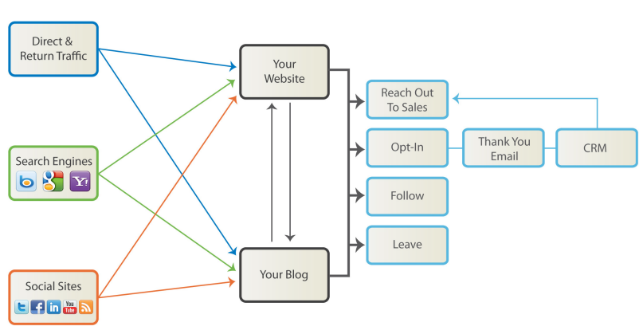
The goal of any strategic plan should be to find and acquire new customers and to grow existing customer relationships. The map on the next page shows how customer engagements happen online and in general. This map to the left helps us determine Cerasis’s route, analyze where we currently are, and hone in on where we should focus our attention to keep the strategy on track.
So, what are all the results from our social and digital marketing you ask?
Cerasis Quick Stats (Sept 12 to March 14)
- All Visits to Cerasis.com: 4,476 to 34,461 (669.91% Increase)
- Blog Visits: 0 to 28,271 (notice how without our content and social media, we would not have grown our website visits to where they are today)
- Social Media Visits: 4 to 8,546 (214,550% Increase)
- Search Visits: 711 to 16,275 (2,189.03% Increase)
- Social Community: 175 users total to 9,635 users total
- Twitter: 0 to 2,760 Followers
- FB: 0 to 492 Likes
- LinkedIn Group Members: 0 to 3,550
- LinkedIn Profile Connections: 120 to 1,456
- LinkedIn Company Page Followers: 51 to 529
- Google Plus Followers: 0 to 662 and over 310,000 views of the Company Page
- Pinterest Followers: 0 to 188
- Engagement Numbers:
- Twitter Mentions/RTs: 14,825/5,721
- LinkedIn Group Comments: 12,766
- Facebook Comments, Likes, Shares: 1,484
- LinkedIn Page Impressions/Interactions/Clicks: 247,359/566/1,560
- Pinterest Impressions/Repins: 73,698/327
- Blog Comments: 841
- Google Plus +1s: 2,976
- Conversion data (note, leads vary based on industry; 1 sale for us can mean a lot of revenue)
- Leads From Search Engines: 71
- Leads From Social Media: 65
- Leads From Webinars: 52
- Total Customers Gained: 35
Conclusion
Social media, content, and digital marketing are much like the Pareto Principle: Focus on the platforms and entities which yield the highest results, don’t just do something or be somewhere to do it! It all comes down to strategy! Now, if you have the resources to be on every social media platform, you should, but only if you do it well!

by Elizabeth Hines | May 1, 2014 | Blog, Content Marketing, Logistics, Manufacturing & Distribution, Marketing, Social Media, Strategy, Supply Chain

By launching a new digital, social media, and content marketing strategy, Cerasis saw a big, positive impact on its bottom line.
Companies within the manufacturing, supply chain, logistics, transportation, distribution and freight industries have been slow to create and execute digital, social media, and content marketing strategies. The primary reason: a lack of understanding of the business case or value.
These strategies utilize platforms that many within these industries perceive to be for socializing, sharing photos, and connecting with friends (e.g., Twitter and Facebook), and they turn the sales process on its head. Content marketing strategies are fundamentally different from traditional strategies employed by businesses to attract new customers, foster relationships with current customers, and grow their bottom line. Because of this, companies do not recognize how these strategies can positively impact their bottom line and therefore decide to steer clear — they feel engaging is too risky.
The reality is that not participating is risky. Like it or not, things have changed. The internet and social networks are where customers are. Content is how you can establish your company as a thought leader within the industry, and how you can attract and retain customers. If you want to grow your business you need to participate.
Looking at the manufacturing, supply chain, logistics, transportation, distribution and freight industries, there are a few companies that have emerged as leaders — companies that exemplify the business value of creating and executing digital, social media, and content marketing strategies. Cerasis, a freight logistics company, is one of them.
How Cerasis acquired 98 customers through content marketing
Cerasis was founded in 1997. For 15 years the company utilized traditional sales and marketing strategies: placing ads in industry print publications, and relying heavily on referrals. This strategy worked. The company acquired new customers, retained current customers, and realized positive growth.
There is a saying: “If it ain’t broke don’t fix it.” Cerasis ignored these words of wisdom.
In the fall of 2012, Cerasis launched a digital, social media, and content marketing strategy. The results have been impressive. For example, visits to the company website have increased by close to 670 percent, and search visits have increased by close to 2,190 percent. The company boasts an impressive number of Twitter followers, Facebook fans, and LinkedIn followers.
The business value of the strategy? Cerasis has acquired 98 customers. For the freight logistics industry, one customer can generate significant revenue; 98 new customers has a positive impact on the company’s bottom line.
Cerasis will be guest blogging for Fronetics for the next three weeks. The three-part series will begin with an overview of the company’s strategy and will discuss the results the company has realized through the execution of the strategy. The next two articles focus on how to create and execute a strategy.
When looking for best practices, Cerasis is a clear example. For companies within the manufacturing, supply chain, logistics, transportation, distribution and freight industries these articles are a great opportunity to learn why (and how) your company should create and execute a digital, social media, and content marketing strategy.
Download the case study to learn more about how Cerasis’ content marketing strategy helped the company acquire new business and increase sales.

Related posts:
by Elizabeth Hines | Apr 21, 2014 | Blog, Content Marketing, Logistics, Marketing, Strategy, Supply Chain
When it comes to content your company doesn’t need to go it alone. Not only is it possible to outsource content, for many companies it may be the best solution. Here is how to determine if outsourcing content is right for your company, and what your company needs to consider when looking for an outsource partner.
Is outsourcing right for you?
Outsourcing is not the panacea. It may be the right solution for your company – or maybe not. Here is what to consider when determining if outsourcing content is the right solution for your company:
- What are your company’s core competencies?
- How can your company deliver the best value to your customers?
- A successful content strategy needs to be deliberate and needs to have someone in charge. Do you have in-house talent who can put together a content strategy for your company and manage the execution of the strategy?
- Does your company have in-house talent that can consistently create good content?
- Does your company have in-house talent that has the time to consistently create good talent?
- Does your company have in-house talent that can distribute your company’s content?
- Does your company have in-house talent that can track and analyze your company’s content strategy?
Be honest. Cobbling together staff or passing content like a hot potato from one person to another is not going to be effective. If content is not an area where your company excels, or if content could be carried out more efficiently and effectively if the service was outsourced – start looking for an outsource partner.
If you do decide that outsourcing is right for your company, know that you are not alone. Forty-four percent of B2B marketers report that they outsource content creation. Diving down further, 72 percent of large B2B companies (1,000 employees or more) outsource content creation and 34 percent of small B2B companies (10 to 99 employees) outsource content creation. Looking specifically at the manufacturing industry – 55 percent of manufacturing marketers report that they outsource content creation.
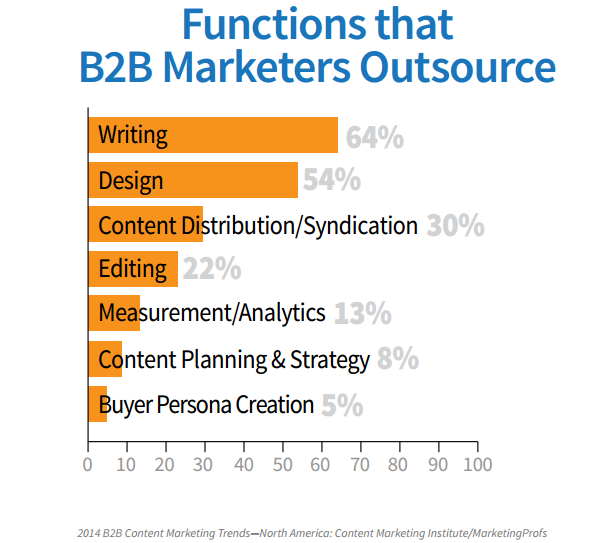
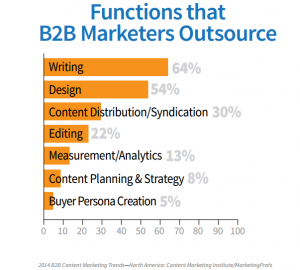
As shown in Figure 1 the content functions that B2B marketers outsource vary from writing to design to distribution to creating a buyer persona. When it comes to outsourcing content functions it doesn’t need to be the kitchen sink.
Figure 1
What to look for in an outsource partner
When it comes to finding an outsource partner you want to find a partner that will bring value to your company and to your customers. Whether you outsource all content functions or just one, here is what to look for in an outsource partner:
- Experience and knowledge of your industry;
- Willing to work with your company to help you achieve your goals;
- Open to exploring and furthering your company’s creative ideas;
- Able to follow instructions and execute with minimal oversight;
- Able to create the type of content your company needs;
- Interested in entering into a long-term relationship.
More generally, Frank Cavallaro wrote that when choosing your perfect outsource mate it is important to start by looking at the mission or value statement of your potential partner. Are these aligned to your company’s? If they are, move on and explore the partnership further. If not, walk away. “Mission and value statements speak to the core culture of the company, so if you can’t find common ground here, it is unlikely you will be able to build a positive working relationship.”
This post was originally published on DC Velocity.