by Elizabeth Hines | Sep 3, 2014 | Blog, Content Marketing, Marketing, Supply Chain
Before personal computers became ubiquitous, my family’s desktop computer served as our sole connection to the digital world. It wasn’t uncommon for someone to rush through dinner so they could be the first to claim their spot in front of it for the evening. On any given night you could find my mom scouring the web for new dinner recipes, my dad waiting his turn to research ways to improve his golf swing, and my sister bemoaning her wait to explore something decidedly less practical. Regardless of subject matter, though, each one of them sought the same thing – information.
Many years later, that same unbridled access to information has shaped a new environment. Companies are taking note and are reexamining the way they target and interact with consumers. As marketers, we are well aware that this new landscape, driven by changes in buyer behavior, looks far different than it did before. What’s less apparent though, is how we should develop our marketing strategy to reflect these changes.
By leveraging advances in technology and using what we know about current buyer behaviors, we can begin to think about implementing an information-driven marketing strategy. That is, empowering buyers through thoughtful content curation and publication.
So, how can your company start putting some of these ideas into practice? Well, here are the basics.
You need a content strategy.
In a marketing environment where direct messages are being largely ignored by consumers, it’s essential that companies provide real, meaningful value through the materials they publish. Just like my family, consumers are seeking to be educated. Gleanster Research found that 50% of leads are qualified, but not yet ready to buy. However, the odds are that someday they will be, and the content they’re reading today will inform their decision to look to you – or not.
Publish and align your content thoughtfully.
Identify when and where your prospects are most likely to want or access your expert content. What kind of content will attract visitors, convert leads, close customers, and delight promoters? Where will they likely look for this information? Aim to deliver relevant content to the right people in the right places, at the right time. Consider that a recent study by Forrester found that a full 85% of business decision-makers said at least one social media channel is very important in the consideration of business technology purchase decisions. It’s not just simply good business for your company to align content correctly – it’s essential.
Consider the Buyer’s Journey.
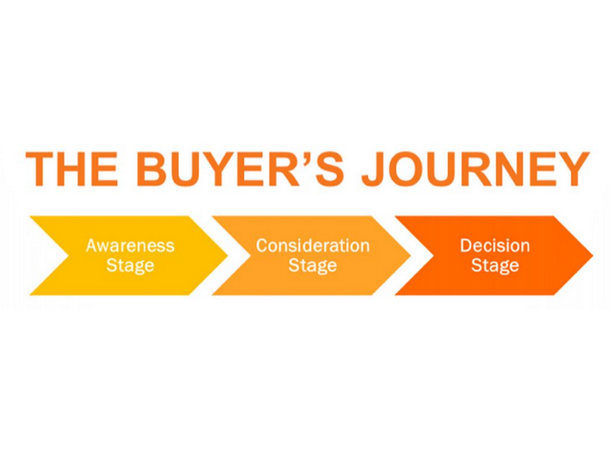
Gone are the glory days of the Sales Funnel. Enter the buyer’s journey. This (relatively) new concept suggests that buyers follow a linear path as they move through the sales process: first the awareness stage, then the consideration stage, and finally the decision stage. Each of these stages in the buyer’s journey necessitates corresponding content. Want to raise awareness of your brand and attract visitors? Try offering a free eBook that addresses a key pain point of your ideal buyer. Looking to close that almost-there sale? Propose a free trial. By considering the journey of your buyer, you are more likely to provide relevant content at the precise moment your buyer needs it.
Considering the characteristics of this new environment, it’s very unlikely that our prospects come to us completely uninformed. With more knowledgeable buyers, businesses must stay one step ahead. Implementing an information-driven marketing strategy gives us an attainable and inclusive way of achieving that.

by Elizabeth Hines | Sep 2, 2014 | Blog, Content Marketing, Data/Analytics, Marketing, Supply Chain

To grow your B2B business you need to take a comprehensive data driven approach to marketing. Metrics enable you to measure success, drive strategy, and demonstrate the ROI of your marketing efforts.
What metrics should you track?
Given that your objective is to attract, acquire, and retain customers, the most effective metrics to track are those where the unit of focus is the prospect, lead, or customer. These include the following:
Visits
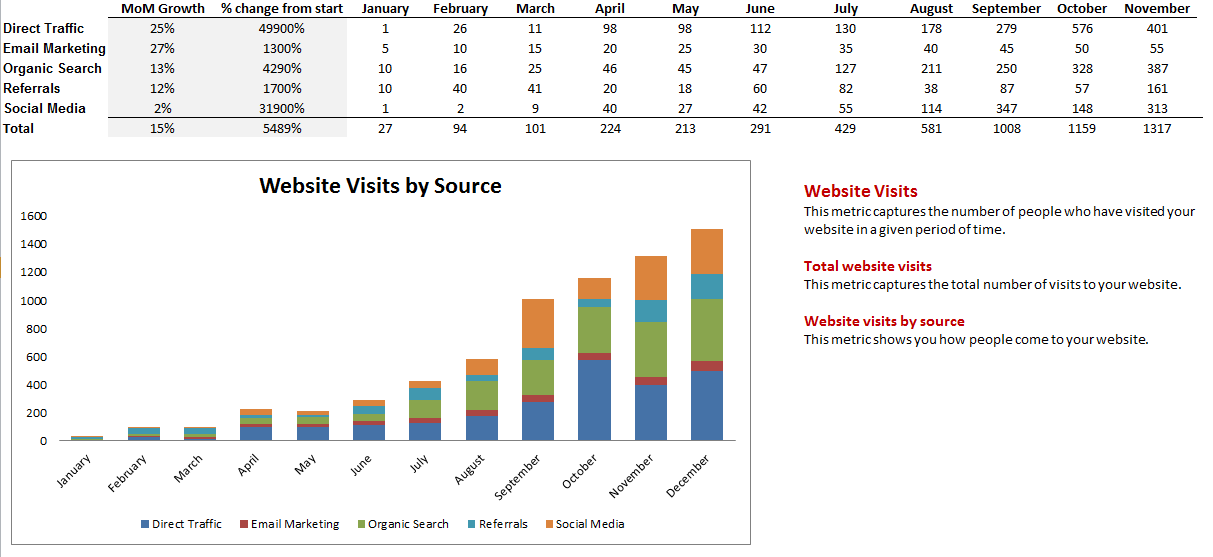
Visits capture the number of visitors to your company’s website in a given period of time. In addition to tracking the total number of visits, it is also important to track visits by source. That is, how visitors come to your website. Sources typically include direct traffic, organic search, referrals, social media, and email marketing.
Reach
Reach is the number of people who can be reached through your marketing channels (e.g. LinkedIn, Twitter, and Facebook). This metric is a good indicator of how well the content you are publishing attracts new people to your network, and how well the content engages people within your network. In addition to tracking your company’s total reach (the total number of people you can reach across all channels), you should also track reach by channel.
Leads
Leads are one of the strongest indicators of ROI. By tracking leads by source, you can identify where your marketing efforts are most effective, areas where you can improve, and areas you could eliminate from your strategy.
Customers
Customers are also a strong indicator of ROI. Like leads, customers should be tracked by source.
Conversion rates
Conversion rates measure the percentage of people who are moving from one marketing stage to the next. An increase in your conversion rates implies an improvement in the quality of your content and/or traffic. You should track the visit-to-lead conversion rate (How many of your website visitors are becoming new leads?) as well as the lead-to-customer conversion rate (Are you generating sales-ready leads?).
Ranking
Ranking matters. The top listing in Google’s organic search results receives 33 percent of the traffic compared to 18 percent in the second position. Two metrics you can track are your domain authority and your marketing grade.
Domain authority is a score ranging from 1 to 100 that represents how well a website will perform in a search engine ranking. The lower the score – the less likely it will be found. Marketing grade is a holistic measure of a site’s online presence as measured by HubSpot’s Marketing Grader on a scale of 0-100. A higher score is better.
How to track metrics for success
Having an established database to capture your marketing metrics is critical to success. We created a template that you can download and use to track your metrics, measure success, and drive strategy. One of the great features about this template is that it generates graphs that can be used in your reports and presentations.

by Elizabeth Hines | Aug 19, 2014 | Blog, Content Marketing, Leadership, Marketing, Strategy, Talent

By consistently creating, curating, and distributing valued and trusted content you can position your company as an industry leader.
What is valued and trusted content?
“Peer-power”
A survey by the CMO Council found that all content is not viewed equally by B2B buyers. “Peer-powered content” is more valued and trusted than non-peer content.
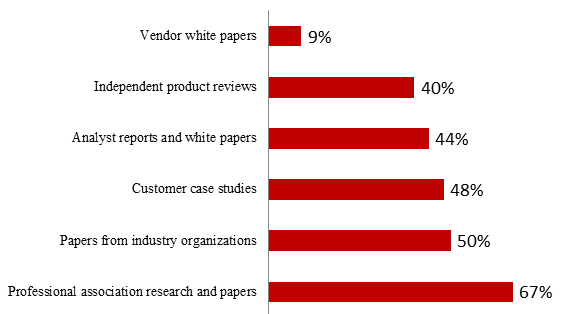
The survey found that professional association research and papers are the most valued and trusted content. Papers from industry organizations, case studies, and analyst reports and white papers were also reported to be valued. In contrast, vendor white papers were not found to be valued highly.
What type of content do you most value and trust?
Source: CMO Council
Depth not promotional
The characteristics that were found to be valued the most by B2B buyers were depth of the content (47 percent) and ease of access and readability (44 percent). Respondents reported that they do not like content that has too many requirements to download (50 percent) or is promotional or self-serving (43 percent).
Good content is shared
B2B buyers report that they share good content. Fifty-nine percent of survey respondents share content with 25 or more peers and associates, and 28 percent of survey respondents forward content on to 100 or more people.
Position yourself
To position your company as an industry leader you need to provide valued and trusted content. This means creating, curating, and distributing content that educates, informs, and addresses specific needs.
It also means avoiding the trap of self-promotion. Valued and trusted content is not content that is self-serving or promotional, rather valued and trusted content provides customers with answers, solutions, and education.
Blogging is essential, but additional content is necessary as well. Case studies and white papers are two go-to content solutions that can help you position your company as a trusted leader within your industry.
Remember that you don’t need to go it alone. More than 44 percent of B2B marketers report that they outsource content creation.
by Elizabeth Hines | Jul 1, 2014 | Blog, Content Marketing, Manufacturing & Distribution, Marketing, Strategy, Supply Chain
Think like a manufacturer
Gartner’s Jake Sorofman wrote a great piece about building a content supply chain. His advice for understanding what it takes to use content as a tool to grow your business: think like a manufacturer.
Why? Sorofman connects the dots:
Manufacturing is actually an instructive example for what it takes to scale and sustain a content marketing program. Why? Because content marketing requires a replenishing pipeline of engaging content—a content supply chain—that helps feed the beast every day.
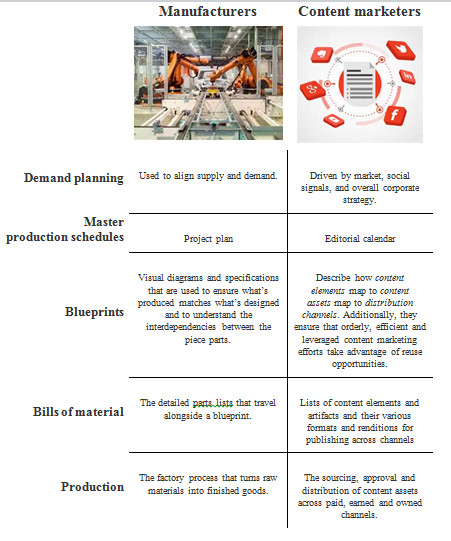
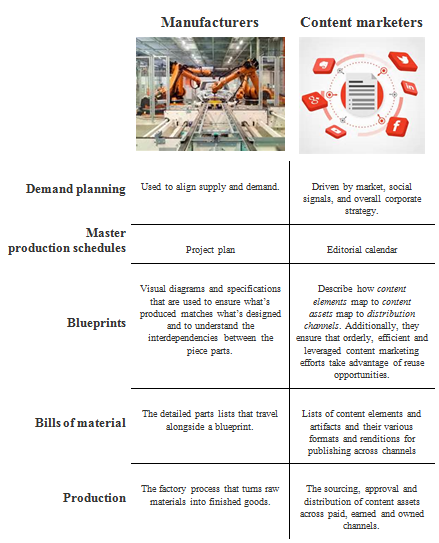
The following table (adapted Sorofman’s article) further illustrates the parallel between manufacturing and content marketing.
How can you successfully replenish your content supply chain and grow your business?
Strategy. As in manufacturing, strategy is essential when it comes to content. Without a strategy in place your content efforts will fall flat and will not help you grow your business. Want to learn more about creating a content strategy that will drive profitable customer action? Download our eBook: Grow your business with content: 12 steps to a content strategy.

by Elizabeth Hines | Jul 1, 2014 | Blog, Content Marketing, Marketing, Strategy
Content can grow your business.
How can content such as blog posts, white papers, eBooks, newsletters, infographics, podcasts, webinars, and video grow a business? Content can grow your business by increasing your search engine ranking, positioning your company as an industry leader, attracting new customers, and helping you retain current customers.
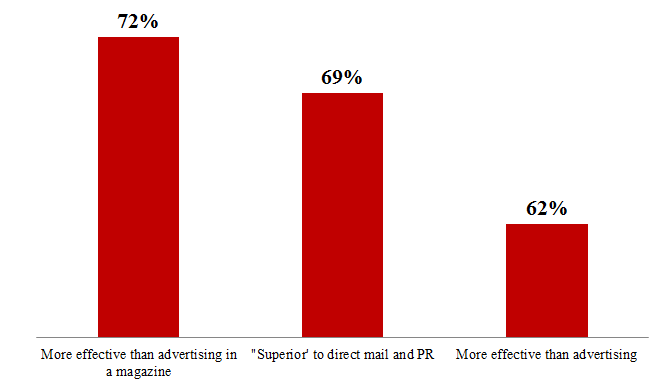
Not convinced? B2B companies with an active blog generate 67% more leads per month than those who don’t. What’s more, a study by the Custom Content Council found that 72% of marketers believe branded content is more effective than advertising in a magazine, 62% believe it is more effective than advertising, and 69% believe it is ‘superior’ to direct mail and PR.
Not all content is equal. Not all content will help you grow your business.
Content that will move the needle for your business is valuable content. It is content that is informative, educational, interesting, and speaks to your customer’s emotions and speaks to their pain points. Valuable content is not a sales pitch. Furthermore, valuable content is content that is delivered consistently over time and at the right time.
Strategy is vital
A 2014 study of B2B marketers found that companies who have a documented content strategy in place are more likely to consider their efforts to be effective than companies who do not have a documented strategy in place (60 percent vs. 11 percent).
The 12 steps to creating a content strategy that will help your company drive profitable customer action are:
- Put someone in charge
- Define your goals
- Define your audience
- Define your metrics
- Identify the right distribution channels
- Create a publishing calendar
- Create content
- Curate content
- Distribute content
- Engage with customers and prospects
- Track and analyze metrics
- Make adjustments as necessary
Want to learn more about these 12 steps and creating an effective content strategy? Download our eBook.