![[Infographic] Content Marketing in Manufacturing: What Works, What Needs Work](https://fronetics.com/wp-content/uploads/2015/08/Infographic-content-marketing-in-manufacturing-801x675.png)
by Elizabeth Hines | Aug 11, 2015 | Blog, Content Marketing, Manufacturing & Distribution, Marketing, Social Media, Supply Chain
Manufacturing is experiencing a graying of its industry. With millions of workers at or near retirement age, many top posts are occupied by workers who have seen radical changes in the workplace over the course of their careers. And while executives have largely embraced advances in technology to transform the operations side of manufacturing, research shows they’ve been slow to adapt marketing and sales processes using emerging digital tools and technology.
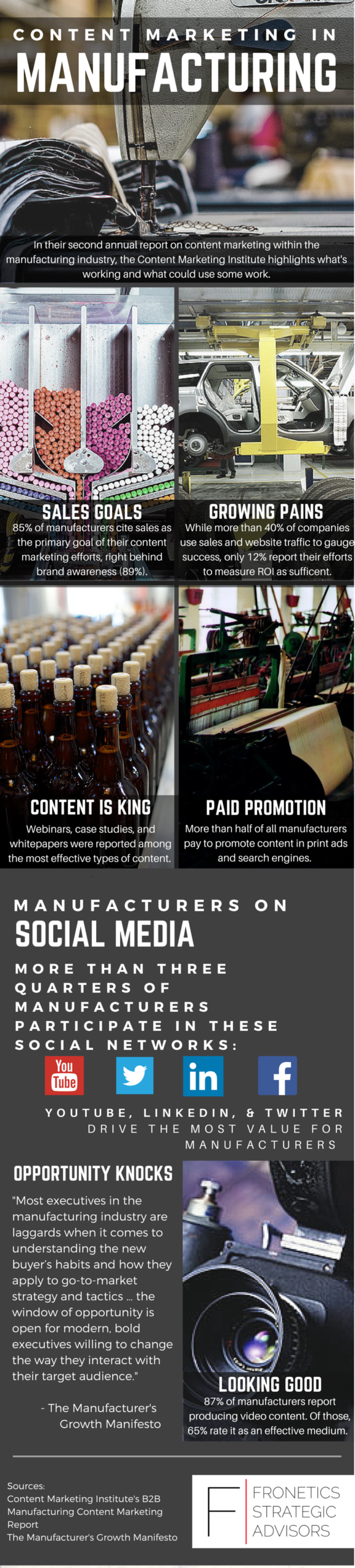
Earlier this year the Content Marketing Institute released its annual report on the current state of content marketing within the manufacturing industry. This year’s report shows that the manufacturing industry continues to make strides in leveraging digital tools for sales and marketing purposes. Still, because these efforts are fairly new, the report also captures a sense of ambiguity about these new marketing strategies, particularly when it comes to measuring program success. Other notable findings from the study reveal that more than two-thirds of manufacturers are using content marketing to build brand awareness, boost sales, and generate leads. The report also uncovers some marked changes between the most recent report and last year’s report; there has been a shift in both the way manufacturers are choosing to distribute content and their perceived effectiveness of those tactics.
Check out our Infographic for a more detailed look at the report’s findings:
Fronetics Strategic Advisors is a leading management consulting firm. Our firm works with companies to identify and execute strategies for growth and value creation.
Whether it is a wholesale food distributor seeking guidance on how to define and execute corporate strategy; a telematics firm needing high quality content on a consistent basis; a real estate firm looking for a marketing partner; or a supply chain firm in need of interim management, our clients rely on Fronetics to help them navigate through critical junctures, meet their toughest challenges, and take advantage of opportunities. We deliver high-impact results.
We advise and work with companies on their most critical issues and opportunities: strategy, marketing, organization, talent acquisition, performance management, and M&A support.
We have deep expertise and a proven track record in a broad range of industries including: supply chain, real estate, software, and logistics.


by Elizabeth Hines | Aug 6, 2015 | Blog, Logistics, Marketing, Social Media, Supply Chain, Transportation & Trucking
Transportation and logistics is a field that is booming. The business is a money-maker and a cornerstone of day-to-day functioning. It’s one that has been present for centuries. We are well past the Age of Discovery, but transportation and logistics companies carry on the torch of moving products that people need and desire around the world. One might wonder if the sultriness of the Silk Road and the Spice Trade has lost its allure and sexiness, but that needn’t be the case. Social media has brought about a fantastic opportunity for transportation and logistics companies to share their successes, display their offerings, create community, and convert leads.
Where to Start
First, think about it. Many transportation and logistics companies think about social media and how to use it, but cite a lack of time as a reason they haven’t explored the various platforms. Thinking about how social media can work for your logistics or transportation company is the first stop towards progress.
Second, learn about it. Understanding individual usage of social media versus B2B usage of social media is important. Do your consumers use LinkedIn, Facebook, Twitter? Where are your competitors finding success, and what platforms are they missing? Once you figure these things out the impulse will be to get started. Post away! Tweet away! Blog away! However, creating a Facebook page or a Twitter account will not draw in your community of employees or existing clients, and will not attract potential customers or clients. Having an account is great thing, but it’s not the most important thing. Knowing how to express your brand, what content to curate and create, and how frequently to share content is critical to social media success.
Learning is a process and takes time. Set up also takes time. Hiring an outside agency to do this work can both save you time, and will ultimately reap ROI. Marketing strategy companies have been doing this work already, and understand how to highlight your company. They know the market, and once they get to know you a bit better, you can work together to figure out how to express your brand through the platform of social media.
What to Highlight
Once you figure out who to focus on and how to reach that community, creating and curating your unique content is key. What is most informative and helpful to your clients? What will feel meaningful to them? What will catch and hold their attention? How do you want people to perceive you, your employees, and your products/services? Some studies have shown that conversion rates from social media can be 100% more effective than from outbound marketing, so getting this right could greatly benefit your company.
The joy of social media is its speed and its ability to humanize a company. A company’s Twitter feed is not like its white papers. Social media is known for personalizing things, so let people know the more human side of your business. Who are the drivers? Who are the employees? What are the success stories? Celebrate your community, partners, and clients. This is a place to engage with other businesses – to educate them and learn from them.
One perfect example of a logistics company that thrives in this arena is UPS. The logistics company has found success with unique, fun, interesting, frequent posts, tweets, and blogs. They also highlight their “heroes” by telling stories, often through video, of their heroic drivers who have been known to save lives. They show the human side of delivery. They connect. And when it comes to social media, it’s all about connection.
Two other examples of companies that excel in this area are Sourcemap and Transfix. Both companies have leveraged social media as a platform for growth. Sourcemap’s founder and CEO Leonardo Bonanni credits social media for the success for his business: “Sourcemap wouldn’t be here without social media.” For Transfix, social media and digital technologies enables the company to make the trucking industry more efficient and user-friendly.
Fronetics Strategic Advisors is a leading management consulting firm. Our firm works with companies to identify and execute strategies for growth and value creation.
When it comes to marketing we work with our clients to create and execute strategies that drive success and elevate their brand position within the industry. Unlike other firms, we align marketing programs with business objectives and, through a data driven approach, are able to deliver results with a targeted ROI. Our team is comprised of strategists, marketing professionals, writers, designers, and experts in social media. Together we leverage our experience to increase brand awareness, position our clients as thought leaders, drive meaningful engagement with prospects and customers, and help businesses grow.

by Elizabeth Hines | Aug 4, 2015 | Blog, Content Marketing, Logistics, Marketing, Supply Chain
Do reverse logistics companies need to focus on content marketing? Yes.
Should they use LinkedIn? Yes. Twitter? Yes. YouTube? Yes. Yes. Yes. Should they blog? Yes!
Several reverse logistics companies are already using content marketing in an effort to connect with peers and potential B2B consumers. IT Asset Disposal (ITAD) company, TradePort, has an informative blog and utilizes LinkedIn, Facebook, and Twitter. The large 3rd-party logistics (3PL) company, Unyson, utilizes the top B2B social media outlets with just under 2,000 followers on Twitter and just over 3,000 followers on LinkedIn. On the homepage of their website you can view a running tally of how much money they have saved their customers. At the time of the writing of this blog it’s at $2,055,763,398.
What the studies show:
The Content Marketing Institute reports that 8 out of 10 people identify themselves as blog readers, and 23% of all time spent online is spent on social media sites. With the rise of the blog, companies have gotten smart about how to reach their current and potential consumers. According to Forbes, many brands are moving their advertising budgets from television to online videos.
In the B2B world things are changing, too, with many executives wanting to gain information through other mediums. The Content Marketing Institute also reports that a majority (80%) of business decision-makers prefer to get information from articles rather than through advertisements.
We know that inbound marketing is effective in garnering consumers’ attention. It’s aligned with a generation of people who want to be educated about the products they’re buying and who are willing to search for those products online. Even with all of this known, it’s important to ask: what is the ROI when it comes to content marketing?
Return on Investment
In order to calculate ROI, the cost of content marketing needs to be assessed:
- salaries (if going in-house)
- marketing agency or contractor services
- additional overhead
- distribution costs
- design and publication software
After those costs have been calculated, the next step is to subtract that number from the revenue generated. The Guardian has put forth its simple content marketing ROI calculator:
(Revenue Generated – Cost of Content Marketing) / Cost of Content Marketing = ROI
According to the newspaper, “A simple calculation could say that you drove 1000 visits through a piece of content, and Google Ads would have cost £1 per click, e.g. £1000 to equal the same. If the content only cost £500, you have a saving!”
But with most seemingly simple things, there’s complexity underneath. Dig deeper and ask more questions:
- Is the money you’re spending on inbound marketing deterring other, less obvious, costs?
- Would it have cost you more through outbound marketing methods to achieve that same level of visibility than through inbound marketing solutions?
- Is inbound marketing bringing in customers or closing a deal more quickly than alternative methods (time is money, after all)?
- Is inbound marketing cutting down the need for staffing in other areas, such as support staff to manage inquiries or support calls?
Some incalculable values from inbound marketing, like consumer preferences, content intelligence, customer relationship strategies, and branding can be hard to tie to a number, but over time you will see that your ROI will become more clear to you as you generate leads, turn leads into customers, and see the result in the form of money gained (American dollars or British pounds!).
There are several ways to measure ROI. Reverse logistics will continue to grow in importance as regulations increase and the environment continues to come to the forefront as an ethical and practical issue. Content is king, so consider it, measure it, and go for it.
Fronetics Strategic Advisors is a leading management consulting firm. Our firm works with companies to identify and execute strategies for growth and value creation.
When it comes to marketing we work with our clients to create and execute strategies that drive success and elevate their brand position within the industry. Unlike other firms, we align marketing programs with business objectives and, through a data driven approach, are able to deliver results with a targeted ROI. Our team is comprised of strategists, marketing professionals, writers, designers, and experts in social media. Together we leverage our experience to increase brand awareness, position our clients as thought leaders, drive meaningful engagement with prospects and customers, and help businesses grow.
![DIY fail-proof content marketing strategy [eBook]](https://fronetics.com/wp-content/uploads/2015/06/content-marketing-strategy-1080x675.jpg)
by Elizabeth Hines | Jun 16, 2015 | Blog, Content Marketing, Marketing, Strategy
95% of B2B enterprise marketers and 86% of B2C marketers use content marketing. The down and dirty is that content marketing works. Content marketing attracts leads and converts leads to customers – and it does so at a lower cost than traditional marketing (and in a much less invasive manner). Here are some cold hard stats:
- 80% of business decision-makers prefer to get information from articles rather than through advertisements
- Inbound leads cost 60% less than outbound leads
- Adopting an inbound strategy doubles average website conversion rates, from 6% to 12%
The reality is that content marketing works. Customers are no longer responding to interruption-based marketing as they once did. They’re ignoring overt sales pitches and looking instead to peers, social networks, and search engines. In short, it’s all about content these days. Companies within every industry – from fashion to fishing – are creating and curating relevant and valuable content and using it to engage prospects and connect with customers.
We have created a DIY fail-proof strategy for connecting with prospects and building brand awareness by creating and distributing amazing content – our content marketing eBook. Earn the attention of your prospects and customers by using this checklist to develop a solid content marketing strategy. In it, you’ll find step-by-step instructions, templates, lists, and samples to get your content marketing program up and running.

by Elizabeth Hines | Mar 31, 2015 | Blog, Content Marketing, Logistics, Marketing, Strategy, Supply Chain
Chief among the determinants of success and failure of companies around the world is the ability to effectively communicate ideas and information. Both internal and external communication play critical roles in advancing business objectives. To be sure, connecting with audiences to convey messaging is a central component of building a solid business strategy. Recent cultural shifts and advances in digital technology have pushed aside traditional methods of communication and given way to the rise of a new type of communication strategy– one that puts content at the very center.
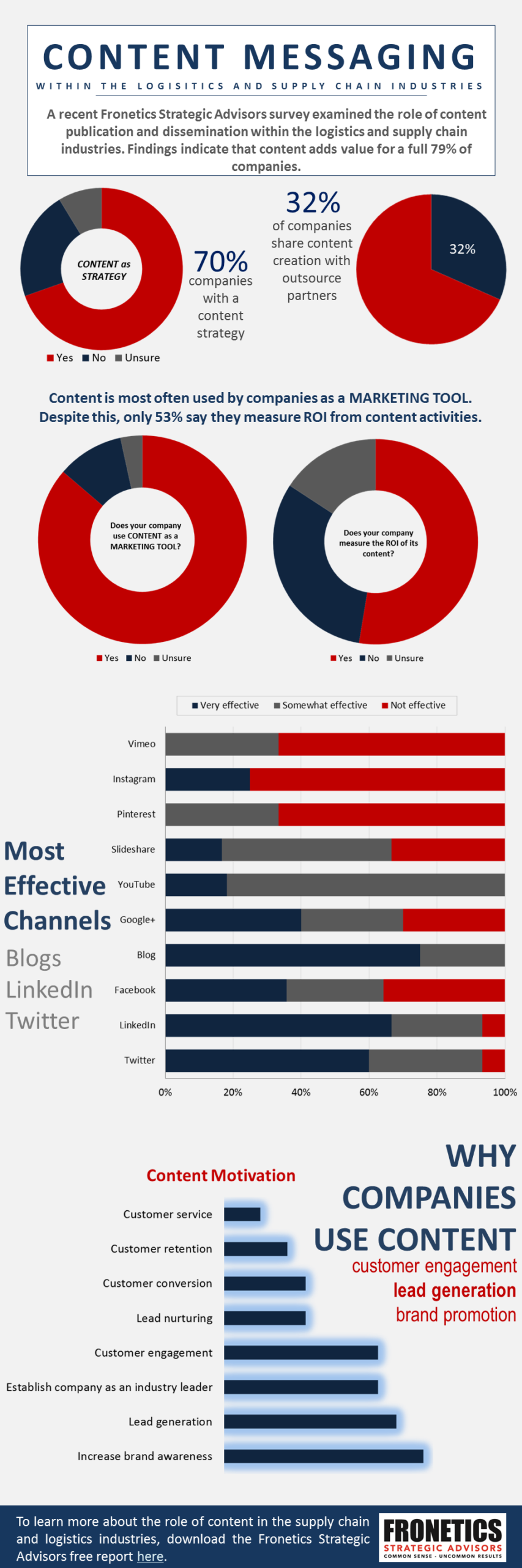
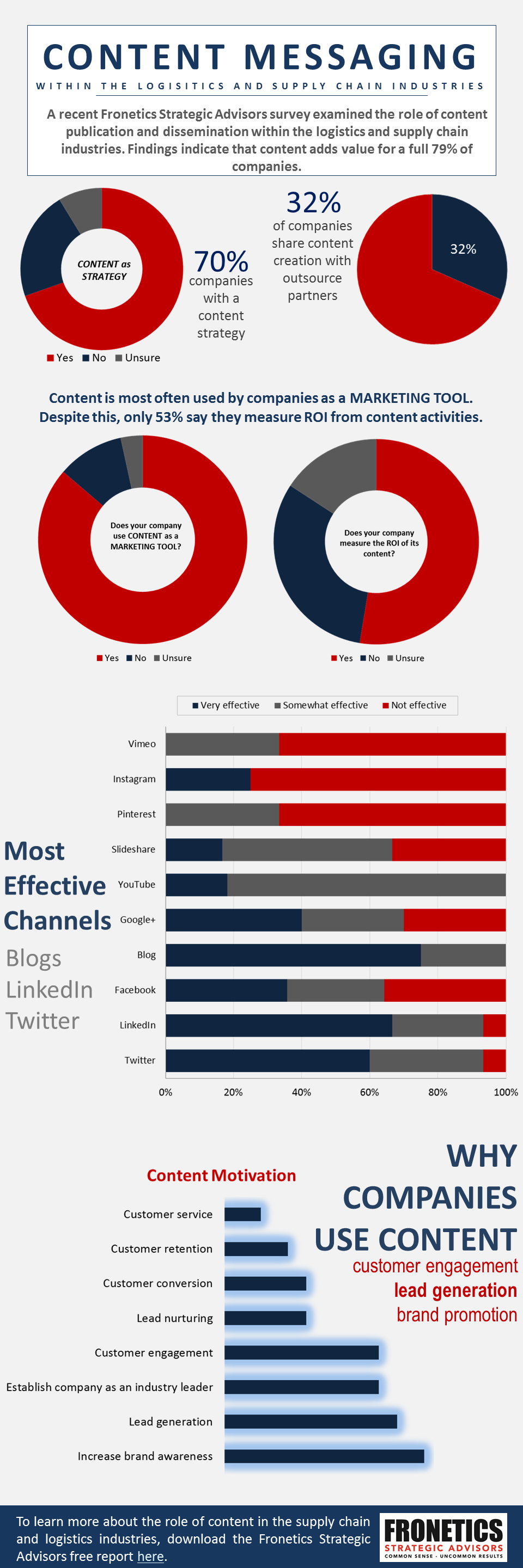
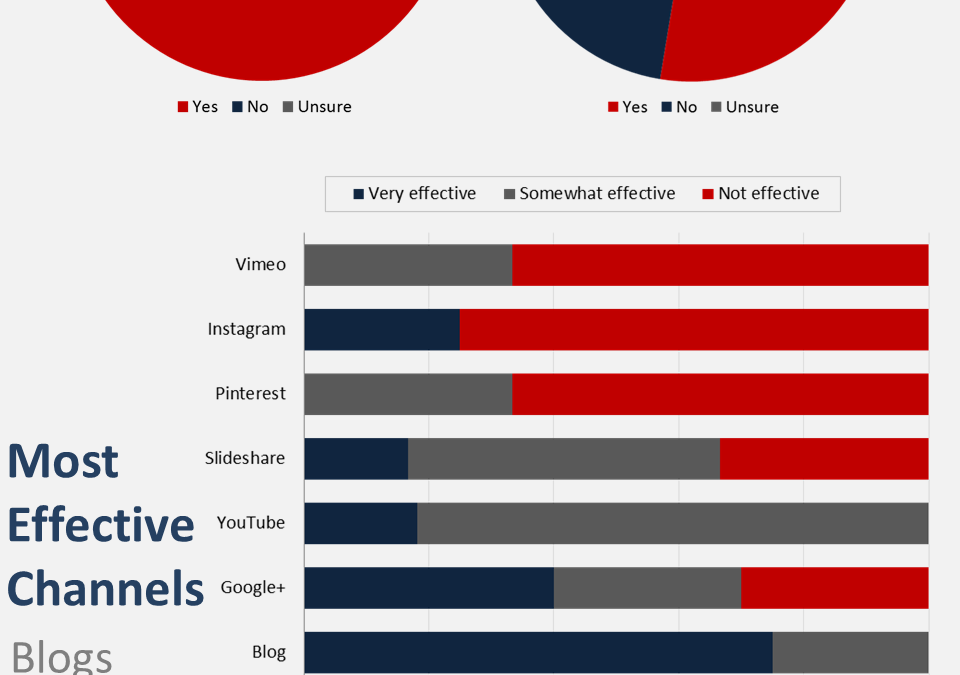
Fronetics Strategic Advisors conducted a survey to better understand the role and use of content within the logistics and supply chain industries.
The survey found that companies within the logistics and supply chain industries are using content as a marketing tool and are realizing benefits.
Survey respondents were asked to identify the goals of their company’s content strategy. The top three goals identified were:
- Increasing brand awareness
- Lead generation
- Establishing the company as an industry leader.
To learn more, check out our infographic, or download the report.