by Elizabeth Hines | Nov 1, 2016 | Blog, Content Marketing, Marketing
Companies dedicate enormous resources to ramping up email marketing programs around seasonal pushes, like the holidays. But do they actually get more customers?
We all know the feeling — how the office buzzes, the anticipation starts to build. Busy season is around the corner, and your team is getting ready for the big push to make this the most successful year yet. But have you ever wondered if all the extra hours and money you pour into these seasonal marketing campaigns are worth it?
As the holidays approach, many businesses, especially retailers and e-commerce companies, are starting to ask themselves this question — or, at least, they should be. At what point will creating and sending another email to your database be detrimental, rather than beneficial? How much should your messaging change? Should you try something totally new and different to catch customers’ attention?
IBM Marketing Cloud’s 2016 Email Marketing Metrics Benchmark Study has some interesting answers to these questions.
The holiday email-marketing study
The 2016 Email Marketing Metrics Benchmark Study is an annual report that offers insight on how many people open, click, and ignore messages from email marketers around the globe. It aggregates data from messages sent by nearly 750 companies representing 3,000 brands in 40 countries. This year, the study also examined the performance of holiday messaging versus non-holiday messaging for retail/e-commerce vendors.
Most retailers send at least double the amount of emails during the holidays (defined as Thanksgiving to New Year’s) as they do during the non-holiday period. They entice potential buyers with aggressive pricing, free shipping, and deal deadlines. But do these more frequent, offer-loaded emails make a difference? Let’s take a look.
Click and open rates
In almost every respect, non-holiday emails outperformed holiday emails in a significant way. Open rates during the holidays were 18.8% lower than during non-holidays. Mean click-through rates differed by 28%. Mean click-to-open rates remained similar.
There are several takeaways here. Yes, open rates were lower during the holidays. But because the volume of emails sent during this period increased significantly, it’s likely that the total number of emails opened was greater during the holidays than non-holiday period. That’s a positive thing.
That being said, click-through rates decreased pretty dramatically. You would expect that special holiday offers would entice recipients to click through more often. But increased email volume seemed to detract from such motivating offers.
Similarly, click-to-open rates measure the effectiveness of email content (in driving a reader to take the requested action, e.g. redeem an offer). These rates remained relatively similar across both time periods, which is surprising. With more people looking to make purchases during the holidays, you would think that more recipients would act on the offers presented in the holiday emails. Again, increased email volume seemed to detract from their doing so.
List churn metrics
Increased email volume meant retailers processed more hard bounces, unsubscribes, and spam complaints during the holidays.
Here are the takeaways. Firstly, more emails equal more hard bounces. That seems logical enough.
Though unsubscribe and spam-complaint rates were slightly lower during the holidays, that doesn’t equal success. Because of the frequency math effect, retailers are losing a larger number of subscribers because they are sending more emails.
Say your company sends one email per week during the year, and two emails per week during the holidays. If you usually have 10 people unsubscribe per week during the year, approximately 20 people are unsubscribing during holiday weeks. That can deplete your database pretty quickly — especially if you’re more than doubling your email volume.
Conclusions
The folks at IBM Marketing Cloud had some interesting thoughts about their findings and how to increase the effectiveness of holiday emails.
For one, while increasing the number of emails you send during the holidays isn’t inherently a bad idea, as more emails equates to more total opens, many retailers are going about it the wrong way, as is evidenced by lagging click-through rates.
That’s because when many marketers ramp up email volume, they forget all the best practices that make their emails successful in the first place: personalization, targeted content, and offers that are relevant to the specific recipient based on his/her place in the buyer’s journey. Personalizing email content will help improve click-through and click-to-open rates, which could dramatically impact sales given the increased email volume.
Further, a courtesy head’s up about increasing email frequency could reduce the number of opt-outs and spam complaints. IBM Marketing Cloud suggests that companies should “consider sending an email to subscribers before you ramp up frequency, explaining the increased frequency, what kind of promotions they can expect, and shipping and return policies. Include prominent language about frequency options and link to your preference center. In addition, revise your preference-center language and options to encourage unsubscribers to opt down or snooze emails instead of simply opting out.”
Application across verticals
While the weeks between Thanksgiving and New Year’s are not every business’s busy season, the findings from this study are still applicable. If your prospects experience an uptick in marketing emails during a particular season from you and your competitors, you’re likely to experience similar results.
The key in ramping up emails prior to a big push is to retain quality — that is, customizing content and offers to the particular recipient. If you can’t scale, then you shouldn’t send.
Furthermore, this study speaks to the value of a strategic, year-round marketing program that builds brand awareness and customer loyalty, regardless of how close the busy season is. If prospects grow to know and trust your brand, they’ll turn to you when it’s time to buy, regardless of how many emails you send them in the weeks prior.
Related posts:
by Elizabeth Hines | Oct 4, 2016 | Blog, Content Marketing, Logistics, Marketing, Social Media, Supply Chain
This list of social media articles includes useful information for both people who rarely use social networking sites and for more advanced users.
We’ve been using this space to write about social media a lot lately. That’s partly because so many exciting new developments and enhancements keep popping up. It’s also because we can’t underscore enough how important it is for companies in the supply chain industry to participate in social media.
I thought it would be helpful to revisit some of our recent information, guides, and tips and tricks regarding social media use for B2B marketers. The following list encompasses both general, how-to-type instruction and more detailed advice for more advanced users.
I’ve segmented articles by platform and included a catch-all category at the bottom as well. Don’t see what you’re looking for? Shoot me an email to let me know what social media-related content you’d like to hear about on our blog.
LinkedIn
LinkedIn is the most popular social network for B2B companies. Here’s what you need to know to get started.
Learn about the free and paid methods LinkedIn offers to help you find and recruit new employees.
LinkedIn’s 433+ million member base presents an enormous opportunity for your company to earn new business. Start attracting those members to follow you.
Twitter
One of the top social media sites for B2B marketers, Twitter can help businesses spread brand awareness and communicate with customers.
You may find yourself frequently strapped for quality tweeting material. Here are some ideas to not only fill your feed but to keep your followers interested and engaged.
Leverage insights from Twitter’s analytics dashboard to improve audience engagement, reach, and content development.
We did an experiment to determine the ideal frequency for posting on Twitter. The resulting numbers were abysmal. But that means the experiment worked.
Add stickers to your photos on Twitter to join in on real-time conversations about trending topics and to grow your audience.
Twitter is changing its rules on the 140-character limit for your tweets. Learn what’s going to be different.
Facebook
Facebook Live offers businesses a new, creative platform for engaging customers. This article describes what marketers need to know about it and how to use it.
YouTube
YouTube is a useful engagement tool for B2B marketers who want to reach the social network’s more-than-3-billion users. Learn how to get started in this article.
Get started creating YouTube videos for your business with these easy-to-use tools and ideas for content.
Learn how to improve the reach of your YouTube videos with these strategies for distribution.
Reddit
Reddit is a gold mine for relevant, engaging content to share with your social media followers. Here’s how it works and how you can get started.
Other resources
Fronetics has developed this training specifically for business owners, marketers, and employees looking to learn more about social media and how they can contribute to their company’s success through these networks.
Fronetics has developed a comprehensive report exploring social media use in general and, specifically, within the logistics and supply chain industries.
Businesses are using social media as a strategic tool. This article explains the top three benefits companies in the logistics and supply chain industries can enjoy from participating on social platforms.
Your business should be on social media showing buyers that you know what they want and that your business can provide it.
A cross-departmental social media team can help your company get more out of social networking sites.
Participating in social media is not about earning followers; it’s about building relationships with your current and future customers.
If your social media strategy doesn’t align with your business objectives and target audience, your marketing budget is probably better spent elsewhere.

by Elizabeth Hines | Sep 29, 2016 | Blog, Content Marketing, Logistics, Manufacturing & Distribution, Marketing, Strategy, Supply Chain, Warehousing & Materials Handling
Content marketing can help your organization amplify its efforts to drive traffic, improve conversion rates, and increase sales.
A recent survey of over 4,500 marketers at organizations around the globe found that converting leads to customers (74%) and growing traffic to their websites (57%) were their companies’ top marketing priorities. Perhaps not surprisingly, these marketers also overwhelmingly reported that generating traffic and leads was their top challenge. Often our business priorities are the most difficult to achieve.
Enter, content marketing.
Content marketing is a form of inbound marketing in which businesses publish content to attract prospects who are interested in products in services like theirs. This marketing approach can be highly effective in growing brand awareness, generating leads, and increasing sales. In fact, according to the same survey, organizations using inbound marketing were four times more likely to rate their marketing strategy highly than outbound organizations.
Let’s look at one example from the warehousing sector.
Business was decent for Company X. It had experienced positive growth for over a decade, despite lacking a clear marketing strategy. But leadership started to wonder: Are we missing opportunities for growth?
Company X sought a multi-level digital marketing strategy that would help them increase web traffic, generate more leads, and convert prospects to customers. The team hired Fronetics to create and implement such a strategy.
After 24 months, the results were telling: Web traffic increased by nearly one-fifth (19%). Company X tracked 244 high-quality leads directly sourced from its new content marketing efforts. And new business grew by a remarkable 30%.
Content marketing was highly successful for Company X in achieving its business goals of driving traffic and new business. In fact, the organization realized many other positive benefits as well. You can read about more of them, as well as the strategy Fronetics used to get there, by downloading the case study below.

Want to increase traffic to your business’ website and generate more leads and customers? Have you tried content marketing? Here are a few resources to get you started.
Related resources:
Need more help? Contact Fronetics to request a free strategy session.

by Elizabeth Hines | Sep 28, 2016 | Blog, Content Marketing, Logistics, Marketing, Strategy, Supply Chain
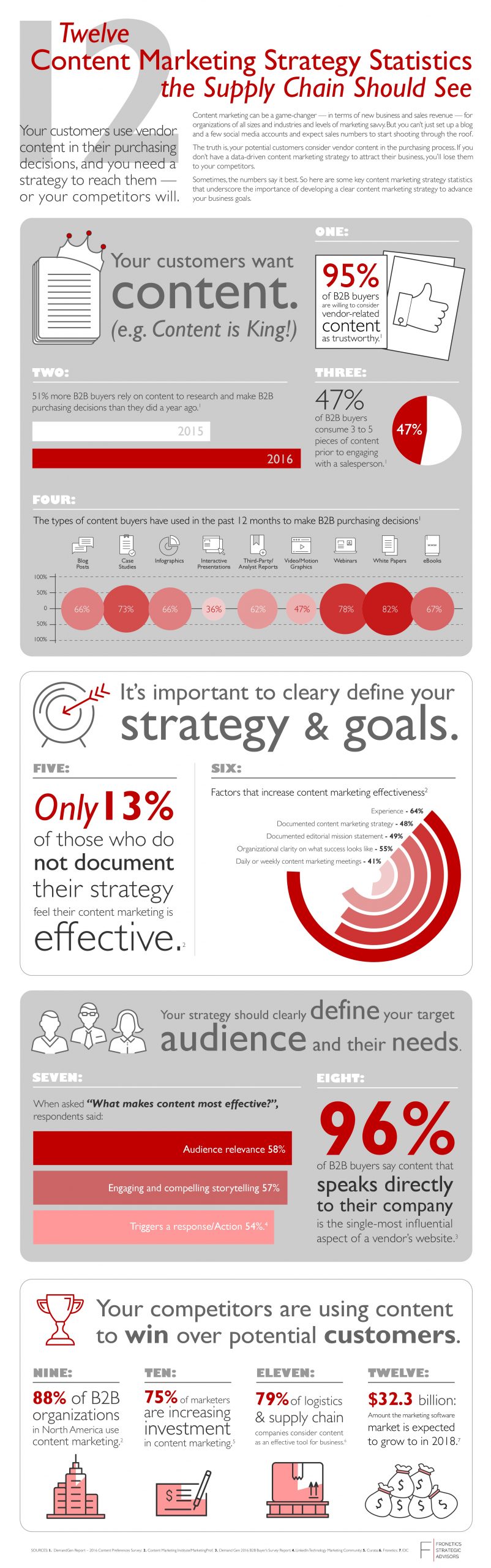
Companies in the logistics and supply chain industries should take a look at this content marketing infographic.
Content marketing is a form of inbound marketing in which vendors publish digital content to attract customers who are searching for products and services like theirs. If done right, it is highly effective in growing brand awareness, generating and converting leads, and driving sales and repeat business.
If your organization is exclusively using traditional outbound marketing techniques, like advertisements in print publications, you’re missing out on growth opportunities. We rounded up some of the most telling facts about the role of content marketing in today’s B2B purchasing environment for you to consider.
Here are 12 facts about content marketing that your business should keep in mind.

by Elizabeth Hines | Sep 13, 2016 | Blog, Content Marketing, Marketing
Considering outsourcing some or all of your content marketing? Check out these statistics.
Companies turn to content marketing to build brand awareness, generate leads, and drive sales. But the constant creation and distribution of original content can drain an organization’s resources. That’s why many choose to outsource all or some of their content marketing efforts to content partners or marketing firms.
If your business is exploring outsourcing as an option, here are some statistics that you might find interesting.
13 stats about outsourcing content marketing
51% of B2B marketers list lack of time/bandwidth to create content as one of their top content marketing challenges, and 50% list producing enough content variety/volume as well. (LinkedIn Technology Marketing Community)
30% of B2B marketers say an external agency/consultant is one of the top resources for content creation for their organizations. (LinkedIn Technology Marketing Community)
The two most outsourced content marketing activities:
- Writing (44%)
- Design (41%)
(LinkedIn Technology Marketing Community)
Marketers are outsourcing 18% of their content, with the remaining content being created in-house, curated or syndicated. (Curata)
Only 25% of marketers don’t outsource any content creation. (LinkedIn Technology Marketing Community)
About two-thirds of marketers outsource less than one-third of their content creation. (LinkedIn Technology Marketing Community)
Business bloggers outsource 14% of their blog posts. The best practitioners outsource 24%. (Curata)
What are the most effective resources for video marketing content creation?
- Combination of outsourced and in-house resources (70%)
- Outsource to a specialist (22%)
- In-house resources only (8%)
(Ascend2 2015 Study)
Related posts: