by Elizabeth Hines | May 3, 2017 | Blog, Content Marketing, Logistics, Marketing, Social Media, Supply Chain
There’s never been a better time for supply chain and logistics businesses to implement a content marketing strategy — except for maybe yesterday.
Content marketing is a form of inbound marketing in which vendors publish digital content to attract customers who are searching for products and services like theirs. If done right, it is highly effective in growing brand awareness, generating and converting leads, and driving sales and repeat business.
Think content marketing isn’t for supply chain and logistics businesses? Guess again. Here are five reasons why companies in these industries should use content marketing.
5 reasons to use content marketing
1. Buyers use content to make purchasing decisions.
The B2B buying landscape has shifted dramatically in the last 10 years. Buyers no longer rely on sales reps to make purchasing decisions; they turn to the internet. Companies must shift to accommodate buyers at various levels of self-sufficiency in the purchasing process.
The reality is that 94% of B2B buyers use online research. That means they’re judging whether or not to buy from your business based on the kind of digital content you publish (or do not publish, as the case may be). Consider these stats:
- 95% of B2B buyers are willing to consider vendor-related content as trustworthy.
- 51% more B2B buyers rely on content to make purchasing decisions than they did last year.
- 47% of B2B buyers consume 3 to 5 pieces of content before engaging with a sales person.
2. Control the conversation in your favor.
Customers go online to discuss their buying experiences — both positive and negative. If a potential buyer googles your business’ name, what will they find?
Content marketing puts you in the driver’s seat of reputation control. If you publish thought-provoking blog posts about industry trends, you can earn a reputation as a thought leader in the space. If you curate the latest articles about relevant happenings, people will begin to view your social media accounts as a resource for industry news. Be professional, quirky, clever, ahead of your time, youthful, wise, funny, off-color — whatever your brand is, you can set that reputation by what you publish online.
3. Present yourself as a solution.
When prospects go online they are looking for information and for answers. Position yourself as an expert who fully understands their problems and how to solve them by publishing content that anticipates their pain points. Quickly and fully respond to customer queries on social media. Use content marketing as an opportunity to be the solution prospects are looking for, right when they need it most.
4. Content marketing is more effective than traditional marketing.
Companies in the supply chain and logistics space have a lot to gain by modernizing their marketing tactics. We see this every day with our clients. With the evolving B2B buying landscape, ads in industry publications no longer cut it as a “marketing strategy.”
Take two examples under consideration. How about TotalTrax, a warehousing technology company that grew new business by 30% with content marketing? Or 3PL Cerasis, who gained 98 customers from its content marketing efforts? Content marketing works, and that’s been proven time and again with logistics and supply chain businesses.
5. Your competitors are doing it.
Content marketing is already a widespread practice within the supply chain and logistics industries. If you’re not producing content to attract prospects and retain customers, you’re missing out.
This year, 75% of marketers are increasing their investments in content marketing. Why? Because it works. Successful content marketers experience drastically more site growth than their competitors. In fact, content marketing leaders experience 7.8 times more site traffic than their competitors.
In sum, content = customers. If you’re not using content marketing as part of your marketing program, you’re going to get left behind, if you’re not already.
Related posts:

by Elizabeth Hines | Mar 7, 2017 | Blog, Logistics, Marketing, Social Media, Supply Chain
Social listening can help your business gain valuable insight about prospects, monitor your competitors, turn around negative conversations about your company, and earn social influencers.
Every day, conversations are taking place about your company, your products and services, your industry, and your competitors. These conversations are not just happening over the water cooler: They are happening on social media.
These conversations not only provide invaluable (and often strategic) information, they also serve to shape and define your company and your brand. With the advent of social media, the reality is that is the customer who drives your company’s image and brand message. If your company isn’t on social media, you miss out.
Social listening — 4 key benefits
Social listening, or social monitoring, is the process of monitoring social media to identify and assess what is being said about a company, individual, brand, product, or service. Through social listening, your company can gain market intelligence. You learn how your company, products, and services are being perceived. Knowing this information in real time is invaluable.
Here are 4 ways social listening can benefit your business and help you grow revenue.
1. Gain valuable prospect insight
Social media can be an incredible tool for getting to know your leads. Think about it: Social networks possess massive amounts of self-qualified, real-time data about billions of people. Consider the astonishing number of monthly active users on each platform:
- Facebook: 1.86 billion
- LinkedIn: 467 million
- Twitter: 319 million
- Instagram: 600 million
That’s a lot of potential customers. Now think about all of the details users provide on their social profiles and the kinds of things they post about: their preferences, where they live and work, and how they feel about different companies and brands, to name a few. Social listening lets you mine this information to learn about your prospects and customers.
2. Stay ahead of the competition
Social listening allows you to access valuable information about your competitors. You can see what customers are saying about your industry peers and make strategic decisions based on this knowledge. Using programs like Hootsuite, you can monitor keywords and your competitors’ brands and products. Based on your findings, you can make critical changes or create content to increase your brand awareness.
3. Create tone awareness
You know customers are talking about your company, but is the tone a positive one? And if it’s not, how are you responding? Social listening gives you the opportunity to take a negative customer-service situation and not only correct the problem, but improve the customer relationship. By having a personal response to negative comments on social media, your company shows a genuine concern for its customers and an investment in customer satisfaction.
4. Earn key influencers
People value the reviews of their peers over claims from a corporation. In fact, 93% of millennials have made a purchase based on a recommendation from friends and family, and 89% of millennials trust these recommendations more than they do the claims of the brand itself. Hence the rise of the influencer marketing.
Social media influencers are people that encourage others to work with your business through social networking. According to Sprout Social, “Social media managers prize their social media influencers because they drive engagement, discussions and word of mouth for your brand.” Real people talking about their experiences with your products and services helps foster trust in new customers.
Using social intelligence
To reap the benefits of social listening, including increasing your revenue, you need to use the information and intelligence gathered. For example, if you learn via social media that your customers are experiencing issues with a specific product, take steps to determine what the issues are, and then make the appropriate changes.
The Aberdeen Group offers additional examples of how businesses have and can use social listening: “Companies can use the voice of the customer to make critical adjustments and find issues related to inventory allocation, order management, returns management, cost, overall service satisfaction and beyond.”
The opportunities the supply chain and logistics industries can realize through social listening are great. Not participating in social listening results in missed opportunities.
Related posts:
![The Role of Content in the Logistics & Supply Chain Industries [Infographic]](https://fronetics.com/wp-content/uploads/2017/02/role-of-content.jpg)
by Elizabeth Hines | Feb 28, 2017 | Blog, Content Marketing, Logistics, Marketing, Supply Chain
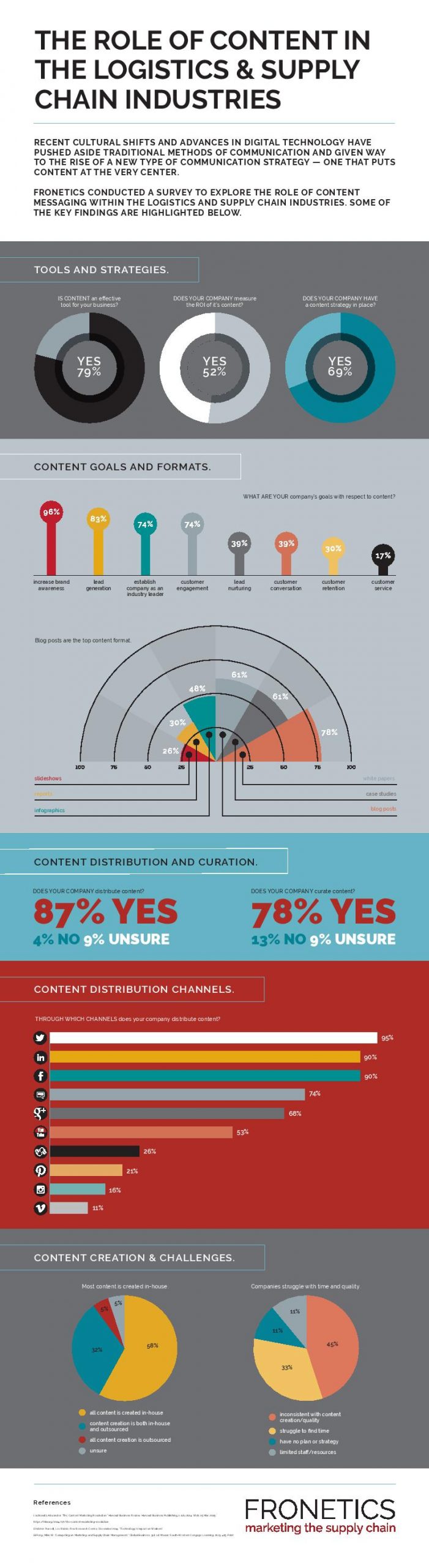
Nearly 80% of logistics and supply chain companies consider content an effective tool for their businesses.
We often use this space to talk to the logistics and supply chain industries about content marketing. Some companies are surprised to learn that this modern marketing method can be so effective for their business. The truth is, content is one of the most useful tools for not only building brand awareness, but also generating leads and earning new customers.
I can tell you this until I’m blue in the face. But, really, what’s most convincing is seeing how other businesses in the industry approach content and how it’s paying off for them.
So we at Fronetics polled supply chain and logistics marketers to determine how their companies are using content. We wanted to find out whether it’s working, as well as their challenges; how they approach outsourcing, distribution, and curation; and more. The below infographic illustrates a few of the key findings from our survey.
(Made with Canva)
To get a complete picture of the role of content in the logistics and supply chain industries, download our report:
Related posts:

by Elizabeth Hines | Feb 16, 2017 | Consumer Electronics, Content Marketing, Marketing, Social Media, Strategy, Supply Chain
Here are two examples of consumer electronics companies leveraging social media to reach their target audiences, build brand awareness, and drive sales.
More and more companies are allocating budget to create a social media presence. That’s because, despite early hesitation, supply chain businesses understand that social media is an important marketing tool in today’s marketplace. The consumer electronics industry is no different: Participating in social media has never been more necessary.
Nearly 60% of consumers have taken a blog or social media post into consideration while shopping in a store. You may think — sure, that probably happens for fashion labels. But in fact, consumer electronics is the top product category influenced by social media posts, followed by fashion, then household items.
So what does this mean for you? Those dollars that you’re driving into social networking posts, tweets, and videos are reaching customers and ultimately affecting their purchasing decisions. Well, I should say, only if you’re driving them in the correct places.
To effectively leverage social media in consumer electronics, you need to have a social media strategy that aligns with your business goals. You need to be using the right channels, distributing the right content, and posting at the right time.
Let’s take a look at two companies that are doing it right and why that is.
Consumer electronics companies leveraging social media effectively
1) GoPro
GoPro designs portable, waterproof cameras that users can strap on their helmets, handlebars, or surfboards to record their experiences. The brand’s target audience includes extreme-sports lovers and daredevils who like to watch and share their adventures.
As part of their social media strategy, GoPro encourages their customers to contribute their videos to its various social media channels. It’s a win-win for both the company and users: GoPro receives tons of content that is interesting and relevant to its users, and the users get to show off their skills (or tumbles). Today, the company has over 4.5 million YouTube subscribers and more than 1.3 billion views of their videos.
Lesson: Know your target audience. GoPro understands who it is trying to reach, what they like to do with social media, and where they are active. It gives users a place to share their accomplishments, and is able to grow brand awareness and brand loyalty at the same time.
2. Beats by Dre
Beats by Dre, owned by Apple and founded by Dr. Dre, is an audio brand that sells headphones, earphones, and speakers. The company is active on several social networking platforms, but its genius lies in how it uses those platforms in different ways to reach different consumers.
On Facebook, Beats by Dre finds the most success by sharing stories and experiences that appeal to music and sports enthusiasts. Content includes inspirational photos and videos of athletes and artists using the brand’s products.
On Twitter, the company has created a dedicated support account to quickly reach customers in need of service. This helps amplify the message that the company offers excellent customer service, and the team is able to quickly and broadly share users’ positive feedback.
Pinterest is an entirely different beast for Beats by Dre. The company found its users were most likely to pin high-quality, interesting images, so that’s exactly the kind of content the brand shares via Pinterest. It also curates “mood boards” around the release of new products. It helps build excitement and awareness surrounding a product launch — and it achieves the longer-term strategy of building brand awareness through its users’ social sharing.
Lesson: What works on one social media network might not work on another. By distributing different kinds of content on different channels, Beats by Dre has been able to maximize the impact of each social media channel and engage with the segment of consumers that operates there.
Today’s consumers are more educated than ever. By understanding how to leverage your social media channels to reach and best serve your target audience, you can make your tweets, posts and videos a success.
Related posts:

by Elizabeth Hines | Feb 6, 2017 | Blog, Content Marketing, Marketing, Social Media, Supply Chain
Instagram Stories offer an on-trend platform for delivering targeted content to B2B buyers and building brand awareness with potential customers.
If you haven’t considered using Instagram as part of your social media marketing program, it might be time to change your mind.
As of December 2016, Instagram had over 600 million monthly active users, about half of whom are between the ages of 18 and 29. Why should supply chain and other B2B marketers pay attention to the social networking preferences and behaviors of millennials? Because 73% of millennial workers are involved in decisions to purchase products or services for their companies. Welcome to the new generation of B2B buyers.
What’s more, Instagram’s recently launched feature, Instagram Stories, offers marketers a new platform for content delivery that is wildly popular with this generation. But unlike other networks with short-term video-sharing opportunities (ahem, Snapchat), Stories can have a polished, professional feel that well suits B2B brands.
What are Instagram Stories?
Instagram Stories are sequences of content that a user posts to his/her Instagram account over a 24-hour period. Besides photos, Stories can include videos, live and prerecorded, as well as Boomerangs, seconds-long motion clips that play forwards and backwards. The content plays as a continuous feed, creating a narrative about the user’s day — hence the term “Stories.”
Users may also customize their Stories with various design tools. Swipe to explore different filters, or add customizable stickers with time, weather, location, or even holiday greetings. You can also use a drawing tool to create your own masterpiece on your photos or videos.
Audiences can view the Stories of the users they follow within the 24-hour window after they are posted. They can find users with active Stories by scrolling the user icons at the top of the app. Or users can tell their followers that they’ve posted a story by tagging them, which notifies them through a direct message.
How you can supply chain and B2B marketers use Stories?
Instagram Stories aren’t just for friends showing friends what they’ve been up to. They’re a creative content-delivery platform that helps build rapport with followers, grow brand awareness, and educate potential buyers.
Here are 5 ways marketers might use Instagram Stories to engage their target audiences.
1. Deliver special offers and limited sales
Take advantage of this channel of communication to give special offers to followers tuning into your Stories. The time sensitivity of the 24-hour period will urge your buyers to engage with your Story and act quickly before the offer expires.
Direct followers to a special landing page or include a code right in the Story. As Social Media Examiner puts it, “The scarcity of Instagram Stories gives them power.”
JCrew’s promotion of the new Jane in Pink sunglasses offers an example of the clever use of Instagram Stories. The brand posted a combination of GIFs and photos teasing the pink sunglasses before announcing that there were a mere 50 pairs available for purchase through a link in its bio. This caused half of the merchandise to sell out in two hours.
2. Sign in for a takeover
Arrange to take over the Instagram account of a partner company or customer. It’s a fun way to draw attention from an existing, built-in audience. And it provides a mutually beneficial exchange of value for both parties.
As explained by media executive Gary Vaynerchuk, account takeovers offer a “backdoor approach to accessing new demographics.” The strategy is about “deepening relationships, gaining exposure, hacking distribution, and raising awareness.”
What’s more, account takeovers don’t require partners to hand over sensitive login information. Simply send your content to your partner to upload. It’s win-win situation that allows both parties to reach a new audience and share new content with ease.
3. Go behind the scenes
This is a great way to humanize your company and let you customers see and experience your brand personality. Capture candid photos of meetings. Take your followers on an adventure or an offsite task. Have a new product? Share a picture of the early designs or the production process. It’s a way to get followers excited and intrigued as to what happens behind the doors of your company.
Happy Socks, a Swedish sock and underwear retailer and manufacturer, does this well. It features videos of what’s going on in the office, birthday celebrations, and other candid moments.
4. Q&As
Get really personal with your customers by answering their questions via 10-second videos. One of Instagram’s community managers, Jeffrey Gerson, did this and found it to be a great success. This allows your viewers to feel as though they are really being heard since they are watching you talk about their questions as opposed to just reading typed answers online. It’s also a great opportunity to showcase the personalities of your employees and social media team while directly interacting with your audience.
4. At a loss? Ask your followers!
Give the people what they want — They may have some great ideas that you’d never considered. Survey your followers by posting a graphic of some options while leaving it open-ended as well. Have them respond in direct messages or comments with what they want to see from your social media. For example, Red Bull had their audience send the thumbs-up emoji in direct messages through Instagram Chat for the Story topic they most wanted to see published.
These five options provide your team with a starting point to begin exploring Instagram Stories. It’s an exciting tool to add some creativity and have some fun with your social media strategy.
Related posts: