by Elizabeth Hines | Mar 13, 2017 | Blog, Content Marketing, Marketing, Social Media, Supply Chain
Use these two strategies to help your blog generate leads faster.
Creating quality content for your blog that educates and engages consumers takes significant investment and resources. But, unfortunately, blog posts usually don’t deliver the immediate ROI that many companies are looking for.
A blog is an excellent lead-generation tool. But, as I’ve written about before, it takes time to generate leads and sales.
Like a fine wine, blog posts become more valuable with age.
Older content — likely, with more shares, likes, and referrals from other webpages — hold more credibility with search engines. The more credible the blog post, the higher it will rank in search engine results. What does this mean for you? The more time your blog has to circulate the internet, the more opportunity people have to read it, the higher it will appear in search queries. It’s that simple.
But your boss wants to see results in the form of leads and sales now. How can you bridge the gap between giving your blog the time it needs to become credible and boosting your lead-generating efforts for this sales cycle?
If you want to accelerate lead generation, it’s going to take a greater investment. But if you’re willing to commit more time and resources, here are two things you can do to see results sooner than later.
Two things you can do now to get leads faster
1. Publish more frequently.
Search engines value posting frequency because it shows that your blog is a consistent source of content. The question is, how much can your organization publish without experiencing a decline in quality and relevancy? Those are other factors influencing search engine rankings, not to mention readership, leads, and conversions.
But “more frequently” doesn’t have to mean going from 0 to 60. Even publishing once more per week can make a dramatic impact. This story, for example, shows how publishing one more post per week helped a client’s web traffic increase by 23%, sales leads double, and a prospect convert to a customer — and that was just in just one month.
A HubSpot study showed a tipping point around 400 total blog posts — blogs with 401+ total posts generated twice as much traffic as those that had published 301-400 posts. And more specifically, B2B companies with 401+ total blog posts generated nearly 3X as many leads as those with 0-200 posts. The faster you can reach that 400 mark, the quicker your results.
2. Don’t neglect your old content.
It’s important to keep in mind that the majority of your web traffic (aka potential leads) will first encounter your older content. Looking at Fronetics’ most-viewed posts last month, for example, 80% were published at least six months prior. In fact, 50% were more than a year old.
What does that mean? For one, you should keep tending to your already published content, particularly those posts that prove to be a consistent source of traffic. Update information; add links to new related posts or other relevant resources; and seek opportunities to insert or update calls-to-action to current offers and campaigns. Making sure those older, consistently popular posts continue to serve and engage your readers will increase your chances of conversion.
Secondly, it’s crucial that you look beyond how the posts you published recently perform. Something that doesn’t get a lot of views in the first week may be a huge traffic source and lead converter in a little time. Many content management systems, like HubSpot, can generate attribution reports, which tell you which web pages users most often visit before converting to a lead. Compare these pages with your high-traffic pages that don’t make the list to see how you can create more opportunities for lead conversion on the pages earning the most traffic.
If you invest the time and resources to run a blog, you owe it to yourself to see it through to success. Doing these two small things can get you there faster.
Related posts:

by Elizabeth Hines | Mar 9, 2017 | Blog, Strategy, Supply Chain, Talent
When it comes to hiring and managing during turbulent times, one thing separates the wheat from the chaff: a progressive focus.
Despite an 8-year bull market, many businesses are still licking the wounds caused by the 2007 financial crisis. Add a volatile political climate and predictions of impending economic turbulence, and you can’t blame those growing wary of rapid growth or expansion opportunities.
But, as the supply chain is already suffering from a talent gap, can companies afford to slow or freeze hiring — or, even, to downsize? Research suggests that organizations that balance caution with a forward-looking talent-acquisition strategy may fair best through difficult economic times.
When risk pays off
Research by Harvard Business School faculty assessed the performance of 4,700 companies across three recessions, and found that only 9% came out in better positions. The success stories had in common a progressive focus, meaning that they were extremely selective about pruning investments and stayed on the watch for growth opportunities.
We’ve all heard anecdotes that support this research.
In the 1940s, when Hewlett-Packard was starting out, times were challenging for the nascent electronics company. But the founders took the tremendous risk of hiring legions of engineers, despite the economic downturn. Many, including the founders, credit the company’s success to this risky decision.
See the way forward by looking back
What does this mean for your business?
Claudio Fernández-Aráoz, senior advisor at the global executive search firm Egon Zehnder and executive fellow at Harvard Business School, offers a comparison to the Roman god Janos, the god of beginnings and endings. Janos is often represented with two heads, facing opposite directions. “His ability to look back is what enabled him to see way forward so clearly,” says Fernández-Aráoz. “His horizon was exceedingly long-term.”
Is your business accurately assessing risk and balancing caution with bold decision-making? Fernández-Aráoz describes how Egon Zehnder weathered the economic crisis following the dot-com bubble burst and 9/11: “A natural reaction would have been to obey the short-term signals and retrench and, indeed, that’s what most of our competitors did, dismissing up to 50% of their staffs. But we barely downsized. We continued to hire outstanding consultants and elected every single candidate who came up for partner during that period,” he writes.
Fernández-Aráoz credits these practices with his firm’s readiness to seize opportunity the moment the market began to recover. The take-away here is that while it’s crucial to mitigate risk during turbulent economic times, “it is those who stay calm, remember the past, and plan for the future who will triumph.”
Related posts:

by Elizabeth Hines | Mar 7, 2017 | Blog, Logistics, Marketing, Social Media, Supply Chain
Social listening can help your business gain valuable insight about prospects, monitor your competitors, turn around negative conversations about your company, and earn social influencers.
Every day, conversations are taking place about your company, your products and services, your industry, and your competitors. These conversations are not just happening over the water cooler: They are happening on social media.
These conversations not only provide invaluable (and often strategic) information, they also serve to shape and define your company and your brand. With the advent of social media, the reality is that is the customer who drives your company’s image and brand message. If your company isn’t on social media, you miss out.
Social listening — 4 key benefits
Social listening, or social monitoring, is the process of monitoring social media to identify and assess what is being said about a company, individual, brand, product, or service. Through social listening, your company can gain market intelligence. You learn how your company, products, and services are being perceived. Knowing this information in real time is invaluable.
Here are 4 ways social listening can benefit your business and help you grow revenue.
1. Gain valuable prospect insight
Social media can be an incredible tool for getting to know your leads. Think about it: Social networks possess massive amounts of self-qualified, real-time data about billions of people. Consider the astonishing number of monthly active users on each platform:
- Facebook: 1.86 billion
- LinkedIn: 467 million
- Twitter: 319 million
- Instagram: 600 million
That’s a lot of potential customers. Now think about all of the details users provide on their social profiles and the kinds of things they post about: their preferences, where they live and work, and how they feel about different companies and brands, to name a few. Social listening lets you mine this information to learn about your prospects and customers.
2. Stay ahead of the competition
Social listening allows you to access valuable information about your competitors. You can see what customers are saying about your industry peers and make strategic decisions based on this knowledge. Using programs like Hootsuite, you can monitor keywords and your competitors’ brands and products. Based on your findings, you can make critical changes or create content to increase your brand awareness.
3. Create tone awareness
You know customers are talking about your company, but is the tone a positive one? And if it’s not, how are you responding? Social listening gives you the opportunity to take a negative customer-service situation and not only correct the problem, but improve the customer relationship. By having a personal response to negative comments on social media, your company shows a genuine concern for its customers and an investment in customer satisfaction.
4. Earn key influencers
People value the reviews of their peers over claims from a corporation. In fact, 93% of millennials have made a purchase based on a recommendation from friends and family, and 89% of millennials trust these recommendations more than they do the claims of the brand itself. Hence the rise of the influencer marketing.
Social media influencers are people that encourage others to work with your business through social networking. According to Sprout Social, “Social media managers prize their social media influencers because they drive engagement, discussions and word of mouth for your brand.” Real people talking about their experiences with your products and services helps foster trust in new customers.
Using social intelligence
To reap the benefits of social listening, including increasing your revenue, you need to use the information and intelligence gathered. For example, if you learn via social media that your customers are experiencing issues with a specific product, take steps to determine what the issues are, and then make the appropriate changes.
The Aberdeen Group offers additional examples of how businesses have and can use social listening: “Companies can use the voice of the customer to make critical adjustments and find issues related to inventory allocation, order management, returns management, cost, overall service satisfaction and beyond.”
The opportunities the supply chain and logistics industries can realize through social listening are great. Not participating in social listening results in missed opportunities.
Related posts:

by Elizabeth Hines | Mar 6, 2017 | Blog, Leadership, Supply Chain, Talent
Mark Cuban thinks liberal arts grads will be the next in-demand employees. Could they be the answer to the supply chain talent gap?
The supply chain talent gap has been called a “perfect storm.” Every report cites doomsday statistics of the impending crisis when, by 2025, 60 million baby boomers will exit the workforce, leaving only 40 million millennials take their place.
To make matters worse, future supply chain professionals need to master not only the hard analytical skills but also the soft leadership skills fueled by the transition from an industrial economy to an economy grounded in service and information. In numbers, it means only 20% of the workforce will possess the skills required of 60% of all new supply chain jobs.
Today’s supply chain companies face a more immediate challenge, however: filling junior-level positions (1-4 years of experience). According to Rodney Apple, founder and president of SCM Talent Group: “When you land your first job out of college… you’re not actively looking for a new job. So [companies] really have to do a lot of direct sourcing to find the analysts, engineers, inventory managers, and planners and sell them on why they should make a career move at this stage of their career.”
Where can employers find young talent that possesses both critical-thinking skills and future leadership potential?
Liberal arts majors struggle with employment opportunities in today’s economy
Students graduating in the past decade have been hit hard by a challenging economy. Almost ten years out from the Great Recession, 44.5% of recent college graduates still are underemployed, many settling for jobs that don’t require a bachelor’s degree.
This is especially true for liberal arts majors. Research shows that their peers in technical fields like nursing and with qualitative skills like engineering have fared better.
But this may soon change. Billionaire investor and Shark Tank personality Mark Cuban, among others, has recently stated that liberal arts majors will be the next in-demand employees. As more technical jobs like coding become automated, companies will need people with creative and critical-thinking skills to offer a human perspective to the automated output. These skills, of course, are the foundation of a liberal arts education.
Bridging the gap between underemployed liberal arts graduates and supply chain companies
Supply chain companies want to find talented employees that can succeed in junior-level positions now but that also could move into management down the road. “Soft skills” like creativity and problem-solving are crucial to both roles — not to mention, every role in between. “That means sometimes being a leader, sometimes being a good follower, monitoring the progress, meeting deadlines, and working with others across the organization to achieve a common goal,” says Lynne Sarikas, MBA Career Center Director at Northeastern University.
Liberal arts graduates bring these abilities to the workplace. Supply chain companies could be actively recruiting these qualified and eager graduates to fill open junior-level positions now, and then groom them to become future leadership. As more jobs become automated, companies will have additional resources to invest in on-the-job training and professional education for their rising stars.
Educated, qualified employees and the shortage of supply chain talent could be an obvious fit — more obvious than liberal arts and supply chain initially sound together. This untapped market of graduates could be the answer to the supply chain talent gap.
Related posts:

by Elizabeth Hines | Mar 1, 2017 | Blog, Diversity, Leadership, Logistics, Supply Chain
Fronetics spoke with 6 women leaders in the supply chain and logistics industries about their professional experiences and thoughts on the gender gap.
March is Women’s History Month, a time when we at Fronetics like to focus our attention on inspiring female leaders who are bridging the gender gap in the supply chain and logistics industries.
As we have written about previously, the lack of gender diversity in the supply chain is not because women do not have the skillset and ability to succeed within the industry. In fact, quite the opposite is true.
We believe that it is important to discuss the lack of gender diversity and point to research highlighting why the industry needs to increase the number of women in all positions, including the C-suite. Additionally, it is just as important to highlight the incredible women who already are working within the industry.
We have had the opportunity to interview 6 supply chain leaders about their professional experiences, as well as their thoughts on some of these issues.
6 women leaders in the supply chain
Kendrea Durr-Smith
Director of Global Trade Compliance, Arrow Electronics
Kendrea Durr-Smith has successfully lead a diverse global team to better support the needs of Arrow customers and suppliers. In our interview, she discusses the exciting changes her team has accomplished and offers some advice for women interested in electronics and trade compliance. Read the Durr-Smith interview.
Barbara Jorgensen
Co-Founder and Managing Editor, Electronics Purchasing Strategies
Barbara Jorgensen has more than 20 years’ experience as a journalist, working for leading electronics industry publications. In our interview, she discusses working in the supply chain industry and the changes she’s witnessed — both broadly and in specific regards to gender diversity — over the course of her career. Read the Jorgensen interview.
Hailey McKeefrey
Editor-in-Chief, EBN
In her extensive and distinguished journalistic career, Hailey McKeefrey has remained enthusiastic about the supply chain industry and her role within it. She spoke with us about how the industry has changed and how women interested in holding leadership positions can seize opportunities and advance their careers. Read the McKeefrey interview.
Cathy Morris
Senior Vice President and Chief Strategy Officer, Arrow Electronics
Cathy Morris “stumbled” into the supply chain by coincidence but now holds a top-level leadership role at a Fortune 500 electronics corporation. In our interview, she discusses how she got to where she is today and how to turn each step in a career into a valuable learning experience. Read the Morris interview.
Mickey North Rizza
VP of Strategic Services, BravoSolution
Now a Top Female Supply Chain Executive, North Rizza was a bored pre-law major who switched to materials logistics management when she discovered a love for negotiating when seeking charity items for a sorority fundraiser. She spoke to us about her rise to success, people who have helped her along the way, and advice she can offer to women interested in the supply chain. Read the North Rizza interview.
Kelli Saunders
President, Morai Logistics
Kelli Saunders is a big believer in mentorship. And millennials. And opportunities for women in the supply chain. In her interview, she discusses her career, her advice, and her perspective on challenges within the industry. Read the Saunders interview.
Throughout the month of March, we plan to continue this interview series to shine the spotlight on more of the admirable women who make the supply chain and logistics industries run. Make sure you’re subscribed to our blog or following us on social media to catch them all.
Related posts:
![The Role of Content in the Logistics & Supply Chain Industries [Infographic]](https://fronetics.com/wp-content/uploads/2017/02/role-of-content.jpg)
by Elizabeth Hines | Feb 28, 2017 | Blog, Content Marketing, Logistics, Marketing, Supply Chain
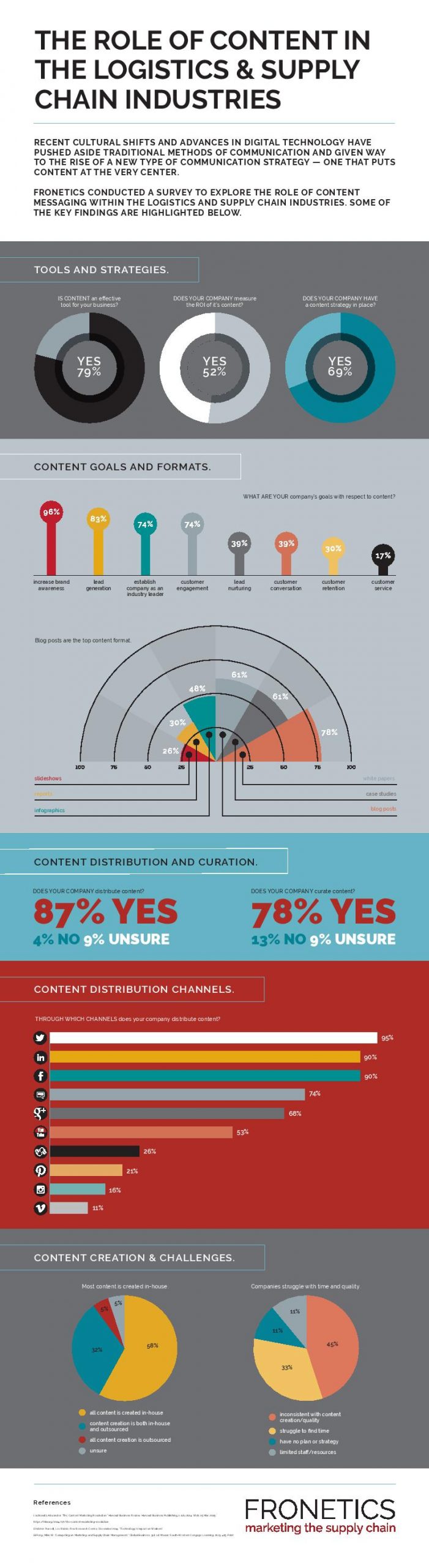
Nearly 80% of logistics and supply chain companies consider content an effective tool for their businesses.
We often use this space to talk to the logistics and supply chain industries about content marketing. Some companies are surprised to learn that this modern marketing method can be so effective for their business. The truth is, content is one of the most useful tools for not only building brand awareness, but also generating leads and earning new customers.
I can tell you this until I’m blue in the face. But, really, what’s most convincing is seeing how other businesses in the industry approach content and how it’s paying off for them.
So we at Fronetics polled supply chain and logistics marketers to determine how their companies are using content. We wanted to find out whether it’s working, as well as their challenges; how they approach outsourcing, distribution, and curation; and more. The below infographic illustrates a few of the key findings from our survey.
(Made with Canva)
To get a complete picture of the role of content in the logistics and supply chain industries, download our report:

Related posts: