
by Jennifer Hart Yim | Oct 22, 2019 | Blog, Current Events, Logistics, Manufacturing & Distribution, Strategy, Supply Chain
Amazon has changed the way we do business. Supply chain companies need to get on board with Amazon’s e-commerce strategy or risk losing business.
It is no secret that Amazon has dominated the online retail industry. Amazon Prime has shifted consumer expectations so that waiting 5-7 business days for your online order is no longer acceptable. With people now ordering anything from couches to groceries online, companies need to get on board with this shift to e-commerce or risk missing out on many sales.
Consumers now more than ever want access to more inventory no matter if they are shopping online or in stores. Many companies report the struggle of trying to keep up with this retail giant, and current-day supply chains have certainly felt the impact.
Historically, supply chains have been set up to support a network of stores using the multichannel business model. This includes retailers managing their different channels almost as separate businesses. These channels are what businesses use to get their goods and services to their consumers. For example, many retailers use brick-and-mortar stores as well as e-commerce when it comes to selling.
So, what’s the problem with this? Well, the customer’s experience can vary depending on the shopping channel they choose. Retailers often keep their online and brick-and-mortar inventory separate, which can lead to a frustrating shopping experience for the customer.
I am sure at some point in your life you have had the experience of walking into a store looking to return an online order only to find out it must be returned to the company through the mail. Customers do not view a brand in silos, and the same selection of inventory is expected whether they are shopping online or in a physical store. Companies also run the risk of losing a sale if the exact item the consumer wants is unavailable or sold out. This is one area that allows Amazon to shine because they maintain one pool of inventory that is not separated by different channels of business.
A 2016 UPS survey found that, for the first time, shoppers revealed they bought more of their purchases online than in stores. It’s hard to tell what is the main driver behind this shift, but you can’t help but think of Amazon. It’s hard to comprehend how other companies not only compete but just even keep up with the trillion-dollar company with a revenue of $10.07 billion in 2018.
This is where the omnichannel business model comes into play. Omnichannel combines physical and online commerce to create a more seamless shopping experience for the consumer. While this business model is not a result of Amazon, it certainly puts companies in a better position to compete. The goal here is to provide the same customer experience throughout each channel while ensuring the product reaches the customer as fast as possible.
Characteristics of an omnichannel business model include:
- Buy online pick up in stores
- Stores shipping to other stores
- Dropshipping
- Order fulfillment from store
Nordstrom finding ways to differentiate from the competition
Online shopping provides many benefits to consumers, but it does not come without its own challenges. It is fairly common to buy a shirt online only to find out it is the wrong size. It can be a hassle to mail the item back, and consumers often opt out of this and chalk the purchase up to a loss. Nordstrom understands this pain point and took it upon themselves to offer a solution by creating service hubs called Nordstrom Local. The sole purpose of Nordstrom Local is to make the online shopping experience effortless. While these hubs do not contain designated inventory, they provide a handful of services to the customers.
They offer:
- Pickups
- Returns
- Stylist
- Dressing rooms
- Tailoring services
- Same-day delivery (if ordered before 2 p.m.)
- Espresso drinks, juices, wine & beer
As a consumer, what more could you ask for? The idea is that you order a variety of clothes online and have them delivered to Nordstrom Local. Here you can try on your purchases in their dressing rooms. If it doesn’t fit, no problem — they’ll mail it back for you. Need it hemmed? There’s a tailor on-site.
Nordstrom has held its own in the retail space. With 2018 revenue reaching $15.5 billion, it is hard to argue with their success. They must continue to innovate and find new ways to connect consumers to their product. Trying out this concept in Los Angeles has proven to be successful, and they are looking at opening up hubs in New York next.
Kohl’s joins forces with Amazon
Kohl’s, like many retail stores, welcomes any opportunity to increase foot traffic. Over 1,000 of their stores are now accepting returns from Amazon. Again, we see a pain point of online shopping removed for the consumer. You can bring your unwanted Amazon item to Kohl’s, and they will pack, label, and ship the item at no cost. The hope is that Amazon customers will flock to Kohl’s and hopefully buy some of their inventory on the way.
Their revenue has continued to rise over the past four years and reached 20 billion in 2018. This is a bold idea that can set Kohl’s apart from the competition by delivering a service that is unique to them. Amazon needs a way to keep its customers happy and Kohl’s needs to increase foot traffic, so it appears to be a win-win for all parties involved — including the consumer.
While Kohl’s new idea offers fewer services than Nordstrom’s, they are opening themselves up to a wider consumer market, and with this will likely come more sales. They have addressed the expected increase in expenses that will come with having to hire more employees and spending more on logistics, but the expected payoff is potentially massive.
Comparing strategies
It’s hard to tell which strategy will prove to be more profitable. The only thing that is for certain is that the shift toward e-commerce is not slowing down anytime soon, so companies need to look at how they connect consumers to their product. If the goal is to get your product to the consumer, then your supply chain needs to be tailored to this objective.
Amazon may have the upper hand now, but you never know what new idea could pop up in a few years. In the meantime, companies are faced with the harsh reality of ever-growing competition. Consumers are now hopping on their computers or mobile devices to choose from a plethora of inventory.
Amazon is not completely to blame when it comes to the evolution of consumer expectations, but they have certainly impacted them. Companies wanting to compete are left to make tough but critical decisions on what their next move will be.
This article was written by Emily Standish, an MBA student at the Peter T. Paul College of Business and Economics at the University of New Hampshire, specializing in Finance and Information Systems & Business Analytics. She graduated from Merrimack College in 2017 with a B.S. in Business Administration and Management with a concentration in Finance and currently works as a Corporate Financial Analyst.
Related posts:


by Elizabeth Hines | Oct 15, 2019 | Blog, Content Marketing, Manufacturing & Distribution, Marketing, Supply Chain
The analog supply chain model is outmoded and inefficient. Here’s how digital transformation is reinventing manufacturing.
Highlights:
- Manufacturers are increasingly adopting artificial intelligence and machine learning technologies.
- The traditional analog supply chain model is unable to compete with digital disruptors in a volatile market.
- Digital transformation empowers manufacturers to create sought-after personalized experiences for buyers.
Digital transformation isn’t just the latest buzzword in supply chain circles. It’s an ongoing trend that’s revolutionizing manufacturing and supply chain efficiency. According to a recent report from Accenture, 78% of CFOs are spearheading initiatives to improve efficiency through adoption of digital technology.
Digital transformation empowers manufacturers to meet the evolving demands of a customer base with rising expectations for customer service. The digital technologies that are emerging today offer analytics that are vital for forecasting and understanding how to shift the balance of supply and demand.
3 ways that the analog supply chain model is outdated
Supply chain management expert Frank Meerkamp writes, “The traditional supply chain is a tapestry built on an outdated analog network – yet it exists in a digital world.” The difficult truth is that in today’s climate of rapidly shifting market demands and an increasingly interconnected world, manufacturers must embrace digital transformation or be left behind.
Before we look at how digital transformation can benefit manufacturers, let’s take a moment to examine the challenges presented by an outdated analog supply chain.
1) Market volatility
Today’s markets move at a breakneck pace. Thanks to a constantly shifting geopolitical landscape, changing regulations and sanctions, and the unpredictability of cost and supply, manufacturers face market volatility, uncertainty, and a high level of risk. The analog supply chain model leaves companies without the agility to respond and pivot quickly and to operate efficiently on a global or regional scale.
2) Competition from digital disruptors
Perhaps the most powerful example of the way in which digital disruptors are challenging legacy leaders is the Amazon effect. Amazon has effectively situated itself as an innovator and easily has outpaced rivals in multiple sectors. Companies that continue to embrace an analog supply chain model simply cannot compete with those that have fully embraced digital transformation.
3) Rising customer expectations
While it can be tempting for B2B companies to bury their heads in the sand, believing that digital marketing is purely a B2C necessity, the reality is that supply chain companies must embrace digital marketing as part of their digital transformation. Buyers expect hyper-personalized experiences, as well as customized products, and the kind of execution that’s impossible for manufactures to deliver within the analog supply chain framework.
4 ways digital transformation addresses today’s challenges for manufacturers
As the complexity of the supply chain increases, embracing digital transformation is the clearest path to success for manufacturers. While companies that cling to an outdated analogue model struggle with eroding margins and an inability to compete, those that establish “a data-driven supply chain,” writes Meerkamp, “can gain advantages in increased forecasting accuracy, identifying and resolving issues in real time, creating new segmentations, and delivering on consumer requirements with speed, specificity, and scale.”
In short, digital transformation uses data to drive visibility and agility for manufacturers, allowing them to operate efficiently and profitably.
1) Establishing visibility and centralized control
The AI and machine-learning technologies available today enable manufacturers to meet the challenges presented by an increasingly complex supply chain. Massive sets of data can be captured and processed, providing invaluable real-time visibility. Not only that, but manufacturers can leverage this visibility to centralize data and decision-making.
2) Creating new performance engines
Thanks to the ability of AI technologies to process enormous quantities of data, digital transformation enables “powerful resolution engines, based on real-time root-cause analyses, to automate the execution of supply chain functions, and optimize transactions to meet strategic objectives,” says Meerkamp. These technologies facilitate the forecasting and immediate decision-making necessary for manufacturers to operate efficiently.
3) Facilitating agility
Today’s marketplace moves faster than ever, and market forces are constantly shifting. Agility has never been more important for companies to compete. Intelligent technologies allow supply chain companies to establish a management model that is collaborative, data-driven, and platform-based. Digital transformation enables the sharing of qualitative information as well as real-time data and implications. This in turns enables agile management, ready to meet the shifting demands of the marketplace.
4) Developing personalization and flexibility
One of the biggest challenges manufacturers face today is the increasing buyer expectations of personalized experiences. AI technology enables the creation of segmentation strategies, addressing buyers’ personalized needs based on various factors, including channel, location, and service level. Real-time visibility into market data also leads to greater insight into buyers’ needs and how to meet them.
Organizations that embrace digital transformation are empowered to create personalized experiences for their customers and operate with the agility, visibility, and centralization necessary to compete in today’s marketplace.
Related posts:

by Elizabeth Hines | Oct 10, 2019 | Blog, Content Marketing, Logistics, Marketing, Robotics & Automation, Supply Chain
Supply chain companies are beginning to use robotics to boost warehouse efficiency and drive profits thanks to new automated technologies.
Highlights:
- High-res cameras, pressure sensors, navigation lasers, and acoustic warning indicators allow automated devices to navigate warehouses efficiently and autonomously.
- Robotics offers enhanced efficiency for both warehouse capability and predictive supply chain management.
- After major investments in automated fulfillment centers, Amazon has seen a 50% increase in capacity when compared to facilities that don’t use robotics.
A recent Information Services Group (ISG) study suggests that something big is happening: 72% of information services (IS) enterprises plan to increase their investment in robotics by the end of the 2019. Why? Because automation and IS are a natural fit.
Leading companies worldwide are beginning to use robotics to boost their warehouse efficiency and forecasting capabilities. And an improving price-to-performance ratio associated with robotics technology means that usage is sure to continue expanding.
The advantages of automation
New automated technologies are a game-changer. Until recently, available robotic devices were stationary and couldn’t interact visually with their surroundings or respond to unexpected inputs. Today, robots are mobile and collaborative. High-res cameras, pressure sensors, navigation lasers, and acoustic warning indicators allow automated devices to navigate warehouses efficiently and autonomously.
Recent technology upgrades include software that causes a robot to cease activity temporarily if it encounters an unexpected object or input, meaning that these devices can safely work alongside humans. Whereas earlier robots were used mainly to transfer objects from one place to another, more recent technology can enhance tasks ranging from managing inventory to retrieving, assembling, and packing orders.
Industry leaders have invested in automated warehouse management systems (WMS) with undeniable results. After major investments in automated fulfillment centers, Amazon has seen a 50% increase in capacity when compared to facilities that don’t use robotics. Amazon has even acquired the company that creates its robots, indicating Amazon’s confidence that the continued production and development of automated technology will play a big part in their future.
JD.com, China’s largest online retailer, has gone even further. Boasting the world’s first fully automated e-commerce warehouse, JD has equipped the 43,000-square-foot facility with 20 industrial robots that allow the company to provide same- and next-day delivery to more than 1 billion customers. Whereas a standard warehouse of that size would require nearly 500 workers, JD employs just 5.
Streamlining operational staff offers a big pay-off. On average, a warehouse employee wastes almost 7 weeks per year in unnecessary motion, which adds up overall to $4.3 billion in labor expenses. For employees, simply walking around in the warehouse accounts for 50% of the time involved in retrieving orders and checking inventories. Coupled with the potential for human error, the superior efficiency of robots makes it a question of “when?” rather than “if?” automation will become the new norm in parcel-sorting hubs and distribution centers.
Automated guided vehicles
The robotics revolution is already underway. One of the most widespread and effective uses of robots in warehouses is the automated guided vehicle (AGV). These self-driving vehicles are rendering expensive and single-use equipment like conveyor belts and large loading vehicles obsolete. Battery-monitoring systems send AGVs back to their charging ports when necessary, maximizing the efficiency of their operation. AGVs can be directed by voice or programmed to retrieve orders, guided by physical markers, magnets, and vision systems. In addition to navigating a warehouse floor more quickly and efficiently than human employees, AGVs are also capable of lifting and transporting much heavier weights, allowing for a larger number of orders to be retrieved in the same amount of time.
The advantages of AGVs run deeper than warehouse efficiency, however, and extend to logistics operations as well. AGVs track and update inventory records in real time as they retrieve orders. Ordinarily, the immense amount of data involved in running supply chains creates inefficiency and requires additional personnel to monitor inventory levels and place orders. The AGV integrates these tasks into a streamlined operation, as it can retrieve items as soon as order data is received and updates inventory levels instantaneously, even placing automatic purchases. This allows for improved forecasting and faster inventory refill.
Effi-BOT & Sawyer
That’s all very well in theory. But how does it work in practice?
DHL has led the pack in using robots to assist employees with repetitive and physically demanding tasks. Effi-BOT, an AGV that follows employees through DHL warehouses, takes over the physical work involved in picking orders. The use of Effi-BOT has allowed DHL to move from single-order picking to a multi-order model, and helps track complex inventory dynamics.
Another robot, Sawyer, has illustrated how automation can be used in flexible ways to accommodate ever-changing purchasing and order patterns involved in e-commerce. Sawyer’s collaborative capabilities allow it to handle repetitive aspects of the co-packing process. By adding Sawyer to its existing workforce, DHL has been able to use the robot to flexibly adjust to unpredictable order data.
Managing robotics
Typically, the inventory and performance data generated by devices such as Sawyer and Effi-BOT is aggregated in a dashboard that supply chain managers can use to check inventory levels and review automated requests sent from robotic devices to purchasing departments. By integrating data recorded in real time by automated devices, dashboards make larger and larger segments of the supply chain visible, allowing managers to pinpoint the source of problems, such as a delayed order from a supplier’s factory.
Robotics thus offers enhanced efficiency for both warehouse capability and predictive supply chain management. While the regulatory policies surrounding the use of robotics in the workplace are as yet uncertain, there can be no doubt that automation is already re-shaping the supply chain. Successful companies of the future will be the ones that find ways of taking advantage of new robotics technology today.
This post originally appeared on EBN Online.
Related posts:

by Elizabeth Hines | Oct 8, 2019 | Blog, Content Marketing, Logistics, Marketing, Supply Chain
Digital marketing helps increase brand awareness, convert leads, and drive measurable business value. But that doesn’t mean it’s always easy to execute. Here are 4 digital marketing failures and how to get back on track.
Highlights:
- While digital marketing is extremely effective, proving ROI is often the top challenge for marketers.
- If your content isn’t SEO-friendly, readers may not even have the chance to see what you’re writing because it is so far down in their search results.
- Though it’s often more time consuming than written content, visual content, including infographics and video, are the most popular form of content right now.
B2B buyers want information, and they’re inundated with it. Are you ready for this? There are 2.5 quintillion bytes of data created each day, and that number is only accelerating with the growth of the Internet of Things (IoT). Over the last two years alone, 90% of the data in the world was generated.
Because of at its core it leverages data to target audiences, digital marketing has been a successful solution for marketers. But it’s not that easy.
Here at Fronetics, we’re big believers in analytics. And while digital marketing is extremely effective, proving ROI is often the top challenge for marketers. Without data to back up your efforts, how do you prove your digital marketing strategy is working? And with all those quintillion bytes of data being created every day, how do you stand out from competitors?
The simple answer is using analytics to evaluate your efforts and to determine what is working and what needs to be tweaked. Digital marketing strategies have to be fluid and easily adaptive to change. Companies have to grow and shift with the times, which means that marketing plans have to evolve.
Here are four digital marketing failures, which you can easily identify through analytics, and how to fix them.
4 digital marketing failures (and how to make them right)
1.Lack of strategy
Many marketers understand the power of digital marketing but think they can jump in without a strategy. And not just a strategy that you thought of over coffee, but an actual documented strategy. Why? Because a documented digital marketing strategy will help you work smarter and more effectively.
In fact, according to the Content Marketing Institute, those with a documented content marketing strategy:
- Are far more likely to consider themselves effective at digital marketing
- Feel significantly less challenged with every aspect of digital marketing
- Generally, consider themselves more effective in their use of all digital marketing tactics and social media channels
- Were able to justify spending a higher percentage of their marketing budget on content marketing
Having a fundamental understating of your digital marketing plan and a strategy for executing that plan is crucial for success.
2. No search engine optimization
Google is responsible for 94% of total organic traffic. That’s almost ALL organic traffic. SEO means creating content for your digital assets so they will be prioritized by Google in search queries related to your brand or products. It’s time for digital marketers to learn the basics of Google’s algorithms and understand how the content they’re creating can rank better against the competition.
61% of marketers say improving SEO and growing their organic presence is their top inbound marketing priority. If your content isn’t SEO-friendly, readers may not even have the chance to see what you’re writing because it is so far down in their search results.
3. Quality is lacking
While this seems obvious, it’s worth repeating. If the quality of your content is bad, no one will read it, regardless of what value it offers. The same goes for content about which you find yourself saying, “it works,” or “it’s fine!” If there are 27 million options, who would choose “fine?”
Do an honest evaluation of your digital assets, or have a neutral outside party do so for you. Is it original, informative, and well-written? Make sure that your copy is edited, and that it is free from grammatical errors, spelling mistakes, and awkward phrasing. If you want people to read your content, you should make sure that it’s worth reading.
And don’t shy away from visual content. Though it’s often more time consuming than written content, visual content, including infographics and video, are the most popular form of content right now.
4. Lack of posting consistency
Inconsistently publishing content is one of the primary reasons readers become disengaged with a particular brand. Having consistent, high-quality content helps establish your company as a thought leader in your industry. Even publishing one more blog post a week can significantly boost your readership.
Try experimenting with the amount of content you publish per week. For example, if you currently publish two times a week, try bumping it up to three times for one month. The following month, maybe you try bumping it to four. You’ll find your sweet spot when you’re increasing engagement but are still able to handle the production schedule and it’s not impacting the quality of your content.
What other digital marketing failures have you encountered?
Related posts:

by Elizabeth Hines | Oct 4, 2019 | Blog, Current Events, Logistics, Marketing, Social Media, Supply Chain
Also, this month in social media news: a court rules LinkedIn cannot stop third-party scraping public information and Facebook expands “Today In” section.
After a relatively quiet month in the world of social media news, social platforms have been hard at work making changes to provide a better user experience and cut down on spam accounts. This is good news for B2B marketers looking to stand out amongst all the competition.
With the growing influence of social networks, social channels have been challenged with making sure the information shared on their sites is authentic and “real” news. In response, social platforms have been working to sort through fake accounts and streamline ways to detect and remove these accounts, which often result in major losses of followers.
But this decline in user accounts does not mean that social media platforms’ influence is declining. In fact, social media usage is at an all-time high, and networks are pushing out new updates, features and policies to keep users happy.
Here’s your social media news for October 2019.
Facebooks announces new business tool for Messenger
Looking to increase leads and engage with new audiences? Facebook is trying to help. The social network introduced a new package of tools for the 40 million active businesses on Messenger, including booking appointments and lead generation workflows. As the new features were announced, Facebook also reported the Discovery tab will be phased out. According to Facebook, “Businesses engaging with potential leads in their preferred channel are seeing results, and finding it easy to continue the conversation and seamlessly nurture leads in Messenger.”
Twitter tests new ‘topics’ shortcut
Twitter users may soon be able to follow topics in the same way they would follow users. Users can see tweets about topics they choose (like digital marketing, supply chain procurement, or even sports) in the home feed. Individual tweets will be monitored through machine learning and chosen to be included in specific topics.
Though only in the testing phase, the new shortcut would help users discover the exact content they need and want without following a specific account. The Verge reports that Twitter is also working on other ways to improve the user experience, including searchable direct messages, the ability to re-order the photos in a tweet after you have attached them to a new post, and plans to add support for Apple’s Live Photos.
Court rules that LinkedIn cannot stop third-party data scraping of public information
hiQabs has been collecting public user information on LinkedIn to create analytics for employers that accurately identify employee patterns and help with retention efforts. But LinkedIn has tried to block the “data scrapping,” alleging that hiQ was violating the CFAA, as well as the Digital Millennium Copyright Act (DMCA).
Until now, when a San Francisco appeal’s court told LinkedIn to take a step back. The court’s decision means the CFAA doesn’t apply to public information, including information collecting via social media platforms. This decision could have major implications for social platforms looking to protect user privacy. We’ll continue to closely monitor any updates from this case in next month’s social media news.
Facebook expands “Today In” section
“Today In” has been running in six U.S. cities since January 2018, and has over 1.6 million people who have opted to receive regular local updates from Today In within the newsfeed. Facebook just announced they’ll be expanding the news section to 6,000 more U.S. cities and towns, bringing local news to “news deserts,” areas with limited local news available.
“Today In” showcases the biggest news stories and happenings in local regions. With declining engagement rates, Facebook created the separate newsfeed in an effort to boost engagement and discussions around topics that matter to local areas.
Facebook clarifies privacy settings for Groups
Public, closed, or secret? What do these privacy settings mean? Users across Facebook’s platform weren’t sure, so the network has changed the wording describing the privacy settings for groups. To make these settings clearer, groups now have the option of public or private. Facebook writes:
“We’re making this change because we’ve heard from people that they want more clarity about the privacy settings for their groups. Having two privacy settings — public and private — will help make it clearer about who can find the group and see the members and posts that are part of it. We’ve also heard that most people prefer to use the terms “public” and “private” to describe the privacy settings of groups they belong to. “
The changes leave privacy settings more straight-forward. Public groups show anyone who is a member and all the content shared within the group, while private groups will only show members and content to users that join the group.
Related posts:

by Elizabeth Hines | Oct 2, 2019 | Blog, Content Marketing, Logistics, Marketing, Social Media, Supply Chain
Our infographic gives you everything from the basics to the specifics of using Reddit for B2B marketing.
Highlights:
- Reddit is a social platform made up of thousands of individual forums where users can post content and vote on its relevance and value.
- The first rule of Reddit: avoid overt brand promotion and sales pitches.
- Creating your own subreddit is the best way to make Reddit a high-value marketing channel.
Reddit calls itself the “frontpage of the internet.” And for good reason. The social networking site boasts over 300 million active users, as well as 140,000 active communities and a whopping 14 million pageviews per month. However, when it comes to using Reddit for B2B marketing, it’s still a relatively untapped channel.
Our infographic is your ultimate guide to using Reddit for B2B marketing. Read on to find out more about this platform and how you can put it to work for your business.
What is Reddit?
Since the site was founded in 2005, Reddit’s user base has skewed young. However, as millennials come of age and rise to positions of influence within the B2B purchasing landscape, Reddit is becoming an increasingly effective way to reach your target audience.
At its most fundamental level, Reddit is a social sharing website built around users submitting links, pictures, and text, which the community can then vote on. Similarly to Quora, the content that’s voted as best rises to top visibility, while downvoted content becomes less visible.
The structure of the site resembles an intricate message board, divided up into hundreds of thousands of subfolders, called “subreddits,” which function as specific forums. Imagine just about any topic you can think of, and there’s probably a subreddit for it. In fact, for thinking about Reddit for B2B marketing, the following subreddits could be of interest:
If you’re looking for industry discussion on a specific marketing topic, it’s likely you can find a relevant subreddit. While each subreddit has different moderators and regulations, there’s one common thread that runs through the entire site: there is a premium placed on authentic content and interactions – and a disdain for overt self-promotion.
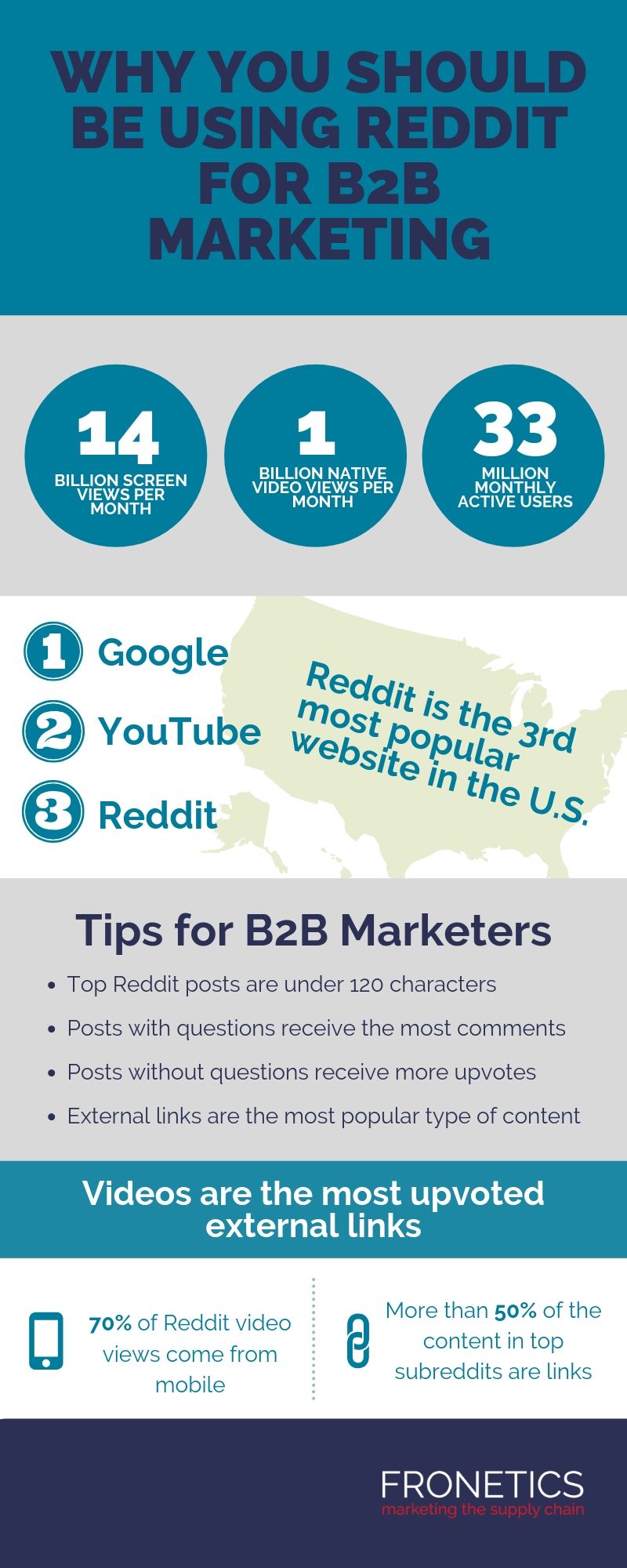
(Made with Canva)
Using Reddit for B2B marketing in 5 steps
Now that we’ve covered the basics about what Reddit is and how it works, let’s talk about how to make it part of your marketing strategy.
Step 1: Determine your target subreddit(s).
In the same way that a good digital marketing strategy begins with identifying your target audience, determining your target subreddits is the starting point for successfully using Reddit for B2B marketing. While the massive quantity of subreddits can be overwhelming, consider the following three questions to zero in on the right subreddits for your business:
- Does the subreddit relate to your business’ brand or products, as well as any specific keywords that shape your digital marketing strategy?
- How large is each subreddit’s audience? (Note: bigger isn’t necessarily better. A larger audience has the potential to generate more traffic, but it’s easier to establish your brand’s presence in a smaller subreddit.)
- How much engagement does the subreddit generate?
Once you’ve determined a few relevant subreddits with various audience sizes and high engagement, you’re ready to begin posting.
Step 2: Post links… to websites other than your own.
Before you start wondering why we’re encouraging you to promote other pages, there’s another facet of Reddit to consider. The platform takes the idea of Karma to a literal level. On Reddit, your reputation is referred to as your “Karma score,” and it’s determined by your level of positive participation on Reddit, measured by the number of upvotes you receive. As your Karma score rises, your posts become more visible.
One of the most effective ways to boost your Karma score, particularly when you’re starting out, is to post links to content that the subreddit community finds relevant and generate conversation. It’s important to make sure you don’t repost content that another member of your subreddit has already posted, as duplicates can hurt your Karma score.
Step 3: Share valuable content… that’s not a sales pitch.
When posting content to your target subreddits, the path to success is quite simple. Post content that offers value to the community. This means engaging in discussions, asking and answering questions, and, at all costs, avoiding blatant sales pitches.
Sam Holzman of ZoomInfo explains it this way: “Sharing a link to a product page will signal that you’re a marketer who wants to promote products, not an engaged community member. On the other hand, a blog post about the benefits of a particular product will be more useful to your fellow community members and, as a result, is more likely to be upvoted and commented on.”
Step 4: Advertise on Reddit.
While blatant sales pitches on Reddit are a sure way to a low Karma score, the platform does offer its own native advertising. Similar to Facebook and Twitter, Reddit Advertising is a relatively inexpensive way to boost the visibility of your content on the platform. However, it’s important to note that Reddit doesn’t offer the type of analytics as Facebook and Twitter.
Sponsored posts on Reddit appear at the top of targeted subreddits for a specified duration. You pay for duration as well as the number of impressions you receive. Sponsored posts look like any other Reddit posts. Advertising on the platform isn’t necessary for success, but it can help establish a visible presence, particularly at first.
Step 5: Create a subreddit.
Creating a subreddit isn’t easy – it requires a significant time investment to start and maintain. However, doing so is the best way to turn Reddit into an extremely valuable marketing channel. Once you’ve established your presence, creating a branded subreddit gives your customers and prospects a forum to interact, with you and with each other.
Particularly at the outset, you’ll likely need to promote your subreddit on other platforms. Post links to it on your other digital assets, and you could even offer an incentive for engaging on your subreddit.
Your branded subreddit is also an ideal place to offer customer service. Holding exclusive Q&As, referred to on Reddit as AMAs (“Ask Me Anything”), is another effective strategy to drive traffic and engagement on your subreddit.
The bottom line on Reddit for B2B marketing
Reddit is a rich resource for marketers and a fertile ground for marketing your brand and products. The platform is best thought of as a place to share and engage with high-quality, valuable content, rather than as a place for overt promotion. Effectively using Reddit for B2B marketing requires an investment of time and energy, but the results can be well worth the effort.
Related posts: