by Elizabeth Hines | Jun 8, 2015 | Blog, Manufacturing & Distribution, Strategy, Supply Chain
For many years robots seemed like the brainchild of science fiction writers and directors, meeting the needs of humans as we saw in the Jetsons, or challenging them as we saw in Battlestar Galactica. Occasionally we hear stories on the news of robots being built in basement labs at prestigious universities such as MIT or Stanford. Recently there was a report on NPR about how one of UCal Berkeley’s robots couldn’t easily figure out how to fold laundry, so, one could ask: what are we worried about? If robots can’t fold laundry in under ten minutes, could they take over manufacturing?
There has been a downward trend in manufacturing jobs since 1980 in the U.S. with similar spirals in Japan, Germany, and China. Is there a correlation between the decrease in manufacturing employment and the rise of the robot? According to the Wall Street Journal, in 2014 most industrial robots were operating in the same countries/regions: Japan (306,700 robots), North America (237,400), China (182,300), South Korea (175,600), and Germany (175,200).
In the same WSJ article, a new generation of robots is profiled. These robots are “smarter, more mobile, more collaborative, and more adaptable.” They are also less bulky and less dangerous for humans to work next to. One might say that the newest generation of robots is acquiring many of the positive qualities of human workers, and that that, combined with many skills humans don’t and can’t possess, makes them the ultimate worker. If robots supersede the work humans can physically do, in a faster, safer, more efficient way, then what will come of the human worker?
Many believe that robots will allow for manufacturers to return to the U.S. from their low-paying, cost-saving plants overseas. They also believe that robots won’t take away from jobs, but rather create them. According to the International Federation of Robotics (IFR), robots actually create millions of jobs. The IFR’s reports oppose the idea that manufacturing jobs are waning. In 2011 article Positive Impact of Industrial Robots on Employment, the author, Metra Martech, stated, “The German and Japanese (automotive) manufacturers who have invested heavily in automation and robots have maintained a lead in the quality market. Germany has increased the number of people employed in the automotive sector.”
The IFR also states that there are many other benefits to robots in manufacturing:
- robots carry out work in areas that would be unsafe for humans.
- robots carry out work that would not be economically viable in a high wage economy.
- robots carry out work that would be impossible for humans.
“The Second Economy”, one in which computers have business interactions only with other computers, is upon us. According the to economist, Brian Arthur, who coined the term, things might not look so bright for the future of the American worker. He states, “If the Second Economy does achieve that rate of growth, it will be replacing the work of approximately 100 million workers. To put that number in perspective, the current total employed civilian labor force today is 146 million. A sizeable fraction of those replaced jobs will be made up by new ones in the Second Economy. But not all of them. Left behind may be as many as 40 million citizens of no economic value in the U.S alone. The dislocations will be profound.”
Others, some who are at the forefront of technology, are also very concerned about the rise of robots. Apple co-founder, Steve Wozniak, is one of the worried. He was recently quoted saying, “Computers are going to take over from humans, no question… Like people including Stephen Hawking and Elon Musk have predicted, I agree that the future is scary and very bad for people. If we build these devices to take care of everything for us, eventually they’ll think faster than us and they’ll get rid of the slow humans to run companies more efficiently.T”
The stuff of sci-fi is becoming a reality. As we humans make the robots that will replace us, only time will tell if that will benefit our race or harm it.

by Jennifer Hart Yim | May 20, 2015 | Blog, Manufacturing & Distribution, Strategy, Supply Chain, Warehousing & Materials Handling
This article is part of a series of articles written by MBA students and graduates from the University of New Hampshire Peter T. Paul College of Business and Economics.
David Chadwick is an MBA student at the University of New Hampshire with a background in retail store management and electrical engineering.
If technology continues to advance, humans may be obsolete in the supply chain as a result of both automation and RFID utilization. Both technologies have been introduced into the supply chain over the past decade, resulting in a major shift in performance and costs. While automation is a process which can navigate product throughout facilities, RFID can improve efficiency dramatically as well as being the major driver for the elimination of human involvement in the supply chain.
RFID (Radio Frequency Identification) is a form of extremely low-power data communication between a RFID scanner and an RFID tag. The tags are placed on any number of items, ranging from individual parts to shipping labels. The RFID tag itself consists of a microchip and antennae, usually without a battery to power it. The tags can be printed using special printers, which wirelessly load the identifying information to the tags. The information on the tags can be used for a wide variety of tasks. When an item goes through the RFID scanners, information is read from the tag, which could include any amount of information, such as:
- Order ID number
- Product bin location
- Order status
- Serial numbers for individual product components
- Location logs
The information is not limited to just holding ID and serial numbers. Since the information can be updated and transferred through any RFID receiver when in range, it can be joined with other software to update databases, send information online, and more. The amount of information that RFID can provide can be matched with order management systems to track shipment and stock locations automatically as the products move through warehouses and trucks. Powerful receivers can also track the exact location of products within a warehouse in real time, instead of relying on time and location logs to determine the location. This has been a major benefit to UPS, who’ve had RFID tracking chips in their warehouses for over ten years.
The largest problem facing supply chain management today is the potential for the occurrence of devastating errors. These errors could lead to trucks leaving product behind, not stocking to capacity, losing product, or delivering to the wrong locations. There are numerous reasons for such errors to occur, but the most common factor in their inception is human error. Much of the errors faced result from manual inspection and control over product flow in warehouses by humans. Many systems still operate using written data tables and checklists, which can be written incorrectly. Despite major advancements in technology over the past decade, the digital world is being sourced by analog supply chains. This is an aspect which RFID control can create beneficial change.
RFID can lead to completely autonomous warehouses and distribution centers. This can be seen in current warehouses with high levels of automation, where picking machines transport bins of product to a central sorting area to be boxed, before returning to their location. Zebra uses this technique to ensure product location accuracy as a means of reducing lost merchandise. Zebra places a great deal of importance on product visibility and transparency as well as accuracy in locations. Implementation of RFID into this system can ensure that both the correct product and the correct quantities of product are collected at both points, thereby eliminating errors seen in traditional analog supply networks. Coupled with the potential for self-driving trucks and the ever expanding internet of things in the cloud, product information can be tracked at all stages of shipment and storage, increasing accuracy, efficiency, and accountability. Where warehouses and receiving departments had to endure a certain amount of shrinkage of products in the past, a fully utilized RFID-enabled supply network can determine exactly where product is at all times, ensuring that theft is discovered immediately and enforced.
While the reduction of human interaction in the supply chain and warehouses in general can be eliminated with enough technology, it is uncertain to what degree this technology will be implemented in all aspects of supply chain management. While there are huge benefits to operating in such a system, the major negatives include high initial costs and restructuring costs associated with implementing this network into existing, analog networks. Humanity may not be completely removed from the supply chain in the future, but this technology, as well as more advanced techniques for automation, will increase the efficiency and reduce the costs required to operate these newer supply chains dramatically while significantly reducing errors and inefficiencies.

by Elizabeth Hines | Dec 30, 2014 | Blog, Logistics, Manufacturing & Distribution, Marketing, Social Media, Strategy, Supply Chain
 I wrote a guest blog for freight logistics company Cerasis in October which discussed how companies within the manufacturing, supply chain, logistics, and industrial industries can increase their B2B visibility on LinkedIn.
The catalyst for writing the blog were results from a recent survey focused on the supply chain and logistics industry. 58% of respondents rated LinkedIn as “very impactful,” and 37% rated LinkedIn as “somewhat impactful.” At the same time, respondents reported challenges associated with strategy (33%) and a lack of understanding about the application of social media (24%).
Leveraging LinkedIn
There are over 3 million LinkedIn company pages. Being present on LinkedIn is critical, but is not enough. To maximize your LinkedIn presence you need to take steps to increase your B2B visibility. Here’s how:
-
Create a compelling company page
Your company page is an extension of your company. Make sure that the page is compelling, informative, and presents your company as a leader within the industry.
-
Be active
In addition to keeping your company page up-to-date, you need to be active on LinkedIn on a daily basis. LinkedIn groups are great. Actively participating in LinkedIn groups will allow your company to: 1) gain business and market intelligence; 2) introduce you to new, interesting, and relevant topics; 3) help you increase brand awareness; and 4) position your company as an industry leader.
-
Distribute content
If you want your content to be seen you need to get it out there; you need to distribute your content. Distribute your content and curated content via your company page and (when relevant) within the LinkedIn groups to which you belong.
-
Employee engagement
Your employees are your brand ambassadors. Empower your employees to be active within LinkedIn groups as representatives of your company. Encourage employees to share your content and industry content with their connections. Additionally, encourage employees to share open positions with their LinkedIn connections, and to identify great talent within their network.
-
Prospect for leads
LinkedIn is an effective prospecting tool. Use LinkedIn to prospect for leads and to build your sales pipeline.
-
Optimize your profile
Every employee is a reflection of the company. Encourage employees to optimize their personal LinkedIn profiles.
-
Don’t be annoying
You will fail if you take a “me, me, me attitude.” Constantly self-promoting is bad for business.
If your company is not using LinkedIn you are missing out on opportunities and revenue.

by Elizabeth Hines | Dec 23, 2014 | Blog, Manufacturing & Distribution, Supply Chain, Talent
As of late June 2014 there were 302,000 manufacturing job openings that were unfilled. These job openings are unfilled because employers cannot find qualified workers.
Pipe fitters, mechanical engineering technicians, welders, machinists, electronic assemblers, and operators of computer-numeric-controlled machines are the workers that are most needed. The problem is workers with these skills tend to be older and are at, or nearing retirement. According to Ben Dollar of Deloitte: “As workers retire, it’s becoming harder to find people with these traditional skills.” The Boston Consulting Group predicts that the number of job openings requiring these traditional skills will increase to 875,000 by 2020.
Companies with positions related to IT, software development, software engineering, and computer science are also struggling to fill positions (and get current employees up to speed). In an effort to help train the next generation of manufacturing talent, Siemens USA has donated more than $3 billion worth of manufacturing software to colleges over the past 18 months.
Eric Spiegel, Seimens USA CEO:
The digital world is coming very fast. There will be jobs. People may not count these jobs in IT and software development as manufacturing jobs, but they really are related to manufacturing.”
Seimens plans to fill 7,000 more people for these positions by 2020.
What positions is your manufacturing company struggling to fill?
What manufacturing job are you searching for?
by Elizabeth Hines | Nov 26, 2014 | Blog, Manufacturing & Distribution, Supply Chain

MIT’s Julie Shah was named one of MIT Technology Review’s 35 Innovators Under 35 in 2014. In an interview with Will Knight, Shah discusses the possibility of collaboration between human robots:
“In factories there are usually physical barriers between people and robots. Originally, this was for safety—industrial robots were unwieldy and unyielding. Although robots are increasingly designed to safely share human work spaces, even in these settings, people do one set of jobs and robots do another.
Imagine if robots could be truly collaborative partners, able to anticipate and adapt to the needs of their human teammates. Such robots could greatly extend productivity. That possibility is really exciting to me.”
Shah is working companies including BMW, Boeing, and Embraer to develop robots that can interact intelligently with human co-workers.
According to Shah:
“If you can develop a robot that’s capable of integrating into the human part of the factory-if it just has a little bit of decision-making ability, a little bit of flexibility- that opens up a new type of manufacturing process more generally.”
Research conducted by Shah has found that teams made up of humans and robots collaborating efficiently can be more productive than teams made of either humans or robots alone. Shah’s experiments have shown that the collaborative process reduced human idle time by 85%. Additionally, Shah found that workers seem to be comfortable with the idea of robotic coworkers.
Are you ready for a robot to join your team? What are your thoughts on teams made up of humans and robots?
by Elizabeth Hines | Oct 14, 2014 | Blog, Logistics, Manufacturing & Distribution, Marketing, Social Media, Strategy, Supply Chain
Social media is a strategic tool. The benefits companies can realize by using social media are immense. Which benefits are motivating companies within the logistics and supply chain to use social media? Even more broadly, why are companies using social media?
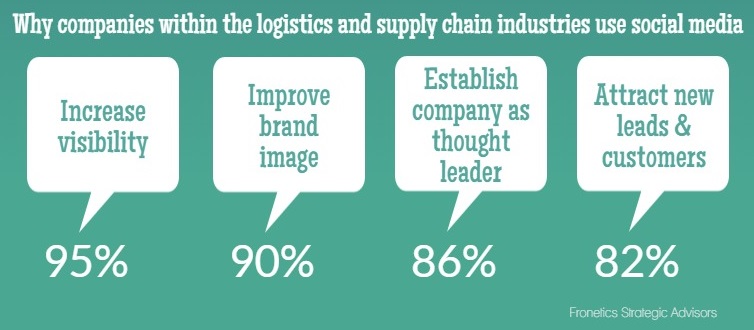
A recent survey conducted by Fronetics Strategic Advisors found that the predominant reasons companies within the logistics and supply chain industries use social media are to: increase the visibility of their company; to improve their brand image; establish their company as a thought leader; and to attract new leads and customers.
To learn more about the use, motivations, benefits, and challenges of social media and the logistics and supply chain industries, download our report: Social media and the logistics and supply chain industries.