by Elizabeth Hines | Sep 16, 2014 | Blog, Content Marketing, Marketing, Social Media, Strategy, Supply Chain
I work with companies from the supply chain and logistics industries to identify and execute strategies that will grow their business. Too often I see companies who have invested time and money into developing a B2B inbound marketing strategy and have fallen flat. Here are six reasons why inbound marketing strategies tend to fail:
The ideal customer is not being targeted
A successful inbound marketing strategy will attract and engage the “right people” – ideal customers. It is therefore essential that time is taken to understand who the ideal customer is, the needs of the customer, and the customer’s pain points. Your company’s website, social media presence, and email communications, should speak to your ideal customer.
Content is not published consistently
A common pitfall is establishing a blog, but only publishing content on a sporadic basis. To establish your company as an industry leader and gain leads, you need to publish content on a consistent basis. For example, your company needs to commit to publishing blog content every Tuesday.
Content is not quality content
All content is not equal. If you want your inbound marketing efforts to succeed, your content needs to be quality content. Your content should be well-researched, sourced, and edited. Grammatical errors and misspellings are inexcusable.
More isn’t always better
It is easy to sign up for a social media account. I’ve seen many companies who have decided to jump into social media feet first and have established many social media accounts, only to become overwhelmed. If you want your inbound marketing strategy to succeed, it is more important to be active on one social network than inactive on five.
Lack of strategy and commitment
A 2014 study of B2B marketers found that companies that have a strategy in place are more likely to consider their efforts effective than companies that do not have a stated strategy in place. Companies that do not have a strategy in place, and who do not have someone in charge of the strategy tend to fail.
A focus on sales
Content that informs and educates attracts and engages. Content that is “salesy” not only fails to attract and engage, it turns customers away.
Is your inbound marketing strategy falling flat? Assess your strategy – honestly. Has your company fallen prey to these common pitfalls?

by Elizabeth Hines | Sep 11, 2014 | Blog, Strategy, Supply Chain
Strategy is not execution
Strategy and execution are fundamentally different. Strategy is about making choices. Execution is about getting down and dirty so that the choices made can produce results. Here’s how you can get from excellent strategy to strong execution.
Strategy is the pursuit of excellence. It is more than white boards, spreadsheets, taglines, slogans, and vanity metrics. Strategy is about making choices on where to play, how to play, and how to maximize value — for your company and for your customers.
Execution is about doing the work needed to produce results within the context of the aforementioned strategy.
Here is how to move from strategy to execution.
Keep it simple.
When it comes to strategy simplicity is key. Develop a few simple but big ideas or themes that will drive your organization. Live or die by these ideas. If you develop too many or they are too complicated, you will lose focus and internal buy-in. When you lose focus and internal buy-in, execution is doomed to failure.
Involve your team.
When you pick your few big ideas (see above), make sure you involve your “front line” team. These are the people who turn action into daily routines. Their insight and knowledge are invaluable.
Be obsessed with your strategy.
If you cannot articulate the “why” of your strategy in everything your organization does, it is probably the wrong strategy. Being obsessed with your strategy means that your strategy can be demonstrated in every action, every day.
Focus on the customer.
If it is not about the customer, it is not strategic. Everything you do needs to link back to the people who are paying you… your customers. If it does not help them, it does not help you and therefore cannot be strategic.
By staying focused on these business execution strategies, you’ll be able to successfully move your supply chains from idea to reality.
by Elizabeth Hines | Sep 10, 2014 | Blog, Data/Analytics, Marketing, Strategy
Metrics matter. Metrics allow you to measure success, drive strategy, and demonstrate the ROI of your marketing efforts. Conversions are one of the most important metrics to monitor.
Why conversion rates matter
What is a conversion? A conversion means action. It means that someone took some action that entered them into your funnel or moved them further down your funnel. Examples of conversions are: downloading a white paper, filling out a form, requesting information, opening an email, and becoming a customer.
By monitoring and tracking conversions you can determine what marketing efforts are paying off. Additionally, by monitoring and tracking conversions you can identify which efforts need to be re-evaluated or even discontinued. In short, conversion rates can help you measure your ROI.
Why conversion rates don’t matter
Conversion rates are not the Holy Grail of metrics. Your website should be a magnet. It should attract and engage prospective customers and current customers. Your website should serve to educate and to establish your business as an industry leader. Eighty to 90 percent of prospects are not ready to make a purchase when they first engage with your company. Conversion rates don’t capture the amount of time people spend on your website, learning, exploring, and getting to know your business. Conversion rates also do not capture the amount of time current customers spend on your website – valuing your company as a resource.
While conversion rates are an important metric to measure, remember that they are not the end all be all.
Tracking conversion rates
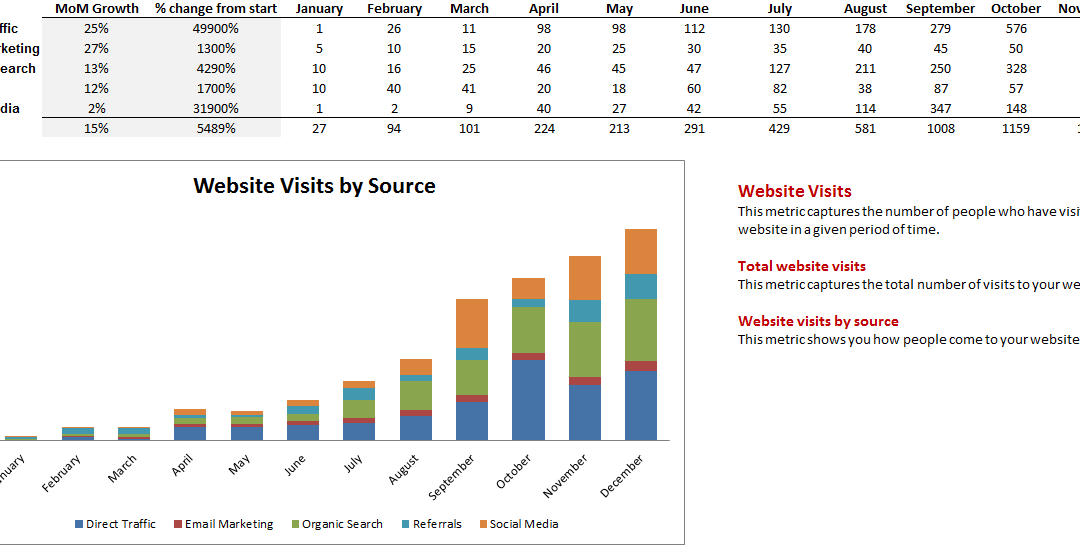
We created a template that you can download and use to track conversion rates and other critical metrics. While the template captures visitor-to-lead and lead-to-customer conversion rates, you can easily modify the template to include additional conversion rates that are useful to your business.


by Elizabeth Hines | Sep 9, 2014 | Blog, Marketing, Social Media, Strategy, Supply Chain
Many companies within the supply chain industry do not participate in social media because “they can’t get past the word ‘social’ and the perception it creates.” Companies with this mindset are at a disadvantage.
The supply chain industry is, by nature, an industry that is built on relationships, partnerships, cooperation, networks, and on communication. Being social is vital to the success of companies with the supply chain industry. Social media is a platform that is well poised to meet the needs and demands of the supply chain industry – and to help companies within the industry grow their business.
Social media is a tool that can be used be the supply chain industry for: risk management, business intelligence, recruitment, lead generation, engaging with current and prospective customers, attracting new customers, improving productivity, problem solving, and establishing your company as an industry leader. Moreover, social media can be used as the foundation for a new business model.
Clara Shih, CEO and Founder of Hearsay Social, and Lisa Shalett, Managing Director and Head of Brand Marketing and Digital Strategy at Goldman Sachs, write:
Social media is perhaps best thought of as a set of new and innovative ways for businesses and customers to do what they have always done: build relationships, exchange information, read and write reviews, and leverage trusted networks of friends and experts.
Similarly, Tony Martins, President of Tony Martins & Associates, notes that:
Supply chain executives should look at the social model of collaboration that can be enabled through social media as the most significant strategic weapon in supply chain optimization today. It liberates them from the rigid framework of functional structures and client-supplier relationships. It is the best way I’ve seen to keep the supply chain moving quickly, in spite of the many problems that will always occur.
Still skeptical? Look at companies who have successfully leveraged social media. Or, as Shih and Shalett suggest: “As you contemplate the risks and rewards of social media, we would suggest that the key ingredient for evaluation is simply to experience it for yourself.”
Interested in learning more about social media and the supply chain industry? Download our white paper: “Social Media and the Logistics and Supply Chain Industries: Why Not Participating is a Risk You Can’t Afford to Take.”

by Elizabeth Hines | Aug 28, 2014 | Blog, Leadership, Strategy, Talent
Most teams are able to fairly easily decipher what needs to be done. However, when it comes to the how, new or weak teams fall flat. Here is how you can optimize your team for success.
Define roles
Clearly define roles and make sure every team member understands not only their role, but the roles of others on the team. When roles are defined and understood the team can avoid overlap and can avoid the trap of “I thought someone else was doing that.” In short, by defining roles your team can be more efficient and more effective.
Establish a communication protocol
Take the time to establish a communication protocol. This protocol should not be a rulebook, but rather it should outline a set of decisions about how the team will message each other and stakeholders on the progress and needs of the team. If you leave this to chance you are, well — taking a chance. If you establish a communication protocol up front you will achieve better communication and it will be less likely the ball will be dropped.
Develop performance metrics
Develop performance metrics up front. If you don’t take the time to do this, how will you know if you are making progress? How will you know what to do if you are not making progress? How will you know when goals are achieved? How will you be able to reward team members? Take the time to develop performance metrics up front — and get everyone on the same page.
Provide your team with necessary tools
Provide your team with the tools that they need to succeed, or you will set them up for failure. For example, give them the go-ahead to make certain decisions without needing to go through 11 bureaucratic steps. Similarly, give the team access to the people and information that they need to get the job done.
By focusing on the best path forward, rather than the end goal, good teams can get even better.
A version of this post previously appeared on EBN.

by Elizabeth Hines | Aug 27, 2014 | Blog, Leadership, Strategy, Talent
Look across business, sports, entertainment, and the military, and identify the top performers. Next, take a step back at look at the characteristics of these individuals. What you will find is that there are at least three elements that they all have.
They know how to maximize through self-knowledge. Top performers have intimate self-knowledge. They know themselves — their strengths, weaknesses, challenges, and vices. They know how to use this knowledge to stretch and apply themselves. Furthermore, they know how to sustain themselves.
They know how to work with the environment. Top performers know and understand their environment. This enables leaders to work with and within the environment effectively, shape it, and be in tune with it.
They know (and use) the ingredients for a top performance. Top performers know what makes a top performance. They know that it requires planning, preparation, delivery, and evaluation. And they execute — each time.
They understand emotion. Top performers understand when and how to remove emotion from the equation. On the flip side, they know when not to table their emotions.
By focusing on these characteristics, you can be a top performer and encourage your team to do the same. In the end, maximizing the performance of each individual will maximize the performance of the team and, eventually, your company.
A version of this post previously appeared on EBN.