
by Elizabeth Hines | Feb 21, 2017 | Blog, Consumer Electronics, Manufacturing & Distribution, Strategy, Supply Chain
Will sustainability trends from the consumer packaging industry have an impact on electronics manufacturing this year?
As we wrap up the first big consumer holiday of 2017, it’s interesting to think about how innovation in packaging never stops. While many of the newest ideas are hitting consumer applications first, perhaps they will point to new directions for electronics manufacturing as well.
Packaging trends suggest a wide range of startups, researchers, and big companies are committed to finding solutions that match the buzzwords du jour — sustainable, bio-degradable, natural, and eco-friendly.
Here are some sustainability trends in packaging that I think will gain momentum in 2017.
2017 packaging trends to watch
1) Multiple uses
Great packaging protects not only your product, but also your brand. But what if the packaging is part of the product itself?
That is the case with innovations such as the expandable bowl by Swedish design studio Tomorrow Machine. Using 100% bio-based and biodegradable materials, the company created a cellulose wrapper that hugs freeze-dried food and morphs into a bowl when hot water is poured into the spout. The bowl ― a sustainable packaging award winner ― is now in good company, and I expect more will follow.
2) Unconventional materials
Egg shells, fermented sugars, barley, and wheat ribbons — those were the materials used to create, in turn:
- Bio-compostable films: Nano-particles from waste eggshells helped researchers at Tuskegee University in Alabama make a plastic film that is completely sustainable and 700% more flexible than other bio-plastic blends. Film made of the new material could be used in retail packaging, grocery bags and food containers.
- A prototype PHBottle: The European PHBottle project aims to initially create a bottle, cap, and sleeve, although use in other applications (non-food packaging and non-packaging uses) will be tested. The bio-plastic material used to make the bottle comes from the transformation of organic matter found in juice processing by-products.
- Edible six-pack rings for beer: Imagine washing down the six-pack ring with your favorite beer. Although that moment is not quite here yet, the future is looking up for a piece of plastic that is notorious for ensnaring wildlife. The first bio-degradable edible six-pack ring for beer is the result of a partnership between Saltwater Brewery; We Believers, an advertising agency; and Entelequia, Inc., a small startup in Mexico. Made from barley and wheat ribbons spent grain from the brewing process, the rings are safe for wildlife to eat and sturdy enough to support the cans.
3) Reusable packaging
The throw-away culture is not for everyone. In fact, Mintel’s Global Packaging Trends 2017 shows 63% of U.S. consumers actively seek out packages they can re-use. More than half of consumers also say they would prefer to buy foods with minimal or even no packaging. With such great demand for waste reduction, innovation is bound to pick up even more momentum.
What do you think 2017 will bring in terms of sustainable packaging for the electronics industry? Let us know about promising innovations you’ve seen.
This post originally appeared on EBN Online.
Related posts:

by Elizabeth Hines | Feb 20, 2017 | Blog, Content Marketing, Marketing, Supply Chain
A recent survey of over 400 business blogs shows what the best bloggers have in common and what supply chain marketers can do to improve their blogs.
Maintaining a blog for your business can be somewhat of a guessing game. How often should you publish? Should you do all the writing in-house? Will anyone read our posts?
A recent survey of 428 marketers conducted by Curata sought to identify any patterns or trends among those with the most successful business blogs. Specifically, the authors grouped together those whose blogs had more than 10,000 views per month and compared them to those with less than 10,000 views per month.
The most successful blogs (those with over 10,000 views per month) have several things in common. The following infographic shows some highlights from the survey.
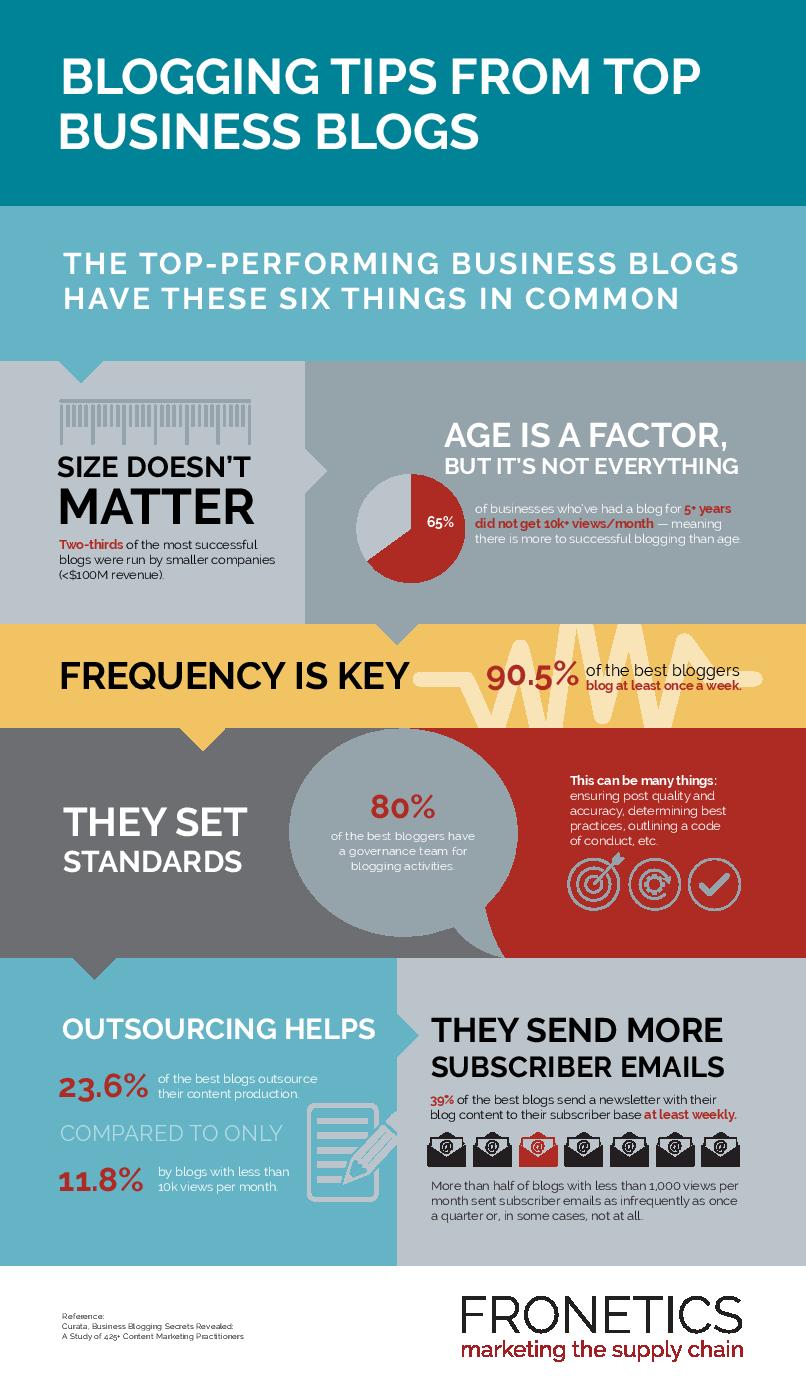
(Made with Canva)
Read the full report from Curata’s survey here to get more insight into the best business blogs. For more information and tips on blogging for your supply chain business, check out our related posts below.
Related posts:

by Elizabeth Hines | Feb 16, 2017 | Consumer Electronics, Content Marketing, Marketing, Social Media, Strategy, Supply Chain
Here are two examples of consumer electronics companies leveraging social media to reach their target audiences, build brand awareness, and drive sales.
More and more companies are allocating budget to create a social media presence. That’s because, despite early hesitation, supply chain businesses understand that social media is an important marketing tool in today’s marketplace. The consumer electronics industry is no different: Participating in social media has never been more necessary.
Nearly 60% of consumers have taken a blog or social media post into consideration while shopping in a store. You may think — sure, that probably happens for fashion labels. But in fact, consumer electronics is the top product category influenced by social media posts, followed by fashion, then household items.
So what does this mean for you? Those dollars that you’re driving into social networking posts, tweets, and videos are reaching customers and ultimately affecting their purchasing decisions. Well, I should say, only if you’re driving them in the correct places.
To effectively leverage social media in consumer electronics, you need to have a social media strategy that aligns with your business goals. You need to be using the right channels, distributing the right content, and posting at the right time.
Let’s take a look at two companies that are doing it right and why that is.
Consumer electronics companies leveraging social media effectively
1) GoPro
GoPro designs portable, waterproof cameras that users can strap on their helmets, handlebars, or surfboards to record their experiences. The brand’s target audience includes extreme-sports lovers and daredevils who like to watch and share their adventures.
As part of their social media strategy, GoPro encourages their customers to contribute their videos to its various social media channels. It’s a win-win for both the company and users: GoPro receives tons of content that is interesting and relevant to its users, and the users get to show off their skills (or tumbles). Today, the company has over 4.5 million YouTube subscribers and more than 1.3 billion views of their videos.
Lesson: Know your target audience. GoPro understands who it is trying to reach, what they like to do with social media, and where they are active. It gives users a place to share their accomplishments, and is able to grow brand awareness and brand loyalty at the same time.
2. Beats by Dre
Beats by Dre, owned by Apple and founded by Dr. Dre, is an audio brand that sells headphones, earphones, and speakers. The company is active on several social networking platforms, but its genius lies in how it uses those platforms in different ways to reach different consumers.
On Facebook, Beats by Dre finds the most success by sharing stories and experiences that appeal to music and sports enthusiasts. Content includes inspirational photos and videos of athletes and artists using the brand’s products.
On Twitter, the company has created a dedicated support account to quickly reach customers in need of service. This helps amplify the message that the company offers excellent customer service, and the team is able to quickly and broadly share users’ positive feedback.
Pinterest is an entirely different beast for Beats by Dre. The company found its users were most likely to pin high-quality, interesting images, so that’s exactly the kind of content the brand shares via Pinterest. It also curates “mood boards” around the release of new products. It helps build excitement and awareness surrounding a product launch — and it achieves the longer-term strategy of building brand awareness through its users’ social sharing.
Lesson: What works on one social media network might not work on another. By distributing different kinds of content on different channels, Beats by Dre has been able to maximize the impact of each social media channel and engage with the segment of consumers that operates there.
Today’s consumers are more educated than ever. By understanding how to leverage your social media channels to reach and best serve your target audience, you can make your tweets, posts and videos a success.
Related posts:

by Elizabeth Hines | Feb 15, 2017 | Blog, Content Marketing, Marketing, Strategy
Ask yourself these six questions to see if you could be attracting more leads by writing better content.
All too often, marketers fall into the trap of sacrificing quality for quantity in their content writing efforts. It’s an easy mistake to make — the pressure to produce a constant stream of content can naturally lead to a drop in quality. But if you’re not writing high-quality, substantive content, you’re wasting time and energy.
If you’re wondering whether your content might not measure up, ask yourself these six questions.
Do you need better content?
1) Is my content search-engine optimized?
Since over three-quarters of today’s buyers use Google to research products, a key to making sure your content is showing up in search results is search engine optimization (SEO). This means writing copy that will be prioritized by Google in web queries related to your business or products. For ideas on SEO optimization, check out these 3 Quick SEO Tips to Improve Your Blog Right Now.
2) Am I using the right channels to reach my target audience?
In order to answer this question, you first need to have a clearly defined idea of your target audience. Once you know who you’re trying to reach, evaluate where they’re active. Analytic programs like Google Analytics and sites like Tweriod can provide valuable insights on your followers’ social media habits.
3) Am I publishing content, or a sales pitch?
Remember that content marketing is about offering valuable, expert information to your audience — it’s not an overt sales pitch. Present your readers with this kind of expertise, rather than a repeated sales pitch, and you attract loyal customers, and associate your brand with quality and value. Anything you post should be geared to meet specific needs of your customer, rather than to bludgeon them with information about your products or services.
4) Am I providing a good quality user experience?
Pay attention to format, length, accessibility, and voice. Is your business’ website visually appealing and easy to navigate? People will read your content only if it’s visually accessible and engaging.
5) Have I paid attention to performance analytics?
Be aware that what worked last year may not work this year — pay attention to performance analytics to monitor what kind of content is successful and what is no longer generating and converting leads.
6) Is my content good?
This might seem like the most obvious question of all, but it’s important to ask it every time you post. Of course, determining what constitutes good and bad content is the key here. Are you producing writing that is original, substantial, and well written? A good tool to get you started is Fronetics’ On Writing Good Content: A Guide for the Logistics and Supply Chain Industries.
Remember, your content is a reflection of your company. When potential buyers come across your blog posts or other content online, that’s how they get to know you. If it’s poorly written with mistakes and blurry images, well — you look pretty sloppy.
Quality, substantive content shows that you are an authority in your field. It will let potential buyers know that you know what you’re talking about, that you run a polished business, and that they can trust you. So while quantity is important when it comes to content, quality should never be compromised.
Related posts:

by Elizabeth Hines | Feb 14, 2017 | Blog, Current Events, Logistics, Manufacturing & Distribution, Supply Chain
Consumers will spend $18.2 billion on Valentine’s Day 2017, down from a record-high 19.7 billion in 2016, according to the National Retail Federation.
Did you purchase something sweet for your loved one to mark the special occasion this Valentine’s Day? You won’t be alone in your pursuit to find the perfect box of chocolates. According to staticsbrain.com, 47.5% of consumers celebrating Valentine’s Day 2017 will purchase chocolate or candy, and retailers will sell over 36 million heart-shaped chocolate boxes.
Connection between chocolate and Valentine’s Day
The history of the love of chocolate dates back to the Mesoamerican time, when it was viewed as a luxury item by the Mayan and Aztec upper-class elites. It wasn’t long until the popularity of the confection took over Europe and, centuries later, landed in America. Richard Cadbury created the first box of chocolates in 1868, and from there the commercialization of the treat grew. Chocolatier giants, such as Hersey and Russell Stover, have created a $98 billion industry.
Labor of love: chocolate and supply chain
When you purchase the little heart- shaped box of chocolates for Valentine’s Day this year, remember the labor of love that went into creating those delicious sweets. From the small cocoa farmers in Ghana and Côte d’Ivoire to the cocoa processors to the chocolate manufacturers and retailers, there are many hands that work together before the product reaches you, the consumer. These products — and gift-givers everywhere — rely on the logistics and supply chain industries each Valentine’s Day.
Valentine’s Day 2017 Infographic
Here’s a quick look at how U.S. consumers will spend — literally and figuratively — this Valentine’s Day.
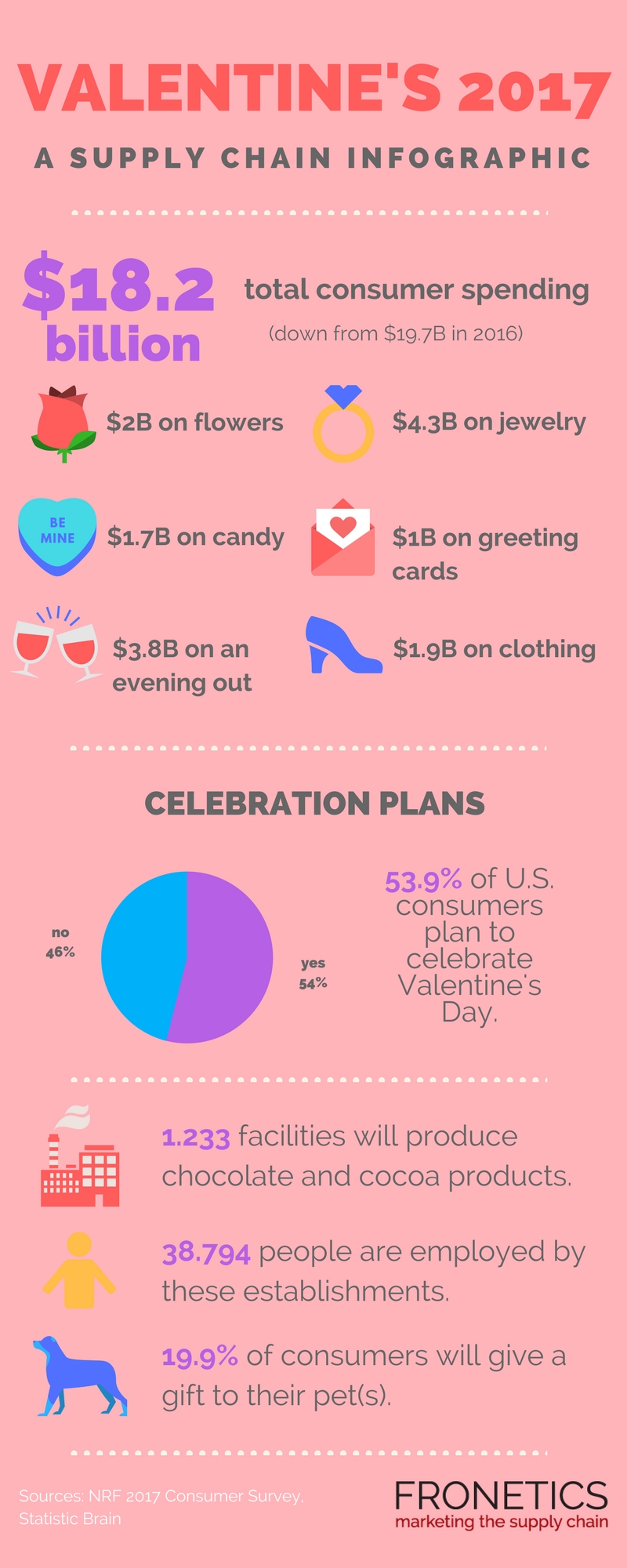
(Made with Canva)
Related posts:
