by Elizabeth Hines | Mar 2, 2017 | Blog, Content Marketing, Marketing, Social Media
These online benchmarking tools can give you insight into how your industry peers are performing on social media, in keyword searches, and more.
Senior Director of Strategy Kate Lee recently wrote about the importance of benchmarking your marketing performance against your competitors. To define success within your market and industry, you need to look outside what’s going on internally and compare yourself to your peers. This will also help your company identify threats and strategic opportunities.
Benchmarking gives you a context to understand how your marketing efforts are paying off. But running another set of reports and keeping track of all those metrics could be a full-time job within itself — and ain’t nobody got time for that.
The good news is there are some really effective tools available for marketers to quickly, even automatically benchmark their performance against the competition. Let’s take a look at three of these platforms below.
3 tools to benchmark your performance
1) BuzzSumo
BuzzSumo’s slogan, “Add value, be uncommon,” exemplifies its mission: to assist companies in creating the most relevant content for their individual audiences. The comprehensive content tool offers insight on what topics are trending, which influencers have the most reach, and more.
The competitor research feature will be of particular interest to those hoping to do some competitive benchmarking. It offers competitive intelligence, such as:
- What content is getting traction for my competitors?
- On what networks are they having success?
- Who is sharing their content?
- How does our content compare?
Overall this site will save you time that you would have spent compiling and analyzing data about you and your competitors.
Pricing: BuzzSumo’s pricing varies from $79-$599 per month, but there’s a free trial option to help you decide if Buzz Sumo is right for your company.
Ease of use: There’s a lot of information to digest, but the compelling data displays make it as easy as possible.
Clients: Rolling Stone, Expedia, National Geographic, IBM, Capital One
2) Serpstat
Serpstat identifies itself as the “growth-hacking tool of marketing” and the “all-in-one SEO platform for professionals.” It offers an abundance of insightful features to view your data in comparison with your competition. You can find answers to the following questions:
- What keywords are placing your competitors in the top search results?
- What does your competitors’ AdWords and paid search look like?
- What does your competitors’ strategy look like in regard to their budget, ad positions in search results, and cost-per-click for AdWords?
Pricing: Serpstat ranges anywhere from $0-$299.
Ease of use: While Serpstat provides an overwhelming amount of information, their 24/7 user-friendly chat feature makes things a little easier. They also offer a completely free demo via Skype or Google Hangouts in as little as 20 minutes.
Clients: Yves Rocher, Gift Baskets Overseas, GL Marketing
3) Rival IQ
Rival IQ offers “digital marketing analytics with a competitive edge.” Essentially, it allows you to compare your performance in social media, keyword ranking, and content against other companies. You also learn when growth in those categories happens for your company, as well as what is driving it. It answers:
- What do your social media metrics (followers, likes, etc.) look like versus your competitors?
- What do your competitors’ social biographies look like, and what are they changing?
- What do the “best” social media posts look like across your competitive landscape?
Pricing: anywhere from $299-$799. They’ll even work with you to create a customized package. A free trial is also available.
Ease of use: While the information presented is extensive, it is displayed in a way that makes it easy to digest. According to New York Times best-selling author Jay Baer, “Rival IQ is a game-changer. Incredibly useful intelligence about the digital activities and successes of your competitors, delivered quick, easy and smart.”
Clients: Studio Science, the Media Flow, Convince & Convert
These three benchmarking tools can help your business gauge how you’re fairing against the competition. The right one for your company could give you a competitive edge, helping you surpass your goals — and your competition.
Related posts:


by Elizabeth Hines | Mar 1, 2017 | Blog, Diversity, Leadership, Logistics, Supply Chain
Fronetics spoke with 6 women leaders in the supply chain and logistics industries about their professional experiences and thoughts on the gender gap.
March is Women’s History Month, a time when we at Fronetics like to focus our attention on inspiring female leaders who are bridging the gender gap in the supply chain and logistics industries.
As we have written about previously, the lack of gender diversity in the supply chain is not because women do not have the skillset and ability to succeed within the industry. In fact, quite the opposite is true.
We believe that it is important to discuss the lack of gender diversity and point to research highlighting why the industry needs to increase the number of women in all positions, including the C-suite. Additionally, it is just as important to highlight the incredible women who already are working within the industry.
We have had the opportunity to interview 6 supply chain leaders about their professional experiences, as well as their thoughts on some of these issues.
6 women leaders in the supply chain
Kendrea Durr-Smith
Director of Global Trade Compliance, Arrow Electronics
Kendrea Durr-Smith has successfully lead a diverse global team to better support the needs of Arrow customers and suppliers. In our interview, she discusses the exciting changes her team has accomplished and offers some advice for women interested in electronics and trade compliance. Read the Durr-Smith interview.
Barbara Jorgensen
Co-Founder and Managing Editor, Electronics Purchasing Strategies
Barbara Jorgensen has more than 20 years’ experience as a journalist, working for leading electronics industry publications. In our interview, she discusses working in the supply chain industry and the changes she’s witnessed — both broadly and in specific regards to gender diversity — over the course of her career. Read the Jorgensen interview.
Hailey McKeefrey
Editor-in-Chief, EBN
In her extensive and distinguished journalistic career, Hailey McKeefrey has remained enthusiastic about the supply chain industry and her role within it. She spoke with us about how the industry has changed and how women interested in holding leadership positions can seize opportunities and advance their careers. Read the McKeefrey interview.
Cathy Morris
Senior Vice President and Chief Strategy Officer, Arrow Electronics
Cathy Morris “stumbled” into the supply chain by coincidence but now holds a top-level leadership role at a Fortune 500 electronics corporation. In our interview, she discusses how she got to where she is today and how to turn each step in a career into a valuable learning experience. Read the Morris interview.
Mickey North Rizza
VP of Strategic Services, BravoSolution
Now a Top Female Supply Chain Executive, North Rizza was a bored pre-law major who switched to materials logistics management when she discovered a love for negotiating when seeking charity items for a sorority fundraiser. She spoke to us about her rise to success, people who have helped her along the way, and advice she can offer to women interested in the supply chain. Read the North Rizza interview.
Kelli Saunders
President, Morai Logistics
Kelli Saunders is a big believer in mentorship. And millennials. And opportunities for women in the supply chain. In her interview, she discusses her career, her advice, and her perspective on challenges within the industry. Read the Saunders interview.
Throughout the month of March, we plan to continue this interview series to shine the spotlight on more of the admirable women who make the supply chain and logistics industries run. Make sure you’re subscribed to our blog or following us on social media to catch them all.
Related posts:

![The Role of Content in the Logistics & Supply Chain Industries [Infographic]](https://fronetics.com/wp-content/uploads/2017/02/role-of-content.jpg)
by Elizabeth Hines | Feb 28, 2017 | Blog, Content Marketing, Logistics, Marketing, Supply Chain
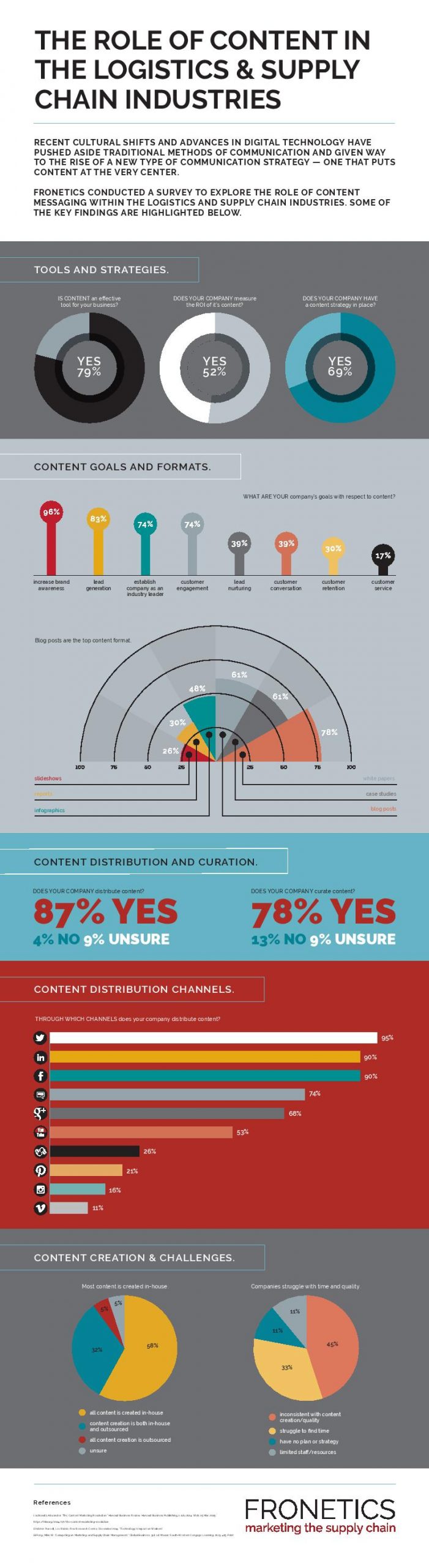
Nearly 80% of logistics and supply chain companies consider content an effective tool for their businesses.
We often use this space to talk to the logistics and supply chain industries about content marketing. Some companies are surprised to learn that this modern marketing method can be so effective for their business. The truth is, content is one of the most useful tools for not only building brand awareness, but also generating leads and earning new customers.
I can tell you this until I’m blue in the face. But, really, what’s most convincing is seeing how other businesses in the industry approach content and how it’s paying off for them.
So we at Fronetics polled supply chain and logistics marketers to determine how their companies are using content. We wanted to find out whether it’s working, as well as their challenges; how they approach outsourcing, distribution, and curation; and more. The below infographic illustrates a few of the key findings from our survey.
(Made with Canva)
To get a complete picture of the role of content in the logistics and supply chain industries, download our report:

Related posts:

by Elizabeth Hines | Feb 23, 2017 | Blog, Marketing, Social Media, Supply Chain
Here’s what supply chain and logistics marketers need to know about recent social media news as of February 2017.
Staying on top of what’s happening in the ever-changing social media world is crucial, but can be a challenge. To keep you informed of some key developments, here’s our February 2017 edition of social media news for the supply chain.
Facebook shares Q4 and full-year 2016 earnings and community updates
Facebook announced that it now has nearly 1.9 billion users, including 1.2 billion people active every day. More than 65 million small businesses use Facebook as a marketing tool. Zuckerberg emphasized to investors that the company is committed to “putting video first across [its] family of apps and making it easier for people to capture and share video in new ways.”
LinkedIn adds option to disable comments on long-form articles
The site now allows publishers to manage comments on individual long-form articles “at any time.” LinkedIn plans to add the option to turn off comments on all posts “soon.” Publishers can now also report, flag, or hide abusive or offensive comments. Read more
Facebook algorithm updates geared to show more authentic and timely stories
Updates rolled out this month are intended to prioritize “more authentic and timely” content in the new feed. Posts and topics that are already getting “a lot of engagement” or “might be temporarily important to you” are getting a boost. Read more
Facebook extends lead ads to Instagram
Marketers can now run lead ads across both Facebook and Instagram placements. The company recommends that advertisers verify that the creative complies with Instagram’s design requirements for lead ads.
YouTube expands mobile live streaming and launches Super Chat
For creators with more than 10,000 subscribers, mobile live streaming is here, and other creators will have it “soon,” according to the company. YouTube also released Super Chat, “a new live stream monetization tool that lets any fan watching a live stream stand out from the crowd and get a creator’s attention by purchasing chat messages that are highlighted in bright colors and stay pinned to the top of the chat window for up to five hours.” Read more
Related posts:

by Elizabeth Hines | Feb 22, 2017 | Blog, Content Marketing, Marketing, Strategy
Follow these 4 steps to learn how to build a successful DIY content marketing strategy that will help grow your business.
Are you trying to create a content marketing strategy, but don’t know where to begin? Even the language around content marketing can seem foreign to newcomers. That’s why Fronetics created its guide, How to Grow Your Business with Content (download below) — to make creating a content marketing strategy possible for the DIYer in your company.
Setting your content marketing strategy is a crucial first step in trying to reach your target audience. Before you begin writing blogs and posting tweets, you need to set goals. A content marketing strategy outlines the methods by which you will target, reach, and engage your audience. Here are four steps, outlined in the guide, to creating a successful foundation to your content marketing strategy.
Steps to building a content marketing strategy
1. Identify your target audience and buyer persona(s)
Knowing who your ideal customer is allows you to create content that is informative, educational, and entertaining to that specific person. Trying to write compelling content for an unidentified audience is like taking a shot in the dark. The more detailed you can be with your buyer persona(s), the more specific and effective your content can become.
2. Define goals and objectives
Your content goals should be a direct reflection of your business goals. What do you want your content marketing efforts to accomplish for your company? The top marketing goals for content marketers in 2016 included converting contacts/leads to customers, growing website traffic, and increasing revenue derived from existing customers. Make sure you include short-term and long-term goals and that you frequently refer back to these goals to make sure your strategy is on track.
3. Developing and distributing content
Once you have identified your audience and defined your content goals, you can begin to educate yourself about the distribution platforms that will work best for your business. Let’s face it: Social media is not a one-size-fits-all solution. It’s imperative you know not only what to post but where to post it.
There are lots of great resources to help you optimize your content marketing presence. You can individualize your outreach so your blog posts are reaching one target audience, while your tweets are capturing another.
4. Put your knowledge to work
Once you have worked through the initial steps of planning a successful content marketing strategy, the real fun begins. It’s time to start pushing valuable, effective content out to consumers. If you’ve spent the time and effort up front to really thing through your strategy, you’ll reap the rewards in good time. Just remember that your strategy should be fluid, and you should be able to adjust your plans as you move forward and find what is working and what isn’t.
Pulling together a content marketing strategy for your B2B business can seem overwhelming. But having the right tools to support you can make all the difference. Download Fronetics’ easy-to-follow, step-by-step guide How to Grow Your Business with Content below to take the leap to a successful DIY content marketing strategy today.

Related posts: