by Elizabeth Hines | Nov 22, 2017 | Blog, Leadership, Strategy
Employees are much more than people you employ — they can be your best brand ambassadors.
There are many benefits to having employee brand ambassadors, and one of the biggest is the rise in peer influence in B2B buying. But the benefits don’t stop there. There are the increased social media reach, growth in brand engagement, and elevated employee performances.
But companies can’t force their employees to become brand ambassadors. To be truly effective, the shift from employee to brand ambassador must happen organically. But there are ways to help. Here are 3 ways to use your employees as your greatest marketing tool.
3 ways to cultivate brand ambassadors
1. Create a work environment people enjoy coming to.
One of the best ways to get employees to speak honestly and positively about your brand is to have employees that enjoy coming to work. Make sure that your office is an environment that promotes a positive culture. Being flexible, recognizing a job well done, and offering opportunities for professional growth are ways to cultivate satisfied, productive employees.
When an employee feels valued, s/he is more likely to promote your brand. Opportunities for professional development and recognition for hard work may seem like small gestures, but they contribute to happy employees. This breeds the most effective brand ambassadors.
2. Improve employee engagement.
The more excited your employees are about their jobs, the more engaged they will be. And what’s more, companies with highly engaged employees see a 20% increase in sales and a 10% in customer ratings.
Improve engagement by encouraging open lines of communication with your employees. Make sure they are in-the-know with company happenings. Encourage their feedback. Work to implement suggestions employees make to improve processes. If you want employees to invest in your brand, you must build the bridge between being an employee and feeling like a part of the team. When employees feel like an insider, they are engaged with your brand and will naturally want to promote it.
3. Provide incentives.
When you have employees that are passionate about your brand, it’s important to find ways to recognize the work they’re doing as brand ambassadors. The obvious incentive is money, but that’s not always the best way to encourage your employees.
Ever heard of motivation crowding theory? This theory states that extrinsic motivators, such as monetary incentives, can undermine intrinsic motivation. If you have happy, productive employees that want to rave about your company, don’t squash their excitement by throwing money at them. This could turn their passion into more work.
There are lots of other incentives that will keep your employees dedicated to being brand ambassadors. One of the easiest to implement is recognition. A shout out on your social media pages or recognition in a staff meeting can go a long way. Other options include product giveaways or discounts with your vendors. Get creative! The incentives don’t have to be expensive, but a little motivation can go a long way.
Don’t miss out on one of your brand’s greatest marketing opportunities — your own employees! Help your team make the leap from employee to brand ambassador, and watch how the shift benefits everyone in your office, including you.
Related posts:

by Elizabeth Hines | Nov 21, 2017 | Blog, Current Events, Marketing
These 10 podcasts for marketers discuss the latest news and trends in the marketing world relevant to the supply chain and logistics industries.
Podcasts have surged in popularity over the past few years. At least 112 million Americans have listened to podcasts, a figure up 11% from last year, with 67 million listening at least monthly. So why are they so popular?
Podcasts are a series of digital audio files that listeners can subscribe to. With the flexibility to listen at their convenience, followers are drawn to the ease and mobility of podcasts. And the available topics are endless.
For supply chain and logistics marketers, podcasts provide the latest digital marketing news, as well as innovative trends that are new to your industry. Here are 10 podcasts that deliver the most up-to-date news in marketing for supply chain and logistics companies.
10 supply chain and logistics marketing podcasts
Millions of dollars are being left on the table right now by supply chain companies because of poor marketing! Supply Chain Gold delivers actionable marketing strategies and information to logistics and 3PL companies, distribution centers, and fulfillment centers to help bring in more sales and increase profit margins. The Supply Chain Gold podcast warehouses internet marketing secrets that your company can leverage to lower customer acquisition costs, grow revenue, increase net profits, drive brand recognition, and dominate your industry.
- #AskGaryVee
Gary Vaynerchuk — author, speaker, and owner of multi-million dollar marketing company VaynerMedia — uses his podcast to answer questions about marketing, social media, and general entrepreneurial topics that his followers ask on social media. If you’re looking for a high-intensity host whose responses are no-fluff, honest, and a tad explicit from time to time, Gary might be just the straight-talking expert you need.
The Marketing Book podcast helps business owners and marketers keep up with the smartest thinking in the quickly changing field of modern marketing. Each episode interviews authors and marketers to give you actionable marketing insights, tips, tactics and resources to help grow your business.
Social Media Examiner’s weekly podcast is hosted by Michael Stelzner and other members of SME’s team. Each podcast focuses on new social media features and strategies, providing listeners with actionable tips they can use to improve their social media results.
Copyblogger FM is a weekly, short-form broadcast hosted by Sonia Simone. Each week she and a team of rotating experts discuss the week’s news and updates in the field of content marketing, email marketing, copywriting, conversion optimization, and more.
John J. Wall and Christopher S. Penn host a 20-minute, weekly show recorded in a local coffee shop. The podcast is designed to be casual and conversational. They share tips on social marketing, SEO, search marketing, copywriting, affiliate marketing, and more. They also take listener questions.
Industry experts Eric Siu and Neil Patel offer users unconventional marketing wisdom that will make you want to kick some of your traditional strategies to the curb. Their goal is to bring valuable, actionable marketing tips in just 10 minutes.
Buffer’s blog is highly successful, so no wonder its podcast is equally informative. The content will appeal to anyone who practices social media marketing, whether you’re brand new to marketing or you’re a social media practitioner. They regularly have industry leaders on the show, including Mari Smith and Neil Patel.
Know Your Audience is a weekly podcast that interviews journalists, bloggers, data scientists, and analytics/audience development professionals. The goal is to start a meaningful conversation about what it takes to create engaging content and learn from the people who are shaping the future of media.
Listen and learn from interviews with social business leaders representing top brands and agencies. Host Bernie Borges leads an educational format as guests share their experiences and insights on social business topics including marketing, selling, customer service, employee advocacy, recruiting and commerce to fuel your social business journey.
Related posts:

by Elizabeth Hines | Nov 20, 2017 | Blog, Content Marketing, Marketing, Social Media
Measuring brand awareness has been notoriously difficult. But these 4 metrics can help you evaluate if potential customers are encountering your content.
Companies work hard to get their products and services out into the world. It’s a key step in gaining exposure among potential customers and earning new business. This process is called brand awareness, the extent to which consumers are familiar with your brand.
Heightening the public’s knowledge of your business will generate leads, some of which will turn into sales. But this knowledge, or brand awareness, has proven difficult to measure. Do potential customers know your name, what you sell, and where to contact you? Creating ways to measure how recognizable your business is will show you what people think of your company, as well as where you should be focusing your time and money to help grow your exposure.
Here are 4 metrics to measure your brand awareness.
1. Social media reach
The larger your social media reach, the larger the potential audience. The reach of your social media content has a big impact on your brand awareness. Tracking engagements on each network will help you measure progress, build a greater following, and, ultimately, generate more site visits.
Use tools like Sharedcount, a free online tool that tracks the number of times a piece of content has been shared on the most popular social media sites — including Facebook, Twitter and LinkedIn — to easily keep track of your social reach.
2. Blog shares
Your blog content is the perfect fodder for organic brand awareness, especially if sharing your posts is easy. Create a share bar on your blog to allow your readers to quickly share your content through social media networks. Measure your number of shares to track your most popular blogs, monitor your growing brand awareness, and help guide the topics of your future blog posts.
3. Brand mentions
Are customers talking about your brand online? There’s a great deal of value in knowing what they’re saying. Monitoring brand mentions online can provide honest feedback and objective insight from current and potential customers.
There are several tools to help you track brand mentions online. Here at Fronetics, we prefer the ease of Google Alerts, which allows you to set up custom alerts when your brand is mentioned online. We also use Hootsuite, where you can track brand mentions, as well as keywords and phrases across all of your social media platforms.
4. Website traffic
Every visit to your website represents someone who is familiar with your brand. The question is: How are people finding your website? Think of web traffic in terms of sources:
- Organic traffic – users come across your website from search engines
- Direct traffic – users type in the name of your website or brand directly
- Referral traffic – users find your website from links on other websites
- Social traffic – users come across your website from social media content
- Paid search/social – users click on one of your paid digital ads, which drives them to your site
- Email traffic – users click through one of your marketing emails
You’ll want a healthy balance of each source to ensure your brand awareness campaign is diversified. Measure each of these metrics using a platform like Google Analytics or HubSpot. As each grows, you’ll know your brand awareness is growing alongside.
Use these 4 metrics to measure your brand awareness and track your progress as you work to grow your exposure. See where you’re having the most success and where you need improvement, and adjust your strategy accordingly.
Related posts:

by Elizabeth Hines | Nov 16, 2017 | Blog, Current Events, Supply Chain
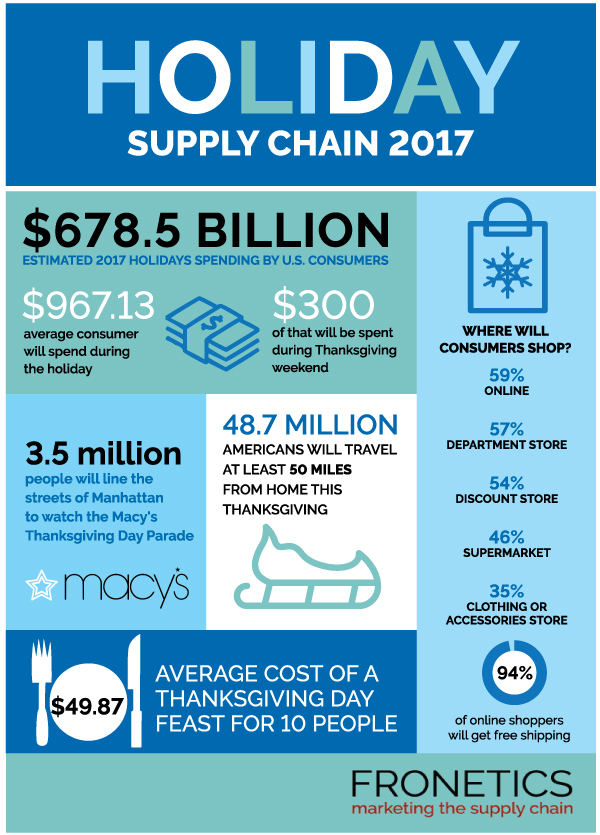
With the 2017 holidays right around the corner, consumers are digging into their pockets and getting ready to increase sales, especially online.
The National Retail Federation is estimating that holiday sales will be up 3.6-4% from last year, totaling $678.5 billion in holiday spending. What’s more, consumers will be hitting the malls earlier than ever. More and more retailors are forgoing the traditional Thanksgiving dinner to open their stores during the holiday. Major retailers, including Target, Kohls, and Toys “R” Us, will open their doors at 5 p.m. on Thanksgiving Day.
“[Thanksgiving] was a strong weekend for retailers, but an even better weekend for consumers, who took advantage of some really incredible deals. In fact, over one third of shoppers said 100% of their purchases were on sale,” said NRF President and CEO Matthew Shay in 2016.
The NRF is estimating that the average consumer will spend $967.13 during the holiday season, almost $300 of which will be spent during Thanksgiving weekend.
Holiday spending can be broken up into three major categories:
- Gifts
- Items such as food, decorations, flowers and greeting cards
- Other non-gift items consumers buy for themselves and their families
For the first time in NRF’s survey history, online shopping has become the most popular shopping destination. In fact, 59% of consumers will head to their computers for holiday spending, where most will benefit from free shipping (94%).
“While many consumers are holding off until November or later to start their holiday shopping, retailers should be prepared for high traffic online and in stores come Thanksgiving weekend,” Prosper Insights Principal Analyst Pam Goodfellow says. “Although sales will remain an important factor for most consumers, many will lean on convenient locations and easy-to-use websites or mobile apps along with free shipping to complete their purchases.”
2017 holidays supply chain infographic
(Made with Canva)
From all of us at Fronetics, have a wonderful Thanksgiving!
Related posts:

by Elizabeth Hines | Nov 13, 2017 | Blog, Consumer Electronics, Current Events, Manufacturing & Distribution, Strategy, Supply Chain
As sales and consumer desire continue to increase for drones and home assistants, the second-life market has a huge opportunity for growth.
Consumers are becoming ever-more enamored with their gadgets and toys. Drones and home assistants are becoming more ubiquitous in our homes (and flying around our skies). However, when these machines run their course — either because they break, or a newer model comes out — is there still use for them?
The market for gadgets
The marketplace for drones is an ever-growing one. Last year drone sales increased by an astounding 60%, and revenue grew to $4.5 billion. The drone market can be segmented into two categories — personal and commercial. Personal drones, which many consumers use for photography, is predicted to grow 40% this year, while commercial drones, which can be used for survey maps and delivery services, are expected to grow 60%.
While personal-use drones dominate unit sales, commercial-drone sales — which make up only about 6% of the market — are projected to represent 60% of the market’s revenue. This is due to the high cost of commercial drones, some with costs that exceed $100,000.
Home assistants are another intriguing category on the rise. These products are intended to control various devices in your home, such as thermostats, lighting, and security. These products also allow an individual to shop online using voice commands.
The frontrunner for this market has been Amazon’s Echo devices. As the primary nature of Amazon’s business is e-retail, the Echo device plays perfectly into this. By making it simple and easy to make Amazon purchases through voice command, these devices have great potential to bolster Amazon’s bottom line.
While this market is still in its early stages, Gartner Research expects tremendous growth, projecting $2.1 billion in consumer spending on personal home assistants by the year 2020.
The second-life market
So what becomes of these products as we replace them with newer models? Smart phones offer a sensible comparison when looking at the second-life market for these products. In 2016, consumers sold or traded in used cell phone devices for an average of $140 per device, generating a total of $17 billion worldwide. This selling and trading doesn’t just end after one transaction. It is predicted that at least 10% of premium ($500 and up) smartphones will have at least three users before they are retired.
We can draw a parallel about second-life potential between drones/home assistants and cell phones. Advances in technology render previous models obsolete or, at best, out of date. Consumers who can afford them will gravitate toward newer products. As with cell phones, they will generally look to recoup some of the cost for the newer product by selling or trading in the old one. These can then be sold to consumers looking for less expensive, older models. Even in the case of drones that crash, parts can be salvaged and sold to individuals that are looking to build their own drones.
The markets for these products are all still in early stages, so second-life markets are still in growth stages as well. As sales and consumer desire continue to increase for drones and home assistants, their life cycle will go on long after the first owners have moved on to newer models.
This post originally appeared on EBN Online.
Related posts: