by Elizabeth Hines | Jan 31, 2018 | Blog, Content Marketing, Current Events, Marketing, Social Media
Also in social media news January 2018: SnapChat is considering 3-second unskippable ads; Twitter will now display a video count on all video tweets; and Facebook is rolling out custom audiences for users that linger on ads.
The new year has brought lots of new changes, especially to the Facebook community. I’m sure by now you have heard about the updates to Facebook’s News Feed that are having major impacts on business page’s organic reach. But the changes don’t stop there. Twitter, Snapchat and Instagram are trying to follow Facebook’s lead and enhance their user experience. Through updates that include video counts, enhanced data collection, and recommended posts, social media is working overtime to make sure it’s active users are staying active.
Here’s your social media news for January 2018.
Facebook’s News Feed tweak penalizes pages soliciting likes and shares.
Facebook continues to make changes to News Feed — including limiting the amount of content users will see from Pages. See our full update here. Facebook also is tightening the reigns on Pages and individuals that use engagement bait to attract new followers. The site will now penalize posts that ask people to like, share, comment on, or otherwise engage with the post to boost engagement. Posts “that systematically and repeatedly use engagement bait to artificially gain reach in News Feed … will now be shown less,” the company announced in early January.
Twitter rolls out account activity API for powering customer service and chatbots
Twitter introduced a new API that will offer developers access to real-time activities, like tweets, mentions and replies, to help update their customer service tools and chatbots. The latest version of Twitter’s data collecting software is designed for those who need data for a large number of accounts, multiple URLs, or managed support.
Instagram allows users to send live video in direct messages
Instagram announced that users can now send live videos through direct messaging. By tapping on the Direct icon, users can send live video to a friend or group to encourage them to view the content. “Today’s change makes it easy to invite people to watch your live videos and send exciting live videos you’re viewing to your friends in real time,” says the announcement.
SnapChat contemplating 3-second unskippable ads
AdAge reports that Snap Inc. is giving “serious consideration” to adding 3 seconds of commercial breaks before offering a skip option on ads on SnapChat. This new ad format was created to attract more ad dollars from brands. “Advertisers are not spending as much as they have previously with SnapChat,” says the top advertiser from a brand that works closely with the messaging service. “They have to do something that draws more interest from advertisers, and they are getting more aggressive to address the market’s needs.” If implemented, the postponed skip option would be similar to YouTube’s ad experience.
Facebook testing custom audiences for users lingering on ads
Matt Navarra, director of social media for @TheNextWeb, reported a new option for targeting a list of people who have “spent more time than usual viewing your display ads on Facebook and Instagram.” The new custom audience option, called Dwell, is an expanded version of Dwell Time, which targeted people who spent any time viewing an ad. In theory, this new custom-audience option will give advertisers the ability to re-target users who viewed your ads but didn’t take any action.
Twitter displays video count on all video tweets
Twitter is adding a video count to all organic and video ads. In compliance with the Media Rating Council’s video viewability standard, Twitter will count a view once the video has been played for at least 2 seconds and with at least 50% of the video in view. This new update is a minor change to support the company’s mission to make the platform more attractive to users. “View counts are a subtle way to encourage people to share more video to the service if they feel their content is being widely seen,” writes Garrett Sloane for Adage.
Instagram rolls out recommended pages
Instagram has officially started recommending posts to users based on posts that have been liked by other accounts the user follows. The new feature is being compared to Facebook’s Explore Feed, where users can view content from a wider network, not just people and pages they follow directly. But don’t worry, the update isn’t meant to replace a user’s preferred content. The section will appear after a user has viewed all the posts in their feed, an Instagram spokesperson explains, while confirming the feature’s public launch to TechCrunch.
Related posts:


by Elizabeth Hines | Jan 29, 2018 | Blog, Content Marketing, Logistics, Marketing, Supply Chain
Use these 8 quick tips in your blog posts to improve SEO and help your target audience find your content.
Search engine optimization: It’s a phrase every blog writer looking to grow readership has wrestled with at one time or another. Part science, part art, SEO writing can evade even the most seasoned blogger. You want people searching the internet to find your blog, but you also want readers to enjoy your posts and not feel like they’re written for machines.
Search engines continue to evolve and improve their algorithms to make sure readers are finding exactly what they’re looking for. Never artificially stuff your posts with keywords, links or images. Search engines, like Google, penalize webpages that use sneaky techniques, like keyword stuffing, by demoting or even removing their pages from their indexes.
Ultimately, if you want to improve your SEO, your content needs to be value to your target audience. That should be your priority when planning and producing content like blog posts. But you can also keep these quick tricks in mind to optimize your posts, and thus increase the likelihood internet searchers will find them in the first place.
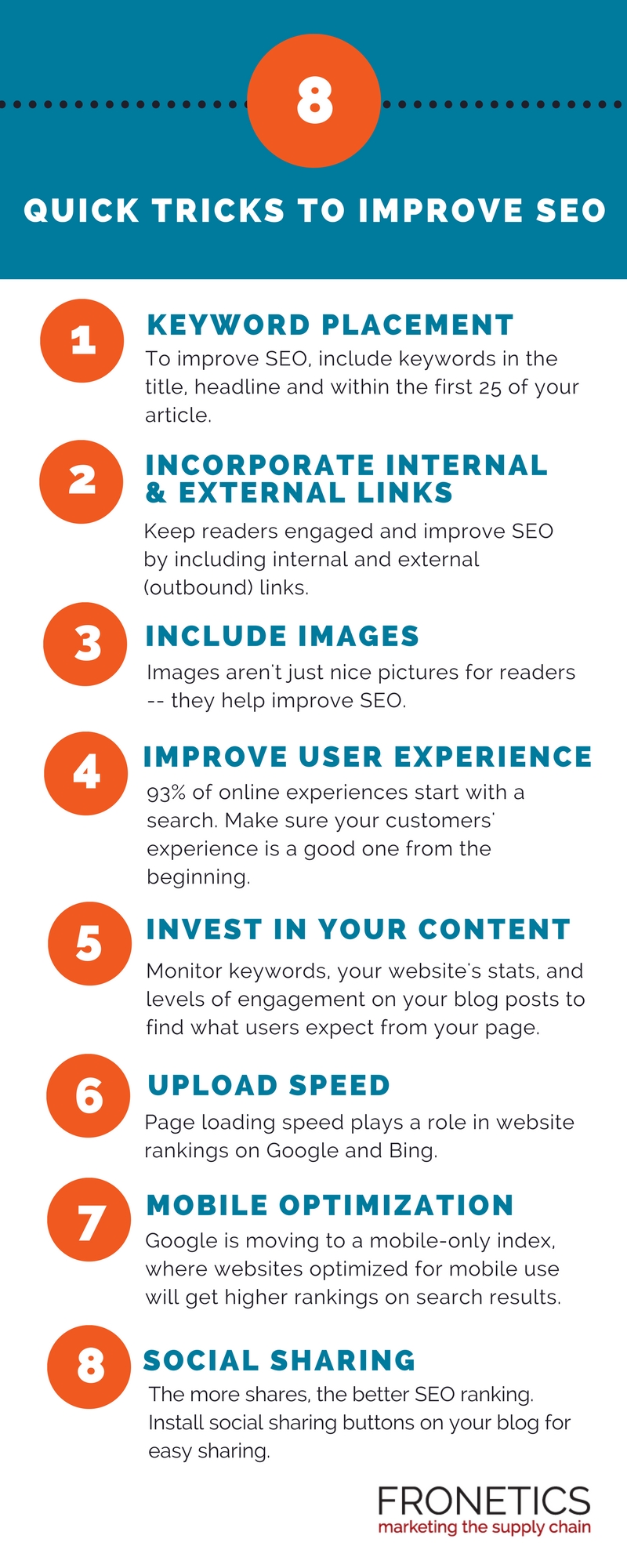
Infographic: 8 quick tips for blog posts to improve SEO
(Made with Canva)
Using these 8 quick tips will improve SEO and get your blog posts in front of your target audience. Remember, your best bet on moving up on search engine results pages is to create content that readers want to read. Sounds simple, I know, but it can be challenging. Let us know how these tips helped improve your SEO.
Related posts:

SaveSave

by Elizabeth Hines | Jan 25, 2018 | Blog, Content Marketing, Marketing
Why is no one reading your blog? Chances are, you’re not doing it right. Here are some of the blog writing mistakes you may be making.
There is so much content out there. In fact, the U.S. alone generates 2,657,700 gigabytes of internet data every minute. Every minute! That’s a whole lot of videos, tweets, posts, and photos being shared online. No wonder no one is reading your blog.
There’s so much competition out there, it’s hard to stand out against those numbers. Even with the time and energy you’re putting into your blog, you’re not seeing the views and engagement you were hoping to achieve.
Most likely, you are making one of these mistakes. Here are some reasons why no one is reading your blog.
10 reasons why no one is reading your blog: an infographic

(Made with Canva)
Related posts:
SaveSave
SaveSave
SaveSave
SaveSave

by Elizabeth Hines | Jan 24, 2018 | Blog, Content Marketing, Current Events, Logistics, Marketing, Social Media, Strategy, Supply Chain
Companies in the supply chain and logistics industries should take note of these top social media trends in 2018.
While we don’t know what 2018 has in store for companies in the supply chain and logistics industries, we do know change is coming. That is true not only in terms of the economy and your business, but also for the marketing tools you use. Of course, ever-evolving social media platforms are an important part of that.
We already know that Facebook News Feed will be making some big changes this year. What other platforms or types of media will be hot? What will your industry peers and competitors be trying in 2018? As we dive into the new year, it’s important to be aware of the social media trends that will dominate the next 12 months so you can incorporate them where you are able.
As always, good content will be as important as ever. With over one million new-data-producing social media users each day, high-quality content is the only way to stand out from the masses. But we also think you should pay attention to a few social media trends that we have highlighted in the following video. We’re certainly planning to adjust our strategy and those of our clients to consider these things.
As you start to strategize for 2018, and beyond, be sure to consider these social media trends in your content marketing plans.
Top social media trends for 2018
Make sure to follow our blog for our monthly social media news posts to stay updated on the latest platform updates. And feel free to reach out to us with questions or if you would like to see a certain social media trend covered on our blog.
Related posts:

by Elizabeth Hines | Jan 23, 2018 | Blog, Content Marketing, Marketing
Measuring the success of your content is important in evaluating your writing for SEO strategy. Here’s how to do that.
This week, we’re wrapping up our series on writing for SEO. In this series, we’ve explored how search engines are changing, how people are changing the way they search, and how to make use of topic clusters and pillar content. Now, with a better understanding of the changing SEO landscape, it’s time to think about how to measure the success of your content.
As with any marketing effort, having a documented strategy for your content’s search engine performance — and a plan for measuring the success of your strategy — is key. You might be asking yourself, “How do I measure the success of a piece of content?”
Should I measure the success of one post at a time?
When it comes to SEO, the answer to this question can be complicated, largely because it’s not a great idea to evaluate the success of your campaign on a post-by-post basis. It’s too narrow a definition of success to account for the complex network of direct and indirect benefits of effective SEO writing.
Take brand-driven content, for example. Your focus isn’t about generating individual sales, but rather about elevating your brand, raising wider awareness, attracting new talent, or generating backlinks. If you based the success of brand-driven content on the number leads it generated alone, you’d think it was performing terribly. But your post may, in fact, have generated hundreds of backlinks and be getting lots of traffic.
Evaluating by cluster topic
So how do you evaluate success? Rather than looking at your content on a post-by-post basis, consider how all the content under each cluster topic performs as a whole.
According to HubSpot, “Measuring the entire topic cluster against all of your core business metrics will enable you to include residual benefits coming from content that doesn’t align with direct conversion goals.”
As you look at the performance of your topic clusters, consider the following four questions:
- Which topics perform best at driving traffic to your website or other web presence?
- Which topics earn you the most leads?
- Which topics drive the most revenue for your business?
- Which topics earn the most backlinks/coverage?
It’s important to remember that at the end of the day, what you’re working toward — and what will work best for your search visibility — is creating content that people want to see. Writing for SEO is ultimately about creating better content, increasing search engine visibility, and providing the best possible experience for your site visitors.
Related posts: