by Elizabeth Hines | Feb 8, 2018 | Blog, Content Marketing, Logistics, Marketing, Social Media, Strategy, Supply Chain
These social media statistics are important to keep in mind when planning out your content marketing strategy.
A strong social media presence is key to successful marketing in 2018. Social media is simply unavoidable these days.
So, you jumped on board and you’re posting and tweeting. You’re creating content. You’re learning about search engine optimization and how to improve your rankings. But you’re still not reaching the audiences you were hoping to attract. What’s going wrong?
When you are posting on social media could be as important as what you’re posting.
Timing is everything, and that statement especially holds true when it comes to posting content to social media. If you are sending out your message and nobody is there to see it, you are that proverbial tree falling in the forest; you did not make a sound. Your post had little to no impact.
So, even if you are putting in the time and effort to craft informative blog posts, tweets with just the right message, or Facebook posts that inspire more than just page likes, you still are not getting the most exposure you can out of social media.
We have done our homework when it comes to the best times to post on social media. And the truth is there is no “one size fits all” answer to when you should post. There are general guidelines that differ for each site. But in general, it’s important to keep your target audience in mind when deciding where and when to post.
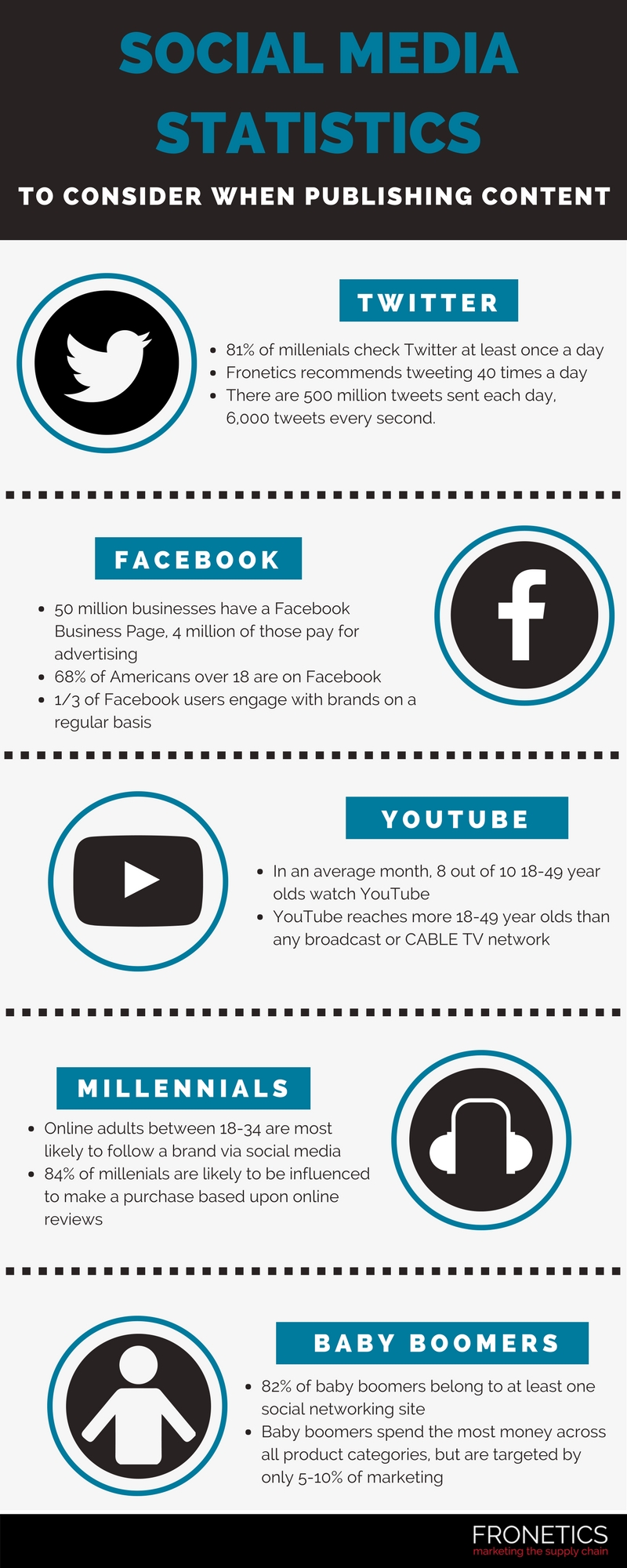
Here are some social media statistics that you need to consider when deciding when to post your content.
Social media statistics your business needs to consider when publishing content
(Made with Canva)
Related posts:

SaveSave
SaveSave

by Elizabeth Hines | Feb 7, 2018 | Blog, Content Marketing, Marketing, Strategy
To be effective, your content marketing strategy should align with your sales goals. Here are three simple questions to ask yourself to make sure your documented strategy is on target.
I recently read an article on the Harvard Business Review that discussed pairing your sales goals with your marketing goals. This strikes at the heart of what we do at Fronetics: build a client’s content marketing strategy that will help advance their short- and long-term business goals. It sounds simple, but you have no idea how many organizations’ marketing goals are misaligned with what the larger organization is trying to accomplish
We need to make sure that — while we’re continuing to increase content production — we have a fundamental understanding of what we’re trying to create.
According to the Content Marketing Institute, 88% of marketers use content marketing. But a mere 30% of B2B marketers say their organization is effective at it. What that says to me is that a lot of companies are dumping their resources into content marketing, but, without a strategy that advances their business goals, they’re throwing away their time and money.
A content marketing strategy outlines the methods by which you will target, reach, and engage your audience. Research and execution of these tasks can be quite complex. Writing out a plan and assigning appropriate resources can offer clarity and guidance to your organization throughout the course of your program.
Here are three questions to ask yourself to make sure that your content marketing strategy is complementing your sales goals.
3 questions to align your sales goals and content marketing strategy
1. Why: Why am I doing this?
This question should be fairly easy to answer. The reason you’re documenting a content marketing strategy is for your business. You’re looking to align your marketing efforts with your business objectives. For a lot of companies, this ultimately means increased revenue from sales growth.
When done correctly, content marketing can support sales goals, making it easier to generate leads and helping the sales team close business. But you need to continually ask yourself, why?
The constant demand for more and more content can have a great impact on quality. More isn’t always better. Make sure you’re checking in with your strategy to make sure the content you’re producing is in alignment with your business goals.
2. Who: Who am I trying to attract?
In order to get the ball rolling in content marketing, you have to understand who you are trying to reach. Your company’s sales goals will help guide this target audience. It’s important to think holistically when considering who you are trying to reach at a potential prospect’s company. Typically, your target audience falls into two categories: Primary (decision-makers) and Secondary (influencers of the decision-maker).
Going one step further, you need to identify your target audience’s needs and pain points so that you can direct your content marketing strategy at creating awareness around those needs.
Once you have a thorough understanding of who your target audience is, you can begin to identify the different social media platforms they use. Using analytics tools within social networks can help you identify trends in social media use.
3. What: What content is going to work the best?
You’ve discovered your why and who, but now you need to finalize what kinds of content you’re going to create. Create the kinds of content your target audience seeks, and distribute it through the platforms on which they seek it. How-to videos on YouTube? Thought leadership on LinkedIn? Optimize the material you distribute for each channel. Use the social channels that best suit your brand message, type of content, and target audience.
Valuable and relevant content is not a sales pitch, but can help the sales process. Create content that communicates valuable information to customers and prospects so that they have the knowledge to make more informed decisions. Moreover, concentrate on content that establishes your business as a reliable source of knowledge — as a thought leader within the industry. Be thoughtful when you create content.
Even though 39% of marketers expect their content marketing budgets to increase this year, that doesn’t mean you should continue throwing money at your content marketing efforts until you have a clear plan that will advance your business. To be effective, marketers should document a content marketing strategy that aligns with their business and sales goals. It doesn’t have to be complicated. But it should reflect the “why, who, and what” of your sales strategy.
Related posts:


by Elizabeth Hines | Feb 6, 2018 | Blog, Content Marketing, Logistics, Marketing, Strategy, Supply Chain
Here are three tips for creating a content strategy that will help advance your business goals.
If we’re adamant about one thing at Fronetics, it’s creating a documented content strategy. But, as a recent Harvard Business Review article suggests, many strategies fail because they are not actually strategies.
This begs the question: what constitutes a real strategy? According to Freek Vermeulen, associate professor of strategy and entrepreneurship at the London Business School, “A real strategy involves a clear set of choices that define what the firm is going to do and what it’s not going to do.” The keyword here is “clear.”
Here are three strategy-creation tips to help you create a clear content strategy that aligns with and furthers your business goals.
3 content strategy tips
1) Show your work.
Just like in high school math class, arriving at the right answer isn’t enough — you need to communicate the logic for how you got there. As you create or refine your strategy, take a step back and examine the reasoning behind each choice.
Says Sly Bailey of the UK publisher Trinity Mirror, “If there is one thing I have learned about communicating choices, it is that we always focus on what the choices are. I now realize you have to spend at least as much time on explaining the logic behind the choices.”
Understanding the reasoning behind each of your choices allows you and your team to fully believe in your strategy, and ensures you carry it out optimally.
2) Trickle down doesn’t work.
Many implementation efforts fail because executives see strategy creation as a top-down process. On this topic, Stanford Professor Robert Burgelman writes, “Successful firms are characterized by maintaining bottom-up internal experimentation and selection processes while simultaneously maintaining top-driven strategic intent.”
In other words, while you need top-down strategic direction, this will only be effective if you simultaneously empower your employees to create bottom-up initiatives that meet the strategic intent.
3) Flexibility is key.
Another source of failure for implementation efforts is the institutional unwillingness to change habits. “People are often not even aware that they are doing things in a particular way and that there might be different ways to run the same process,” says Vermeulen.
It’s important to identify and effectively work against the bad habits that hamper your strategy’s effectiveness. As Vermeulen describes in his book, Breaking Bad Habits, “There are various practices you can build into your organization to make it work.” This often involves identifying key processes, and asking, “Why are we doing it this way?” If the logic isn’t clear (see above), this process is likely a good candidate for change.
Related posts:


by Elizabeth Hines | Feb 5, 2018 | Blog, Content Marketing, Marketing
Internet users are changing how they search, and search engines are changing in response — which means writing for SEO is changing, too. Here’s what you need to know.
I’ve just completed a really detailed, often-complicated series about writing for SEO in today’s changing search landscape. I hope you read all four posts and now have a better understanding of the new way we marketers are thinking about content marketing.
But, as my colleagues occasionally have to remind me, not everyone enjoys the nitty gritty of SEO writing like I do. It’s also important to step back and take a look at the forest after examining the trees.
So here are some really important takeaways from the series — about how internet users, search engines, and writing for SEO are changing — that I think are important for all marketers in the supply chain and logistics industries.
4 things to know in a changing search landscape
1) Search engines are changing.
While keyword rankings used to be the gold standard for measuring SEO success, this is no longer the case. New search algorithms have moved beyond giving everyone the same results of a query, meaning that keyword ranking can change drastically depending on context (like location).
In addition, Google is increasingly showing featured snippets at the top of search results.
What you need to do:
Know that measuring SEO success is no longer as simple as keeping track of keyword rankings. It’s still information worth having, but it’s part of a larger set of metrics you need to evaluate your success and tailor your efforts.
To effectively take advantage of featured snippets, it’s important to structure your content so it’s optimized to appear in this prime location.
Read the full post.
2) People are changing how they search.
Because of the rise of mobile and voice search, people are now searching with a phrase or question rather than a single term. In response, search engine development has focused on natural language processing — meaning search engines now analyze phrases as a whole rather than a keyword. That essentially means they evaluate a site’s content regarding an entire topic rather than its use of a particular word in order to deliver the best answers to users’ queries. Basically, we’re looking at the same issue as the last post, but from the user end.
What you need to do:
Stop trying to rank for a small set of keywords. What’s important is broad visibility across a topic. You should start thinking about the major themes of your content and then build posts and website pages to support them.
Read the full post.
3) Structure your content in topic clusters and pillar content.
Pillar content is your evergreen content that offer a high-level overview of the several ideas/phrases/value propositions that most closely align with your brand. Topic clusters are the subtopics that provide more detail on those high-level ideas of your pillar content. Adding hyperlinks to pillar content pages from topic cluster pages and vice versa creates a structure that signals to search engines that your site has lots of good, well-organized information about a certain topic, which improves ranking across that topic.
What you need to do:
Structure your content into pillar content and topic clusters. Add hyperlinks between the pages. Optimize topic cluster pages to drive traffic and pillar content pages to convert leads.
Read the full post.
4) Measure the success of your content.
Measuring success is getting more complex. You can no longer effectively gauge the effectiveness of campaigns on a post-by-post basis. Instead, measure your visibility across each topic.
What you need to do:
Start looking at the bigger picture. Consider how all content under each cluster topic performs as a whole. As you do this, keep the big four questions in mind:
1) Which topics perform best at driving traffic to your website or other web presence?
2) Which topics earn you the most leads?
3) Which topics drive the most revenue to your business?
4) Which topics earn the most backlinks/coverage?
Read the full post.
Related posts:

by Elizabeth Hines | Feb 1, 2018 | Blog, Content Marketing, Logistics, Marketing, Supply Chain
Our readers voted LTX Solutions, Women In Trucking, and Apex Capital Blog as the top 3 logistics and supply chain blogs of 2018.
You voted, and the results are in! LTX Solution is your number one favorite blog of the year, with “Ellen’s Blog” of Women In Trucking and Apex Capital Blog coming in second and third.
We love hearing what blogs you enjoy reading and find valuable. There are lots of great industry options, so we know it’s not easy to narrow down your favorites. We had lots of great responses, but only Women In Trucking held its spot on our list of the top logistics and supply chain blogs from last year.
What did remain consistent from previous years is the quality of the content and the consistency of posting by the three winners. These key components have remained invaluable across all successful logistics and supply chain blogs.
Here are the top 3 logistics and supply chain blogs of 2018.
1. LTX Solutions
LTX provides professional supply chain logistics management and customer service solutions to improve transportation efficiency, reduce costs, and give companies a competitive advantage. The blog focuses on topics that impact the global supply chain, including freight management, cutting-edge data and analytics trends, and risk prevention. The blog, which consistently posts a few times a week, tackles the most pressing issues facing the supply chain industry, as well as professional tips and insight into the latest industry technology.
2. Ellen’s Blog – Women In Trucking
The Women In Trucking Association is a non-profit organization focused on encouraging the employment of women in the trucking industry, promoting their accomplishments, and minimizing obstacles. President and CEO Ellen Voie’s blog offers thought-provoking insight on topics from best practices to becoming a thought leader in a male-dominated industry. Her years of experiences and passion for advancing women’s position within the trucking industry make her blog invaluable to readers. For the second year in a row, this blog has been one of our readers’ favorites due to the relatable topics and insightful content, such as family problems stemming from job-related realities and assimilating to trucking culture.
3. Apex Capital Blog
Apex Capital specializes in factoring freight invoices for small to medium-sized trucking companies with over 20 years’ experience. Apex clients include owners and operators starting their own trucking company with one truck to large-scale companies with hundreds of trucks and employees. The blog focuses on the latest trends and happenings in the trucking industry. In the past five years the blog has published over 500 articles on topics ranging from trucking regulations, tips on running a successful trucking business, and interviews with industry leaders. The posts highlight news and information that companies can use to run and grow their trucking business.
Runner up: Muddassirism
Dr. Muddassir Ahmed’s blog focuses on all things supply chain management, including advancements in development and strategies, professional development, and improving customer experience.
Related posts: