by Elizabeth Hines | Oct 13, 2015 | Blog, Content Marketing, Marketing, Strategy
Imagine for a moment you’re entering an electronics retailer, ready to purchase a new television. You’ve been thinking about buying a new TV for a while, so you’ve done your homework. You know the difference between LCD and plasma. You’re certain that a 50 inch flat screen would look stellar hanging on the wall in your living room. Today’s the day. As you approach the salesman and begin to tell him the specifics of what you are looking to purchase, he looks at you and says, “Thanks for contacting me. I’ll be in touch within 24 to 48 hours.” It sounds silly, right? But that’s essentially what your company is telling prospects when it fails to respond quickly to online leads.
So how is “quickly” defined? Harvard Business Review (HBR) set out to measure how long on average it took for companies to respond to a web-generated lead. Auditing more than 2,200 businesses, they found an average first response time of 42 hours for businesses that responded to a lead within 30 days. Surprisingly, 23% of companies never responded. 
42 hours sure sounds like a long response time, but is it really? Turns out, it’s worse than you might think.
After reviewing the results of the HBR study, a research team at InsideSales.com examined three years of data across six companies that generate and response to web leads, from over fifteen thousand leads and over one hundred thousand call attempts. They focused on one question for this study: When should companies call web-generated leads for optimal contact and qualification ratios? Of this study a researcher wrote:
“…the odds of making a successful contact with a lead are 100 times greater when a contact attempt occurs within 5 minutes, compared to 30 minutes after the lead was submitted. Similarly, the odds of the lead entering the sales process, or becoming qualified, are 21 times greater when contacted within 5 minutes versus 30 minutes after the lead was submitted.”
Essentially, sales teams aren’t only missing opportunities to contact leads when they wait to respond, they’re also missing opportunities to qualify leads.
So where does the organizational problem lie? It could be that your sales team is hyper-focused on their own sales leads, ignoring signs from online leads that they’re nearing closer to purchase. It’s also possible there’s inherit incongruence in the distribution of online leads to members of your sales team. Could you improve response time if leads were distributed differently? Also culpable could be the frequency with which your sales team checks for new leads. Is your CRM pushing sales lead notifications to your sales team only once per day? Pushing out immediate notifications could positively affect your lead response time. Whatever the reason you identify, it’s important to address and rectify these issues as soon as possible.
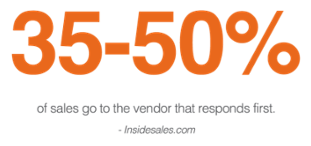
With a white paper authored by Google and the Corporate Executive Board reporting that today’s B2B customers are nearly 60% through the sales process before engaging a sales rep, it is unsurprising that a reported 35% to 50% of sales go to the vendor that responds first. Is your sales team’s average response time faster than your competition?
by Elizabeth Hines | Oct 12, 2015 | Blog, Logistics, Strategy, Supply Chain

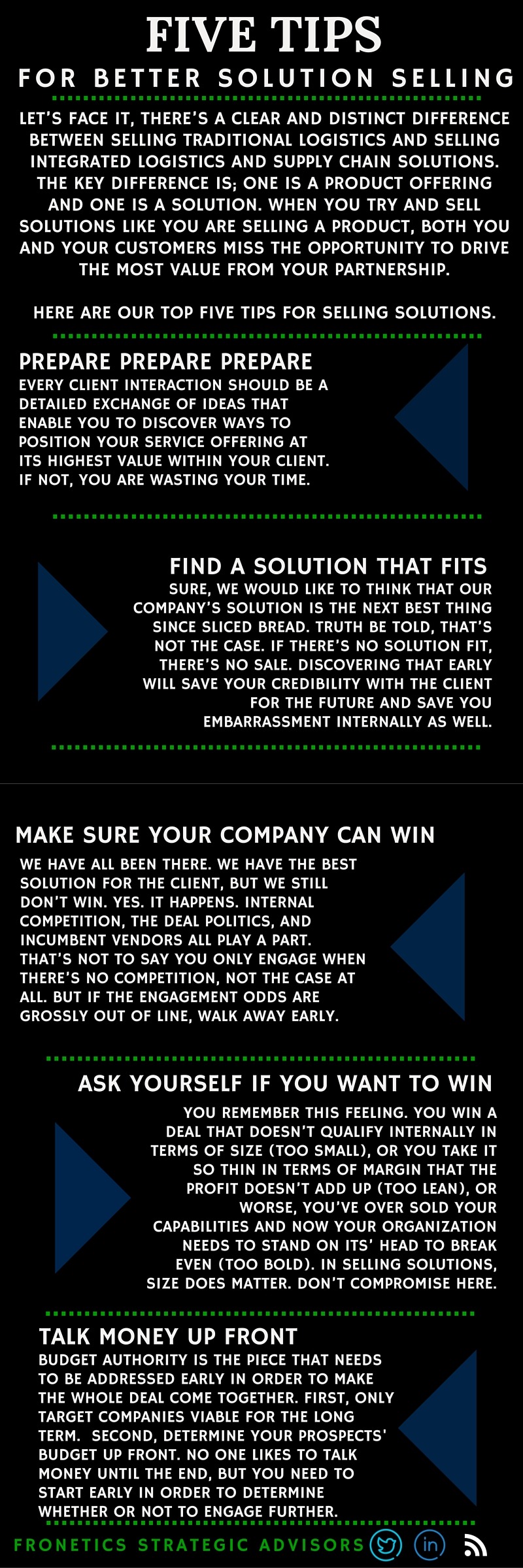
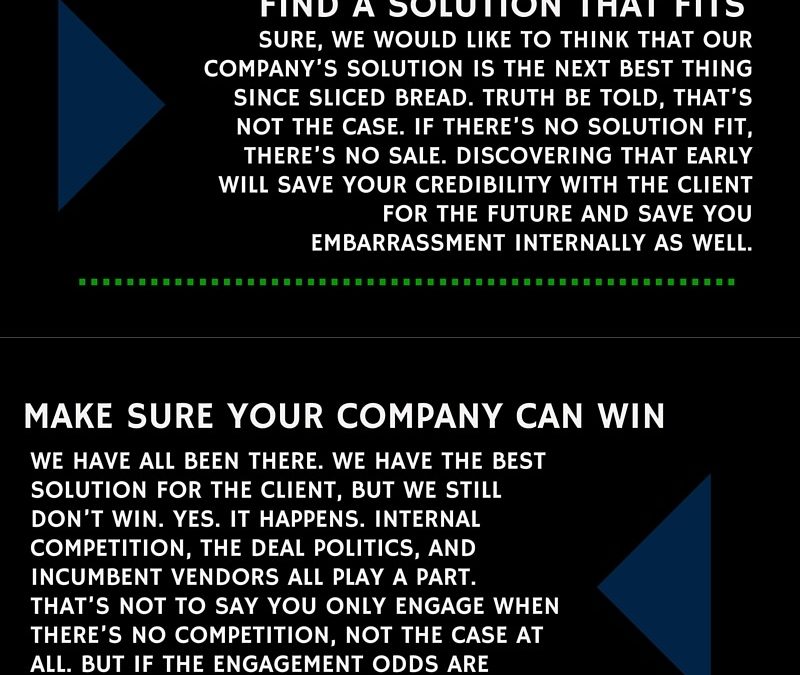
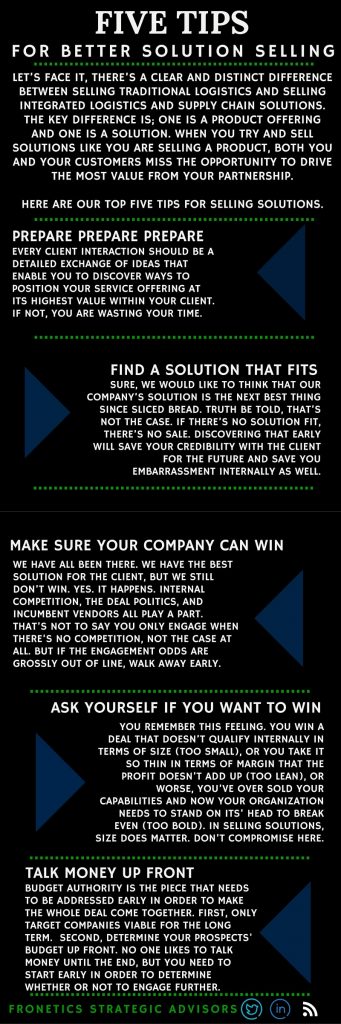
There are organizations that sell products and there are organizations that sell solutions. To be sure, both can be successful as long as products are being sold as products and solutions like solutions. The difference is that the product sale is really a commodity sale. Commodities come with an “each” price or a “per pound” pricing matrix, etc. It usually is a short or shortened sales cycle and negotiations revolve around the total price and your typical supplier performance metrics. The solution sale is much different. This sale is one that requires client discovery, isolation of unique client pain points (that only your solution can address effectively), and being able to drive distinct value for the client, and in turn, for your organization. This sales effort is highly specialized and requires selling time (sales cycle) that is much more detailed than a product sale. That being the case, you need to be sure that your close rates are high enough to justify the work load and sales cycle needed. You also need to be sure that the deals you close have a deal size that reflect the sales effort and cycle time (said another way, is the deal worth winning?)
If your sales team thrives on creating value for their customers far beyond ‘supplying’ their ‘product’ at the best price, check out our other solution selling tips below.
Fronetics Strategic Advisors is a leading management consulting firm. Our firm works with companies to identify and execute strategies for growth and value creation.
We advise and work with companies on their most critical issues and opportunities: strategy, marketing, organization, talent acquisition, performance management, and M&A support.
We have deep expertise and a proven track record in a broad range of industries including: supply chain, real estate, software, and logistics.

by Elizabeth Hines | Oct 8, 2015 | Blog, Strategy, Talent
Hiring someone who says he or she is not a team player sounds like a risky proposition, right? Few employers are, after all, searching for renegade employees or stubborn loners who refuse to interact with co-workers. But what if it actually turned out to be a good strategy? Researchers at the University of Tuebingen set out to examine the effects on applicant pools by stressing the need for teamwork in job ads. The conclusion of the study puts it like this: “Given the evidence of a possible downside, it is recommended that firms should never look for team players just because ‘everyone else is doing so.'”
The study analyzed survey data from 1,300 college students who had been asked to evaluate a number of job postings that outlined various requirements, including whether the applicant should be a team player or an independent task-oriented self-starter. Interestingly, what researchers found was that although the ads did indeed attract applicants who considered their teamwork skills to be a primary asset, they also discouraged people whose qualifications matched the job description with the exception of one criterion: social skills. As a result, the employer missed out on technically skilled or task-oriented candidates who took themselves out of the running before the race even began. The study went on:
“…considering that organizations always need employees with high task-related skills, but that they may not always need team players, they should carefully consider when the requirement for teamwork skills is listed in their job advertisements—because there is a downside to looking for team players.”
For organizations that truly need employees with an aptitude for collegial collaboration, the study shows ads that stress the importance of possessing teamwork skills do what they were intended to accomplish. But in other cases, where teamwork takes a backseat to specific talents or technical skills, the employer is likely to end up with a smaller pool of applicants than if that routine phrase had been left out of the job requirements.
People who don’t cite social acumen among their list of skills may not thrive at “water-cooler conversations” or rush to plan the next company outing, but they know how to get the job done and they do it well. If teamwork is irrelevant to their job description, isn’t that all we really need?
Fronetics Strategic Advisors is a leading management consulting firm. Our firm works with companies to identify and execute strategies for growth and value creation.
We advise and work with companies on their most critical issues and opportunities: strategy, marketing, organization, talent acquisition, performance management, and M&A support.
We have deep expertise and a proven track record in a broad range of industries including: supply chain, real estate, software, and logistics.

by Elizabeth Hines | Oct 7, 2015 | Blog, Marketing, Social Media, Strategy
I wrote previously about the opportunities companies within the logistics and supply chain industries can realize through social listening. I cautioned that to reap the benefits and seize the opportunities afforded by social media, companies need to use the information and intelligence gathered.
Using the information and intelligence gathered is essential. There is; however, another critical element: engagement. Engagement is a differentiator. Without engagement you are a lurker. You don’t want to be a lurker.
What is a lurker?
A lurker is someone who observes, but does not participate. If your company does not engage via established social media accounts, your company is lurking. Stop lurking. To realize the benefits of social media and social listening you need to actively engage with customers and others via social media.
What is active engagement?
How can your company actively engage with customers and other via social media? Here are some ideas:
- Ask questions
- Answer questions
- Provide clarification
- Weigh in on a discussion/topic
- Thank followers for their ideas, suggestions, and feedback
- Highlight when/how you have used customer feedback to make changes to a product or service
- Simply let people know you are listening to their comments and feedback.
Action
The information and intelligence your company can gather via social listening is immense. If you do not use what you have gathered you miss out on opportunities and revenue. The same can be said about social lurking. By not actively engaging via social media your company misses out on opportunities.
Social media can be a strategic tool – if used correctly.
This was originally published on Electronics Purchasing Strategies.

by Elizabeth Hines | Oct 6, 2015 | Blog, Marketing, Social Media, Strategy, Supply Chain
Companies within the logistics and supply chain industries have been slower to participate in social media than other industries. The primary reason being because of a lack of understanding of what social media is and the role it can play for business. Unfortunately, companies who do not participate in social media miss out on opportunities – and revenue.
Every day conversations are taking place about your company, your products and services, your industry, and your competitors. These conversations are not just happening over the water cooler, they are happening on social media. These conversations not only provide invaluable (and often strategic) information, they also serve to shape and define your company and your brand. With the advent of social media, the reality is that is the customer who drives your company’s image and brand message. If your company isn’t on social media you miss out.
Social listening
Social listening is the process of monitoring social media to identify and assess what is being said about a company, individual, brand, product, or service. Through social listening your company can not only become an innovation engine, you can also gain market intelligence, and you gain intelligence about how your company, products, and services are being perceived. Knowing this information in real-time is invaluable.
Caterpillar is one company that has embraced social listening. Caterpillar engages in social listening with the objectives of gaining deeper insight into:
- Who is talking about the company;
- What is being said about the company;
- What competitors are doing;
- Key influencers;
- The tone of conversations that are taking place.
Kevin Espinosa, Caterpillar’s eBusiness Loyalty Manager, further discusses the company’s social listening strategy and the benefits of social listening:
“If you haven’t started already, you have to start with social listening. It’s like building a large campus without the sidewalks. Let your audience lay down the paths and sidewalks they want to take. They’ll tell you where they’re participating and what they need. Then you can backfill with a strategy that addresses their needs. This is the push aspect of social media. Eventually, you get to the pull aspect, where the customer is a big contributor to your social media strategy. This is where there is truly two-way dialogue and relationship building.”
Engagement and action
To reap the benefits of social listening, including increasing your revenue, you need to use the information and intelligence gathered. For example, if you learn via social media that your customers are experiencing issues with a specific product, take steps to determine what the issues are, and then make changes to the product. The Aberdeen Group offers additional examples of how social listening has been and can be used: “companies can use the voice of the customer to make critical adjustments and find issues related to inventory allocation, order management, returns management, cost, overall service satisfaction and beyond.”
The opportunities the supply chain and logistics industries can realize through social listening are great. Not participating in social listening results in missed opportunities.
This post originally appeared on Electronics Purchasing Strategies.