by Elizabeth Hines | Apr 29, 2014 | Blog, Content Marketing, Logistics, Marketing, Social Media, Supply Chain

Content will help you grow your business; by creating and distributing valuable and relevant content in a strategic and consistent manner you can drive profitable customer action. But, it’s not all about you. It’s not all about the content you and/or your business creates. Here’s why content curation is an essential component of a successful content strategy.
The internet is a fire hose stream of content. Being able to navigate the deluge of content and identify the content that is valuable to your customers and to your business is essential. The process of identifying and sharing this content is content curation.
By consistently being able to identify, make sense of, and share content that is important and relevant to your customers and to your industry you will establish your business as a thought-leader and a trusted resource.
A 2014 survey found that 76 percent of respondents reported that content curation positively impacted their business goals in 2013. Ninety percent of respondents predicted that content curation will have a positive impact on their business goals in the upcoming year.
This article was originally published on DC Velocity.
by Elizabeth Hines | Apr 21, 2014 | Blog, Content Marketing, Logistics, Marketing, Strategy, Supply Chain
When it comes to content your company doesn’t need to go it alone. Not only is it possible to outsource content, for many companies it may be the best solution. Here is how to determine if outsourcing content is right for your company, and what your company needs to consider when looking for an outsource partner.
Is outsourcing right for you?
Outsourcing is not the panacea. It may be the right solution for your company – or maybe not. Here is what to consider when determining if outsourcing content is the right solution for your company:
- What are your company’s core competencies?
- How can your company deliver the best value to your customers?
- A successful content strategy needs to be deliberate and needs to have someone in charge. Do you have in-house talent who can put together a content strategy for your company and manage the execution of the strategy?
- Does your company have in-house talent that can consistently create good content?
- Does your company have in-house talent that has the time to consistently create good talent?
- Does your company have in-house talent that can distribute your company’s content?
- Does your company have in-house talent that can track and analyze your company’s content strategy?
Be honest. Cobbling together staff or passing content like a hot potato from one person to another is not going to be effective. If content is not an area where your company excels, or if content could be carried out more efficiently and effectively if the service was outsourced – start looking for an outsource partner.
If you do decide that outsourcing is right for your company, know that you are not alone. Forty-four percent of B2B marketers report that they outsource content creation. Diving down further, 72 percent of large B2B companies (1,000 employees or more) outsource content creation and 34 percent of small B2B companies (10 to 99 employees) outsource content creation. Looking specifically at the manufacturing industry – 55 percent of manufacturing marketers report that they outsource content creation.
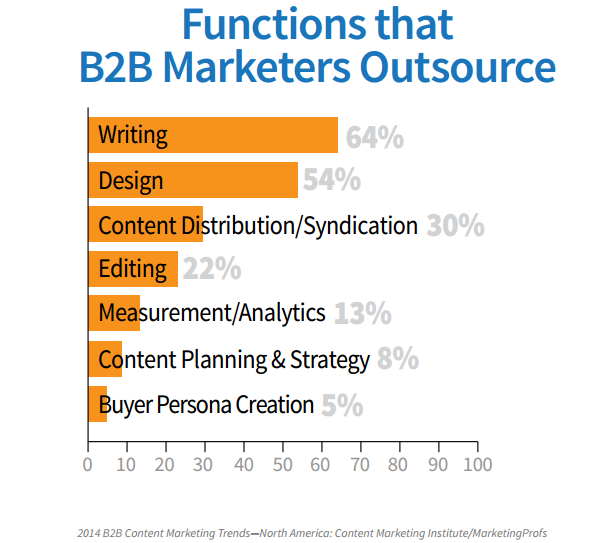
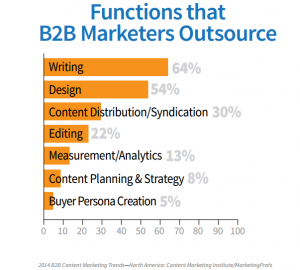
As shown in Figure 1 the content functions that B2B marketers outsource vary from writing to design to distribution to creating a buyer persona. When it comes to outsourcing content functions it doesn’t need to be the kitchen sink.
Figure 1
What to look for in an outsource partner
When it comes to finding an outsource partner you want to find a partner that will bring value to your company and to your customers. Whether you outsource all content functions or just one, here is what to look for in an outsource partner:
- Experience and knowledge of your industry;
- Willing to work with your company to help you achieve your goals;
- Open to exploring and furthering your company’s creative ideas;
- Able to follow instructions and execute with minimal oversight;
- Able to create the type of content your company needs;
- Interested in entering into a long-term relationship.
More generally, Frank Cavallaro wrote that when choosing your perfect outsource mate it is important to start by looking at the mission or value statement of your potential partner. Are these aligned to your company’s? If they are, move on and explore the partnership further. If not, walk away. “Mission and value statements speak to the core culture of the company, so if you can’t find common ground here, it is unlikely you will be able to build a positive working relationship.”
This post was originally published on DC Velocity.
by Elizabeth Hines | Apr 16, 2014 | Blog, Marketing, Social Media
For every blog post, tweet, and Facebook update, you should ask yourself: Who is listening?
Without a comprehensive social media strategy, your message may be getting lost in the chatter. There are a number of tools that will help you monitor your online influence and, effectively, make the necessary adjustments to ensure your efforts are paying off.
Here are 10 free tools to help you measure your social media ROI. The basic features of each of these tools are free.
1. Hootsuite
Considered one of the top social media management systems, Hootsuite is a web-based dashboard that enables your business or organization to execute campaigns across multiple social networks. This tool helps you identify audiences, distribute targeted messages, launch marketing campaigns, streamline workflow and much more. It also provides weekly reports on your social analytics. Social network integrations include, among others, Facebook, Twitter, LinkedIn, and Google+.
2. Facebook Insights
Sometimes the best analytics tools are built into the platform, like Facebook Insights. After your Facebook page receives at least 30 likes, Insights can be applied to break down the metrics of your content. See how people discover and respond to your posts and use the anonymized demographic data to analyze trends and tailor your message.
3. Google Analytics
By using Google Analytics you will have access to a wealth of strategic data across multiple venues such as ads, videos, websites, tablets, smartphones and social tools. The result is a complete profile of your potential customers and their needs. Learn, for example, how visitors find your site, what they like and don’t like, and what they technology they use to access the information.
4. TweetDeck
TweetDeck resembles Hootsuite but is exclusively focused on your engagements on Twitter. This real-time tracking and organizing tool allows you to customize your Twitter experience in one interface. You can manage multiple accounts, build timelines, and track hashtags, events, and topics.
5. SumAll
SumAll connects you to all the services you use in one interactive chart. SumAll enables you to monitor and measure more than 30 services (e.g. Facebook, Twitter, Instagram, PayPal, Google Analytics) – for free. SumAll is a great option for small and medium sized businesses who want to be able to monitor all of their platforms in one spot – and have reports delivered via email on a daily basis.
6. Twazzup
An ideal tool for those new to Twitter, Twazzup enables you to follow a real-time stream of updates about keywords of your choosing. The interface presents a clear look at your related real-time tweets as well as trending and user information. It also identifies the top influencers in your field.
7. IceRocket
Specializing in displaying the most up-to-the-second search results, IceRocket covers blogs, the web, Twitter, and Facebook. Find out who links to your blog posts and search the IceRocket database of 200 million blogs. Your monitoring results can be viewed on a single, easily digestible page.
8. Klout
How influential are you online? The so-called “Klout score” reveals your effectiveness on Twitter, Facebook, Google+, LinkedIn, Foursquare, Wikipedia, and Instagram. The company recently added business analytics to its list of services to assist users learn more about their online audiences.
9. HowSociable
HowSociable measures the impact of your brand across multiple social media platforms, helping you identify which one is the best fit for you. By analyzing the metrics of your presence on 36 popular social media sites, this tool produces a score between 1 and 10 to indicate the activity around your brand during a given week.
10. Addictomatic
Addictomatic is a straight-forward application to monitor your brand’s reputation and industry developments. Simply select your keywords and Addictomatic will scan a variety of platforms such as Google, Bing, Twitter, WordPress, YouTube and Flickr.

by Elizabeth Hines | Apr 8, 2014 | Blog, Content Marketing, Logistics, Marketing, Social Media, Strategy, Supply Chain
Content is king. By creating and distributing valuable and relevant content in a strategic and consistent manner you will be able to create demand for your products and services and will be able to drive profitable customer action. That being said, while content is king, content doesn’t go far (actually it goes nowhere) without distribution. Wise words by BuzzFeed’s Jonathan Perelman: “Content is king, but distribution is queen and she wears the pants.”
For content to be successful for your business you need to do more than create content – you need to distribute content. Moreover, the content needs to be delivered consistently over time, at the right time, and in the right place.
For your company this means taking the time to identify the distribution channels that are the right fit for your company, your content, and your goals. It also means taking the time to learn how to distribute content via these channels effectively.
For example:
- LinkedIn and Twitter are good candidates for letting people know about the white paper your company just released, whereas Pinterest is probably not a good white paper distribution channel.
- Levering your 140 characters for Twitter is key, but taking those same 140 characters to LinkedIn or Facebook will likely result in you falling flat.
- Distributing your content multiple times a day via Twitter is essential given the short lifespan of a Tweet; however, distributing content multiple times a day via email will not be well received.
Content will help you move the needle. Content will drive profitable customer action. However, your content, no matter how valuable it is, will not be seen and therefore will not be effective if you do not have a solid content distribution strategy. If you want results, remember who wears the pants.
This post was first published on DC Velocity.