by Elizabeth Hines | Nov 25, 2014 | Blog, Internet of Things, Marketing, Social Media, Strategy, Supply Chain
The 2014 UPS B2B Buyers Insight Study found that companies need to have a strong online presence to grow their business.
Buyers are looking for information online
Buyers are conducting research on industrial suppliers online. Sixty-eight percent of buyers research supply purchases via supplier website, and 52 percent use search engines.
In their report, UPS and TNS discuss the importance of a strong online presence:
“Given buyers’ high satisfaction levels with supplier performance on key selection criteria, and considering that web-based research is most preferred, it’s reasonable to infer that many buyers consider online research essential to their supplier selection process. The use of search engines means that suppliers may be at greater risk of losing share to companies whose products are perhaps easier to find, in stock or competitively priced. On the other hand, suppliers whose products are easy to find online and meet buyers’ criteria may also stand to gain customers.”
Being able to buy online is more important to buyers than a sales rep
Being able to access information about products online and being able to make purchases online is more important to buyers than sales representatives and printed catalogs.
Respondents were asked to rate attributes with respect to deciding from which industrial supplies vendor to purchase. Seventy-eight percent of respondents rated product information on the supplier website as “extremely important” or “very important.” Seventy-four percent of respondents rated the ability to make purchases on the supplier’s website as “extremely important” or “very important.” In contrast, fifty-eight percent of respondents rated having a sales representative as “extremely important” or “very important.” Fifty-four percent of respondents rated having a hardcopy product catalog as “extremely important” or “very important.”
Buyers like to purchase through websites
Sixty-three percent of industrial supplies buyers reported that they purchase through websites (directly from suppliers or via a third-party provider).
Sixty-seven percent of buyers responded that the ability to order through a supplier’s website is considered “extremely important” or “very important”
If you think your current customers don’t care if you don’t offer the ability to purchase products online – think again. The survey found that 34 percent of buyers say that they have gone outside of their existing supply base to make an online purchase.
Meet your customers online
Having a strong online presence is an essential component to your business strategy. If you want to grow your business you need to be online. UPS and TNS sum this up nicely:
“Be in the right place when buyers are looking: Having a superior supplier website with stellar functionality means little if buyers can’t find the site or don’t know it’s available. Making sure products and supplier information can be found easily by search engines (SEO), and being visible when buyers search for products (SEM), are essential strategies for retaining and increasing customer base.”

by Elizabeth Hines | Jul 22, 2014 | Blog, Supply Chain, Talent
Hiring the wrong person is a costly mistake not only financially, but also in terms of team morale and productivity. Making the right hire is crucial.
Research conducted by the PewResearch Internet Project found that in 2013 73 percent of online adults used a social networking site of some kind. The percentage is even higher for job seekers – 89 percent. Given the high prevalence of use, it is likely that your talent pool is on at least one social networking site. Hiring managers and HR professionals within the supply chain industry should use this reality to hire great supply chain talent.
Social media is increasingly being used by hiring managers and HR professionals in their hiring process. More than one third of employers use social media in their hiring practices, here’s why you should follow suit.
A study conducted by CareerBuilder.com found that 65 percent of employers who use social media to screen candidates do so to see how the candidate presents themselves professionally. Fifty-one percent of employers used social media to see if the candidate would be a good match for the company’s culture, and 45 percent reported that they used social media to further research the candidate’s qualifications.
Of those employers who use social media in their hiring process, 34 percent reported that they found content that resulted in them not hiring a candidate. Close to 50 percent of reported that they did not hire a candidate because of inappropriate material in their profile, and 45 reported they did not make the hire because of indications of drinking and/or drug abuse. Other negatives found by the employer were poor communication skills, criticizing former employers, and making prejudicial comments.
A candidate’s social media profile and use can also provide employers with information that can push a candidate to the top of the list. Approximately 29 percent of employers reported that they hired a candidate because their social media profile supported professional qualifications and/or contained a great reference about the candidate. Additionally, employers reported that they hired a candidate because their social media profile showed that the candidate was creative, well-rounded, or had great communication skills.
One thing to keep in mind – all information found online and via social media needs to be treated in the same manner as information found via traditional sources. All hiring practices must abide by state and federal laws relating to fair and equal hiring.
Social media is a great tool that can assist hiring managers and HR professionals hire great talent.
by Elizabeth Hines | Jul 16, 2014 | Blog, Manufacturing & Distribution, Marketing, Social Media, Strategy, Supply Chain, Talent, Warehousing & Materials Handling
According to the 2013 CareerBuilder Candidate Behavior Study, job seekers looking for a position with the manufacturing, transportation, and warehousing industries are using the internet and social media not only to look for jobs, but also to research companies within these industries.
Candidates use the internet and social media throughout their job search
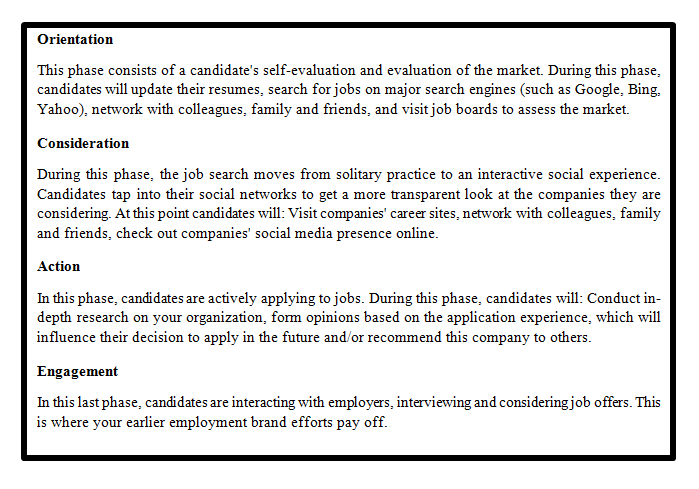
The CareerBuilder study looked at the behavior of candidates throughout the four phases of their job search (orientation, consideration, action, and engagement) and found that the internet and social media were used throughout each of the phases. (See Figure 1 for a definition of each of the four phases.)
Figure 1: The four phases of the the job search
Source: 2013 CareerBuilder Candidate Behavior Study
Job seekers in the orientation and consideration phases have not yet applied for a job at your company. Instead they are assessing the market, learning about an industry, and learning about companies within the industry. These stages are very much knowledge seeking phases for the candidate. Companies who are positioned right can attract great talent during these phases. However, companies who do not have a strong online presence and who do not participate in social media will not catch the eye of job seekers. Think of it as speed dating – you only have a short period of time to make an impression. According to the Neilson Norman Group you have 10 to 20 seconds to make that great impression. If you don’t make a great impression during those few seconds the user will navigate away from your website. Therefore you need to make sure that your website is visually engaging, easy to navigate, and contains quality and informative content.
When a candidate reaches the action stage they not only apply to jobs, they also conduct more in-depth research about a company, and form opinions based on the application experience. Candidates are not afraid to share their experience with the application process. Fifty percent of candidates share bad experiences with others and 64 percent share positive experiences.
In the engagement stage candidates interact with employers, interview for positions, and consider offers. Ninety-one percent of candidates believe employment brand plays a role in their decision whether or not to apply – therefore it is at this stage where your company’s online presence and participation in social media pays off.
How do candidates looking for a position within the manufacturing, transportation, and warehousing industries approach their job search? Let’s look.
Manufacturing industry
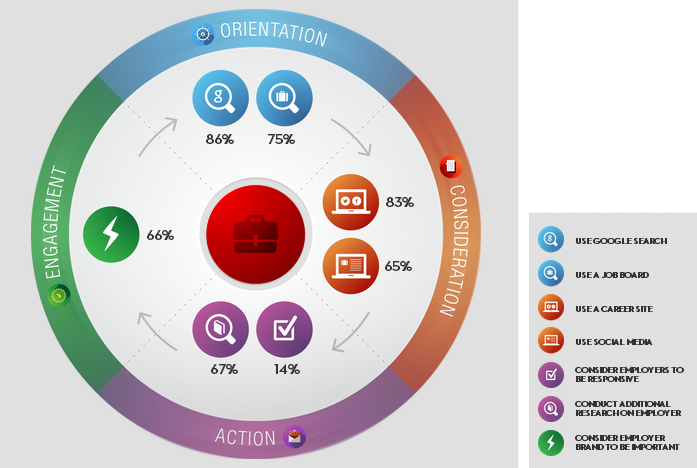
As shown in Figure 2, within the orientation stage, 85 percent of candidates looking for a job within the manufacturing industry turned to Google and 75 used a job board. In the consideration stage 83 percent used a company’s career site and 65 percent used social media to learn more about the company.
In the action stage 67 percent of candidates reported that they conducted additional research on an employer. In this stage only 14 percent of candidates reported employers in the manufacturing industry to be responsive.
Finally, looking at the final stage of the candidate’s journey, 67 percent reported that they felt the employer brand to be important.
Figure 2: The four phases of the job search; manufacturing industry
Source: 2013 CareerBuilder Candidate Behavior Study
Transportation and warehousing industries
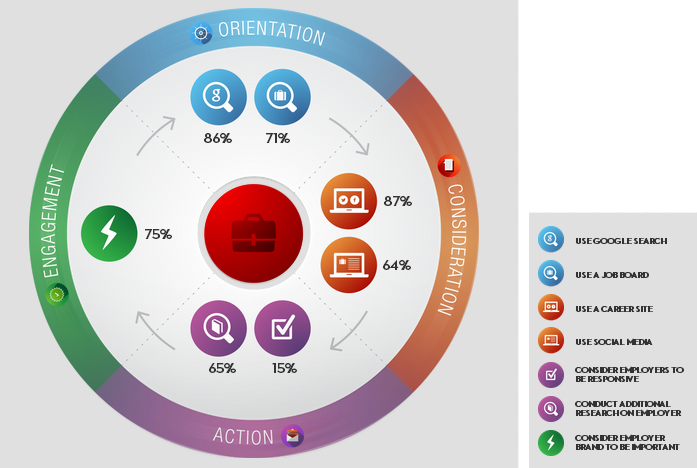
Figure 3 shows that within the orientation stage 86 percent of candidates looking for a job within the transportation and warehousing industries turned to Google and 71 percent used a job board. In the consideration stage 87 percent used a company’s career site and 64 percent used social media to learn more about the company.
In the action stage 65 percent of candidates reported that they conducted additional research on an employer. In this stage only 15 percent of candidates reported employers to be responsive.
In the engagement phase, 75 percent of candidates reported that they felt the employer brand to be important.
Figure 3: The four phases of the job search; manufacturing industry
Source: 2013 CareerBuilder Candidate Behavior Study
In the end
Candidates looking for jobs within the manufacturing, transportation, and warehousing industries are using the internet and social media. They are researching these industries and researching companies within these industries. They are forming opinions, acting on these opinions, and sharing their opinions with others.
If the manufacturing, transportation, and warehousing industries want to attract great talent and retain their interest throughout a candidate’s job search they need to invest in their online presence and become active in social media.

by Elizabeth Hines | Feb 10, 2014 | Blog, Marketing, Social Media
This article was originally published on DC Velocity.
A recent study conducted by the Corporate Executive Board’s (CEB) Marketing Leadership Council found that the average customer progresses nearly 60 percent of the way through the purchase decision-making process before engaging with a sales rep.
Where are customers looking for and finding information? Customers are turning to the internet and social media. If they are looking for your company – what are they finding? A key finding of the CEB study was: “companies that fail to ‘show up strong’ in this context are underserving potential customers and are at risk of losing mindshare and, ultimately, sales opportunities.” This is largely due to when customers tend to buy. Specifically, 80 to 90 percent of prospects who first engage with a company are not ready to buy. Forty percent of these prospects will be ready to buy within a year and 80 to 90 percent will be ready to buy within two years.
Improving your company’s visibility can be achieved by establishing a presence and by optimizing your presence. This is inclusive of launching a company blog, participating in social media, creating YouTube videos focused on your company’s products and services, and ensuring that your website is easily navigable and provides both current and potential customers with the information and services they need.
There are several tactics that can be used to increase visibility and help with measurement efforts include leveraging multiple digital platforms, regular analytics reporting, mobile optimization and content curation – a more recent trend which marketers and business owners have found as an effective method by which to establish online influence.
Both Kinaxis and SJF Material Handling Equipment have invested in becoming visible and both have seen positive results.
Kinaxis, a supply chain management company, launched an online social media campaign with the objective of doubling leads and web traffic numbers. The campaign included two online comedy series (Suitemates and The Late Late Supply Chain Show) and the launch of the company’s 21st Century Supply Chain Blog. The campaign was successful – traffic increased by 2.7 times and leads increased by 3.2 times.
SJF Material Handling Equipment the largest stocking distributor of new and used material handling equipment in the United States, has a strong presence on Facebook, Twitter, and Google+. The company reports that nearly 20 percent of their website traffic is driven by social media. Stafford Sterner, President, notes “If you’re trying to reach out to totally new markets, then you might want to do Facebook and Twitter. If you’re comfortable building that relationship with people or companies you’re close to, then it’s LinkedIn.”
Being visible is an essential part of any business strategy. Take the time to make your company visible.