by Elizabeth Hines | Sep 3, 2014 | Blog, Content Marketing, Marketing, Supply Chain
Before personal computers became ubiquitous, my family’s desktop computer served as our sole connection to the digital world. It wasn’t uncommon for someone to rush through dinner so they could be the first to claim their spot in front of it for the evening. On any given night you could find my mom scouring the web for new dinner recipes, my dad waiting his turn to research ways to improve his golf swing, and my sister bemoaning her wait to explore something decidedly less practical. Regardless of subject matter, though, each one of them sought the same thing – information.
Many years later, that same unbridled access to information has shaped a new environment. Companies are taking note and are reexamining the way they target and interact with consumers. As marketers, we are well aware that this new landscape, driven by changes in buyer behavior, looks far different than it did before. What’s less apparent though, is how we should develop our marketing strategy to reflect these changes.
By leveraging advances in technology and using what we know about current buyer behaviors, we can begin to think about implementing an information-driven marketing strategy. That is, empowering buyers through thoughtful content curation and publication.
So, how can your company start putting some of these ideas into practice? Well, here are the basics.
You need a content strategy.
In a marketing environment where direct messages are being largely ignored by consumers, it’s essential that companies provide real, meaningful value through the materials they publish. Just like my family, consumers are seeking to be educated. Gleanster Research found that 50% of leads are qualified, but not yet ready to buy. However, the odds are that someday they will be, and the content they’re reading today will inform their decision to look to you – or not.
Publish and align your content thoughtfully.
Identify when and where your prospects are most likely to want or access your expert content. What kind of content will attract visitors, convert leads, close customers, and delight promoters? Where will they likely look for this information? Aim to deliver relevant content to the right people in the right places, at the right time. Consider that a recent study by Forrester found that a full 85% of business decision-makers said at least one social media channel is very important in the consideration of business technology purchase decisions. It’s not just simply good business for your company to align content correctly – it’s essential.
Consider the Buyer’s Journey.
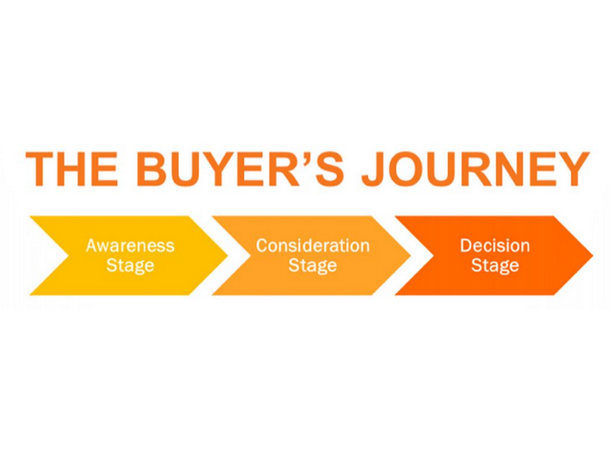
Gone are the glory days of the Sales Funnel. Enter the buyer’s journey. This (relatively) new concept suggests that buyers follow a linear path as they move through the sales process: first the awareness stage, then the consideration stage, and finally the decision stage. Each of these stages in the buyer’s journey necessitates corresponding content. Want to raise awareness of your brand and attract visitors? Try offering a free eBook that addresses a key pain point of your ideal buyer. Looking to close that almost-there sale? Propose a free trial. By considering the journey of your buyer, you are more likely to provide relevant content at the precise moment your buyer needs it.
Considering the characteristics of this new environment, it’s very unlikely that our prospects come to us completely uninformed. With more knowledgeable buyers, businesses must stay one step ahead. Implementing an information-driven marketing strategy gives us an attainable and inclusive way of achieving that.

by Elizabeth Hines | Apr 1, 2014 | Blog, Content Marketing, Logistics, Marketing, Supply Chain

In the 1970s people were exposed to an average of 2,000 ads per day. Today we are exposed to more than 5,000 ads per day. The barrage of ads has resulted in buyers tuning them out. With buyers no longer paying attention to ads, businesses need to adjust how they find and engage new prospects, and how they establish and maintain long-term relationships with customers.
The solution: content. Why content is king and your business should take an oath of alliance to the kingdom.
Content is inclusive of blogs, white papers, e-books, newsletters, infographics, podcasts, webinars, and video. Creating and distributing valuable and relevant content in a strategic and consistent manner is what will drive profitable customer action.
Valuable and relevant content is not a sales pitch. It is not content that pushes your products and services. Rather, it is content that communicates valuable information to customers and prospects so that they have the knowledge to make better informed decisions. Moreover, it is content that establishes your business as a reliable source of knowledge – as the thought-leader within the industry.
How does this translate into consumer acquisition and retention? When the customer is ready to make a purchase they will reward your company with their business and with loyalty.
Skeptical? B2B companies with an active blog generate 67 percent more leads per month than those who don’t. A study by the Custom Content Council found that 72 percent of marketers think branded content is more effective than advertising in a magazine, 62 percent say it is more effective than advertising, and 69 percent say it is ‘superior’ to direct mail and PR.
Content that will move the needle for your business is valuable content. It is content that is informative, educational, interesting, and speaks to your customer’s emotions and speaks to their pain points. Furthermore, it is content that is delivered consistently over time and at the right time.
Before you start to create content for your business consider this sage advice offered by Arjun Basu: “Without strategy, content is just stuff, and the world has enough stuff.”
Research supports Basu. Companies that have a documented content strategy are more likely to consider themselves effective than companies that don’t have a strategy in place (60 percent v. 11 percent). Similarly, companies who put a person in charge of content marketing were more likely to be successful than those who did not (86 percent v. 46 percent).
How do companies put together and execute a content strategy? Eight percent of B2B marketers outsource content planning and strategy. Sixty-four percent of B2B marketers report that they outsource writing and thirty percent outsource distribution and syndication. Diving down further, 72 percent of large B2B companies (1,000 employees or more) outsource content creation and 34 percent of small B2B companies (10 to 99 employees) outsource content creation.
Content is king. By taking an oath of alliance to the kingdom, your company will attract and retain customers. Your company will realize an increase in leads, short sales cycles, and more loyal customers.
If you’d like to learn more about creating a content strategy for your business and/or about content creation , get in touch.
A version of this article also appeared on DC Velocity

by Elizabeth Hines | Feb 25, 2014 | Blog, Marketing, Social Media, Supply Chain
Twitter is one of the more powerful platforms to influence consumers and grow a business. Is your business on Twitter? If not, here are three reasons why your business should be on Twitter:
1. Be Found
When business consumers are searching for products and services, they typically start online. According to a recent study by Pardot, 72 percent of B2B buyers begin their research with Google. Other starting points for research: personal networks (15.58%), Yahoo (5.53%), Bing (2.76%), LinkedIn (2.51%) and social networks (2.01%).
Having a strong presence on Twitter- which has nearly a billion users – will significantly increase your business’ search engine rank and increase visibility. Why is this important? If you don’t rank well you won’t be found – 75 percent of users don’t scroll past the first page of search results.
2. Provide Customer Service – In Real Time
Twitter is an increasingly effective way to provide customer service – and a channel to which many consumers are turning. Your customers may run into issues with your product or service and not have the opportunity to simply make a phone call to a call center or customer service center to take care of this issue. Furthermore, in this day and age, people are using mobile devices more often for their business needs, and Twitter – being a primarily mobile social media network – provides an excellent outlet for customer service representatives to help customers in need. Customer service representatives can communicate more effectively and execute troubleshooting techniques with Twitter than with most other platforms due to the ease of accessibility.
The number of companies handling more than 25 percent customer service inquires via social media has increased from nine percent (2012) to 18 percent (18 percent). Even as more consumers are turning to social media for customer service, many companies are falling flat with respect to providing quality customer service. Only 36 percent of consumers report that their customer service inquiry was dealt with efficiently and effectively. This an opportunity for companies who can/do provide excellent and timely customer service via social media – a J.D. Power and Associates study found that 87 percent of consumers reported that their online social interaction with the company positively impacted the likelihood that they’d purchase from the brand, and that the responsiveness of the service representatives were a key of that satisfaction.
3. Keep an Eye Your Competitors
Since Twitter is a public platform, it enables you to see what your competitors are doing. When performing an industry or business related search, Twitter can provide valuable insights into what kind of information and services your competitors are providing for their customers as well as help you keep an eye on significant achievements – and sometimes, failures – that your competitors will experience, helping you to make important decisions.
This post previously appeared on DC Velocity.
by Elizabeth Hines | Feb 4, 2014 | Blog, Logistics, Marketing, Social Media, Strategy
This article also appeared on DC Velocity.
Research conducted by Adrian Gonzalez, founder and president of Adelante SCM, found that 30 percent of respondents (supply chain professionals) reported that their companies block access to social media sites. One of the reasons for the lack of participation in social media by these companies is likely due to a lack of understanding of what social media is and the role it can play in business. As noted by Gonzalez: “many supply chain executives and companies are stuck on the starting line because they can’t get past the word ‘social’ and the perception it creates.”
In a 2013 article in MIT Sloan Management Review, Gerald C. Kane, Associate Professor at the Carroll School of Management at Boston College, wrote: “When asked to define social media, most people probably rely on something similar to Supreme Court Justice Potter Stewart’s definition of obscenity: ‘I know it when I see it.’” Unfortunately this approach to defining social media tends to perpetuate stereotypes and does not accurately reflect what social media is and how it can be utilized by business. What, then, is social media? Social media is defined by the Oxford English Dictionary as: “websites and applications that enable users to create and share content or to participate in social networking.” These websites and applications are inclusive of Twitter, Facebook, LinkedIn, and Google+. Social media is part of a larger framework called social technologies. The McKinsey Global Institute defines social technologies as: “IT products and services that enable the formation and operation of online communities, where participants have distributed access to content and distributed rights to create, add, and/or modify content.” Social technologies are inclusive of Yammer, Jive, Moxie, and Supply Chain Operating Networks such as Descartes, GT Nexus, Elemica, E2open, LeanLogistics, and One Network. Also included in social technologies are network-based business intelligence and analytics.
Clara Shih, CEO and Founder of Hearsay Social, and Lisa Shalett, Managing Director and Head of Brand Marketing and Digital Strategy at Goldman Sachs, call attention to the fact that when you get right down to it, social media encompasses “a set of new and innovative ways for businesses and customers to do what they have always done: build relationships, exchange information, read and write reviews, and leverage trusted networks of friends and experts.” Furthermore, engaging in social media and utilizing social technologies provides business with the tools to manage status, social networks, and established relationships—all drivers of firm performance. Social media and social networking also enable companies to be able to better manage risk, create demand, define their reputation, innovate, enhance business intelligence, and improve productivity.
To learn more about social media and the role it can play in business, see our white paper: Social Media and the Logistics and Supply Chain Industries: Why Not Participating is a Risk You Can’t Afford to Take.
by Elizabeth Hines | Feb 3, 2014 | Blog, Marketing, Social Media
Getting 10,000 hits a week on your website may be huge accomplishment for your business (and it is), but if at the end of the week none of those hits turn into a lead how do you measure your business’ success?
Knowing which metrics you need to be paying attention to is a crucial task for your marketing team. Whether you’re using Google Analytics or another custom web application, the data that you can learn about your customers – based on their actions online – is priceless. This data will help you create the kind of content that will convert your website visitors into customers, all in good time, of course.
Here are five metrics you should be looking for and measuring in 2014:
1. Customer Engagement
How do your customers interact with the content you digitally share? Do your customers frequently engage with your company’s LinkedIn page, respond to or retweet your tweets, or comment on your blog? If the answer is yes, you have a high level of customer engagement. It’s important to stay engaged with your customers (and potential ones) through these different types of media. The more your customers are engaging with you, the better.
Ignoring negative feedback on your Facebook page, Twitter or blog can be greatly detrimental to your engagement, however. Use these platforms as a customer service tool in order to leverage them to take full advantage of the power of your channels.
2. Conversions
Driving a high volume of traffic to your site is a great way to improve your SEO ranking, build brand awareness, and most importantly, sell your product. Create a definitive way to measure your website analytics and traffic in order to track conversions from your website. If you’re not seeing as many conversions, you may need to take a step back and reevaluate your website. Keep in mind that 55 percent of customers commit to a company because of the ability to find the information or help they need. Are there calls to action on your homepage? Is there easy to find content for consumers to download? And most importantly – how prominent are these calls to action for the untrained eye of your customer to locate?
3. Profit vs Revenue
Many companies generate a significant amount of revenue over the course of a fiscal year but still find themselves coming up short and often times operating at a loss. Expenses over the course of a year may outweigh the actual net profit the company earns. Throwing money at improperly used marketing tools and signing contracts can ultimately be a waste of money. Measure the ROI of these tools to make better buying decisions and save some money.
4. Customer Satisfaction
While this may be a difficult metric to gauge, there are several ways to measure customer satisfaction, both organically and through paid tools. Customer satisfaction is also one of the most important metrics businesses need to consider in order to promote a successful business. Create surveys for customers to provide qualitative and quantitative feedback. Follow product reviews and utilize your social media channels to keep an on what your customers are saying. The value of this type of data is priceless and will help your business plan for future product launches and train customer service representatives.
5. Returning Customers
The success of your business lies on the shoulders of your customers. If your customers are happy, they will keep coming back for more. But how do you ensure that your customers remain in your sales funnel until they are ready to make a purchasing decision again? Keep in touch with them! Send special offers, newsletters and create and distribute content that will keep your customers informed about your products and your industry in order to maintain a level of engagement with them, even when they are not interested in buying something. Businesses with a high number of returning customers will ultimately experience success and growth.