by Elizabeth Hines | Feb 26, 2015 | Blog, Marketing
Different marketing efforts produce different customer conversion rates. Here’s what you need to know so you can maximize your marketing efforts.
Deciding where to focus your company’s marketing dollars to attract leads and convert them into customers can be a tricky endeavor. The key to a successful marketing strategy requires evaluation beyond what’s anecdotally “working” to a more evidence-based approach. Here we pull the curtain back to reveal how certain marketing activities stack up against one another when it comes to customer conversion rates.
Tradeshows
While tradeshows continue to be a staple of most marketing departments in the logistics and supply chain industries, the return on investment can be disappointing. Implisit reports the average opportunity to customer conversion rate for all marketing channels to be 48%, but less than 30% of opportunities generated by tradeshow activity are converted into customers. Tradeshows don’t have to be a total bust, though. Turn tradeshow activities into robust lead nurturing campaigns and use social media to keep the conversation going with customers and prospects. Use your company blog to dig deeper into the issues your prospects had and turn their questions into answers addressed in-depth in blog posts. By driving tradeshow activity back to your company blog and social media accounts, you create more intimate, meaningful relationships with prospects that are far more likely to result in customer conversions.
Lead Lists
Conversion rates for lead lists are among the poorest for all marketing activities. In addition to being one of the highest cost per lead marketing approaches, lead lists can damage the credibility of marketers with target prospects and email service providers alike. Akin to a credit score, marketers who use email to reach prospects should protect the credibility and reputation of their email sender score. If you load up emails and blast them out to anyone and everyone like you would a t-shirt gun at a basketball game, your score will suffer and future emails will be less likely to reach their intended recipient. Similarly, sending generic, uninspired emails to unsegmented lists can undermine your efforts to reach high-value prospects. Work smarter with your lead lists by creating highly segmented mini-lists. Send relevant and specific material to each segmented list. Building hyper-focused lead nurturing campaigns and creating real value for 250 leads is much more likely to generate real opportunities than sending 500 leads a groan-inducing, delete-immediately email.
Webinars
On the surface, webinars seem to pack a big punch for marketers. Having a captive audience in front of which to visually promote your services or products is what marketers live for, right? Not exactly. When it comes down to closing deals and winning customers, webinars don’t live up to expectations. In fact, less than one third of webinar-generated opportunities will convert to customers. One reason for such a meager conversion rate is that most marketers tend to hold webinars as a one-off product or service promotion. Trying to produce a speedy sale by presenting and closing with a webinar turns leads cold or worse, closes deals with customers who aren’t a good match for your products or services. Building a solid, lead nurturing webinar strategy can improve your conversion rates for this marketing channel. Creating a webinar funnel and aligning webinar topics to lead positioning within the funnel builds rapport and ensures your company has the attention of the right audience.
Websites
Leads generated via a company’s website not only have a higher than average lead-to-deal conversion rate (1.5%), but also a faster average time to closing. Other marketing channels – email marketing, social media, print – often link back to a company’s website where the actual conversion will take place. Because of this, special attention should be given to the wording of calls to action, the formatting, and the ease of use of your website. Further, a robust, consistent publication and distribution strategy for website content and resources will ensure the return of visitors and increase opportunities for lead and customer conversions.
Social Media
HubSpot reports that social media has a 100% higher lead-to-close rate than outbound marketing, making it a worthwhile marketing activity for many companies. Social media allows for a more personal and nimble engagement with leads and prospects. Optimize your lead and customer conversion rates via social media by aligning content with platform etiquette, encouraging the promotion of your content by making it easy for followers to share your resources, and not limiting your engagement to leads and prospects.
Surprisingly, marketing activities that generate the most leads often don’t produce the best conversion rates. Do you see that reflected in your own marketing efforts? Which marketing channels have proven the most successful for your company?

by Elizabeth Hines | Feb 4, 2015 | Blog, Data/Analytics, Marketing, Social Media, Strategy

Inbound marketing costs less than outbound marketing. And it works.
The internet has empowered customers. It has provided customers with new methods for finding and researching companies. It has also provided customers with new methods for finding, researching, and buying products.
The internet has changed marketing from a one way street to a two way street.
Customers no longer rely solely on TV/newspaper/magazine ads, billboards, direct mail, email, banner ads, and other traditional outbound marketing channels to learn about new products. These methods are now viewed as too intrusive, especially among younger consumers who regularly tune out the tactics.
Customers want to find YOU (not the other way around)
A study conducted by the Corporate Executive Board’s (CEB) Marketing Leadership Council found that the average customer progresses nearly 60 percent of the way through the purchase decision-making process before engaging with a sales rep. How are they able to do this? By going online. Customers are using websites, blogs, and social media.
A study by Pardot found that 72 percent of B2B buyers begin their research with Google. Other starting points for research: personal networks (15.58%), Yahoo (5.53%), Bing (2.76%), LinkedIn (2.51%) and social networks (2.01%).
What is inbound marketing?
Inbound marketing focuses on consumers finding you.
Inbound marketing meets your customers and prospects where they are, with the information for which they are looking, and at the right moment. Inbound marketing provides value, builds trust and authority, which ultimately result in increased leads and higher conversion rates.
The components of inbound marketing are pretty simple: Create and distribute fresh, relevant, targeted content specifically designed to reach a target audience.
Strategies include:
- Social media marketing
- Blogging and content marketing
- Podcasts
- White papers
- ebooks
- Infographics
- Search engine optimization (SEO)
- Case studies
What is outbound marketing?
In contrast, outbound marketing focuses on paying to broadcast your message to find consumers who will listen to you.
Outbound marketing is a value-driven numbers game. The more banner ads, print ads, and direct mailings you pay for, the more people see your product, and the more sales you’ll make. However, it is costly. Outbound marketing costs 38% more than inbound marketing. The average cost per lead using outbound marketing is $373. The average cost per lead using inbound marketing is $143.
Outbound marketing strategies include:
- Print ads
- TV ads
- Banner ads
- Telemarketing
- Cold calling
- Press releases
- Trade shows
- Email marketing
- Direct mail
Inbound marketing makes sense
Inbound marketing just makes sense. It is a proven methodology and it costs less. Isn’t it time to meet your customers where they are? Get online. Create content. Distribute content. Engage with customers. Optimize your website.
Fronetics Strategic Advisors is a management consulting firm focused on strategy and inbound marketing. When it comes to inbound marketing we take a different approach than other firms. This is because of our business experience and background. We know ROI is important, so our approach is data driven and produces results.
We understand that developing and implementing an inbound marketing strategy can seem daunting. We are here to help. We are happy to take a few minutes and look at your current strategy and give you ideas on how to start, or suggestions on what you can do to make your current strategy more successful. We are also happy to talk with you about what we can do.
We’d love to talk with you about how you can grow your business through inbound marketing.

![Get SMART about your marketing goals [Free Marketing Goals Template]](https://fronetics.com/wp-content/uploads/2024/10/marketing-goals.jpg)
by Elizabeth Hines | Jan 22, 2015 | Blog, Leadership, Marketing
Want to reach your marketing goals? It’s time to get SMART.
Do you know what it is you’d like to see your business achieve this year? It’s likely you do. In fact, most people know generally what they’d like to see happen over the course of a year because they plan. But don’t be fooled, SMART goal setting is far more than just planning.
If you aren’t yet familiar with the SMART Goal concept, it’s essentially a roadmap to success. It makes our goals Specific, Measurable, Attainable, Realistic, and Time-Bound. SMART Goals are a tool that can be applied in many settings. For example, SMART Goals can be used to reduce costs associated with order fulfillment as well as to increase your website’s monthly visits and visitor to lead conversation rate.
Let’s take a look at how one marketing manager, we’ll call him Sam, might apply the SMART goals framework to his marketing efforts.
Specific – Here Sam will describe his goal in detail. He knows he wants to increase website traffic this year, but that’s not enough, so he gets specific. Sam sets a goal of increasing website traffic by 15% by the end of this fiscal year.
Measurable – How will Sam track his progress? In order to keep Sam on track to meet his goal by target date he set, he decides to use the website performance indicators he already tracks monthly.
Attainable – Sam’s goal should be challenging, but not impossible to reach. He reviews his company’s digital media strategy and prior year website traffic reports. After reviewing those, he decides that his current goal to increase sales by $250,000 by the end of this fiscal year is challenging yet achievable.
Realistic – Sam’s company expanded its product line at the beginning of the fiscal year, so it’s likely the company will experience increased marketplace exposure – an ideal situation for his goal of increasing website traffic.
Time-Bound – Sam plans to reach his goal by the last date of this fiscal year. He will track his progress monthly using website performance indicators.
By setting a SMART goal, Sam gives himself a specific focus and builds structure to his general plan of increasing website traffic. Breaking it down into more manageable parts will give him the motivation he needs to reach his goal.
What are your marketing plans for this year? Do you have a SMART goal guiding you? Increase your chances of success by downloading our free Marketing Goals Template.


by Elizabeth Hines | Jan 20, 2015 | Blog, Content Marketing, Marketing, Social Media
Content and social media are integral to business growth
Editor’s Note: This is a guest blog written by Kecia Gray, Vice President, Corporate Marketing & Communications, Transplace. Transplace is a premier provider of transportation management services, intermodal, truck brokerage, and SaaS TMS solutions. Transplace successfully leverages social media and content to expand the company’s brand awareness and thought leadership. The company’s LinkedIn page, Facebook page, and blog were named as “favorites” in a survey conducted by Fronetics.
At Transplace, social media has become an integral part of our marketing and communications strategy and key to expanding our brand awareness and thought leadership in the logistics and transportation space. Our marketing and communication team has had the opportunity to utilize multiple social channels, including:
While we consistently post content to all of these channels, what has been and continues to be important to our social strategy is creating our own original content and utilizing it within a more aggressive approach on Facebook, Twitter and LinkedIn. Sharing content on these channels has allowed our newest blog to achieve fast success in under a year’s time.
Content Is King…
Within any industry, there is always significant opportunity to create original thought leadership content that is informative and insightful. When developing a social media strategy, our foremost goal was to establish a thought leadership blog resource for the market, in addition to providing engaging and personalized content across social channels that was easily sharable. Our main objectives focus on connecting with customers, and creating content that resonates with the members of our industry and provides value to their businesses. By distributing this content across our social channels to foster sharing, conversation and engagement, we’ve continued to gain influence with our targeted audiences.
…And Metrics Are Key
Because of the rapid pace of developing content, it’s important to track and report on levels of engagement to optimize and repurpose information. We created a social plan that included a comprehensive calendar to capture the topics and content items we’d be working on throughout the year. For maximum integration, we purposely aligned new pieces to marketing campaigns and corporate objectives such as events, transportation services and current industry issues. In addition, we established benchmarks and metrics that were important for us to track, such as followers and level of engagement. Analyzing the data allowed us to regularly monitor and evaluate our program, maximize what worked and adjust areas that did not meet expectations.
Incorporating Talent for Quality Thought Leadership
We have also taken advantage of the significant opportunity for Transplace employees at all levels to contribute quality thought-leadership posts across a number of channels. We’ve learned that the best place to utilize this content is on the company’s logisticallyspeakingblog.com. Some of the posts we’re most proud of turned out to be the most popular of 2014, including:
- A motivating guest blog post highlighting our dedication to our customers – from George Abernathy, our president and CCO.
- An insightful commentary on the growth of Transplace in light of a recent acquisition – from Frank McGuigan, president of transportation management at Transplace.
- An informative infographic recap of our signature event, the annual Transplace Shipper Symposium, highlighting some amazing speakers.
To ensure we always stay up-to-date and focused, our team holds quarterly meetings in which we share key highlights, metrics and snapshots of the program quarter by quarter. The time is used to plan for what’s coming up in the future, brainstorm new ideas and make changes as needed. We always make the utmost effort to continually update our program and assess our short and long term goals – an important aspect to any social program!
How is your organization utilizing social media and thought leadership content?
![The Girl Scout Cookie Supply Chain [Infographic]](https://fronetics.com/wp-content/uploads/2024/10/Girl-Scout-Cookie-Supply-Chain-810x675.jpg)
by Elizabeth Hines | Jan 15, 2015 | Blog, Marketing, Supply Chain

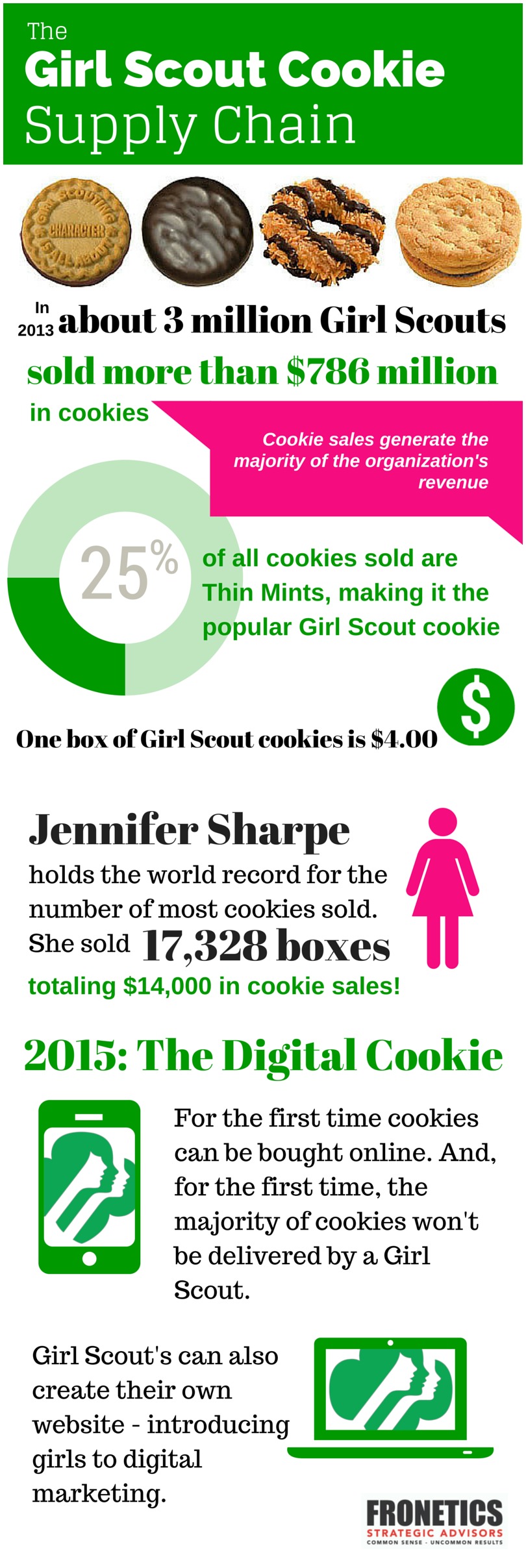
In 2015 The Girl Scouts launched the “Digital Cookie.” How will this impact the Girl Scout Cookie Supply Chain?
When the Girl Scouts of America began selling their now ubiquitous cookies way back in 1917, their operations were simple: cookies were baked in the ovens of troop members and sold in a high school cafeteria. On a mission to raise enough funds to cover the activities of their Muskogee, Oklahoma-based troop, these first cookie salesgirls unknowingly set the stage for a century-long operation that now includes over 2.8 million Girl Scouts and tops $700 million annually.
Throughout the program’s history, the Girl Scouts have made significant changes to the way they do business. To understand the evolution of their supply chain you have to look not only at the physical growth of the program, but the societal factors that have shaped their manufacturing, distribution, marketing and sales functions throughout the years.
From the cookie program’s modest beginnings in the late 1910s through the 1920s, operations were kept small and simple. Cars weren’t yet pervasive in American cities and towns, and door-to-door sales and delivery of goods were the norm. As such, each local troop of Girl Scouts baked, packaged, and priced their own cookies and then combined marketing and sales functions by going door to door. The 1930s saw the Girl Scouts professionalize their manufacturing operations by partnering with and licensing their first commercial bakery – a move concurrent with the rise of automated and commercial bakeries across the United States.
During World War II, flour, sugar, and butter shortages caused a brief stoppage of Girl Scout cookie production. In the post-war boom though, the Girl Scouts were back in the cookie business, setting up shop outside the shopping malls that had sprung up in the suburbs.
As membership rapidly grew, cookie flavors were narrowed to four types in order to standardize their product for greater manufacturing efficiency. Meanwhile, advancements within the packaging industry proved to be a boon for the marketing and sales of Girl Scout cookies as it brought extension to the shelf-life of their products. The most dramatic shift in operations came in 1978. By that time, the number of commercial bakeries involved in the manufacture of GirlScout cookies had swelled to an unmanageable amount. That year officials made the decision to limit operations to only four bakeries, showing a commitment from the organization to uniform quality, packaging, and distribution (a practice even further evidenced today by their licensing of only two bakeries).
From the 1950s through 2014 the sales and marketing strategy of Girl Scout cookies has remained almost unchanged. Each year, between January and April, thousands of girls and their parents have sold cookies by going door-to-door or by hawking their wares outside local supermarkets.
In 2015, in a move that has significant implications for their supply chain, the Girl Scouts have unveiled a new strategy that is directly influenced by yet another societal shift. “Digital Cookie” enables Girl Scouts to market and sell cookies online.
With Digital Cookie, girls are able to create personalized cookie websites and invite customers to visit their website via an email invitation. Digital Cookie also allows girls to take in-person cookie orders (at a local cookie booth for example) via mobile app.
Additional features of Digital Cookie include: campaign advertising, inventory tracking, and shipping management.
Kelly Parisi, Girl Scouts of the USA chief communications executive, points out that these changes are essential in terms of building leadership skills: “It is all about the girls and building future business leaders. They are learning about e-marketing, managing money and additionally creating their first websites.”
The Digital Cookie will have a significant impact on the organization’s supply chain. Not the least of which is that this year, for the first time, the majority of customers will have cookies delivered directly to them – the option of having a Girl Scout deliver the cookies is only available in select markets.
Hungry? Connect with your local Girl Scout or Girl Scout Troop, or try the free mobile Cookie Finder app for your iPhone or Android phone.