by Elizabeth Hines | Apr 21, 2015 | Blog, Leadership, Strategy
The inability to delegate effectively is a principal reason why executives fail. According to London Business School Professor John Hunt, only 30% of managers think that they are able to delegate well. Among these individuals only one-third are considered to be good delegators by their subordinates.
For many managers there is a fear of delegation – a fear of letting go and a fear of losing control. Others confuse delegation for giving away or passing off work, and therefore steer clear. On the other side are those individuals who delegate too easily; managers who delegate everything, but do so ineffectively setting everyone up for failure.
There are still others who have no idea when to delegate and/or how to approach the act of delegation.
Here are 10 steps to successful and effective delegation:
Know when to delegate. Use the 70% rule. Simply put, if the person is able to perform the task at least 70% as well as you are able to, you should delegate the task.
Also consider delegating tasks that you are not good at, tasks you don’t like, tasks that you would like others to learn, or tasks that others should learn.
Choose the right person. When delegating it is important that you choose the right person to whom to delegate. Don’t make the mistake of delegating to the person who has the most time available. Instead, delegate to the individual who has the skills and abilities to deliver.
Trust. Don’t second guess, don’t micro-manage, don’t become a backseat driver. Once you have delegated a task you need to trust that the individual will not only accomplish the task but also that they will do a good job.
Provide clear instructions. It is critical that you provide clear instructions on the task including your expectations, a timeline including the date due, and other details that are needed so that the individual has the information needed to succeed.
Provide the right tools. Make sure you provide the individual with the right tools to accomplish the task.
Delegate in responsibility and authority. Don’t just delegate the task, make sure that you delegate the responsibility and authority as well.
Answer questions. Do not delegate a task and then end all communication. Instead, make sure that you are available to answer questions or to clarify things as necessary.
Recognize that there is more than one way to accomplish a task. Don’t assume that how you would accomplish the task is the only way and/or is the right way. Once you delegate the task you need to support the individual and their approach to accomplishing the task.
Provide recognition. It is important to recognize the work accomplished. Provide public and written recognition.
Say thank you. Don’t forget to say thank you. Saying thank you is very powerful; however, it is often forgotten.
Delegating effectively is critical for business and for your sanity. Let it go.

by Elizabeth Hines | Apr 15, 2015 | Blog, Leadership, Strategy, Talent
You might be surprised to find currently untapped financial gains just by putting employee happiness at the top of your priority list.
The way we work has fundamentally changed. There’s no doubt it is still evolving, but what we know about the way we work is that it can no longer be summed up by the decades-old “going to work” experience. Company-owned buildings, offices, and cubicles are no longer required to accommodate employees and the growing trend of companies offering flexible scheduling and remote work options for employees has substantial implications. There’s good news in that these new employment structures are impacting employee satisfaction and productivity in ways that employees and employers alike can celebrate.
Of the most significant factors affecting employee satisfaction is the employee-manager relationship. Communication is essential for relationships to flourish – especially employee-manager relationships. A recent Gallup poll found that employee engagement was highest among those with daily communication with their managers. By leveraging digital communication tools, employees who work remotely are able to have just as much, if not more, interaction with supervisors. Consistent, regular access to management creates a culture of connectedness and accountability – a culture where employee satisfaction is high. Not only does this allow for nimble adaptations in project approach or client strategy, but the immediate feedback loop positively affects employee engagement and motivation. The emergence of this unique employee-manager structure has allowed for managers to effectively monitor work and provide meaningful feedback, but to avoid micromanagement.
The most effective managers have been shown to be the ones who have respect for their employees as individuals. These managers actively work to help their employees find an ideal work-life balance. Recognizing and responding accordingly to situations where employees are disengaged, either physically or emotionally, from their work responsibilities is at the heart of building a relationship of trust and conviction.
Even though remote work arrangements seem to run counterintuitive to expanding the capacity of workplace productivity, giving employees the flexibility to fit work around their life actually improves worker productivity. The effects of building a company culture where employee satisfaction is valued translates into increased efficiency. That is, a happy and well-managed staff is likely to stay engaged, motivated, and committed to company objectives.
The flexibility that working remotely provides makes it easier for workers to strike their ideal work-life balance. A significant finding emerged from a 2000 study in which researchers found that on average workers reached peak productivity in their 30s and 40s. Most often concurrently, these same workers are tasked in their home lives with parenting responsibilities and the care of aging parents. Giving employees options to maintain flexible work schedules allows employees to give equal attention to both home and work life, enabling maximum productivity. What’s more, by eliminating commute time and spending less time in meetings, people who work from home actually spend more time working. Some find managing work responsibilities from a quieter environment, as opposed to a noisy office, more conducive to productivity.
Presented with all the benefits flexible scheduling and remote work options have to offer, some companies might find it tempting to quickly implement a flexible work program in order to start realizing benefits. But consider that this new work structuring also brings with it a new set of issues for managers to navigate. Supervising employees who aren’t location-specific and monitoring performance without personally interfacing require companies to put thoughtful initial focus on building a solid communication structure and setting manageable expectations for employees. Clear articulation of these expectations and structures is required for success.
While this type of work structuring might not be a good match for every employee or every workplace, the opportunity exists for employers to positively affect worker happiness while simultaneously increasing productivity. If your company is interested in exploring the benefits of offering flexible scheduling and remote workplaces, consider a trial period or experimental program. You might be surprised to find currently untapped financial gains just by putting employee happiness at the top of your priority list.

by Elizabeth Hines | Apr 14, 2015 | Blog, Leadership, Marketing, Talent
As much as 80 percent of employee turnover is due to bad hiring decisions, which doesn’t fare well for a company since a poor hiring choice can cost from 1.5x to 3.5x of that person’s annual salary. Consider an employee who earns $50,000 a year. If that person is a bad hire it could cost a company up to $175,000. The higher the position, the higher the salary, the higher the cost is to lose or fire that person.
More than ever companies are hiring project-based professionals who provide a specific skill-set. These placements might be short-term or long-term, depending on the company’s needs. According to the Wall Street Journal, in March 2014, more than 2.8 million workers, or 2.5% of the workforce, held temporary jobs, up from 1.7 million in 2009. One reason for the spike in numbers is due to companies having to reassess their processes and spending after the recession. Some of these employees, many of whom hold multiple part-time jobs as temps or contractors, are the new semi-permanent, temporary, or “perma-temp” work force. They are in charge of their own brand, skill-set, and advancement.
Why do companies continue to lean in this direction, even while the economy is recovering?
Let’s have a look at the benefits for employers:
- Hiring a temp or contractor allows a company to meet work demand and deadlines without having to make rushed decisions about long-term, expensive, permanent staffing.
- By hiring a contractor or temp employee companies cut expensive benefit, administrative, and payroll costs, not to mention unemployment insurance.
- Bringing in temps or contractors can boost morale amongst other employees who may feel overtaxed. A temp or consultant can take some of the work overflow from other employees.
- Temporary and contracted employees are often eager to work hard to prove themselves and gain experience. Some may be coming off of a period of unemployment and anxious to get back to work. Temporary and contract workers may work creatively and tirelessly to meet their own financial obligations. They might not have the same loyalty as full-time, permanent employees, but since they have to fend for themselves, they are not complacent. According to University of Illinois professor Joe Broschak, “On average, these temporary workers displayed better performance relative to goals compared to their full-time counterparts.” When those temps were hired on as full-time employees “they continued to become better workers after becoming permanent.”
- Temp and contract workers can offer an area of specialization that a company might be lacking in current staffing. It might be less expensive to hire a new contracted employee with years of experience in a specific skill-set than to train a current employee.
Semi-permanent work is not ideal for everyone. Some employees, especially those seeking security, certainty, and the full gamut of benefits will not be satisfied with this work. One concern is how temporary or semi-permanent employees are paid and treated. If paid fairly and treated well, this paradigm will work smoothly for some people.
What are the benefits for employees?
- Many contracting and temporary positions allow for flexibility. The jobs might be part-time and allow for adjusted hours that could accommodate an employee’s home life, another part-time job, or other interests. Because these workers have a different status than permanent, full-time employees, the same “in-office face-time” expectations may not apply to a consultant or temporary worker.
- If a temporary worker or consultant is hired for a specific skill set, they are able to focus on work they’re good at and interested in. If they’ve been out of work they can use this as an opportunity to sharpen their skillset or, perhaps, learn a new one.
- Working on a short-term project might be freeing and invigorating. Having more of a sense of control over one’s own branding, hours, and projects is exciting for many people.
- This can be a wonderful opportunity for people to network, build their personal “press kit”, and garner new, current references.
- Temporary positions often turn into long-term, semi-permanent project based consulting positions. Some people find the combination of interesting work and flexibility perfect for their lives.
It is important to remember that every dollar paid to employees –temporary, semi-temporary, “perma-temp”, full-time, or part-time—is not a dollar taken away from the bottom line, but an investment in the company. Finding the right fit that benefits employers and employees is critical.

by Elizabeth Hines | Apr 7, 2015 | Blog, Leadership, Strategy
There are times when change is good. There are also times when change is bad for business.
The phrase “If it ain’t broke, don’t fix it” is often attributed to Thomas Bertram Lance, businessman and Director of the Office of Management and Budget under President Jimmy Carter. He was quoted in the May 1977 issue of the magazine Nation’s Business, though the sentiment feels as old as human existence. If something is working, and has always worked, then why change it? There are many adages along the same lines: leave well enough alone, never change a running system, don’t change a winning team.
True, humans are always evolving, but we also like consistency and stability. In his book Handbook of Contemporary Economics, Morris Altman wrote, “Without some stability over at least the short term, it is hard to conceive of humans engaging in sustained goal-oriented activity.” Change, adaptability, and flexibility, especially in business culture and lore, have turned from buzzwords to commandments. There are some things, though, that don’t require change. Assess whether change is necessary, rather than assuming it is because it’s socially and commercially popular. Ask:
- Are there assessment tools in place to monitor the business’s success?
- Are customers reporting satisfaction?
- Do your goods match customer needs?
- Do you understand the current market and your place amongst competitors?
- Are profits growing?
- Are overall finances sound?
- Are things running efficiently?
- Are current practices meeting regulations?
- Do you have the right people to meet your objectives?
- Are employees engaged, trained, and developing?
If the answer to these questions is yes, then why change? According to Harvard Business Review change could alienate your base, confuse people, damage your brand, and lose you money. Cadbury and its parent company, Kraft, are experiencing intense backlash due to a change in the Cadbury Creme Egg recipe. People are protesting, writing letters, posting negative comments online, and accusing the company of “ruining Easter.” We’ve seen this before. According to TIME’s article on the top 10 bad beverage ideas, “April 23, 1985, stands as one of the most significant dates in business history — the date the 99-year-old Coca-Cola company announced it was scrapping its original soda formula for a newer, sweeter version.” This change brought with it over 40,000 letters of protest, not to mention the bad press. Within three months the original soda formula, Coca-Cola “classic”, was back and met with an incredibly positive reception.
Some companies opt for a subtler approach to change by expanding its traditional offering. Instead of changing the successful product line for women, Dove expanded into the male market, creating Dove Men+Care, while still adhering to their public image and mission of creating personal care products that support natural health and realistic beauty.
The Harvard Business Review lists Brooks Brothers as a company that successfully found new opportunities without changing its values, “Instead of simply sticking to selling classic clothing, and waiting for outside catalysts (such as the popularity of the fashion in the television show Mad Men) to increase its popularity, the chain innovated around the edges by offering more fashionable accessories — shoes, belts, bags and the like — while leaving its core basically unchanged.” Capitalizing on this opportunity did not drive customers away because Brooks Brothers’ base products remained.
Remember that change has a cost. Are your consumers willing to pay the cost, especially if they didn’t require the change in the first place? Will your partners in the supply chain be willing to do business with you if the change you implement doesn’t suit them or benefit them? Think about some of the elements, for example, of a brand change:
- Content
- Communication
- Collateral
- Contacts
Things such as graphic design, business cards, letterhead, social media, advertising, re-launch, etc. all require real time and money. You must assess if your change will reap real, solid benefits. You don’t want to expend the effort, time, and money to change if you don’t have to, especially if it requires reversing the change or worse, killing your business.
![Supply Chain: 4 Essential Year End Questions to Ask Yourself [Infographic]](https://fronetics.com/wp-content/uploads/2024/10/SupplychainSMARTgoals-1080x675.jpg)
by Elizabeth Hines | Jan 14, 2015 | Blog, Leadership, Strategy, Supply Chain

Don’t start the year without asking these 4 essential questions.
Well, another year has come and gone. Out with the old, in with the new, right? Wait, not so fast. Don’t overlook the valuable information you can glean from conducting a year end review. Use these four questions as a guide to thoughtfully assess the past year. Then, read on to see how a few simple tasks can help shape your best year ever.
1. What were my biggest accomplishments this year?
Twelve months can seem like a long time when you consider everything that happened over the course of the last 365 days. Setting aside some time to review successful projects, notes of thanks from clients, or a particularly positive performance review reminds us what we’re capable of achieving and gives us a renewed sense of accomplishment.
Try this: This year, designate a file folder near your workspace to collect any materials or notes related to your successes as they occur. Doing so will make it easier for you to recall your accomplishments and provide quick access to a list of your achievements – helpful for a healthy dose of motivation or last-minute performance reviews.
2. How satisfied are you with the past year?
Were you successful in meeting the majority of your goals? Do you feel that you worked to your highest potential? Would you have done something differently? What about missed opportunities? Examining what went right and identifying areas for growth and opportunity are powerful exercises that both prevent the recurrence of negative behaviors and reinforce our commitment to our priorities.
Try this: Adding some context to your experiences presents a more accurate picture of your year by tempering unusual highs and lows. Thinking about your experiences of the past year in sum, try to assign a value to your entire year. How would you rate your year on a scale from 1 to 10? 1 to 100? Why?
3. Is my current daily routine structured to optimize time for my priorities?
It’s easy to fall victim to time suckers, especially when they become ingrained into your routine. Has your daily 15 minute coffee break gradually morphed into 25 minutes? Are your 10 minute “headline scans” now closer to 30 minutes? These small, seemingly innocent extensions can snowball into major time loss, causing unnecessary panic as you scramble to meet deadlines.
Try this: The start of a new year is a great time to reset (or rethink) our daily routines. Build activities into your day. If you’d like to continue your now-daily 25 minute coffee break, think about extending your work day by 25 minutes. Feeling like you can’t absorb everything news-worthy in less than 30 minutes? Set your morning alarm 30 minutes earlier so you can arrive to work having already completed your scan of daily headlines. By taking a hard look at where your time is actually going and then spending a few minutes realigning your daily routine with your priorities, you’re intentionally and consciously assigning time to the things you find the most important.
4. What is it that I want to achieve next year?
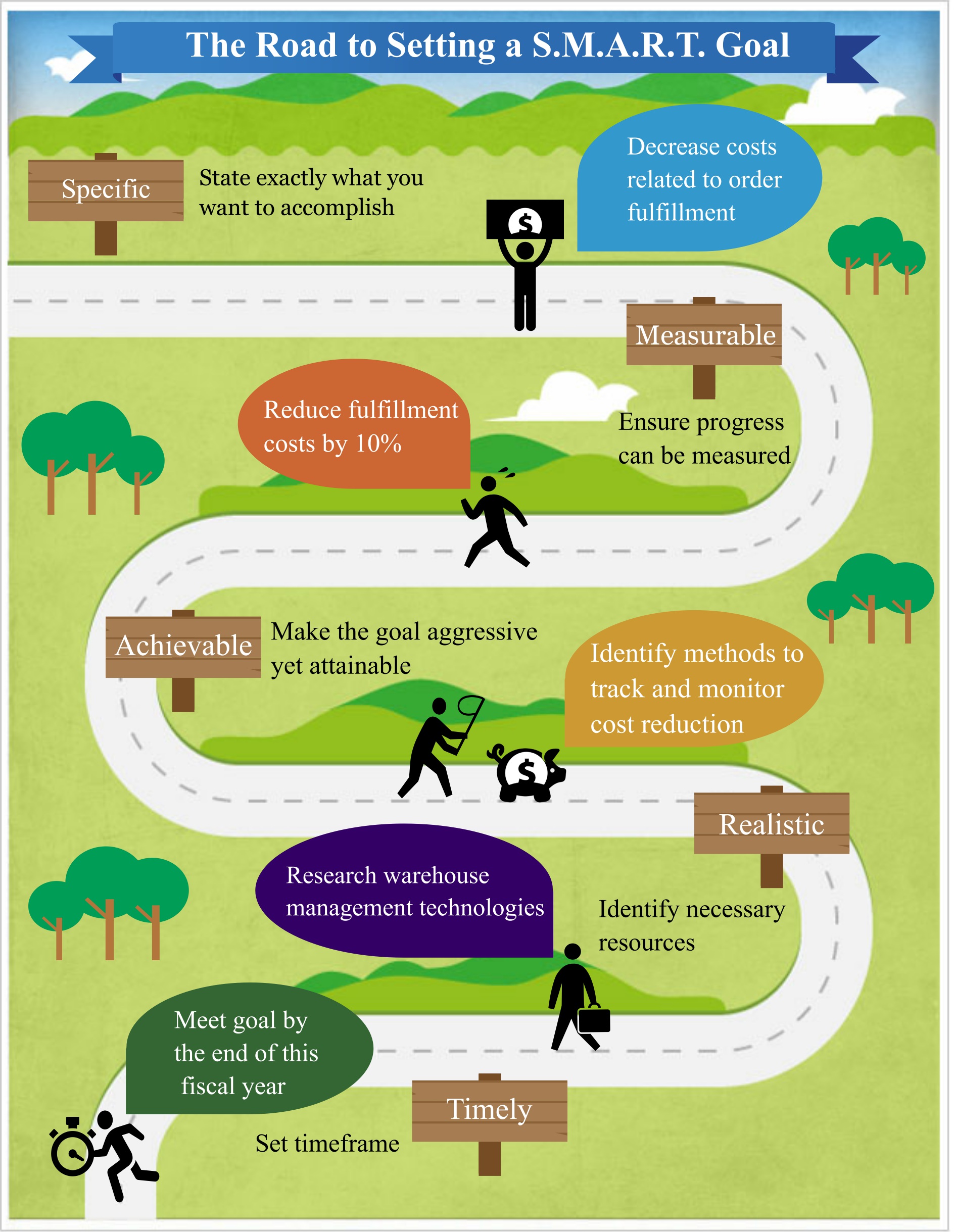
Each new year brings with it a renewed energy to being our best selves. In order to get started, we need to define our priorities and what our success will look like. Setting SMART goals, or goals that are specific, measurable, achievable, realistic, and timely, keeps us moving forward by providing detail and assigning accountability.
Try this: After reviewing your past year, set aside some time to consider what you’ll set out to achieve this year. Create a detailed roadmap to successful completion of your goals.
Use this infographic to help you set, and achieve your SMART goals.
How was your year in review? What were your biggest accomplishments? Are there any goals that you’ll carry over into the new year? Do you regularly set aside time at the close of a year to reflect? We’d love to hear what you do to reset for a new year.