![Workplace diversity impacts the bottom line [Infographic]](https://fronetics.com/wp-content/uploads/2015/08/Workplace-Diversity-Fronetics-Infographic-795x675.jpg)
by Elizabeth Hines | Aug 3, 2015 | Blog, Diversity, Leadership, Strategy
“A diverse organization will out-think and out-perform a homogeneous organization every single time”. A. Lafley, CEO – Procter & Gamble
Recent research conducted by McKinsey & Company found that when it comes to the bottom line, diversity matters. Specifically, companies in the top quartile for gender diversity are 15% more likely to have financial returns above their respective national industry medians, and when it comes to ethnic diversity the financial returns are even greater – 35%. McKinsey & Company note that “correlation does not equal causation;” however, “the correlation does indicate that when companies commit themselves to diverse leadership, they are more successful.”
Why are diverse companies more successful? McKinsey & Company believe diverse companies are better able to attract and retain top talent, improve their customer orientation, and have higher employee satisfaction rates than companies that are not diverse. Arrow Electronics’ Cathy Morris points to an additional reason: “Diversity enables better decision-making and diminishes groupthink.”
Workplace diversity has a significant and positive impact on the bottom line – and on the day to day success of your company. How diverse is your company? What can you do to increase diversity within your company?
![Workplace Diversity [Infographic]](https://fronetics.com/wp-content/uploads/2015/08/Workplace-Diversity-Fronetics-Infographic-scaled.jpg)
Fronetics Strategic Advisors is a leading management consulting firm. Our firm works with companies to identify and execute strategies for growth and value creation.
We advise and work with companies on their most critical issues and opportunities: strategy, marketing, organization, talent acquisition, performance management, and M&A support.
We have deep expertise and a proven track record in a broad range of industries including: supply chain, real estate, software, and logistics.

by Elizabeth Hines | Jul 3, 2015 | Blog, Leadership, Strategy, Talent

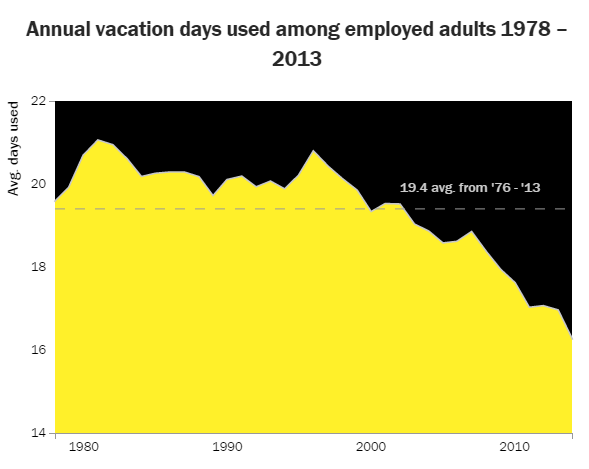
In 1983, the year that Chevy Chase loaded his movie family into the Griswold’s station wagon in National Lampoon’s Vacation, Americans took an average of 20 vacation days. Now, the youngest member of the Griswold family is back on the big screen in 2015, this time taking his own family on a vacation. If Americans’ recent use of paid time off is any indication, reports suggest he’ll see a more open road than his father. Plummeting to an average of 16 vacation days in 2013, the time that Americans spend away from work has fallen precipitously over the past decade. And neither workers nor employers are benefiting from this marked decline.
Source: Project Time Off, Oxford Economics, 2014
You Need a Vacation
Occasionally escaping daily routine is central to both the physical and mental health of employees, and taking time off has been proven to boost work performance and productivity. A 2011 Harvard Medical School study found that sleep deprivation costs American companies $63.2 billion a year in lost productivity. Ernst & Young conducted an internal study of its employees in 2006 and found that for each additional 10 hours of vacation employees took, their year-end performance ratings from supervisors (on a scale of one to five) improved by 8%. What’s more, retention rates were significantly higher among vacationers.
Wish You Were(n’t) Here
Given that the Center for Economic Policy and Research reports that the United States is the only advanced economy in the world that does not guarantee its employees paid time off, it’s unlikely the use of vacation days will increase without some type of policy reform. With American employers not legally required to give workers either paid vacation time or paid holidays, a high number – 77% of private sector companies offer paid time off and paid holidays as part of employee compensation packages. Not surprisingly, though, as employee wage increases, so does the likelihood that they will receive time off; half of low-wage workers typically receive paid time off whereas more than 90% of high-wage workers receive paid time off.
Unplug and Unwind
Harris Interactive reports that people like the idea of more time off. Specifically, 50% of workers who receive paid vacation time in the top 10 cities in the US say they would be willing to sacrifice a workplace benefit for more paid time off. Ironically, although employees say they want more time off, 57% don’t take off the time they already receive. Each year there are 175 million vacation days which American workers are entitled to which are not taken. Even when employees actually do use their time off, they don’t spend the time unplugged. 47% of respondents in a recent survey by Pertino reported that they feel less stressed on vacation if they can stay connected to the office. The same study found that 59% of Americans regularly work, check email, take a phone call, and do other work related tasks while on vacation. But, aside from increased productivity upon their return, employers have another incentive to encourage employees to unplug while away. The Pertino survey found that 77% of those who work on their vacation do not have access to their office network. Because of this, employees use unsanctioned or unsecured cloud services (32%) and/or bring their work computers and files with them on vacation (35%). Public Wi-Fi hotspots are commonly used by vacationers, creating an opportunity for company data and/or log-in credentials to be stolen.
While there are certainly many factors at play in the 2013 job satisfaction study published by the non-profit research group Conference Board, it’s worth noting that back in 1987, when the average American worker took 20 days of vacation, job satisfaction stood at over 61%. Now that Americans have cut back on days away from the office, job satisfaction hovers slightly above 50%. There’s no definite way to tell if Americans could move the needle of job satisfaction by loading up their cars and hitting the open road, but it’s a good start. Let’s start making vacations work for us.
Fronetics Strategic Advisors is a leading management consulting firm. Our firm works with companies to identify and execute strategies for growth and value creation.
Whether it is a wholesale food distributor seeking guidance on how to define and execute corporate strategy; a telematics firm needing high quality content on a consistent basis; a real estate firm looking for a marketing partner; or a supply chain firm in need of interim management, our clients rely on Fronetics to help them navigate through critical junctures, meet their toughest challenges, and take advantage of opportunities. We deliver high-impact results.
We advise and work with companies on their most critical issues and opportunities: strategy, marketing, organization, talent acquisition, performance management, and M&A support.
We have deep expertise and a proven track record in a broad range of industries including: supply chain, real estate, software, and logistics.

by Elizabeth Hines | Jul 2, 2015 | Blog, Leadership, Strategy
“You’re fired!” What you need to know about firing a client
In the early stages most independent contractors and businesses encounter a learning curve when it comes to client procurement and business practices. They may need to find their footing in terms of understanding their own interests and strengths. Over time they start to understand what kind of clients mesh with their expertise, interests, temperament, ethical practices, and work style.
Perhaps you’ve heard some say, “I/we don’t take on new clients.” Don’t new clients bring in more work, more connections, more money? At some point in a person’s career or a business’s lifespan, there is a shift that occurs from needing and seeking clients to needing and seeking better clients. Perhaps at some point the seeking part leaves the equation, and the contractor or company is the one being sought by clients. And, perhaps, a business doesn’t need to take on new clients because they’ve found a sweet spot with their current clients.
In order to reach this enviable equilibrium with clients, sometimes certain clients need to go. Consultant Dorie Clark, who authored the Harvard Business Review article, A Consultant’s Guide to Firing a Client, shares, “I’ve been a consultant for the past nine years, and my client list today looks dramatically different than it did when I launched, in large part because of strategic decisions I made to let some clients go and take on others.”
The thought of firing clients makes some people shudder. It can feel like a risk. In many ways it is a risk, but the payoff can be great. It’s advantageous to take stock of the clients you’re currently working with. Are there clients who are temperamental or disrespectful, who drain time or money from your business, who require skills or services you’re not interested in providing, who aren’t willing to pay what you’re worth, who you’ve been working with as a favor (such as legacy clients)? In order to make room for new clients, who align with your skills and practices and pay what you’re worth, some old clients may need to go. In order to lighten your load, if you’re looking to become more lean, selective, or focused, some old clients may need to go.
Another anxiety around letting clients go is the conflict that could arise. The best way to fire a client is to do it in a respectful manner, remembering that your integrity and reputation are both on the line. Even if you’re dealing with an abusive client, take the high road. The Forbes article Four Reasons to Fire a Client also encourages this approach, “Remember to remain neutral, avoiding accusation, and whenever possible give your customer a referral to another provider.”
Here are 5 tips for successful culling of clients:
1. Do it in writing. Cover potential legal encounters. This is especially useful when citing the client’s breach of contract or working with a disrespectful or petulant client.
2. Be formal. Even if your relationship has felt informal at times, use professional language.
3. Be concise and clear. There is no reason to bring emotions into the mix and no reason to be ambiguous. Briefly state why the termination is occurring and when it will take place (e.g. on X date, by the end of the contract, immediately, etc.) This should be an air-tight document.
4. Be grateful. There’s no need to gush, but even if the relationship has been challenging, express an understanding that clients are the backbone of a business. A simple line like, “we’ve appreciated the opportunity to work with you…” will secure your integrity. After all, it’s not a lie. Most likely you did appreciate the opportunity, but opportunity and experience are two different things.
5. Be helpful. Don’t leave a client stranded. As previously mentioned, if possible, refer your client to another business. This leaves you in good standing with the client and also fosters connections with other businesses.
At the end of the day, how you handle firing a client could impact the relationships with current and potential clients, as well as your own employees. In a society in which transparency and information are demanded and more available, you want to be sure to end this relationship respectfully. Don’t be the one people are gossiping about, be the one people want to work with.
Fronetics Strategic Advisors is a leading management consulting firm. Our firm works with companies to identify and execute strategies for growth and value creation.
Whether it is a wholesale food distributor seeking guidance on how to define and execute corporate strategy; a telematics firm needing high quality content on a consistent basis; a real estate firm looking for a marketing partner; or a supply chain firm in need of interim management, our clients rely on Fronetics to help them navigate through critical junctures, meet their toughest challenges, and take advantage of opportunities. We deliver high-impact results.
We advise and work with companies on their most critical issues and opportunities: strategy, marketing, organization, talent acquisition, performance management, and M&A support.
We have deep expertise and a proven track record in a broad range of industries including: supply chain, real estate, software, and logistics.

by Elizabeth Hines | Jul 1, 2015 | Blog, Leadership, Strategy
How to increase prices and retain customers
Companies raise prices all the time. There are various reasons, explanations, and results. Sometimes companies disclose the changes, but sometimes customers and clients never even catch wind of a change. Let’s have a look at the causes, the perception, and the actions to take.
Why?
Usually there’s an impetus for a company to raise prices. Perhaps there’s a business model already in place to raise future prices, but often a price increase is tied to another event. Here are some typical reasons:
Spike in raw material prices used in manufacturing products
Is there dearth of raw materials used to make the products your company is producing? Perhaps there’s a lack of access to the materials due to stalled transportation from inclement weather, natural disaster, drought, etc. Perhaps resources are dwindling or other roadblocks in the supply chain are driving up prices.
Services or products have become incredibly popular (value-based pricing)
Perhaps you realize that your services or products weren’t appropriately priced early on, and you’re realizing your product’s value in the market. You may also need to reduce demand for some time by increasing prices.
Unexpected change in business or a new tact
Perhaps you’ve lost business recently or your business strategy has changed and you need to cover costs by increasing prices. These changes can come with the opening of a new branch or factory, or the launch of new services or products.
Inflation and market trends
It would be nice to keep prices where they started 5, 10, or 20 years ago, but most businesses aren’t sustainable that way. As all prices of other goods and services rise, so too must yours.
Perception
As detailed in an article about the power or perception, behavioral economist Richard Thaler ran an experiment in which some study members were asked how much money they would give a friend to go buy beer at a “run-down grocery store”. Some study members were asked to get the alcohol at a “fancy hotel”. According to the article, “the fancy resort’s median price was 71% higher than the run-down store’s price.”
This might suggest that considering the perception of your product or services could be key to your next price adjustment. Considering what your current branding is, who your competitors are, and where you want to see your company could help shift your own perception of your company, and that of others. Aligning the two could be critical to successfully stewarding a price shift.
How?
It’s important thoroughly think through a price adjustment. Considering your own worth is important, but understanding that some clients and customers won’t be convinced can be a hard pill to swallow. To make the change more palatable, or even attractive, you should consider these options:
Consider the tactic (good-value pricing, value-added pricing)
Are you planning on going to offer any promotions or price discounts in the future? Are you going to attach value-added features and services to support the higher prices? Are you considering doing bundles packages? It’s important to answer theses questions so that you can communicate to clients and customers.
Consider timing
Have you recently increased prices? Does it feel too soon to do it again? You could risk loyalty from consumers and clients if price increases come back to back. However some believe that small increases frequently are better than large increases infrequently.
Are you implementing new, improved services or bundling new packages? An announcement tied to value increase or product change can be more comfortable for consumers and clients.
Make a solid announcement
Most people feel it is best to announce an increase, especially to current customers and channel partners, rather than try to hide the increase. People don’t want to feel fooled or ignored. They want transparency.
Understand that wording is critical
Being direct and confident in expressing the increase is the best tact. Remember that if you value your product and services, your customers and clients are more likely to as well.
Although you’re briefly sharing the reason for the increase, don’t feel the need to disclose sensitive financial information.
Lastly, provide clear timing on the changes and be sure that changes don’t violate any pre-existing agreements.
Although some customers and clients may bristle at an increase of prices, if you’ve been playing fairly and providing solid products and services, many loyal customers will come along for the ride. If you value yourself, and others value you, you can survive a price increase. You may even thrive from one.
Fronetics Strategic Advisors is a leading management consulting firm. Our firm works with companies to identify and execute strategies for growth and value creation.
Whether it is a wholesale food distributor seeking guidance on how to define and execute corporate strategy; a telematics firm needing high quality content on a consistent basis; a real estate firm looking for a marketing partner; or a supply chain firm in need of interim management, our clients rely on Fronetics to help them navigate through critical junctures, meet their toughest challenges, and take advantage of opportunities. We deliver high-impact results.
We advise and work with companies on their most critical issues and opportunities: strategy, marketing, organization, talent acquisition, performance management, and M&A support.
We have deep expertise and a proven track record in a broad range of industries including: supply chain, real estate, software, and logistics.

by Elizabeth Hines | Apr 23, 2015 | Blog, Leadership, Strategy, Talent
When it comes to hiring it is important to get it right. This is especially true for small businesses. This is not only because of the significant financial implications of a bad hire, but also because, as Jeff Haden points out,
“When employee No. 300 turns out to be a disaster, the impact on the business is relatively small and often confined to a small group of staff. When employee No. 3 turns out to be a disaster, everyone—and everything—suffers.”
When considering candidate for a position intelligent companies don’t focus on where the individual went to school, what degree was obtained, or the companies for which the individual has worked. Rather, intelligent companies focus on qualities; good employees tend to possess distinct qualities.
Here are 14 qualities that good employees possess:
Innovative
Good employees think outside the box and introduce new ideas and new methods for accomplishing a task or achieving goals.
Determined
Determined employees don’t see challenges or constraints as roadblocks. Rather they are unwavering in their resolve to accomplish the task, achieve the goal, or further their career.
Positive
Individuals who have a positive attitude and come to work with an optimistic outlook and tend to be more productive than negative or pessimistic individuals. Moreover, a positive attitude tends to be contagious; therefore, creating a more positive (and productive) workplace.
Confident
A confident individual is one who is willing to take on tasks that others avoid out of fear of failure or fear of a challenge. A confident individual is also someone who is not afraid to speak up and introduce new ideas, or question the status quo.
Honest
As Benjamin Franklin said: “Tricks and treachery are the practice of fools, that don’t have brains enough to be honest.”
Detail-oriented
While it is important to be able to see the big picture, being detail-oriented is critical.
Smart
When someone is smart they are willing and able to learn, to evolve, and to tackle challenges without needing to be coached or coddled.
Ambitious
An individual with a desire enhance their career is someone who will bring valuable contributions to your company.
Hard working
There is no substitute for hard work. As Vince Lombardi put it: “The price of success is hard work, dedication to the job at hand, and the determination that whether we win or lose, we have applied the best of ourselves to the task at hand.”
Cultural fit
It is critical that the individual be a good match for the culture of the company. If there is no cultural fit it is not only likely that there will be friction, it is also likely that the person won’t stay with the company very long.
Autonomous
A good employee is one who is able to work on their own without hand-holding.
Magnanimous
An individual who is considerate, humble, and recognizes the contributions and work of others is someone you want to have join your company and your team.
Accountable
A person who has proven that they are accountable to themselves and to others is someone you want to hire.
Proactive
When an individual is proactive they are more likely to approach their job with energy, and they are more likely to address and tackle challenges before challenges become problems.