There are a staggering number of outlets available for consumers to search for products and services. From Google, Yahoo and Bing to Angie’s List or Craigslist to Facebook or Pinterest, people are spending much more time online researching before making a purchasing decision.
While many businesses may have an excellent track record within their industry, not having a presence on social networks can be detrimental many companies. Without this presence, when consumers are exploring their options before making a purchase, companies are missing out and it ultimately affects the bottom line. Using social media is an increasingly beneficial way for businesses to build and improve their reputations.
Fronetics Strategic Advisors believes that embracing presence is a great way to build your reputation. Here are three reasons why using social media is a valuable decision your company needs:
1. People Should Be Talking About You.
According to Ragan Social Media, 97 percent of consumers who bought a product based on an online review found the review to be accurate. Online reviews can be found on nearly every type of social network – from LinkedIn and Facebook pages, to conversation on Twitter and Reddit. Consumers are talking about your product – and if they are not, there is a problem.
2. The Higher the Number, the Better.
When consumers are researching products and services, they will be looking at your social media channels. Consumers want to know that your business is the go-to in the industry, that you are fully knowledgeable, and want to see that you are sharing content that is relevant to your industry and not simply using social media as a completely self-serving tool. Using social media as a tool to demonstrate thought leadership will increase your reputation. Having a solid number of followers on your social networks, and a high rate of engagement with them, will let your potential customers know that you are a reliable resource for information – and ultimately, a great product that they need to have.
3. Social Media Can Help You Manage Your Reputation
Unfortunately, in businesses across all industries, there are public relations issues (and sometimes nightmares) that require a level of management that is difficult to achieve by simply distributing a press release or adding a note to your website. Building a strong brand through social media and utilizing these channels as a means of being more transparent to consumers is highly beneficial to all businesses. These efforts supplement your public relations efforts and can help restore brand loyalty.
Over the past decade, social media has significantly changed how companies can manage their image. Having a low number of followers and lack of engagement will be a negative on many different levels. On the contrary, building a strong social media presence allows for businesses to connect with customers and consumers like never before. Take advantage of this opportunity and interact with your customers – you’ll be sure to learn something about your own company, as well as about your targeted consumers.
This post was originally published on DC Velocity.
Social technologies offer business enormous potential – potential to unlock value and to increase productivity. How enormous is this potential? The McKinsey Global Institute (MGI) looked at four sectors (consumer packaged goods, consumer financial services, professional services, and advanced manufacturing) in the United States, Germany, United Kingdom, and France and found that social technologies could unlock between $900 billion and $1.3 trillion across these sectors on an annual basis. With respect to productivity, MGI found that social technologies have the potential of raising the productivity of high-skill knowledge workers by 20 to 25 percent.
What are social technologies? Gartner, Inc. defines social technologies as: “Any technology that facilities social interaction and is enabled by a communications capability, such as the Internet or a mobile device.” Examples of social technologies are: blogs, social media (e.g., Facebook, LinkedIn, Twitter), social business software (e.g., Jive, Moxie), and supply chain operating networks (e.g., GT Nexus, E2Open, One Network).
Social technologies are powerful tools because they improve communication and collaboration. MGI estimates that a shift from channels designed for one-to-one communication (e.g., phone, email) to social channels could reduce the time an employee spends on email by 25 percent per week and the amount an employee spends searching for content and expertise by 35 percent per week.
Don’t get discouraged by this. James Manyika, Michael Chui, and Hugo Sarrazin (all from McKinsey) note that establishing a culture that supports social technologies is worth it:
It may take years to establish the conditions of openness and to build trust across the organization, but the companies that accomplish this transformation will not only reap the greatest benefits from social technologies, they will also find that they are faster on their feet, more adaptable, and much more capable of absorbing — and acting on — new ideas. Not a bad investment.
Despite the considerable amount of attention paid to demand generation, many companies (including some companies actively employing a demand generation strategy) do not have a clear understanding of what demand generation actually is.
When asked to define demand generation, a common response is: the generation of demand. Another common response: a marketing strategy. An honest response: I don’t know; what the heck is demand generation?
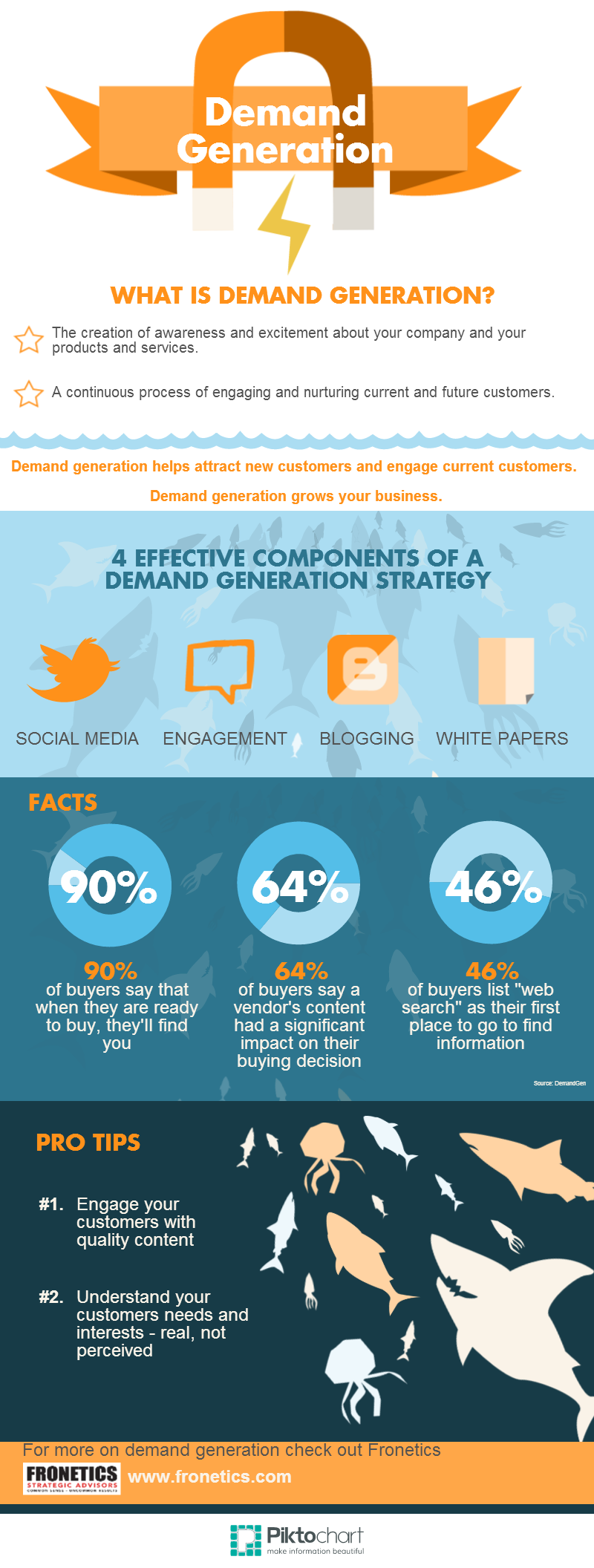
Demand generation is the creation of awareness and excitement about your company and your products and services. Demand generation is not a one-off; rather it is a continuous process of engaging and nurturing both current and future customers. Demand generation helps you attract new customers and engage (or re-engage) current customers. Demand generation grows your business.
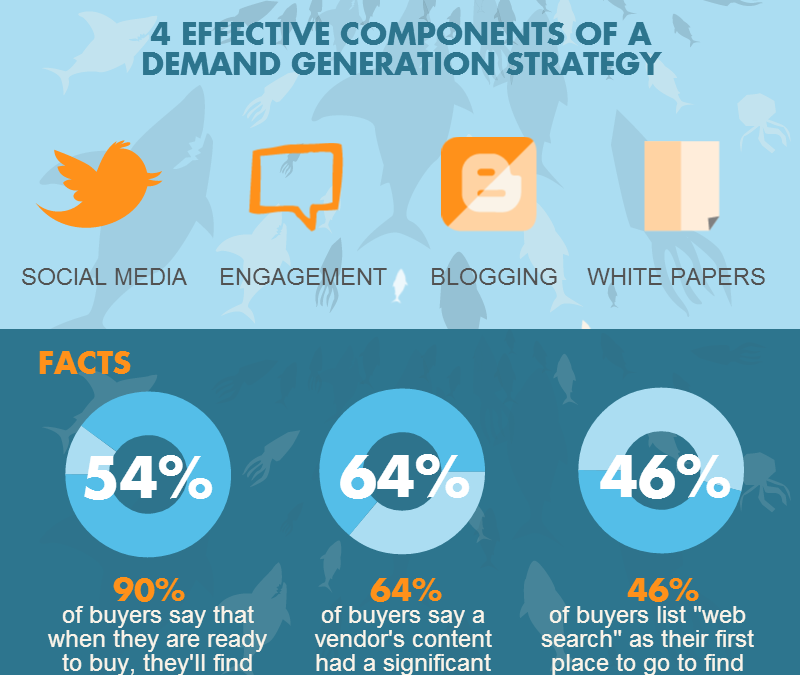
Components of a demand generation strategy include: blogs, social media, podcasts, video, newsletters, email, white papers, and case studies. These components work together. They position your company as a thought leader, expert, and influencer in your industry. They build trust. Importantly, they drive engagement and communication. The foundation of demand generation is the creation and sustaining of relationships between your company and your customers – current and future.
According toDemandGen, 90 percent of business buyers say when they’re ready to buy, they’ll find you. How will they find you? When B2B buyers were asked to rank where they turn to find a new solution, 46 percent listed a “web search” as their first source for information. The leading choice for both the second and third ranked sources was vendor web sites.
With respect to social media, DemandGen found that blogs are considered to be the social media channel with the biggest impact on the researching process (46 percent). LinkedIn was also found to be a place where buyers turned to conduct research (41 percent).
The survey also found that content had a significant impact on the decision to buy. Nearly two-thirds of respondents said “a vendor’s content had a significant impact on their buying decision,” and 34 of respondents “strongly agreed that the winning vendors provided a better mix of content to guide them through each stage of the researching and decision-making process.”
What is the take away? The take away is that a company with astrong presenceand a demand generation strategy is more likely to be successful than a company who does not have a strong presence or a demand generation strategy.
What is the different between a successful demand generation strategy and one that falls flat? A successful strategy incorporates communication, engagement, and quality content. Furthermore, a successful demand generation strategy is built upon an understanding of customer needs and interests –real, not perceived.
At Fronetics we work with our clients to design and implement a demand generation strategy that is right for them – for their company and for their customers. We know how to create awareness and excitement about our clients’ companies and their products and services. We also know how to help our clients engage with and nurture their customers.
Throughour demand generation service, Engage, we help companies acquire new customers and grow their businesses by penetrating new markets and deepening their presence and impact in existing markets. If you are interested in learning more about Engage and about creating a successful demand generation strategy, we’d love to talk with you.
This article was originally published on DC Velocity.
A recent study conducted by the Corporate Executive Board’s (CEB) Marketing Leadership Council found that the average customer progresses nearly 60 percent of the way through the purchase decision-making process before engaging with a sales rep.
Where are customers looking for and finding information? Customers are turning to the internet and social media. If they are looking for your company – what are they finding? A key finding of the CEB study was: “companies that fail to ‘show up strong’ in this context are underserving potential customers and are at risk of losing mindshare and, ultimately, sales opportunities.” This is largely due to when customers tend to buy. Specifically, 80 to 90 percent of prospects who first engage with a company are not ready to buy. Forty percent of these prospects will be ready to buy within a year and 80 to 90 percent will be ready to buy within two years.
Improving your company’s visibility can be achieved by establishing a presence and by optimizing your presence. This is inclusive of launching a company blog, participating in social media, creating YouTube videos focused on your company’s products and services, and ensuring that your website is easily navigable and provides both current and potential customers with the information and services they need.
There are several tactics that can be used to increase visibility and help with measurement efforts include leveraging multiple digital platforms, regular analytics reporting, mobile optimization and content curation – a more recent trend which marketers and business owners have found as an effective method by which to establish online influence.
Kinaxis, a supply chain management company, launched an online social media campaign with the objective of doubling leads and web traffic numbers. The campaign included two online comedy series (Suitemates and The Late Late Supply Chain Show) and the launch of the company’s 21st Century Supply Chain Blog. The campaign was successful – traffic increased by 2.7 times and leads increased by 3.2 times.
SJF Material Handling Equipment the largest stocking distributor of new and used material handling equipment in the United States, has a strong presence on Facebook, Twitter, and Google+. The company reports that nearly 20 percent of their website traffic is driven by social media. Stafford Sterner, President, notes “If you’re trying to reach out to totally new markets, then you might want to do Facebook and Twitter. If you’re comfortable building that relationship with people or companies you’re close to, then it’s LinkedIn.”
Being visible is an essential part of any business strategy. Take the time to make your company visible.