![Why you need an editorial calendar for your blog [Free template]](https://fronetics.com/wp-content/uploads/2015/02/editorial-calendar-template-1080x675.jpg)
by Elizabeth Hines | Feb 16, 2015 | Blog, Content Marketing, Marketing, Strategy
An editorial calendar is an invaluable tool; it will drive success.
When it comes to blogging, you may know what outcomes your company is looking to achieve, but do you have a specific plan to get there? We know post and pray isn’t an effective strategy.
Enter the editorial calendar. The use of an editorial calendar gives structure to your blogging efforts. Think of it as both a commitment to your potential customers and built-in accountability for your overall strategy.
The editorial calendar is a dynamic, internal document that will help your team determine what activities you’ll focus on (and when they’ll be completed) in order to connect and engage potential customers with your blog content. Presented in a calendar-like format, an editorial calendar makes it easy to visualize your marketing strategy, ensuring consistently scheduled blog posts and a diversity of topics. Beyond scheduling blog posts, the use of an editorial calendar keeps other essential considerations front of mind. Including related information, such as keyword assignments, target persona(s), and associated promotions or calls to action, will make your editorial calendar an indispensable guide to your blogging success.
We’ve created an editorial calendar template to guide your blogging efforts. Designed to keep you on track as you develop content that will attract and engage your prospects and customers, our template (it’s free) will help you map out your content in a strategic manner, maximize productivity, and keep you organized.



by Elizabeth Hines | Feb 12, 2015 | Blog, Content Marketing, Marketing, Strategy
7 steps to a blogging strategy for your business.
Blogging has proved to be a successful marketing strategy for many companies. In fact, a full 82 percent of companies who blog daily day have acquired a customer from their blog. Freight logistics company Cerasis acquired 98 new customers by leveraging their blog and digital strategy.
What does it take to attract prospects and acquire customers? Strategy. A 2014 study of B2B marketers found that companies who have a documented content strategy in place are more likely to consider their efforts to be effective than companies who do not have a documented strategy in place (60 percent vs. 11 percent).
Here are 7 steps to follow to develop a blogging strategy for your business.
1. Understand the ‘Why’.
The first step in the development of your blogging strategy will serve as the foundation for all remaining elements. Defining the purpose of your blogging activities and communicating them to your team will create a clear path to successful implementation. Understanding the purpose of your blogging activities means being able to answer two important questions: Why has your company decided to blog? What is it hoping to gain? Setting the strategy for your blog starts with understanding the reasons and motivations for prioritizing blogging as a marketing strategy.
2. Let your ideal customers define content.
Content will be the backbone of your blogging operation. Since you are likely targeting ideal customers with this content in order to convert them to leads, it stands to reason that you should look to them for content inspiration. Building out hypothetical profiles of your ideal customers will allow you to answer important questions such as their pain points, challenges, demographics, and job duties. Use what you know about the buying and researching behaviors of your ideal customers to craft relevant and interesting content they’d likely be searching for. Above all, publish nothing less than your most quality content. Part of building your reputation as a trusted industry thought leader is setting – and continuing – to meet expectations. You’re better off missing one day of a blog post than phoning in something that has the potential to undermine the credibility of your company.
Keywords signal to search engines when there’s a match between your content and the search term of a user. Similar to crafting content with your ideal customer in mind, keywords should be tailored to phrases your ideal customers use to research and buy. Determine which keywords you’ll be targeting and then draft a list of 5-10 keywords and associated long-tail keywords you will include in blog content.
4. Identify content distribution activities and platforms for promotion.
Once you’ve determined strategy for content creation and optimization, it’s time to make a plan to get your quality content in front of potential customers. It’s not enough to just post and pray that you’ll be found – you should actively distribute and promote blog content. Fortunately, the proliferation of social media has made it easier for companies to reach their target audiences, but not without competition. Reusing blog posts and repackaging content in different forms – such as infographics, summary tweets, & photos – will help break through the noise of competitors.
5. Assign responsibility.
Decide what your day-to-day blogging operations will look like. Who will be accountable for each function of your blogging strategy? The size and resource availability of your organization is likely to determine how centralized blogging responsibilities will be. When thinking about responsibilities, consider tasks beyond just writing posts; responsibility for tasks such as publishing and promoting content, drafting an editorial calendar, and analyzing data will all need to be assigned.
6. Maintain an editorial calendar.
Analogous to a roadmap, an editorial calendar will guide your blogging activities and give you a big picture look at where you’re headed and how you’re getting there. It also serves to hold those with blog-related responsibilities accountable to a publishing schedule. And while it’s true that the frequency of blog posts can be linked to an increase in website traffic, stepping outside of what you can reasonably commit to is a recipe for disaster.
Use your editorial calendar to set the number of blog posts you’ll publish each week to ensure posts are published with consistency and regularity. That not only establishes routine for your team, but also for your readers. Get started now with this template for creating your own editorial calendar.
7. Measure, analyze, adapt, and repeat.
Determine what your blogging success will look like and use relevant tools to regularly track and monitor metrics. Include metrics from all platforms of distribution, not just website page views or traffic. Think in terms of retweets, follows, likes, and subscribers. Set, review, and revisit goals consistently. Modify approaches that aren’t working. This on-going analysis keeps blogging efforts nimble, which is particularly helpful when outside factors make changes in blogging objectives necessary.
Develop and implement a well-thought-out blogging strategy. Using quality blog content to find, connect, and engage potential customers online can quickly become your powerhouse marketing activity.
Interested in learning more about how your business can develop a winning blogging strategy? We can help. We are a consulting firm focused on inbound marketing and strategy.


by Elizabeth Hines | Jan 1, 2015 | Blog, Content Marketing, Marketing, Strategy, Talent

93% of B2B marketers use content marketing. However, less than half (42%) of B2B marketers say that they are effective at content marketing. One of the reasons these marketers are ineffective: bad content.
All content is not created equal. There is good content. There is bad content. Good content drives profitable customer action. Bad content does not drive profitable customer action.
You need good content.
What is good content? Here are 3 elements of good content:
1. Good content is original
Good content is content that is unique. It is not content that is copied and pasted. It is not regurgitated content. Not only is original content SEO friendly, original content is customer-friendly. 70% of consumers prefer to get to know a company through original articles.
2. Good content stands out
There are more than 27 million pieces of content shared each day. If you want your content to get lost, create bad content. If you want content that stands out you need content that differs from that of the rest of the pack. You can make content stand out by using winning headlines, graphics, images, infographics, and with great writing.
3. Good content attracts and engages current and prospective customers
Every single piece of content that makes it onto your website and blog needs to be content that is created with your current and prospective customers in mind.
Content that attracts and engages is not a sales pitch. Rather, it is content that communicates valuable information to customers and prospects so that they have the knowledge to make better informed decisions. Moreover, it is content that establishes your business as a reliable source of knowledge – as the thought-leader within the industry.
Good content excites customers and prospects and makes them want to reach out to you.
You get what you pay for
Content creation takes time. However, time is often hard to come by. 69% of content marketers feel a lack of time is their greatest challenge. Moreover, almost 50% of marketers struggle with producing enough content, and producing content that engages.
Faced with constraints of time and volume, quality often takes a hit. In some cases the company itself creates and distributes content of poor quality. In other cases, the company chooses to outsource content creation, but does not do their due diligence with respect to the outsource partner and the quality of content that is created.
Good content is not inexpensive. That being said, good content is worth its weight in gold. This is not something I just say, this is something I know. I gave several low cost content options a try.
I began by conducting a search for companies that offered low-cost content (content that costs less than $20 per blog post). I then narrowed the field down even more by researching which of these companies had the highest rankings and customer satisfaction rates. I then selected two companies and decided to give it a go.
The results were dismal. The content was not good content.
If you want content that is good content and will drive profitable results you need to invest. You need to either invest in someone in-house, or you need to conduct your due diligence and find an outsource partner that can create good content for your company.
Interested in learning more about content? Check out these articles:
Or simply,
by Elizabeth Hines | Dec 31, 2014 | Blog, Content Marketing, Marketing, Strategy
Content marketing is among the hottest topics in marketing and media. However, most companies should stop their content marketing efforts – immediately. The reason these companies should stop is because, despite the hipness of content marketing, they will not realize a positive ROI and will not grow their business through content marketing. In short, many companies are just plain wasting their time and money.
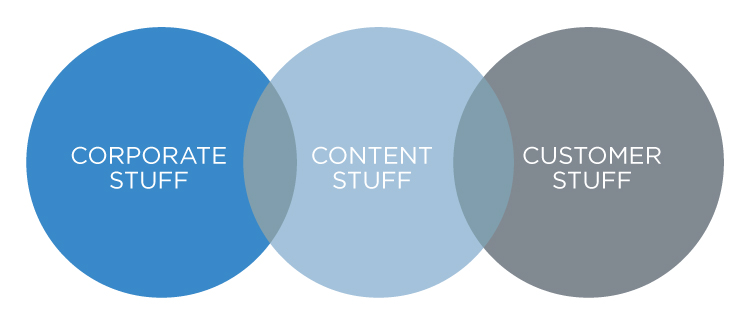
Everybody – companies and customers – has stuff. Joe Pulizzi, Founder of the Content Marketing Institute, discusses the importance of not only recognizing this reality, but also the importance of acting on it.
Pulizzi defines three categories of stuff:
- Corporate stuff;
- Content stuff; and
- Customer stuff.
The majority of companies fall prey to focusing on content stuff within a vacuum. But, as Pulizzi points out: “For content marketing to work, we need to link the corporate stuff with the customer stuff through content.”
What does this mean? This means that in order for content marketing it be effective you need strategy. Strategy is what enables you to link what you know as a brand (corporate stuff) with customers’ needs (customer stuff) through content.
The importance of strategy is underscored by the results of a 2014 study. The study found that 93% of B2B marketers use content marketing. 60% of companies who have a documented content strategy in place consider their efforts to be effective as compared to 11% of companies with no documented content strategy in place. Similarly, the study found that companies who put a person in charge of content marketing were more likely to be successful than those who did not (86% vs. 46%).
If your company is employing content marketing and does not have a strategy in place, stop. Create a strategy, put someone in charge, then re-start your efforts. With a strategy in place, content marketing will drive profitable customer action.
by Elizabeth Hines | Sep 24, 2014 | Blog, Marketing, Social Media, Supply Chain, Talent
“Practice makes perfect.” This is what we have been told by our parents, our teachers, Malcolm Gladwell, and researchers. And, as pointed out by Fast Company, “There’s even a Macklemore song about it, so that makes it real.”
Here’s the problem – it’s not real. A 2014 study found that practice doesn’t make perfect. Instead, reaching a mastery level of whatever it is that you are trying to reach is dictated by your personality, intelligence, and a number of other factors.
Where does that leave us? For business it reaffirms the adage: “Do what you do best, and outsource the rest.”
During a Small Business Week panel discussion Gene Marke, Inc. columnist and owner of the Marks Group, discussed the importance of strategic partnerships and outsourcing:
“One of the smartest things I’ve been seeing companies do is that they do what they do best and outsource the rest. Companies are now thinking more about partners they can work with to provide the type of technologies, services, and solutions they cannot do or don’t have time to do.”
Dan Leberman, the vice president and general manager of PayPal’s North American online small and medium business unit, expressed similar sentiments:
“It’s all about knowing your company’s core competencies. As a small business, you need to decide what you’ll build and what you’ll give to a partner.”
The supply chain and logistics industries have been slower to adopt social media and inbound marketing than other industries. Reasons for this include: a lack of understanding of the benefits, lack of experience, and both time and budget constraints. In short, inbound marketing and associated activities including content creation and social media management are great examples of what companies within the supply chain and logistics industry should consider outsourcing.
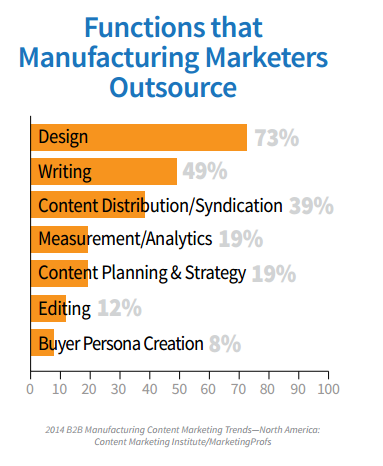
A 2014 study found that 86 percent of manufacturing marketers have adopted content marketing and that the majority (55 percent) of companies look to outsource partners for help.
As shown below, manufacturing marketers outsource a variety of content functions including writing, distribution, design, and editing.
Now that we know practice doesn’t make perfect – play to your company’s strengths and considering outsourcing the rest.