by Elizabeth Hines | Jun 23, 2014 | Blog, Logistics, Marketing, Social Media, Strategy, Supply Chain
Many companies within the logistics and supply chain industries are stuck on the social media starting line. The reason – “they can’t get past the word ‘social’ and the perception it creates.” The reality is that social media is a tool that can be utilized to create value and grow your business.
This is the fourth in a series of articles that provides examples of companies within the logistics and supply chain industries who have moved beyond the social media starting line and have realized the business value of participating in social media.
Cerasis is a top freight logistics company and truckload freight broker. During the company’s first 15 years it focused on traditional sales and marketing strategies and relied heavily on referrals. This strategy worked. Cerasis acquired new customers, retained current customers, and realized positive growth. However, Cerasis was not viewed as an industry leader, and brand awareness was low.
In 2012 Cerasis decided to participate in social media and launch a content marketing strategy.
Cerasis began actively blogging, and began using Twitter, LinkedIn, Facebook, Pinterest, and Google+. The company quickly became seen as a leader within the industry, and brand awareness increased dramatically.
Within 15 months the company received 71 leads from search engines, 65 leads from social media, and 52 leads from webinars. Even more impressive, within 15 months the company gained 35 customers (one customer within the freight logistics industry can mean a lot of revenue).
The results show that Cerasis is no longer on the social media starting line – rather, Cerasis is now a leader, not only in the freight logistics industry, but also in using social media as a business tool.

by Elizabeth Hines | May 19, 2014 | Blog, Content Marketing, Marketing, Social Media, Strategy
The internet is a fire hose stream of content. Being able to navigate the deluge of content and identify the content that is valuable to your customers and to your business is essential; it can also be incredibly time consuming. Content curation tools can save time and increase productivity.
Here are 11 content curation tools that will help you establish your business as a thought-leader and trusted resource.
Bundle Post
With Bundle Post you connect and control Alerts and RSS feeds based on keywords. Bundle Post saves the content from your feed channels as a social media post, allowing you to view, edit or delete the content within the channel, all in one place, then merge selected curated content with scheduled posting times you create for each of your social media accounts and networks. Bundle Post offers a free 30 day trial. After that subscriptions start at $19.99 per month.
ContentGems
ContentGems monitors more than 200,000 news sites, blogs, and social media accounts. With ContentGem you can filter content a number of different ways including: custom keywords, sources, and media types. With ContentGems it is easy to share content via social media (one-click publishing and the ability to schedule posts). Freemium and premium options available.
feedly
feedly enables you to organize, read and share the content of your favorite feeds, blogs and news sites. If you liked Google Reader, feedly fills that gap. Free and premium versions available.
iFlow
iFlow allows users to discover, create, and curate ‘flows’ on any topic. Flows are topic-based streams that let users stay connected and updated with selected topics. These ‘flows’ may be followed, which results in users being continually updated with content relevant to selected topics. Flows can be set up to include detailed filters to provide for high quality of content curation. iFlow also allows users to create their own private flows. Users may invite others to contribute on their flows or can even keep their flows private. iFlow is free.
Individurls
Individurls is quite similar to feedly. One of the strengths of this content curation is how easy it is to use on your mobile phone. Individurls is free.
Netvibes
Although Netvibes is one of the original content curation tools, it remains a solid (and not outdated) solution. Netvibes offers a number of ready-made feeds and widgets. Both freemium and premium versions are available.
Newsle
Newsle is a great tool to keep you on top of what is happening with people within the industry and within your social network. It is also a great tool if there are specific writers or journalists whose content you want to keep track of. With Newsle you identify the people and Newsle sends you an email when those individuals are mentioned in the news.
paper.li
paper.li enables you to create your own online newspaper based on content you select. You add various sources and specify filters on these sources and a paper is produced. You can then add or remove “articles” from the paper. While paper.li can be used for free, the paid version allows you to brand your newspaper.
Post Planner
Post Planner is a solution for those who are avid Facebook users; PostPlanner is a Facebook app. With PostPlanner you enter in keywords and search for trending content within your niche. You can then sort this content to view the content with the most likes or shares so you can see the most popular content. While PostPlanner does offer a free version, to get the most from this tool you will need to upgrade to one of the premium packages.
Scoop.it
Scoop.it offers users a great experience and a constant stream of content. Scoop.it automatically finds and features comment from places like Twitter and Google blogs based on your target keywords and interests. It is also customizable, allowing for additional sources to be added to your stream(s). In Scoop.it you create boards of content around specific topics and then add content to these boards. Scoop.it allows for one-click publishing to your blog and social networks. Scoop.it offers a free trial, after that plans start at $12.99 per month.
Trapit
Trapit positions itself as a “smart” curation tool, increasing in intelligence and relevance the more you use it. It features more than 100,000 vetted content sources and includes “hidden gems” that have the potential to make your presence stand out. How does it do this? Trapit uses the same Artificial Intelligence and Machine Learning Technology from which Siri is derived.
by Elizabeth Hines | May 12, 2014 | Blog, Content Marketing, Marketing, Social Media, Strategy
Adam Robinson of freight logistics company Cerasis wrote a series of posts which outlined the company’s social media and content marketing strategy and the successes the company has achieved through the execution of their strategy. The series also included how-to guides: how to create a social media and content marketing strategy and how to execute a social media and content marketing strategy. Robinson’s series is a must read for companies interested in learning the potential business value of a social media and content marketing strategy and for companies wondering the steps they need to take to create and execute a successful strategy.
Two sentences in Robinson’s series stand out:
“It all comes down to strategy!”
“Now, if you have the resources to be on every social media platform, you should, but only if you do it well!”
Sage advice.
Without a strategy it is unlikely that your company will be successful. Social media and content marketing can be effective tools for attracting new customers and retaining current customers; however, it is unlikely that your company will reap these benefits if you do not have a strategy in place. A 2014 study shows just how important strategy is. The study found that 60 percent of companies with a documented strategy in place consider their efforts to be effective as compared to 11 percent of companies with no documented strategy in place.
A successful strategy takes into consideration your company’s strengths, resources, limitations, and goals. Another component of success – doing things well. For some companies it is possible (and makes sense) to be on every social media platform. For many companies a well-executed strategy means focusing on one or two platforms. Don’t spread yourself thin, make your company show up strong!
It is also important to remember that if you need help, there is help available. It is possible to obtain training in social media and content marketing and it is possible to outsource these functions.
This article also appeared on DC Velocity.
by Jennifer Hart Yim | May 6, 2014 | Blog, Content Marketing, Marketing, Social Media, Strategy
This is the first in a series of blog posts written by Adam Robinson, Director of Marketing at Cerasis. Founded in 1997, Cerasis is a top freight logistics company and truckload freight broker.
The purpose of this series of blog posts is to give others in our industry and especially those in the manufacturing industry, a guide to create an effective digital, social media, and content marketing strategy which will produce results for your company. If you have followed the Cerasis blog since its launch in March 2013, you have noticed that we work really hard at executing our strategy. The reason we work so hard is because we are passionate about educating the marketplace on information that matters to them. In that way, we want to be the de facto expert in the manufacturing and logistics industries. If we can help those who are our customers and potential customers (manufacturers and distributors) with best practices around logistics and freight, as well as manufacturing industry news, we are continuing our mission of driving long term value (even if we give the information away for free). The result (we hope and have seen) is that people view us as the expert and will want to engage us in a long term relationship as their logistics services provider. We hope this is helpful and you learn something from it!
Background of Cerasis use of Content Marketing and Social Media
- Company started formal marketing for the first time in October 2012, its 16th year.
- Little brand awareness, not thought of as a thought leader, but company still grew well by referral.
- It was important for us to establish our messaging, our target audience, and how we were going to best market the company.
- We didn’t have any budget for advertising, and with the rise of content marketing, we knew it was important to use social media and content as a way to start marketing and fine tuning the messaging of the company.
- We finished our market research phase (tips below on how to conduct one), and knew the content and who we wanted to reach.
- We then looked at all the social media channels and decided which platforms to use and what online communities to join.
- We built a strategy and started executing our content by simply posting one piece of content every business day.
Digital Marketing Strategy Approach for Cerasis
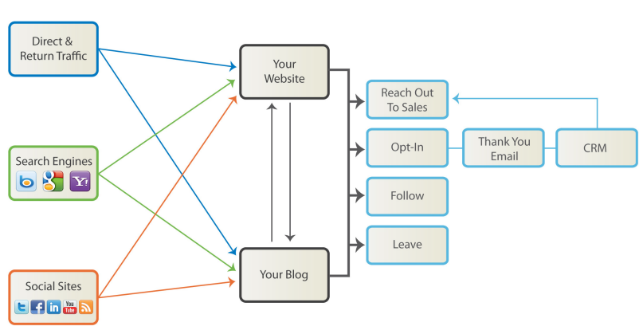
There is a process to strategic planning in order to lead towards sustainable marketing programs which yield a tangible return-on-investment (ROI). The process starts with understanding where social, digital, content, and traditional marketing fits in the world of inbound lead generation and increased brand awareness.
The goal of any strategic plan should be to find and acquire new customers and to grow existing customer relationships. The map on the next page shows how customer engagements happen online and in general. This map to the left helps us determine Cerasis’s route, analyze where we currently are, and hone in on where we should focus our attention to keep the strategy on track.
So, what are all the results from our social and digital marketing you ask?
Cerasis Quick Stats (Sept 12 to March 14)
- All Visits to Cerasis.com: 4,476 to 34,461 (669.91% Increase)
- Blog Visits: 0 to 28,271 (notice how without our content and social media, we would not have grown our website visits to where they are today)
- Social Media Visits: 4 to 8,546 (214,550% Increase)
- Search Visits: 711 to 16,275 (2,189.03% Increase)
- Social Community: 175 users total to 9,635 users total
- Twitter: 0 to 2,760 Followers
- FB: 0 to 492 Likes
- LinkedIn Group Members: 0 to 3,550
- LinkedIn Profile Connections: 120 to 1,456
- LinkedIn Company Page Followers: 51 to 529
- Google Plus Followers: 0 to 662 and over 310,000 views of the Company Page
- Pinterest Followers: 0 to 188
- Engagement Numbers:
- Twitter Mentions/RTs: 14,825/5,721
- LinkedIn Group Comments: 12,766
- Facebook Comments, Likes, Shares: 1,484
- LinkedIn Page Impressions/Interactions/Clicks: 247,359/566/1,560
- Pinterest Impressions/Repins: 73,698/327
- Blog Comments: 841
- Google Plus +1s: 2,976
- Conversion data (note, leads vary based on industry; 1 sale for us can mean a lot of revenue)
- Leads From Search Engines: 71
- Leads From Social Media: 65
- Leads From Webinars: 52
- Total Customers Gained: 35
Conclusion
Social media, content, and digital marketing are much like the Pareto Principle: Focus on the platforms and entities which yield the highest results, don’t just do something or be somewhere to do it! It all comes down to strategy! Now, if you have the resources to be on every social media platform, you should, but only if you do it well!

by Elizabeth Hines | Feb 13, 2014 | Blog, Content Marketing, Logistics, Marketing, Social Media, Supply Chain
Despite the considerable amount of attention paid to demand generation, many companies (including some companies actively employing a demand generation strategy) do not have a clear understanding of what demand generation actually is.
When asked to define demand generation, a common response is: the generation of demand. Another common response: a marketing strategy. An honest response: I don’t know; what the heck is demand generation?
Demand generation is the creation of awareness and excitement about your company and your products and services. Demand generation is not a one-off; rather it is a continuous process of engaging and nurturing both current and future customers. Demand generation helps you attract new customers and engage (or re-engage) current customers. Demand generation grows your business.
Components of a demand generation strategy include: blogs, social media, podcasts, video, newsletters, email, white papers, and case studies. These components work together. They position your company as a thought leader, expert, and influencer in your industry. They build trust. Importantly, they drive engagement and communication. The foundation of demand generation is the creation and sustaining of relationships between your company and your customers – current and future.
According to DemandGen, 90 percent of business buyers say when they’re ready to buy, they’ll find you. How will they find you? When B2B buyers were asked to rank where they turn to find a new solution, 46 percent listed a “web search” as their first source for information. The leading choice for both the second and third ranked sources was vendor web sites.
With respect to social media, DemandGen found that blogs are considered to be the social media channel with the biggest impact on the researching process (46 percent). LinkedIn was also found to be a place where buyers turned to conduct research (41 percent).
The survey also found that content had a significant impact on the decision to buy. Nearly two-thirds of respondents said “a vendor’s content had a significant impact on their buying decision,” and 34 of respondents “strongly agreed that the winning vendors provided a better mix of content to guide them through each stage of the researching and decision-making process.”
What is the take away? The take away is that a company with a strong presence and a demand generation strategy is more likely to be successful than a company who does not have a strong presence or a demand generation strategy.
What is the different between a successful demand generation strategy and one that falls flat? A successful strategy incorporates communication, engagement, and quality content. Furthermore, a successful demand generation strategy is built upon an understanding of customer needs and interests –real, not perceived.
At Fronetics we work with our clients to design and implement a demand generation strategy that is right for them – for their company and for their customers. We know how to create awareness and excitement about our clients’ companies and their products and services. We also know how to help our clients engage with and nurture their customers.
Through our demand generation service, Engage, we help companies acquire new customers and grow their businesses by penetrating new markets and deepening their presence and impact in existing markets. If you are interested in learning more about Engage and about creating a successful demand generation strategy, we’d love to talk with you.