
by Elizabeth Hines | Feb 18, 2015 | Blog, Content Marketing, Marketing, Strategy
Content curation is an essential component of a marketing strategy.
When it comes to creating and executing a successful marketing strategy, content curation is often forgotten. There are two reasons for this: 1) lack of knowledge about what content curation is; and 2) lack of knowledge about the role of content curation within a marketing strategy.
Here is what you need to know about content curation.
What is content curation?
Simply put, content curation is the act of identifying valuable content from a variety of sources and distributing via it your own platform in a strategic manner.
Heidi Cohen, President at Riverside Marketing Strategies, looked to content marketing experts so as to better understand what content curation is and how it can be used to achieve business objectives. She compiled 19 definitions. Here are three of the definitions:
Content curation is the process of identifying content created by others that will be valuable for your audience and then publishing it on your own platform. Michael Brenner of SAP and the B2B Insider blog.
Content curation is hand selecting content created by other sources and sharing them with your community. Best done when whoever is curating adds their own explanation for sharing, reaction or opinions. C.C. Chapman author of Author of Amazing Things Will Happen and co-author of Content Rules.
Content curation is the process of choosing the most relevant information to meet your readers’ needs on a specific topic like a good editor or museum curator. Content curation requires more than just the selection of information. It’s the assembling, categorizing, commenting and presenting the best content available. Heidi Cohen of Riverside Marketing Strategies.
Why content curation matters
A 2014 survey found that 76% of respondents reported that content curation positively impacted their business goals in 2013. 90% of respondents predicted that content curation will have a positive impact on their business goals in the upcoming year.
No one wants to hear about you all the time. As strange as it may sound, talking about your products, services, and your value all the time is bad for business. Here is where content curation comes in. Content curation will serve to establish your business as a thought-leader within the industry and as a trusted resource. Additionally, it will serve to increase your brand visibility. The great thing about content curation is that it enables you to achieve these business objectives without talking all about you.
Navigating the deluge of digital content available, and identifying the content that is relevant and valuable to your prospects and customers is critical.
Two things to remember:
Quality is key
There is a lot of digital clutter. Steller content curation sorts through the clutter and identifies quality content. Make sure that the content you curate is quality content and not clutter.
Be valuable and relevant
Make sure that every piece of content your curate is content that is both valuable and relevant to your prospects and customers.

by Elizabeth Hines | Dec 30, 2014 | Blog, Logistics, Manufacturing & Distribution, Marketing, Social Media, Strategy, Supply Chain
 I wrote a guest blog for freight logistics company Cerasis in October which discussed how companies within the manufacturing, supply chain, logistics, and industrial industries can increase their B2B visibility on LinkedIn.
The catalyst for writing the blog were results from a recent survey focused on the supply chain and logistics industry. 58% of respondents rated LinkedIn as “very impactful,” and 37% rated LinkedIn as “somewhat impactful.” At the same time, respondents reported challenges associated with strategy (33%) and a lack of understanding about the application of social media (24%).
Leveraging LinkedIn
There are over 3 million LinkedIn company pages. Being present on LinkedIn is critical, but is not enough. To maximize your LinkedIn presence you need to take steps to increase your B2B visibility. Here’s how:
-
Create a compelling company page
Your company page is an extension of your company. Make sure that the page is compelling, informative, and presents your company as a leader within the industry.
-
Be active
In addition to keeping your company page up-to-date, you need to be active on LinkedIn on a daily basis. LinkedIn groups are great. Actively participating in LinkedIn groups will allow your company to: 1) gain business and market intelligence; 2) introduce you to new, interesting, and relevant topics; 3) help you increase brand awareness; and 4) position your company as an industry leader.
-
Distribute content
If you want your content to be seen you need to get it out there; you need to distribute your content. Distribute your content and curated content via your company page and (when relevant) within the LinkedIn groups to which you belong.
-
Employee engagement
Your employees are your brand ambassadors. Empower your employees to be active within LinkedIn groups as representatives of your company. Encourage employees to share your content and industry content with their connections. Additionally, encourage employees to share open positions with their LinkedIn connections, and to identify great talent within their network.
-
Prospect for leads
LinkedIn is an effective prospecting tool. Use LinkedIn to prospect for leads and to build your sales pipeline.
-
Optimize your profile
Every employee is a reflection of the company. Encourage employees to optimize their personal LinkedIn profiles.
-
Don’t be annoying
You will fail if you take a “me, me, me attitude.” Constantly self-promoting is bad for business.
If your company is not using LinkedIn you are missing out on opportunities and revenue.

by Elizabeth Hines | Nov 20, 2014 | Blog, Marketing, Social Media, Strategy
 Last month when Flipboard launched the third version of its mobile news app, Mashable called it “the most personal and magazine-like experience the platform has offered yet”. Compared to previous versions, Flipboard 3.0 seems more adept in curating relevant and individualized content for users – a function that can be traced to Flipboard’s newly acquired, topics-based technology.
Earlier this year when Flipboard acquired Zite from CNN, it announced plans to integrate Zite’s technology into Flipboard’s product, improving its capability to personalize news feeds for users. The company reports that once the full integration is in place, they’ll sun-set the nine year old Zite app. First debuting as an iPad-only application, Zite quickly expanded its reach into the smartphone applications market while concurrently navigating acquisitions by CNN then eventually landing at the giant media aggregation app Flipboard. So what is it, exactly, that CNN and Flipboard found so appealing about Zite? Quite simply, it’s personalization.
What the founders of Zite realized early on, and then successfully developed, was that users wanted an individualized news feed that served up topics-specific content. Not only did Zite deliver on that functionality, but it took news feed generation a step further by introducing an element of fluidity. Over time, the application learned what type of content and topics the user found valuable and used that information to curate highly-relevant material. Setting Zite further apart from competitors was its expertise in culling articles from sources other than what users would typically find on social media or search engine results. Flipboard has positioned themselves well to leverage the Zite technology given their similar user bases and platforms. Indeed, Flipboard 3.0 is both more personal and less personal – striking a balance of topic specific, uniquely-sourced content and trending, staff-curated content.
4 Flipboard Uses for Content Marketers
-
Use it to Promote
If your content strategy includes blog writing and the distribution of your content, you should be using Flipboard. It naturally lends itself to the social promotion of your brand and content. Extending your brand beyond your website is as simple as creating a Flipboard magazine of your products and/or services.
-
Use it to Learn:
Flipboard’s 100 million active readers have already amassed a sizable collection of insightful content about specific topics. No matter what industry you work in, it’s almost guaranteed that you’ll find unique content either generated or curated by industry peers.
-
Use it for Productivity:
You’ve already created great content. Flipboard makes it easy to share content across your existing social networks. Want to send a prospect a product or service listing? Tweet them a link to your Flipboard magazine showcasing your products and services.
-
Use it to Unwind:
Miss the last episode of your favorite show? Catch up by reading show-related content. Want to plan a trip to the beach in February? Browse Flipboard’s travel magazines to find the best hotel deals and insider information about resorts.
You can download Flipboard for free. It is available for iOS, Android, Windows, Blackberry, Kindle Fire & NOOK.

by Elizabeth Hines | Oct 30, 2014 | Blog, Marketing, Social Media, Strategy, Supply Chain
The use of third-party logistics providers are on the rise. As many as nine out of ten 3PLs surveyed by Inbound Logistics reported their client base grew by 5 percent this year, continuing the unabated expansion of recent years.
And there’s good reason for it.
In an interesting article on SupplyChain 24/7, Adam Robinson, the marketing guru at Cerasis, lists seven reasons companies should outsource non-core transportation management functions to 3PL providers. Surprisingly, perhaps, many of the same arguments can be applied to companies debating who should be in charge of their content creation.
As the number one reason to outsource, Robinson cites “Time and Money.”
He writes:
“3PL providers are able to reduce the amount of infrastructure investments in equipment, software, facilities and personnel… These 3PLs are like having non-paid employees on your staff and allow shippers to focus resources on areas where they are the expert (i.e. manufacturing, product sales).”
Time and money – or lack thereof – are similarly common issues among companies with respect to social media. In a new Fronetics report on social media use in the supply chain and logistics industries, nearly half of the respondents cited time and budgetary constraints as their top two challenges. Such companies may, as a result, participate only sporadically or not at all.
Since consistency is crucial to online lead generation, anything but a fulltime commitment to the company blog, content curation, and social media outreach is doomed to fail. An outside provider can, just like a 3PL, take these tasks off your hands, allowing you to focus on your core competencies.
Robinson also argues:
“As shippers rely on 3PL partners to provide more strategic oversight, and help catalyze business process change within the organization, the relationship is growing more fluid, and less analytical. Service providers are becoming an extension of the enterprise.”
In short, 3PL providers should not be perceived as outsiders but as partners who know their stuff. They contract with thousands of carriers and know the fastest and most reliable routes to move product from point A to point B.
A marketing company, especially one specialized in content creation for the logistics, transportation and supply chain industries, works the same way, drawing on a wealth of industry knowledge. In essence, you hire experts equipped with the right strategic tools to leverage their market expertise to your advantage.
Finally, Robinson writes visibility of loads gives 3PLs a leg up on the competition:
“Many 3PLs are able to integrate tracking into shipper IT systems, provide integration into ERP and WMS automated notices or even real-time delivery notifications by e-mail.”
Losing track of a shipment equals chaos. 3PL providers are there to ensure it never happens. In the same vein, companies need to track the metrics of their content strategy or risk wasting resources on something that yields no results. They need to know which social media outlets work for their business and what types of content draw traffic to their site. It takes time and resources – and as our survey revealed, both tend to be in short supply.
Your content marketing partner, on the other hand, knows metrics is as important as a shipment is to a 3PL provider.
Outsourcing content creation may be your strategic advantage over your competition.

by Elizabeth Hines | Sep 3, 2014 | Blog, Content Marketing, Marketing, Supply Chain
Before personal computers became ubiquitous, my family’s desktop computer served as our sole connection to the digital world. It wasn’t uncommon for someone to rush through dinner so they could be the first to claim their spot in front of it for the evening. On any given night you could find my mom scouring the web for new dinner recipes, my dad waiting his turn to research ways to improve his golf swing, and my sister bemoaning her wait to explore something decidedly less practical. Regardless of subject matter, though, each one of them sought the same thing – information.
Many years later, that same unbridled access to information has shaped a new environment. Companies are taking note and are reexamining the way they target and interact with consumers. As marketers, we are well aware that this new landscape, driven by changes in buyer behavior, looks far different than it did before. What’s less apparent though, is how we should develop our marketing strategy to reflect these changes.
By leveraging advances in technology and using what we know about current buyer behaviors, we can begin to think about implementing an information-driven marketing strategy. That is, empowering buyers through thoughtful content curation and publication.
So, how can your company start putting some of these ideas into practice? Well, here are the basics.
You need a content strategy.
In a marketing environment where direct messages are being largely ignored by consumers, it’s essential that companies provide real, meaningful value through the materials they publish. Just like my family, consumers are seeking to be educated. Gleanster Research found that 50% of leads are qualified, but not yet ready to buy. However, the odds are that someday they will be, and the content they’re reading today will inform their decision to look to you – or not.
Publish and align your content thoughtfully.
Identify when and where your prospects are most likely to want or access your expert content. What kind of content will attract visitors, convert leads, close customers, and delight promoters? Where will they likely look for this information? Aim to deliver relevant content to the right people in the right places, at the right time. Consider that a recent study by Forrester found that a full 85% of business decision-makers said at least one social media channel is very important in the consideration of business technology purchase decisions. It’s not just simply good business for your company to align content correctly – it’s essential.
Consider the Buyer’s Journey.
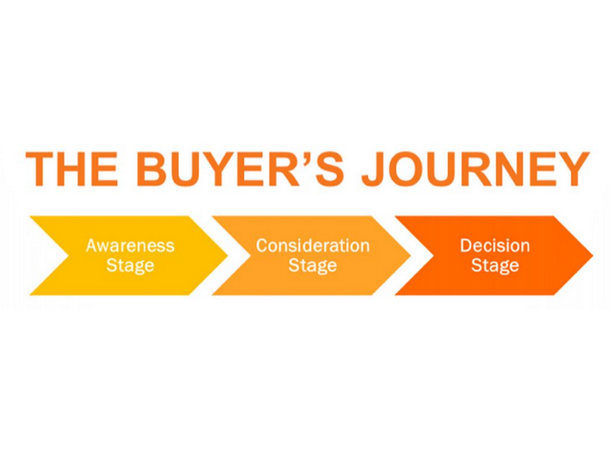
Gone are the glory days of the Sales Funnel. Enter the buyer’s journey. This (relatively) new concept suggests that buyers follow a linear path as they move through the sales process: first the awareness stage, then the consideration stage, and finally the decision stage. Each of these stages in the buyer’s journey necessitates corresponding content. Want to raise awareness of your brand and attract visitors? Try offering a free eBook that addresses a key pain point of your ideal buyer. Looking to close that almost-there sale? Propose a free trial. By considering the journey of your buyer, you are more likely to provide relevant content at the precise moment your buyer needs it.
Considering the characteristics of this new environment, it’s very unlikely that our prospects come to us completely uninformed. With more knowledgeable buyers, businesses must stay one step ahead. Implementing an information-driven marketing strategy gives us an attainable and inclusive way of achieving that.
