by Elizabeth Hines | Jul 16, 2014 | Blog, Manufacturing & Distribution, Marketing, Social Media, Strategy, Supply Chain, Talent, Warehousing & Materials Handling
According to the 2013 CareerBuilder Candidate Behavior Study, job seekers looking for a position with the manufacturing, transportation, and warehousing industries are using the internet and social media not only to look for jobs, but also to research companies within these industries.
Candidates use the internet and social media throughout their job search
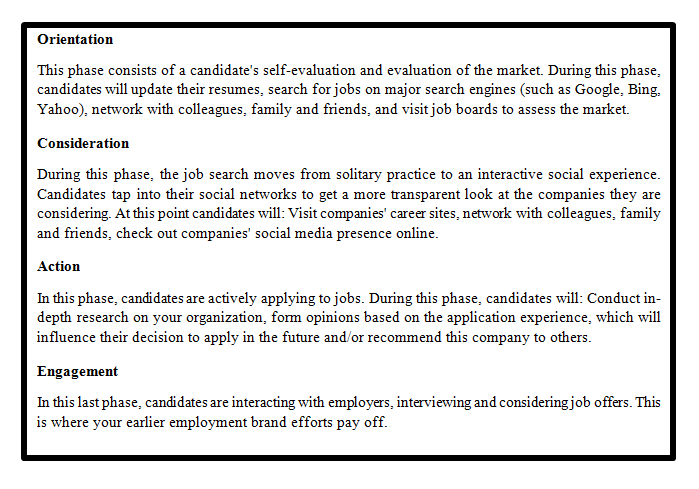
The CareerBuilder study looked at the behavior of candidates throughout the four phases of their job search (orientation, consideration, action, and engagement) and found that the internet and social media were used throughout each of the phases. (See Figure 1 for a definition of each of the four phases.)
Figure 1: The four phases of the the job search
Source: 2013 CareerBuilder Candidate Behavior Study
Job seekers in the orientation and consideration phases have not yet applied for a job at your company. Instead they are assessing the market, learning about an industry, and learning about companies within the industry. These stages are very much knowledge seeking phases for the candidate. Companies who are positioned right can attract great talent during these phases. However, companies who do not have a strong online presence and who do not participate in social media will not catch the eye of job seekers. Think of it as speed dating – you only have a short period of time to make an impression. According to the Neilson Norman Group you have 10 to 20 seconds to make that great impression. If you don’t make a great impression during those few seconds the user will navigate away from your website. Therefore you need to make sure that your website is visually engaging, easy to navigate, and contains quality and informative content.
When a candidate reaches the action stage they not only apply to jobs, they also conduct more in-depth research about a company, and form opinions based on the application experience. Candidates are not afraid to share their experience with the application process. Fifty percent of candidates share bad experiences with others and 64 percent share positive experiences.
In the engagement stage candidates interact with employers, interview for positions, and consider offers. Ninety-one percent of candidates believe employment brand plays a role in their decision whether or not to apply – therefore it is at this stage where your company’s online presence and participation in social media pays off.
How do candidates looking for a position within the manufacturing, transportation, and warehousing industries approach their job search? Let’s look.
Manufacturing industry
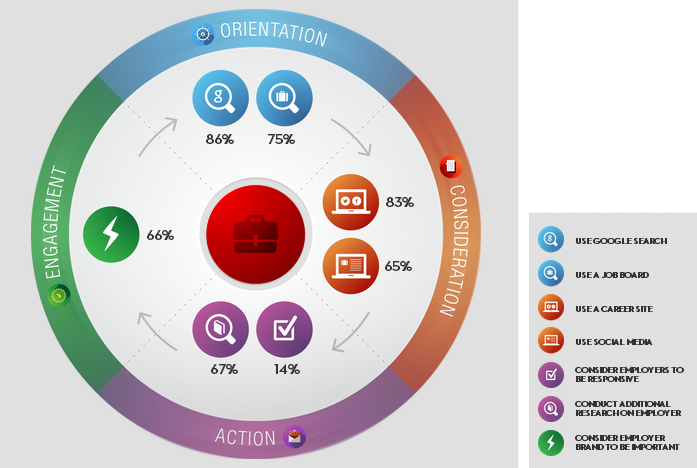
As shown in Figure 2, within the orientation stage, 85 percent of candidates looking for a job within the manufacturing industry turned to Google and 75 used a job board. In the consideration stage 83 percent used a company’s career site and 65 percent used social media to learn more about the company.
In the action stage 67 percent of candidates reported that they conducted additional research on an employer. In this stage only 14 percent of candidates reported employers in the manufacturing industry to be responsive.
Finally, looking at the final stage of the candidate’s journey, 67 percent reported that they felt the employer brand to be important.
Figure 2: The four phases of the job search; manufacturing industry
Source: 2013 CareerBuilder Candidate Behavior Study
Transportation and warehousing industries
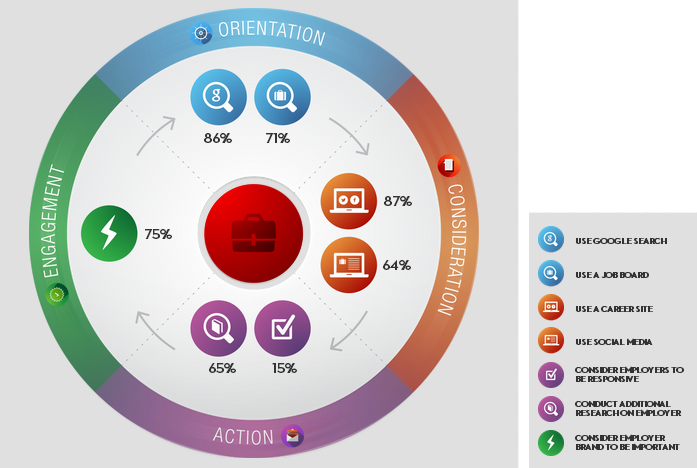
Figure 3 shows that within the orientation stage 86 percent of candidates looking for a job within the transportation and warehousing industries turned to Google and 71 percent used a job board. In the consideration stage 87 percent used a company’s career site and 64 percent used social media to learn more about the company.
In the action stage 65 percent of candidates reported that they conducted additional research on an employer. In this stage only 15 percent of candidates reported employers to be responsive.
In the engagement phase, 75 percent of candidates reported that they felt the employer brand to be important.
Figure 3: The four phases of the job search; manufacturing industry
Source: 2013 CareerBuilder Candidate Behavior Study
In the end
Candidates looking for jobs within the manufacturing, transportation, and warehousing industries are using the internet and social media. They are researching these industries and researching companies within these industries. They are forming opinions, acting on these opinions, and sharing their opinions with others.
If the manufacturing, transportation, and warehousing industries want to attract great talent and retain their interest throughout a candidate’s job search they need to invest in their online presence and become active in social media.

by Elizabeth Hines | Jul 7, 2014 | Blog, Strategy, Supply Chain, Talent

According to Supply Chain Insights 60 percent of companies within the supply chain industry have job openings and 51 percent of companies are seeing an increase in turnover of supply chain leaders. This is now. Looking ahead, the Bureau of Labor and Statistics predicts that the number of logistics jobs are expected to grow by 22 percent by 2022 – nearly double the rate of other professions.
The shortage of supply chain talent is generally attributed to a skills gap. Specifically, that graduates with undergraduate and graduate degrees in supply chain management are not adequately prepared for supply chain jobs, and that professionals within the supply chain do not have the skill set necessary to take on management roles.
Thought leaders including Lora Cecere and David Widdifield have offered viable strategies to address the skills gap. That being said, focusing on education and training, employee retention and growth, and rethinking the talent pool itself does not address the bigger issue – the supply chain industry just isn’t perceived as sexy.
Bob Trebilcock captures this sentiment perfectly in a recent piece in the Supply Chain Management Review:
Admit it. You go to a party and someone asks you what you do for a living. You want to say: Hey, I’m the bass player for Metallica or I’m a transplant surgeon or I’m a skydiving instructor. Something with a Wow factor. Instead, a little sheepishly, with averted eyes, you say: Oh, I work in the supply chain.
Here’s the thing – the supply chain industry is perceived by those outside the industry as having no “wow” factor whatsoever. If the supply chain industry is going to attract new and qualified talent, it needs a face lift. It is time for the supply chain industry to rebrand itself.
If the supply chain industry wants to fill open positions with great talent it needs to change its image. Companies within the industry can start by redesigning their website and by becoming active in social media. Companies can also rethink their recruiting materials and talking points.
What is it that makes (or could make) the supply chain sexy? What can the supply chain industry offer great talent? How can the supply chain better showcase the supply chain of today?
If the supply chain industry can successfully rebrand itself, great talent will not dismiss the supply chain industry, instead it will come pounding at the door.

by Elizabeth Hines | Mar 24, 2014 | Blog, Marketing, Social Media

3PL provider Coyote Logistics is one of the fastest growing companies in North America. The company’s incredible growth (five-year growth: 3,585 percent) and tenacious spirit has not gone unnoticed. Forbes included Coyote in its list of Most Promising American Companies; Supply & Demand Chain Executive listed Jeff Silver, Coyote CEO, as one of their “Pros to Know;” and the company was listed as one of the best places to work by the Chicago Tribune.
There are undoubtedly many factors that have contributed to the success of the company. Coyote’s approach to social media is likely one of the company’s keys to success.
Coyote is a customer-centric company that is creative and pushes boundaries in its effort to “offer the best 3PL experience ever.” Go to Coyote’s webpage and you’ll see that it oozes the company’s culture and mission. Likewise, the company’s LinkedIn, Twitter, Facebook, and YouTube channel exemplify the company’s commitment to their culture, customers, and mission.
Coyote has leveraged social media. The company uses social media to engage with customers, to provide information about the company and the industry, and to find great talent. Coyote’s approach has personalized the company – making it stand out from competitors. The level of engagement has also helped to create relationships – relationships that are essential to growth, especially in the B2B environment.
According to Ron Faris, co-founder and CEO of a new Virgin start-up company, “Social conversation is the only way small brands can get an edge on the big boys.” Why? Faris points to the three ingredients of brand affinity: rational, cultural, and emotional. According to Faris, the rational space is where the big boys play, and the he cultural and emotional space is where there is opportunity for the small brands. More specifically, when a company focuses on the cultural and emotional it is able to capture a customer’s interest not because of what is on sale, but by being bold and engaging.
Faris writes: “Goliath will always have the luxury of being omni-present in the consumer’s field of vision. But Goliath is not nimble. And to truly win a crowd, you need to pivot to tell the right stories they want to hear at the right time.”
If you’d like to learn more about social media and what it can do for your business, get in touch. Fronetics Strategic Advisors works with companies in the logistics and supply chain industries to acquire new customers and grow their businesses by penetrating new markets and deepening their presence and impact in existing markets.
A version of this article also appeared on DC Velocity.

by Elizabeth Hines | Feb 13, 2014 | Blog, Content Marketing, Logistics, Marketing, Social Media, Supply Chain
Despite the considerable amount of attention paid to demand generation, many companies (including some companies actively employing a demand generation strategy) do not have a clear understanding of what demand generation actually is.
When asked to define demand generation, a common response is: the generation of demand. Another common response: a marketing strategy. An honest response: I don’t know; what the heck is demand generation?
Demand generation is the creation of awareness and excitement about your company and your products and services. Demand generation is not a one-off; rather it is a continuous process of engaging and nurturing both current and future customers. Demand generation helps you attract new customers and engage (or re-engage) current customers. Demand generation grows your business.
Components of a demand generation strategy include: blogs, social media, podcasts, video, newsletters, email, white papers, and case studies. These components work together. They position your company as a thought leader, expert, and influencer in your industry. They build trust. Importantly, they drive engagement and communication. The foundation of demand generation is the creation and sustaining of relationships between your company and your customers – current and future.
According to DemandGen, 90 percent of business buyers say when they’re ready to buy, they’ll find you. How will they find you? When B2B buyers were asked to rank where they turn to find a new solution, 46 percent listed a “web search” as their first source for information. The leading choice for both the second and third ranked sources was vendor web sites.
With respect to social media, DemandGen found that blogs are considered to be the social media channel with the biggest impact on the researching process (46 percent). LinkedIn was also found to be a place where buyers turned to conduct research (41 percent).
The survey also found that content had a significant impact on the decision to buy. Nearly two-thirds of respondents said “a vendor’s content had a significant impact on their buying decision,” and 34 of respondents “strongly agreed that the winning vendors provided a better mix of content to guide them through each stage of the researching and decision-making process.”
What is the take away? The take away is that a company with a strong presence and a demand generation strategy is more likely to be successful than a company who does not have a strong presence or a demand generation strategy.
What is the different between a successful demand generation strategy and one that falls flat? A successful strategy incorporates communication, engagement, and quality content. Furthermore, a successful demand generation strategy is built upon an understanding of customer needs and interests –real, not perceived.
At Fronetics we work with our clients to design and implement a demand generation strategy that is right for them – for their company and for their customers. We know how to create awareness and excitement about our clients’ companies and their products and services. We also know how to help our clients engage with and nurture their customers.
Through our demand generation service, Engage, we help companies acquire new customers and grow their businesses by penetrating new markets and deepening their presence and impact in existing markets. If you are interested in learning more about Engage and about creating a successful demand generation strategy, we’d love to talk with you.

by Elizabeth Hines | Jan 27, 2014 | Blog, Manufacturing & Distribution, Marketing, Supply Chain
This post originally appeared on EBN.
For many customers, both current and prospective, you are your packaging. Take the time to do it right.
I recently read a great piece by Zach Williams, founder and creative director of Venveo, on the role of packaging from a marketing perspective.
Williams puts forth the idea that packaging is a critical element to marketing, and therefore, should become the fifth P in marketing (the other four being Product, Pricing, Placement, and Promotion). He makes the point that “packaging embodies so much more than promotion… [it] can make or break how your company is positioned.”
Williams discusses how packaging can create customer experiences. He offers the example of Apple’s packaging and how getting a box with the Apple logo on it creates an emotional response for customers. So emotional is the response that Williams pointed out that there are videos on YouTube of people “unboxing” their new products. When Williams wrote the article in October 2012, there were “thousands” of videos; when I looked today there were close to 3.5 million. That growth alone says a lot. And, the joy and excitement displayed in the videos speaks volumes to Apple, the product, and to the packaging itself.
Another company whose packaging has become iconic in the realm of creating customer experience is Tiffany & Co… New York Times writer Alice Rawsthorn wrote an articleabout the role Tiffany’s packaging played in her decision to purchase a pendant for her goddaughter: “Would I have bought that pendant without the packaging? I’m not sure, but the thought of Delilah opening that duck egg blue box tied with white satin ribbon certainly clinched my choice.”
Williams also notes that packaging can also serve to justify the price of the product and that “packaging should always aim to increase the perceived value of the product.” To Williams’s point, look at both Apple and Tiffany — their prices are higher than their competitors.
The final point in Williams’s article is that the packaging of a company needs to go beyond the physical and extend to the company’s website — that the website “can be considered packaging as well.” The point is a good one, but I think it should go further. I believe packaging should not only include the company’s website, but should also extend to the company’s Facebook and LinkedIn pages, Twitter account, blog, and any outward-facing materials. If your company does not take the time to create an exceptional package for customers, you will be passed over.
Your company’s physical packaging and online packaging speaks volumes about your company. For many customers, current and prospective, you are your packaging. Take the time to do it right.