by Elizabeth Hines | Nov 10, 2016 | Blog, Content Marketing, Marketing
Just as purchases are becoming more automatic, generating marketing content also needs to keep up with the times.
Automated purchasing systems are more and more in vogue, opening another avenue for strong content marketing to reign.
Did you know with the simple touch of a button, consumers are able to receive boxes of cereal, bags of coffee, and jugs of laundry detergent with hardly a thought? Amazon’s latest offering — the Dash Button — is a branded wireless device that allows consumers to efficiently order products right when they think of it. Customers can strategically place the button in their pantry, for example, so they can easily reorder supplies when reaching for the last bottle of water or opening the last bar of bath soap.
“Subscribe and save” programs available through retail giants such as Amazon and Target are another way to keep consumers stocked with the supplies they need. These items arrive on a pre-set schedule without the buyer even having to think about it. And subscription-based sales models offered by Dollar Shave Club, Starbucks, and Blue Apron keep consumers clicking through, adding big bucks to corporate coffers.
Influencing the preprogrammed bots
The robotization of consumer spending is changing the current model of marketing, advertising and shopping, according to a recent Harvard Business Review article, and marketers need to be prepared for the next level of automation in order to keep revenues streaming.
If this automation crosses into the B2B marketplace, suppliers will face new challenges — including finding ways to affect choices of preprogrammed “bots,” such as Amazon’s Dash Button. In this possible and increasingly likely world, HBR posits that advertising dollars will be diverted from traditional models to building relationships, challenging incumbents, increasing rates of consumption, and influencing marketing algorithms.
One such algorithm analyzes products that are pre-selected as the default brand in the item’s software (think: the scurry to become Apple’s default map program). Fresh and tailored content that even bots can process will be paramount to targeting content to buyers.
Content that educates the people behind the bots
In this future scenario, what can brands do to win business from competitors?
Certainly, it will take a significant effort to persuade a customer to change the algorithm’s default settings to another product or service. Vendors will have to produce highly targeted, personalized content that demonstrates a deep understanding of the customer’s business and how their product or service will better suit their needs.
Interestingly enough, that’s a preference that we’re already seeing among B2B buyers.
In the 2016 B2B Buyer’s Survey Report, 69% of buyers said relevant content that speaks directly to the company is very important, signaling that personalized content packages equate to satisfied customers and potential customers.
Using content to build relationships will continue to be of utmost importance, even in the age of bot-to-bot purchases. Optimize content to include buzz phrases and recognized keywords, and even bots will get the message.
Related posts:

by Elizabeth Hines | Nov 3, 2016 | Blog, Content Marketing, Marketing, Social Media
The web search has changed the way businesses shop for products and services — and content marketing is your key to reaching them.
What’s the first thing we all do when we need a gift for Fathers’ Day, can’t think of a song lyric, or want to buy a new kitchen appliance? We Google it.
The world of B2B sales is no different. Demand Gen’s 2016 B2B Buyer’s Survey Report found that 62% of B2B buyers say that a web search was one of the first three resources they use to learn about a solution. In fact, 94% of buyers reported using online research at some point in the purchasing process.
That means businesses must be more than just conscious of their digital presence: They must actively manage their website and digital content assets to accommodate the ways buyers are conducting research.
Seeing opportunity in the new reality
In the pre-internet age, the salesperson’s role began relatively early in the buyer’s journey. Today’s average B2B buyer, however, progresses nearly 60% of the way through this process before making any sort of contact with a sales rep. That means your prospects are forming their early opinions about your business and your products based on what they find on the web.
This new reality may seem daunting, given how much of the purchase decision-making process occurs before you have the opportunity to engage with a potential client. But in reality, this changing climate offers serious opportunities for businesses to demonstrate their expertise, without turning buyers off with overt sales pitches.
Content is king/key
To make the most of the potential purchaser’s experience with your business, content is key.
A robust content marketing strategy builds brand awareness, establishes trust and rapport with prospects, and generates traffic to your website. Thoughtfully generated and curated content catches the attention of buyers and keeps them interested in your business through the time of purchase.
Specifically, 67% more leads will be generated by companies with an active blog in 2016. And content isn’t limited to your website: a vibrant social media presence helps buyers conduct their research, with 57% of consumers reporting that they are influenced to think more highly of a business after seeing positive comments online.
Again, while this new reality may seem like a challenge, it’s actually a golden opportunity for your business to put its best foot forward with potential buyers. By thoughtfully generating and curating focused, informative content, companies can guide B2B buyers through the sales process, and develop an engaged and loyal customer base.
Related posts:


by Elizabeth Hines | Oct 26, 2016 | Big Data, Blog, Content Marketing, Data/Analytics, Marketing
Big-data insights can help you segment your email database to better target prospects based on where they are in the buyers’ journey.
Most companies these days are swimming in a sea of big data, the great swaths of information they’ve amassed from sales records, social media connections, website leads and contacts, and online analytics.
At first glance it’s a tangle of information that is hard to organize and even harder to learn anything from. That’s a stumbling block that forward-looking businesses need to overcome. Big data can help breathe new life into one of the most reliable yet shopworn tools of the trade: email campaigns.
Embrace Big Data
A study by the executive head-hunting firm Spencer Stuart surveyed 171 companies regarding big-data usage. Just a little over half of the companies used their big data to help guide email, SEO, and SMS marketing campaigns. That’s a fairly low rate, given the potential leg-up that big data can provide.
Consider what Walmart is doing. The company has big-data information on about 60% of all Americans, with which it micro-targets customers based on their individual interests and habits. It’s a powerful strategy that is spreading quickly to businesses of all sizes.
How can you use big data to freshen up your email campaigns?
Be a Collector, Not a Hoarder
Chances are, you are obtaining a lot of data, especially if you have an active content marketing plan in place. Not all of the data you get is equally important. Your focus should be on data that can lead to an actionable and quick response — for example, are you gathering information on your customers’ buying habits? Do you know who they are, where they are, what their interests are, what their email address is, and how your business connects with them?
Collect that relevant data and study it. Much of it will come from the buyer’s journey — the breadcrumbs that potential buyers leave for you in your big data. These pieces of information are keys to your personalized email responses.
Respond In Kind
Most experts agree that a quick and targeted email response is a good strategy for encouraging a new customer to make a purchase. The email needs to respond directly to the buyer’s interests — using information you’ve (hopefully) logged with your big data.
From this point on, it’s crucial to make sure that every email that is sent to that buyer is built around a backbone of big data. Nurture your customers with personalized emails that offer content and deals that line up with their specific interests.
Don’t Mess with the Masses
Mass emails — the generic sales pitch email — used to be the cost-effective and simple way of reaching and converting customers. Now, it’s more than likely they’ll get sent to the trash, or worse, the spam filter. The mass email is your one-way ticket to spam purgatory.
“Traditional methods of mass marketing doesn’t resonate anymore and they’re being ignored by the audience,” said Volker Hildebrand, Global Vice President of Strategy at SAP Hybris, in a recent interview with Forbes. “Data is the fuel for customer engagement, and being able to pull together all the relevant information about in real-time.”
You can do better than the mass email approach. If you’ve collected relevant data and you’ve studied your buyers’ journeys, you have the tools in place to build a smart email campaign. Tailor your campaign to personalize your approach to your customers, and more than likely they’ll open that email.
Related posts:

by Elizabeth Hines | Oct 19, 2016 | Blog, Content Marketing, Marketing, Social Media, Supply Chain
Native advertising is the non-ad-like way to promote your business’ content to users who might be interested in it.
Is your business using native advertising to promote your content with a targeted audience? If not, you’re missing out on one of the biggest upcoming trends in content marketing.
So how can your business use this technique to promote your content and, ultimately, your products and services? Let’s take a look at the basics of native advertising.
What is native advertising?
Native advertising blurs the line between advertising and editorial content. It allows publishers (of content) to get their message to a targeted audience in a format the audience is already using. Think of sponsored updates on LinkedIn, which look just like regular posts, or when a radio DJ promotes a product within the regular broadcast.
Content Marketing Institute founder Joe Pulizzi defines native advertising with the following three qualities:
- “A Directly Paid Opportunity. I hate to bring out the obvious, but native advertising is ‘pay to play.’ If a brand or individual did not pay for the spot, it’s not native advertising.
- “Usually Content Based. The information is useful, interesting and highly targeted to the specific readership. So, in all likelihood, it’s not an advertisement promoting the company’s product or service directly.
- “Delivered In-Stream. To truly be a native ad, the user experience is not disrupted. The advertising is delivered in a way that does not impede the normal behavior of the user in that particular channel.”
Native advertising is not content marketing…
… But it can be an effective way to promote your content.
Remember, content may be king, but distribution is queen, and she wears the pants. That is to say: Publishing valuable and relevant content in a strategic and consistent manner will create demand for your products and services. But content doesn’t go far — actually it goes nowhere — without distribution.
Native advertising is a paid opportunity to distribute your content to more people. It can be more effective than non-native advertising, like banner ads or commercials, because it does not interrupt the user experience but rather complements it. It doesn’t feel like an ad, even though someone paid to have it appear on your screen.
Social media platforms are offering more and more opportunities for businesses to advertise this way through sponsored posts and updates. LinkedIn, Facebook, Instagram, Pinterest — you may have noticed that more and more posts from companies you don’t follow appear in your newsfeeds now. These platforms use proprietary algorithms to help businesses target users might be interested in the content they are promoting.
Here’s what a sponsored post on LinkedIn looks like, for example:
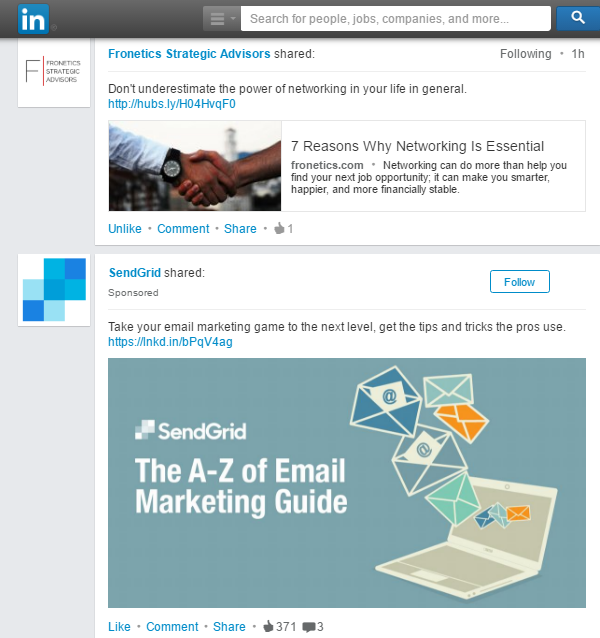
The sponsored post from SendGrid looks just like the other posts in my feed. Another important thing: It’s totally relevant for the kind of content I consume. I might even ignore the comma splice and click on it to get the information about email marketing because that’s what I like to read about on LinkedIn.
Some native advertising facts
The use of native advertising is growing among businesses because it is proving to be so effective. Here are some facts that might interest you.
Doing it right
Because native advertising blurs the line between editorial and advertising, some advertisers have gotten in trouble for violating rules of compliance. In response, the FTC has come out with some official guidelines for native ads in order to prevent confusion and to protect consumers. If your business is launching a native advertising campaign, make sure that you are familiar with these rules and best practices.
Related posts:

by Elizabeth Hines | Oct 12, 2016 | Blog, Content Marketing, Marketing
Make sure you’re not making these seven common mistakes when starting your B2B blog.
So you’ve started a B2B blog for your business and are standing at the ready, waiting for those leads to start rolling in. But you’ve only gotten three views so far (you, twice, and one by your mother). It’s not working out exactly how you pictured.
For one, it takes time — and patience — to build up readership for any blog. The more content you publish, the greater its quality, and the more consistently you post, the more quickly that success will happen.
But, chances are, you’re making one (or more) of the rookie mistakes that prevent B2B blogs from driving traffic, leads, and sales. Take a look at the seven common blogging errors that are holding you back.
7 common blogging mistakes for new B2B blogs
1) You’re promoting your products, services, and/or business.
Believe it or not, your sales pitch is bad for business. While your blog seems like another avenue for advertising your products, that’s actually counterproductive. Today’s consumers have no tolerance for overt, interruption-based marketing. They can smell a sales pitch from a mile away and purposefully avoid them. There is plenty of content available on the internet that they have the ability to do so.
Here’s another way to think of it: When have you ever changed channels while watching TV to find a commercial? If you’re flipping around, it’s probably because you’re looking for content that is appealing to you, not seeking advertisements. Blog readers feel the same way.
Solution?
Your posts should provide information, value, and/or entertainment relevant to your area of expertise for your target audience. They will read it — and, ideally, subscribe — because they regard you as a trusted source of knowledge. When they are ready to purchase, you will be top of mind because of the rapport you’ve built through your content.
2) You write about anything and everything.
While it’s important to publish content that is meaningful to you and relevant to your area of expertise, your B2B blog shouldn’t be a dumping ground for every thought that crosses your mind. It’s not a forum for you to discuss what seems interesting to you on a given day. Unless you’re a celebrity whose lifestyle is your brand, your blog is not the place to make it about you.
Solution?
On the contrary, your blog is all about your target audience. Your posts should answer their questions, satisfy their needs, or cater to their interests. You should put considerable thought and planning into what you write to ensure it aligns with their expectations. An editorial calendar can help you map out content for your blog and make sure you are evaluating your posts from the 1,000-foot view as well.
3) Your writing stinks.
Writing a blog is different than writing an academic thesis, a business proposal, or a product catalog. If your content is boring, stuffy, error-filled, unintelligible, or otherwise difficult to read, people are going to move onto the billions of other content available on the internet.
Your readers need to understand what you’re saying, and, what’s more, they need to connect with your content. Of course, that’s easier said than done. It’s ok if you’re not a great writer — the first step is admitting that and then deciding what to do about it.
Solution?
Hire someone to write it for you. At the very least, have a colleague glance over your posts for errors and clarity.
4) You’re a copycat.
There are so many good ideas and well-written articles out there that some people might be tempted to copy and paste without fear of retribution. Unfortunately that will only hurt your B2B blog.
Firstly, discerning readers can tell when something’s not quite right. It’s easy for them to find the original source with a quick Google search, and even easier for them to never trust your blog again. Further, search engines can penalize your site if you’re caught plagiarizing content, which can dramatically impact your potential growth.
Solution?
Make sure your blog contains original content and ideas. If you use information or images from another site, make sure to properly cite them.
5) You’re not posting frequently enough.
Blogging frequency impacts factors like search engine rankings and audience engagement. Posting rarely or without any kind of regularity will negatively affect both, and thus your readership.
Solution?
How much is enough? A recent analysis of the top business blogs found that 90.5% blog at least once a week. Figure out the blogging cadence that allows for the most posts with your available resources, and stick to it.
6) You don’t have the option to subscribe (or you’re not pushing it).
A blog is an excellent way to gain organic traffic. But part of your goal should also be to establish a regular readership. After all, you want to build a rapport with potential customers, who come to trust your expertise because they regularly read your content.
Now, people like to do what’s easy. It’s possible that your biggest supporters type in your blog’s web address everyday to see what you’re saying. But it’s more likely that more people will read your content if it arrives in their inboxes on a regular basis.
Solution?
Make sure the option to subscribe to your blog is easy to find and easy to do. Most content management systems make this simple to set up right on your blog. But you can also encourage people to subscribe by adding a call to action to your emails, your social media accounts, etc.
7) You’re not distributing it.
Don’t let your content live in a vacuum. Certainly readers will find your B2B blog through organic search. But you don’t have to just post and pray.
Solution?
Distribute your content through whatever channels you have available to you: social media, email newsletters, paid content-promotion platforms, sites like Reddit and Quora, and more. And don’t just tweet about it once and consider distribution done. Keep distributing it whenever it’s relevant to do so.
Related posts: