by Elizabeth Hines | Jan 8, 2018 | Blog, Marketing, Social Media, Talent
LinkedIn, with almost 500 million users, is the #1 networking site for professionals. Here are 7 supply chain and logistics professionals to follow for top posts and articles in your industry.
With 94% of B2B marketers using LinkedIn to distribute content, it’s now the premier social media site for businesses. More and more users — including supply chain and logistics professionals — are turning to LinkedIn to keep up with industry news and to understand larger trends affecting their businesses. In fact, LinkedIn gains two new users every second.
With LinkedIn Publishing, users are able to create long-form posts and articles to communicate their subject-matter expertise and interests. Following LinkedIn members gives you access to their profiles, as well as any original or third-party posts they publish on their newsfeeds. So your newsfeed becomes populated with the content the users you follow are publishing and sharing — meaning, if you follow the right people, you get invaluable insight into industry leaders’ thoughts and trends. So what are you waiting for? Here are some of our favorite supply chain and logistics professionals to follow on LinkedIn.
7 top supply chain and logistics professionals to follow on LinkedIn
Kelli Saunders, President of Morai Logistics Inc. at Mode Transportation Associates
Kelli Saunders was recently named one of Canada’s Most Powerful Women – Top 100 for her superior work in the Women’s Executive Network. She was also named Women Exporter of the Year in 2016 and received Canada’s Doing Business Award in 2015. Saunders is a high-achieving entrepreneur with over 30 years of outstanding performance in the supply chain and logistics industries. She understands the complexities and nuances involved in long-term sustainability in the transportation industry.
Sean Griffey, CEO and Co-Founder at Industry Dive
Awarded the Digital Hall of Fame Media News Award in 2015, Sean Griffey is co-founder and CEO of Industry Dive, a digital media company that publishes business news and original analysis for 4.5 million executives in 12 vertical markets. Griffey also runs the Logistics and Supply Chain Professionals group on LinkedIn with almost 270,000 members.
Tim Debus, President & CEO of Reusable Packaging Association
Tim Debus has 20+ years of experience in bringing to market new technologies and leading industry initiatives to improve the production and supply of agricultural commodities, including the development of reusable plastic containers. His group, the Reusable Packaging Association (RPA), leverages its collective voice of industry-leading knowledge to advance the adoption of reusable packaging by clearly demonstrating supply chain efficiencies, environmental benefits, ergonomic improvements, and cost advantages to end users in all industries.
Patrick Bian, Director of Supply Chain Management at Watts Water Technologies
Patrick Bian is a supply chain executive with a consistent track record developing supply chain strategic roadmaps and leading multi-national teams to support the business vision for global companies. His work at Watts Water Technology provides outstanding solutions used to safely convey, conserve and manage water. Standing president of the French American Chamber of Commerce, New England for the past four years, Bian is also a lecturer at Northeastern University for the Masters Program in Business and Engineering.
Steve Norall, Co-Owner/Founder and Vice President of New Development at Cerasis, Inc.
Steve Norall has an impressive breadth and depth of expertise in the logistics and transportation management space, most recently as co-owner/founder of Cerasis, a top third-party logistics provider and truckload freight broker. A frequent poster, Norall covers all manner of supply chain management and logistics, but his current focus on LTL freight management.
Adrian Gonzalez, President at Adelante SCM & Founder/Host of Talking Logistics
Adrian Gonzalez is a well-respected, trusted, and influential supply chain and logistics analyst and strategic advisor to high-level executives in manufacturing, retail, third party logistics, and technology companies. He is the founder, host, and creative force behind Talking Logistics, a weekly online video talk show where he interviews thought leaders and newsmakers in the supply chain and logistics industry. And he is the founder and president of Adelante SCM, which is focused on enabling supply chain and logistics young professionals to share knowledge, advice, and best practices with each other in a private, trusted, and solicitation-free environment.
Michael Levans, Group Editorial Director at Peerless Media
Michael Levans is the group editorial director at Peerless Media, which oversees the publications of Logistics Management, Supply Chain Management Review, and Modern Materials Handling. He oversees the Alliance Awards, an annual program designed to recognize how shippers and their service providers work together to overcome challenges to critical components of their unique supply chains.
Related posts:


by Elizabeth Hines | Jan 4, 2018 | Blog, Current Events, Supply Chain, Transportation & Trucking
The FMCSA is not certifying ELD vendors’ products, which means carriers must ensure devices meet the organization’s technical specifications.
On December 18, new electronic logging device (ELD) regulations went into effect for commercial vehicle fleets across the U.S. The ELD mandate has caused major waves in the transportation industry. But it has the potential to rock supply chains and manufacturers around the globe — and not just because of anticipated transportation disruptions and increases in costs.
ELD manufacturers must comply with technical specifications outlined by the Federal Motor Carrier Safety Administration (FMCSA). They must also register their devices with the FMCSA. Motor carriers might assume that selecting a device that vendors are promoting as “FMCSA certified” would be a simple solution. Amazingly, however, that certification may not be worth the paper it’s printed on.
When does “certified” not mean “verified?”
Last year the FMCSA directed carriers to a site where they could find a list of registered ELDs. The problem with this is that the devices on this list are self-certified by the manufacturer. There’s no guarantee that they actually meet FMCSA guidelines.
To appear on the FMCSA’s list, ELD manufacturers must submit certain documents, including malfunction and diagnostics and product serial numbers. However, to gauge if their product is compliant, manufacturers must conduct their own tests. And the FMSCA is not vetting documentation of the testing.
The problem with this is fairly obvious. Without mandatory testing from a neutral, third-party source, devices are subject to only the rigor of their own manufacturer’s testing. They may not follow the FMCSA’s test specifications. And, of course, less-than-honorable manufacturers could use the lack of oversight to their advantage.
Consequences, however, will fall entirely on the shoulders of the operators and their carriers using non-compliant ELDs.
Compliant today, not tomorrow
Motor carriers purchase these systems under good faith that they will meet the FMCSA’s performance requirements once in use. But the possibility is looming that some ELDs may be noncompliant. Then what?
Carriers have eight days from the time an ELD is determined to be noncompliant to replace it with a compliant one. While drivers can temporarily use paper logs, this obviously isn’t a real solution, and will leave carriers scrambling to get their ducks in a row.
Due diligence
Before selecting an ELD vendor, carriers need to understand the details of compliance and hold vendors to those standards.
Carriers should push vendors for specific information about compliance with FMCSA test specifications. Or they should seek vendors who have opted to use third-party testing companies, such as PIT Group, to independently verify ELDs meet FMCSA standards. Either way, carriers should test and verify the ELDs they have chosen for their fleets on their own to ensure compliance as soon as possible.
The coming months are bound to see many headaches from the confusion caused by FMCSA-certified (but not regulated) ELD devices. Carriers need to be aware of this now, so they can properly prepare for any issues that may arise.
Related posts:
SaveSave
by Elizabeth Hines | Jan 3, 2018 | Blog, Content Marketing, Marketing
In part one of a four-part series on writing for SEO, we address how search engines and the search landscape have changed recently.
Content marketing has seen a lot of changes in the past few years. These changes are largely results of the rapidly evolving search landscape, as well as a seismic shift in the way people are actually discovering content. New, more sophisticated search algorithms, changes in the way people use search engines, and new ways that marketers develop their content are just a few of the contributing factors and outcomes.
Over the next few weeks, we’ll be writing a series of posts examining how marketers should approach writing for SEO in this new landscape. Today, we’re exploring specifically how search engines have evolved — something they are always doing, as they improve to help searchers find the content that best answers their queries.
Are keyword rankings still important?
It’s important to recognize that as search engines change the way they process and evaluate content, older metrics of SEO success aren’t as reliable as they used to be. Take keyword rankings for example. While conventional wisdom tells us that it’s absolutely necessary for content marketers to check their Google keyword rankings for target keywords, debate has swirled recently about the actual reliability of this metric.
Why is this once-standard metric being called into question? The answer is largely about context: Search engines have evolved beyond the point where everyone gets the same results of a query, and therefore rank can change drastically depending on context.
Location-based searches are one of the most obvious and important contextual variables. Simply put, depending on where you’re searching from, you’ll see different search results. This makes it difficult and unreliable to evaluate success based on keyword rankings alone.
Featured snippets
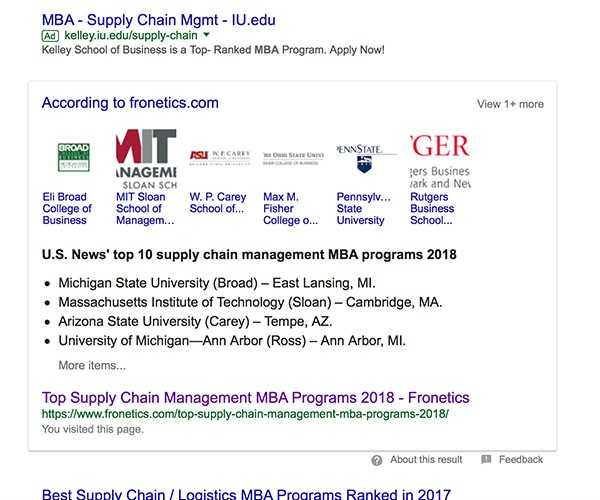
In addition to keyword-ranking problems, search engines are starting to dictate how content should be structured — particularly with the increased appearance of featured snippets. These snippets typically display content from within one of the pages ranking on page one of a question-based query, directly answering the question searched for without the user ever having to visit the actual page.
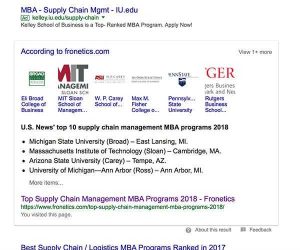
Fronetics has the featured snippet for Supply Chain Management MBA Programs.
A recent study found that of 1.4 million queries, 30% showed a featured snippet — that’s big growth. This means that content that ranks within the featured snippet section often gets a much greater share of the traffic for the given query. For content creators, this points to a need to restructure content to try to appear within these featured snippets.
Changes to the way search engines work do present a challenge for content creators writing for SEO. But keeping pace with the ever-changing technology is key to keeping your content relevant.
Make sure to check out part 2 in our series, Writing for SEO: People Are Changing How They Search, part 3, Writing for SEO: Topic Clusters and Pillar Content (NOT Keywords), and part 4, Writing for SEO: Measuring the Success of Your Content.
Related posts:
SaveSave

by Jennifer Hart Yim | Dec 21, 2017 | Blog, Strategy
Resumes are hard. Always have been, always will be. It’s hard to write and talk about yourself. It’s even harder to boil years – or even decades – of experience and accomplishments into a few short pages of text and visuals.
This guest post comes to us from Argentus Supply Chain Recruiting, a boutique recruitment firm specializing in Supply Chain Management and Procurement.
You’re probably more focused on your job than keeping a resume updated, and if a few years pass in between the times when you need a resume, you often find that resume trends have changed, and it’s hard to know how to format it, what to include, and what to leave out. It’s easy to feel lost because, of course, resume writing is one of the toughest tasks of any professional.
Let’s revise that slightly: it’s easy enough to write any old resume, but it’s difficult to craft a document that actually boosts your credibility.
A recruitment firm like Argentus is something of a resume clearing house. We see them all: the good, the bad, and the ugly. We see resumes that have up-to-the-minute style, as well as resumes where we have to brush off the cobwebs as we double click on the attachment in our inbox. We’re frankly bored of the latter. That’s why we’re doing a new miniseries on the Argentus blog, called The Quest for a Better Resume. We’re going to dive into some key aspects of resume writing and give examples to help you craft a resume that wows hiring managers and, hopefully, us!
In the first installment of this series, we gave some tips for boosting your resume’s style, which is something that sadly doesn’t get enough attention in fields like Supply Chain and Procurement.
Today, we’re going to dive into the Content side of things and help answer: if you’re a professional in Procurement, Supply Chain, or any of their related fields, what exactly should go on a resume and what doesn’t belong there?
Read on to hear our advice!
Resume Content:
Supply Chain and Procurement professionals make their careers by extracting relevant insights from complex sets of data. So it makes sense that they’re often skilled at loading their resumes up with valuable content – even if their resumes lack visual panache. The resumes we see tend to be stronger from a content perspective than an optics perspective – but there are still common shortcomings in terms of what people choose to write on a resume.
So when it comes to content, what does a bad resume look like?
Obviously, the worst resume is one that doesn’t show that the candidate has any relevant experience, or one that misrepresents that experience. But let’s take it for a given that you’re a professional with a solid background, trying to communicate the breadth of skills and work experience that you’ve accumulated:
- A bad resume tends to be overly stuffed with buzzwords. It tends to talk a lot without actually saying anything, full of words like “self-motivated,” “detail-oriented,” “team-player” – qualities that you shouldn’t have to put on a resume. These kinds of qualities are “table stakes” for getting an interview. They should be self-evident when the hiring manager speaks to you in person – on a resume, they come across as empty.
- It might tend to contain irrelevant experience, or show a lack of focus. This flavor of resume tries to be all things to all people – the resume equivalent of the job seeker who applies to every job we have, without tailoring their resume to one particular niche. We get that often people do have a wide variety of experience – some professionals at the director or VP-level have touched on every aspect of the Supply Chain, from inventory management to procurement to distribution. But you should tailor your experience to the role for which you’re applying.
- It talks about “duties fulfilled” instead of accomplishments. We’ve blogged a lot about how important it is to create an accomplishment-based resume. Bad resumes tend to read like job descriptions instead of describing what the person has delivered to their employers.
- It has extra info that isn’t relevant. Trends are always changing in terms of what info your resume should (and shouldn’t) include, and it can be hard to keep up. But as of late 2017, headshots, marital status, personal info, and links to multiple social media profiles are distractions from what’s important.
With these common shortcomings in mind, what approach should Supply Chain and Procurement professionals take when trying to write a resume that impresses?
- Show, don’t tell. This old writer’s adage is also the best rule of thumb both for avoiding buzzwords and packing your resume full of impressive accomplishments instead of squandering the precious few seconds that a hiring manager will dedicate to your resume. Don’t just say that you’ve “increased cost savings,” show the amount of money that you’ve saved, and how you did it. Speak in terms of numbers: how many people did you oversee? What size of budget were you responsible for? Don’t just say you have “exceptional communications skills,” show it by presenting a resume that’s concise.
- Include the meat, not the fat. As recruiters in Procurement and Supply Chain, there are a few pieces of vital information we’re looking for when assessing a resume – beyond the accomplishments we mentioned above: if you’re in Supply Chain, what aspects have you touched on? (e.g. inventory management, logistics, warehousing, distribution, sourcing). What software do you have experience and skills with? (e.g. SAP, ARIBA). If you’re in Procurement, what categories have you purchased in? (e.g. raw materials, information technology, marketing, etc.) This is key information that sometimes gets lost within long bullet-pointed lists of “duties.”
- Less can be more. Similar to how white space is important from a visual perspective, concision is key when it comes to content. Try to write your resume with more action verbs and fewer adjectives.
If you’re like us, you’ve probably noticed that a lot of the resume advice floating around the internet is distressingly general – shouldn’t it be obvious that resumes need to avoid typos, grammatical mistakes, and incorrect contact information? So hopefully these tips give a bit more detail about how to approach a resume’s content in a blue-sky way.
Related posts:

by Elizabeth Hines | Dec 20, 2017 | Blog, Talent
Here are our most-viewed blog posts from 2017 about talent, including tips on retaining your top talent and helping turn your employees into brand ambassadors.
The start of the new year brings along a host of resolutions. Finding a new job or advancing in a current position are common new year’s resolutions for individuals. For companies, identifying new strengths and interests within your employees and hiring and retaining great talent are common goals.
We’ve assembled our top 10 talent posts of 2017. We hope these posts help you and/or your company overcome challenges, and achieve your goals for next year.
Top 10 most popular talent posts of 2017
1. Gender Diversity is Not a Women’s Issue: It’s an Economic Issue
Gender diversity is generally viewed as a women’s issue. It is not. Research conducted by McKinsey & Company and LeanIn.org finds that despite corporate America’s stated commitment to gender diversity, outcomes are not changing. Moreover, the research finds that employees do not believe companies are taking the necessary steps to enact change. Read more.
2. Top Supply Chain Management MBA Programs 2018
Looking for talent? Try recruiting from these top-rated supply chain management MBA programs and schools. We have written before about the importance of recruiting and strengthening the relationship between academia and the supply chain industry as means to solve the growing supply chain talent gap. If your company is looking to hire, consider strengthening your rapport with schools that offer supply chain programs or specialties. Read more.
3. Are We Thinking About “Soft Skills” All Wrong?
By calling them “soft skills,” are we shortchanging competencies that are critical for supply chain and procurement professionals to succeed? One of the biggest stories in the world of Supply Chain and Procurement talent over the past few years has been the emerging importance of Soft Skills. As the field has become more strategic — with a greater impact on wider areas of business — professionals in the field have had to become stronger at advocating for it. Read more.
4. Great Supply Chain People Are Getting Harder to Find, But Do Companies Have a Talent Management Issue?
Is the Supply Chain talent gap problem really a talent management problem? This guest post from Argentus explores the so-called “talent deficit” in the field from all angles and perspectives. The fact is, it’s becoming harder for companies for find the talent that they need for these positions as baby boomers retire and the function evolves. Read more.
5. Employee Brand Ambassadors Can Influence B2B Buying Decisions
As peer influence becomes increasingly important in B2B buying decisions, empowering employee brand ambassadors will benefit your bottom line. I’ve written lately about the rise of influencer marketing. It’s a strategy B2B businesses are starting to understand and use to their advantage. But you don’t need a Kardashian or even an important industry professional to get started. Employees are your most natural, ready-made influencers. Read more.
6. Freight Driver Shortage Update: Will 2017 Come to a Head and Cause Issues for Shippers?
Growing woes over a forthcoming capacity crunch are not going away anytime soon. But, the capacity crunch may have a major impact on the freight driver shortage and vice versa. In a sense, fewer drivers mean that capacity will grow tighter. Yet, as capacity shrinks, the incentive for drivers increases. Read more.
7. 3 Ways to Attract Millennial Talent for the Supply Chain
Hoping to draw more millennials to your talent pool? Implementing these three ideas might help win them over. By the year 2020, millennials are estimated to make up a majority of the workforce. In addition, a 2014 study found that 46% of B2B buyers were millennials, and that number is on the rise. This seismic shift in workplace demographics calls for a new approach to attracting and retaining talent. Read more.
8. 3 Questions to Ask before Making a Professional Change and Overcommitting
Thinking of making a professional change? Here are some questions to consider before taking the plunge and overcommitting. We’ve all been asked to take on new projects at work when we’re already completely swamped. In the moment, it can be very hard to say no. And we’ve all jumped on LinkedIn to see what other opportunities are out there. More money, less headaches. The grass is always greener. Read more.
9. Could Liberal Arts Grads Fill the Supply Chain Talent Gap?
Mark Cuban thinks liberal arts grads will be the next in-demand employees. Could they be the answer to the supply chain talent gap? The supply chain talent gap has been called a “perfect storm.” Every report cites doomsday statistics of the impending crisis when, by 2025, 60 million baby boomers will exit the workforce, leaving only 40 million millennials to take their place. Read more.
10. Three Tips for Retaining Your Top Talent
Investing in your top talent and playing an active role in developing their careers will motivate them to stay around. Company loyalty is a thing of the past. In today’s day and age, everyone is looking for the next best thing, and that is true in the workplace as well. But this doesn’t mean that retention of top talent is hopeless. Read more.
Related posts: