by Elizabeth Hines | Feb 22, 2018 | Blog, Content Marketing, Logistics, Marketing, Social Media, Supply Chain
Twitter bots may get you more followers and retweets, but artificial influence isn’t a healthy indicator of marketing performance.
In this age of influencer marketing, in which followers and retweets are all-important indicators of marketing success, a new phenomenon is emerging: Twitter bots.
According to a recent New York Times article, these computer programs are generally run by “shadowy companies that sell Twitter followers and retweets to celebrities, businesses, and anyone who wants to appear more popular or exert influence online.”
These bots essentially constitute large-scale identity theft, as they use the personal data — including names, profile pictures, and hometowns — of real twitter users. According to recent research from the University of Southern California and Indiana University, “as many as 48 million of Twitter’s reported active users — nearly 15% — are automated accounts designed to simulate real people.” Bot producers count on the economy of online influence, with businesses desperate to monetize a mass audience.
Why are Twitter bots around?
The temptation for businesses to buy followers is strong. Amplification bots, the specific type of Twitter bot most often favored by businesses, promise follows, retweets, and likes for those who buy them, boosting the visibility and “amplifying” the influence of buyers.
“This virtual status is a real-world currency,” say the New York Times writers, as follower counts play a role in determining “how potential customers evaluate businesses or products.”
But as tempting as it may be, paying for followers can get you a lot more — or less — than you bargained for.
The bad news
For one thing, Twitter and other social media sites explicitly forbid buying or selling followers or retweets. While social media companies are more apt to penalize sellers than buyers, if you’re paying for followers, your business is engaging in what can best be described as shady practices.
While companies that sell bots describe their services as legitimate, these claims are shaky at best. They often promise “discretion,” but there’s no guarantee that their client records will remain private.
“It’s fraud,” says British rower and Olympic gold medalist James Cracknell, who regrets purchasing 50,000 followers. “People who judge by how many likes or how many followers, it’s not a healthy thing.”
The bottom line
Cracknell’s statement points to an important, though often overlooked truth about influencer marketing: While quantity of followers and amplification may be fruitful in the short-term, artificial influence isn’t a healthy indicator of market performance. It will ultimately be detrimental to your reputation, a far more important and illusive currency than followers.
“I tell anyone and everyone who ever asks that it’s a total scam,” says Marcus Holmlund, a freelance writer formerly tasked with buying followers for an international modeling agency. “It won’t boost their engagement.”
And there’s the bottom line: While businesses are under constant pressure to increase their social media presence, and bots carry a powerful lure, they are ultimately an ineffective scam.
Related posts:


by Elizabeth Hines | Feb 20, 2018 | Blog, Content Marketing, Current Events, Logistics, Marketing, Social Media, Supply Chain
One of 2018’s fastest growing marketing trends is influencer marketing. Companies will increase their influencer marketing budget to keep up with the competition.
You’ve probably heard the buzzword by now: Influencer marketing seems to be on the tip of every marketer’s tongue these days. Linqia’s latest report, The State of Influencer Marketing 2018, shows that B2C companies are already taking full advantage of this marketing trend. Their report shows that 86% of B2C marketers used influencer marketing in 2017, and 92% of marketers that tried it found it to be effective.
B2B marketers, on the other hand, have been slower to adopt this new marketing trend. Influence 2.0 – The Future of Influencer Marketing Research Report 2017 showed that only 11% of B2B marketers have an ongoing influencer program.
To understand why influencer marketing is becoming so popular and why B2B companies need to jump on the trend, let’s start with the basics.
What is influencer marketing?
Influencer marketing is a form of marketing in which focus is placed on influential people, rather than the target market as a whole. Marketers identify individuals that have influence over potential buyers and create marketing campaigns and activities around these influencers.
For example, Microsoft teamed up with National Geographic last year to launch an influencer marketing campaign, called “Make What’s Next.” The technology giant leveraged some of the most famous adventure photographer influencers on Nat Geo’s Instagram for the campaign. The objective was to bring awareness to young women with interest in science, technology, engineering and math (STEM). By utilizing Nat Geo’s most heavily followed female photographers, Microsoft was able to access a built-in following.
Why influencer marketing works.
Influencer marketing is extremely effective because of three key components:
- Social reach: Influencers can reach millions of followers (and consumers) through their social media channels, websites, and blogs.
- Original content: Influencers work with marketers to produce original content for your brand.
- Consumer trust: Through their existing, strong relationships with their audiences, influencers have a built-in level of trust and can influence consumer opinions.
Content marketers are working overtime to update their content marketing strategies to include influencer marketing campaigns. Consumers no longer want to hear from brands about their products; they want someone they trust to recommend products and services. This is where influencer marketing comes in to play.
Marketers across industries found influencer marketing to be so effective in 2017, that 52% of are planning programs that leverage multiple types of influencers (celebrities, top-tier bloggers, micro-influencers) in 2018.
Where do you begin?
Instagram should be your starting point. According to new research, influencer marketing on Instagram will have generated over $1 billion by the end of 2017, with significant annual growth going forward. With more than 700 million users, Instagram’s platform allows influencers to easily share photos and videos with their followers. Product promotion has never been easier.
Boxed Water turned to Instagram influencer marketing to market its philanthropic campaign, The ReTree Project. The company paired with social influencers, like actors Aidan Alexander and Jaime King, and YouTube star Megan De Angelis, to spread the word about their new campaign. These popular Instagram users asked consumers to post a photo with the hashtag #ReTree and, in turn, Boxed Water would plant two trees for every photo posted. Just one month after launching the campaign, Boxed Water generated more than 2,600 posts with the hashtag.
With 39% of marketers planning to increase influencer marketing budget this year, B2B companies are quickly seeing the leverage that influencers can have over their target audiences. By pairing your products or services with the right influencer, marketers can easily tap into thousands of potential consumers, increasing website traffic and leads.
Have you tried influencer marketing? How was your experience?
Related posts:

by Elizabeth Hines | Feb 13, 2018 | Blog, Content Marketing, Logistics, Marketing, Supply Chain
Here are three tips for writing pillar content that will help structure your posts, attract leads and gain better page rankings.
In case you missed our series on writing for SEO, pillar content is a highly effective way to define your brand, drive traffic, and convert website visitors to leads. But in order to be effective, these pages should be strategically designed to do their proper job in telling search engines what your site is all about.
Before we go further, let’s take a step back and talk about exactly what pillar content is. As search engines adjust their algorithms to favor topic-based content, savvy marketers are turning to topic clusters to structure their content.
“This method uses a single pillar page as the main hub of content for a given topic. All of your content assets related to that topic link back to the pillar page,” explains HubSpot blogger Amanda Zantal-Wiener.
Need some ideas for writing and structuring effective pillar content? Here are three tips to get you started.
3 tips for writing pillar content
1) Start thinking about your site differently.
Not so long ago, SEO optimization was all about keywords. But search engines are changing. As their algorithms get more sophisticated, they look for websites that can provide depth and breadth on a particular topic. That means topic-based content wins you better page rank. It’s time to start thinking about your site as a collection of topics rather than a collection of keywords.
2) Consider your core audience.
“Think about the top interests and challenges of your core audience personas to give you ideas for pillar page content,” says HubSpot blogger Sophia Bernazzani.
Good content marketing is all about cultivating your reputation as a trusted resource for your audience, and pillar pages are no exception. Chose topics that answer the needs of your target audience. Topics should be broad enough to be able to generate multiple related blog posts, but narrow enough that you can cover all related content on a single pillar page.
3) Your content is about answering questions.
“Pillar pages should answer any question or query a searcher might have about a topic — which will make them want to click on your pillar page when they enter a Google search term that your page ranks for,” writes Bernazzani. The goal is to draw site visitors with savvy pillar content, and let them explore all content in your topic cluster.
Related posts:


by Elizabeth Hines | Feb 12, 2018 | Blog, Current Events, Logistics, Manufacturing & Distribution, Supply Chain
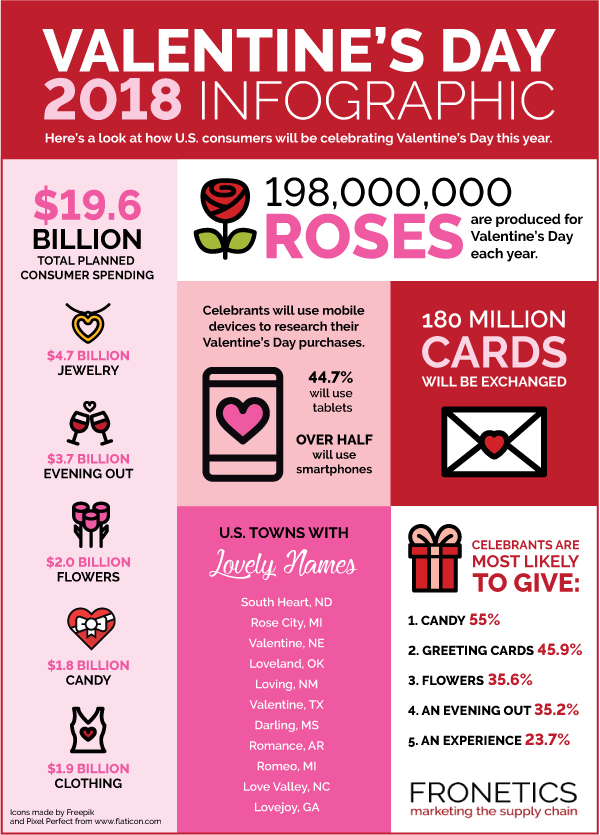
As Cupid spreads his wings, gifts of experience and romantic, at-home options will take over the market for Valentine’s Day 2018.
Consumers will spend a near-record $19.2 billion on Valentine’s Day 2018, up from $18.2 billion in 2017. According to NRF’s annual survey, over half of the country will participate (55%) in the romantic holiday, spending just over $140 on average.
Gifts of experience
A new Valentine’s trend is giving gifts of experience, such as a spa treatment, concert tickets, or a cooking class. Almost half of celebrants said they would prefer a gift of experience, and 23% said they plan on giving a gift of experience. Blue Apron’s Love at First Bite targets couples looking for gifts of experience with a foolproof, stay-at-home option for Valentine’s Day 2018. And they’re not the only ones! Hello Fresh, Plated and even Whole Foods are publishing blog articles and offering meal options for creating the perfect Valentine’s dinner from the comfort of your own kitchen.
Out on the town
The NRF’s survey also found that younger people (ages 18-34) are more likely to take their Valentine out for the evening than older generations. So it’s no surprise that 6 out of 10 younger celebrants (ages 18-34) would also prefer a gift of experience over candy and flowers.
Mobile trend
95% of Americans own a cell phone. The growing connection between smartphones and digital information is starting to take over Valentine’s Day, as well. Over half of participants plan to use their smartphones to assist with Valentine’s Day purchase decisions. Nearly 40% said they plan to use their cell phone to research products and compare prices.
Tradition prevails
Not to worry, though: Celebrants will still purchase plenty of flowers, jewelry and candy to mark the holiday. Celebrants are most likely to give candy as a gift, followed by greeting cards, flowers, and an evening out.
Here’s a look at how U.S. consumers will be celebrating Valentine’s Day 2018.
Valentine’s Day 2018 Supply Chain Infographic
Related posts:

by Elizabeth Hines | Feb 7, 2018 | Blog, Content Marketing, Marketing, Strategy
To be effective, your content marketing strategy should align with your sales goals. Here are three simple questions to ask yourself to make sure your documented strategy is on target.
I recently read an article on the Harvard Business Review that discussed pairing your sales goals with your marketing goals. This strikes at the heart of what we do at Fronetics: build a client’s content marketing strategy that will help advance their short- and long-term business goals. It sounds simple, but you have no idea how many organizations’ marketing goals are misaligned with what the larger organization is trying to accomplish
We need to make sure that — while we’re continuing to increase content production — we have a fundamental understanding of what we’re trying to create.
According to the Content Marketing Institute, 88% of marketers use content marketing. But a mere 30% of B2B marketers say their organization is effective at it. What that says to me is that a lot of companies are dumping their resources into content marketing, but, without a strategy that advances their business goals, they’re throwing away their time and money.
A content marketing strategy outlines the methods by which you will target, reach, and engage your audience. Research and execution of these tasks can be quite complex. Writing out a plan and assigning appropriate resources can offer clarity and guidance to your organization throughout the course of your program.
Here are three questions to ask yourself to make sure that your content marketing strategy is complementing your sales goals.
3 questions to align your sales goals and content marketing strategy
1. Why: Why am I doing this?
This question should be fairly easy to answer. The reason you’re documenting a content marketing strategy is for your business. You’re looking to align your marketing efforts with your business objectives. For a lot of companies, this ultimately means increased revenue from sales growth.
When done correctly, content marketing can support sales goals, making it easier to generate leads and helping the sales team close business. But you need to continually ask yourself, why?
The constant demand for more and more content can have a great impact on quality. More isn’t always better. Make sure you’re checking in with your strategy to make sure the content you’re producing is in alignment with your business goals.
2. Who: Who am I trying to attract?
In order to get the ball rolling in content marketing, you have to understand who you are trying to reach. Your company’s sales goals will help guide this target audience. It’s important to think holistically when considering who you are trying to reach at a potential prospect’s company. Typically, your target audience falls into two categories: Primary (decision-makers) and Secondary (influencers of the decision-maker).
Going one step further, you need to identify your target audience’s needs and pain points so that you can direct your content marketing strategy at creating awareness around those needs.
Once you have a thorough understanding of who your target audience is, you can begin to identify the different social media platforms they use. Using analytics tools within social networks can help you identify trends in social media use.
3. What: What content is going to work the best?
You’ve discovered your why and who, but now you need to finalize what kinds of content you’re going to create. Create the kinds of content your target audience seeks, and distribute it through the platforms on which they seek it. How-to videos on YouTube? Thought leadership on LinkedIn? Optimize the material you distribute for each channel. Use the social channels that best suit your brand message, type of content, and target audience.
Valuable and relevant content is not a sales pitch, but can help the sales process. Create content that communicates valuable information to customers and prospects so that they have the knowledge to make more informed decisions. Moreover, concentrate on content that establishes your business as a reliable source of knowledge — as a thought leader within the industry. Be thoughtful when you create content.
Even though 39% of marketers expect their content marketing budgets to increase this year, that doesn’t mean you should continue throwing money at your content marketing efforts until you have a clear plan that will advance your business. To be effective, marketers should document a content marketing strategy that aligns with their business and sales goals. It doesn’t have to be complicated. But it should reflect the “why, who, and what” of your sales strategy.
Related posts: