by Elizabeth Hines | Aug 22, 2018 | Blog, Content Marketing, Logistics, Manufacturing & Distribution, Marketing, Strategy, Supply Chain
Account-based marketing has traditionally utilized outbound marketing tactics, until now.
Account-based marketing has been around for decades, but it has been gaining a lot of attention in the past few years. More and more companies are starting to use account-based marketing to increase their brand awareness with specific audiences and work together with sales teams to close deals.
But what is account-based marketing?
Account-based marketing
Account-based marketing (ABM) is a focused approach to B2B marketing in which marketing and sales teams work together to target best-fit accounts and turn them into customers. Marketers and sales teams focus their efforts on specific accounts — companies, customers, target audiences — and work to get marketing materials in front of them.
Essentially, account-based marketing takes a potential customer and turns them into their own market. “[ABM] is to address the needs of organization by connecting with all of the stakeholders within it. That’s one reason why it works so well in B2B — oftentimes you have to work with five or more stakeholders in a given sale,” writes Sam Balter, HubSpot’s Corporate Marketing Manager.
So how can content marketing help with ABM, which has traditionally been a sales strategy?
Content marketing and account-based marketing
Inbound marketing focuses on audiences finding you. Instead of pushing a message onto buyers, inbound marketing allows you to establish your brand as an industry leader and let interested audiences come to you. This type of marketing attempts to draw in potential customers through interesting and engaging content.
Content marketing is a type of inbound marketing that uses blog posts, social media, infographics, and video to expose target audiences to a brand.
Merging sales and marketing efforts
There’s no reason that ABM and content marketing can’t work together. In fact, you’re missing out on maximizing your marketing efforts if you aren’t incorporating both of these marketing strategies in your overall marketing plan.
Today’s buyers don’t want to be ‘sold.’ Traditional sales pitches are no longer pushing buyers down the sales funnel. Instead, buyers want a personalized experience, where they feel they are getting to know a brand before they make a buying decision.
What does this mean for your ABM strategy? It means that content marketing can help educate and inform the specific accounts your sales team has identified through valuable, interesting content.
“For example, if you approach any content you create as part of the strategy with both goals in mind, you can create a piece of content that is both incredibly useful from a keyword perspective (and drives a ton of traffic to your site) while also providing all the key information that you’d like to say to your ABM contacts,” writes Stacy Willis for Impact.
When creating content for any marketing effort, the key is to make sure that your content has value. Whether you’re trying to attract a specific account or looking to increase web traffic, content marketing focuses on value and not just volume.
Creating a cohesive account-based marketing and inbound marketing strategy will help maximize your marketing efforts. Though not traditionally used together, it’s time to think outside the box and start seeing the benefits of a joint marketing approach.
Related posts:

by Elizabeth Hines | Aug 20, 2018 | Blog, Content Marketing, Logistics, Marketing, Strategy, Supply Chain
Here’s a breakdown of the latest findings regarding the best time to send an email and what we recommend for getting the most of out of your email marketing efforts.
We are all inundated with daily emails. Whether it’s work emails, special offers from brands you love, or straight-up spam email, we all have inboxes full of emails – most of which will never be opened.
But, on the flip side, “email is the third most influential source of information for B2B audiences, behind colleague recommendations and industry thought leaders,” reports WordStream.
So how do you get your emails to stand out in cluttered inboxes? How do you get readers to actually open — and scroll through — your thoughtfully crafted content?
At Fronetics, we believe there isn’t a one-size-fits-all answer to what works best for email marketing. In order to be successful, you need to take into consideration:
- Who is your target audience?
- What job titles do they hold?
- What kind of devices do they use?
- When are they commuting to work?
Taking a look at the schedules and habits of your target audience will give you insight into the optimal times for readers to engage with your emails. Here’s Jennifer Hart Yim, director of strategy at Fronetics, with a look at what we recommend when trying to find your optimal time to send marketing emails.
Video: When is the best time to send an email?
Takeaway: Trial and error
As with most aspects of content marketing, there’s no universal answer to the best time to send marketing emails. The only way to truly know what works best for your company is trail and error. You’ll have to test dates and times to find the best time to send an email your target audience.
But keep in mind that there are other factors, aside from date and time, that affect open and click-through rates. You’ll also have to play around with frequency, subject lines, length of emails, and the overall look and feel of your email.
Have you tested your best time to send an email? What worked for your company?
Related posts:


by Elizabeth Hines | Aug 1, 2018 | Blog, Content Marketing, Marketing
The Fronetics blog will be taking a brief summer vacation.
Starting today, the Fronetics blog will be taking a little hiatus. Don’t worry — it’s only for 2 weeks! We are working on some exciting things behind the scenes and can’t wait to share them with you.
We’ll be back with our regular posting schedule beginning Wednesday, August 15. If you find yourself missing us while we’re away, feel free to check out our ever-growing list of resources for supply chain and logistics marketers.
Or feel free to browse through our recent posts. We’ve been covering some really interesting stuff lately. There’s a little something for everyone — whether you’re looking for industry marketing trends or DIY content marketing guides. Here are a few favorites:
We hope you have a safe, wonderful, and relaxing end of summer, and we look forward to having you back in two weeks!

by Elizabeth Hines | Jul 25, 2018 | Blog, Content Marketing, Logistics, Marketing, Social Media, Strategy, Supply Chain
Here are 4 components of an effective lead-nurturing campaign that will entice your potential customers and have them moving down the sales funnel.
Your content marketing objectives really come down to one basic goal: to generate a high number of quality leads. These leads will help drive tomorrow’s revenue and increase sales. In fact, 85% of B2B marketers say lead generation is their most important content marketing goal.
As more and more buyers discover brands before they are ready to purchase, an essential function of any marketing department is lead nurturing. That is, moving leads through the sales funnel by leveraging what’s known about their needs and online behavior.
Marketo, a marketing software company, describes lead nurturing as being “personalized, adaptive, and able to listen and react to buyer behavior in real time.”
We know that marketers need to focus their lead nurturing strategy on multi-channel engagement. This includes utilizing email, social media, blogs, and video to interact with potential customers. A multi-channel lead nurturing strategy is essential for companies looking to optimize their user experience and bring in high-quality leads.
With so many variables contributing to a productive lead-generation campaign, it can be challenging to pinpoint what differentiates a successful campaign from a mediocre one. Here are four tools that will help you deliver a series of targeted messages across multiple touch points and platforms to help solidify your lead-nurturing strategy and increase your quality leads.
4 building blocks of an effective lead-nurturing campaign
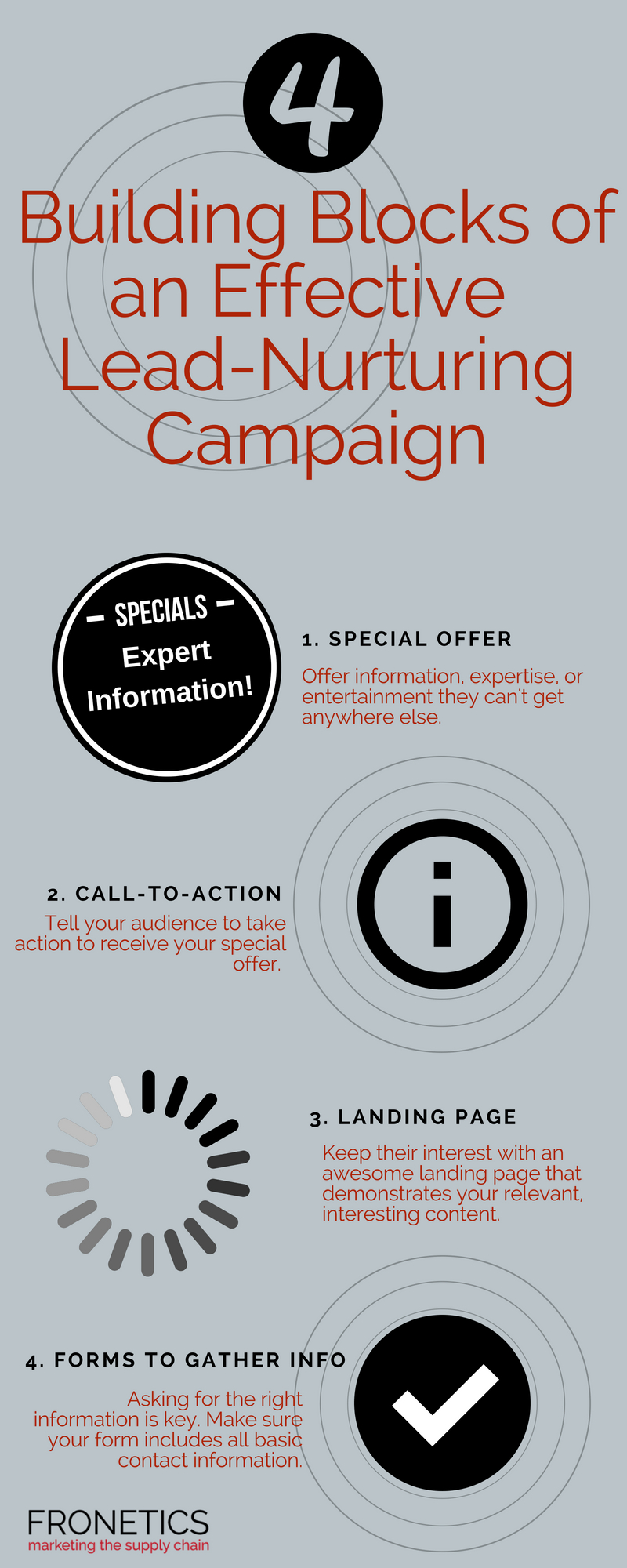
(Made with Canva)
Takeaway
Successful lead nurturing is really about utilizing all the tools at your disposal to meaningfully connect with your leads in order to build trust and establish credibility. Using these four key points, marketers can start building on their lead-generation efforts as they guide potential customers on their journey to becoming a client.
And don’t forget: Asking for the right information is key! If you want to nurture high-quality leads, you need to make sure you’re capturing relevant, helpful information along the sales journey.
Related posts:

by Elizabeth Hines | Jul 19, 2018 | Blog, Content Marketing, Logistics, Marketing, Social Media, Strategy, Supply Chain
In part three of our series on effective lead generation and nurturing, we walk you through the components of effective landing pages that convert visitors to leads.
If you’ve been keeping up with our four-part series on effective lead generation, you should be up to speed on creating a valuable offer and a call-to-action that works. The next step in a finely tuned lead generation process is a landing page that converts.
Why does my offer need a landing page?
Landing pages are crucial, and brands miss out on big opportunities when they fail to optimize them. In fact, according to HubSpot, marketers have seen an average 10% conversion rate on landing pages — that represents a huge amount of missed opportunities. Brands that have it right, those that focus on designing for conversions, reap the benefits in big ways.
Your primary objective for a landing page is to get visitors to submit their contact information in exchange for the offer. At this point in the process, your potential customer has already engaged with your call-to-action, meaning he or she is interested in your offer. When they get to your landing page, everything they find there should affirm their choice to and assure them that the content they are about to download is going to be relevant, interesting, and valuable.
Designing landing pages that convert
So what are the hallmarks of a great landing page? Starting with the basics, your landing page should briefly, simply, and clearly describe the benefits of your offer. It’s important that there be as few distractions as possible. For example, make sure the page doesn’t have a top navigation menu. Bonus points for including ways to share your offer on social media.
Additionally, you should make sure that your landing page doesn’t include links to other things on your website, as they can distract the lead and perhaps send them somewhere else on your website where they can find the information you’re presenting in your offer.
As you design your landing page, keep this checklist in mind:
- Is it clean, organized, and clearly presented?
- Is there any ambiguity about where or how leads should enter their information?
- Does it describe the benefits of my offer?
- Is it free of extraneous or distracting content or links?
- Is it mobile-friendly?
- Does it contain easy ways to share on social media?
If you follow these tips for landing pages that convert visitors to leads, we’re confident you’ll start to see an uptick in your website conversion rate almost immediately.
Related posts: