by Elizabeth Hines | Oct 21, 2014 | Blog, Data/Analytics, Marketing, Social Media
Individuals within the logistics and supply chain industries want to learn more about social media ROI. A recent survey conducted by Fronetics found that 81 percent of respondents reported that information on proving social media ROI would be helpful to their company.
Proving social media ROI can seem impossible, but it is not if you put the right framework in place. Here’s how to put that framework in place, and prove social media ROI:
Set goals
Support your goals with SMART objectives. This allows you to track and measure your progress towards meeting your goals.
- Specific: Describe your objectives specific to the results you want. Go deeper than “gain leads” to “achieve a visitor to lead conversion rate of one percent.”
- Measurable: Metrics are essential. You can’t assess your progress towards your goal without metrics.
- Achievable: Make your goal achievable. A visit to lead conversion rate of 10 percent may not be realistic. Your goal of a visitor to lead conversion rate may be more plausible. When setting your objectives, keep reality in check.
- Realistic: As with any job, you need to have the right tools. Make sure that you have the resources, tools, and talent to meet your objectives.
- Timed: Be specific with your objective and incorporate a time frame.
Track and measure
Once you have set your goals and objectives and have identified your key metrics, put a system in place that will track and measure your metrics. At the very least, your metrics should be tracked on a monthly basis.
React
Tracking metrics is not enough. You need to react. Look at your metrics in the context of your goals and objectives. Which efforts are moving you towards your objectives and goals? Which efforts are not supporting your goals and objectives? Can these efforts be tweaked? Should you scrap them and try something new?
Taking a data driven approach is critical to proving ROI.
Wash. Rinse. Repeat.
This process is not static. When you achieve your goals and objectives, set new ones. If you are really struggling to meet your goals and objectives, you may need to revisit them to determine if they need to re-worked.
Proving social media ROI is possible. But it needs to be supported by a framework. Take the time to put a solid framework in place for your business.
by Elizabeth Hines | Oct 16, 2014 | Blog, Marketing, Social Media, Strategy, Supply Chain
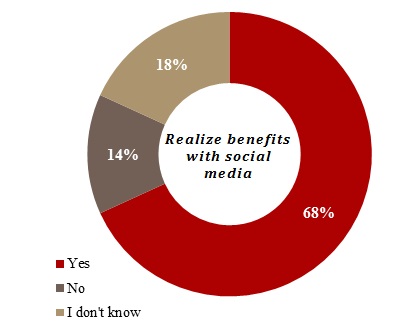
A survey conducted by Fronetics Strategic Advisors found that companies within the logistics and supply chain industries are realizing benefits from social media.
When asked if their company realized benefits from social media 68 percent of respondents reported “yes.”
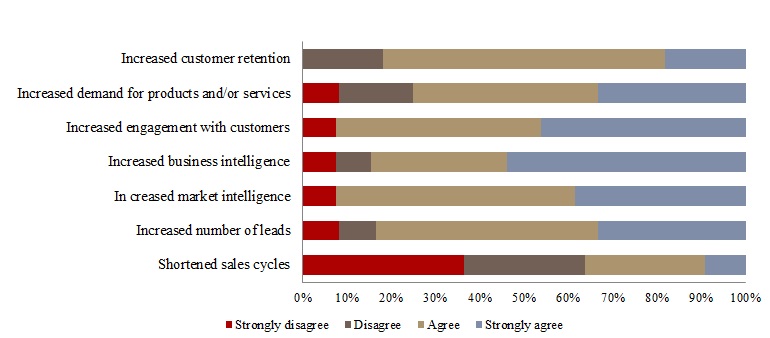
What benefits are companies realizing?
Increased engagement with customers (86 percent), increased market intelligence (80 percent), and increased business intelligence (73 percent) are the primary benefits reported by respondents. Other benefits include:
- Increased customer retention;
- Increased demand for products and services;
- Increased leads;
- Shortened sales cycles.
To learn more about the use, motivations, benefits, and challenges of social media and the logistics and supply chain industries, download our report: Social media and the logistics and supply chain industries.

by Elizabeth Hines | Oct 14, 2014 | Blog, Logistics, Manufacturing & Distribution, Marketing, Social Media, Strategy, Supply Chain
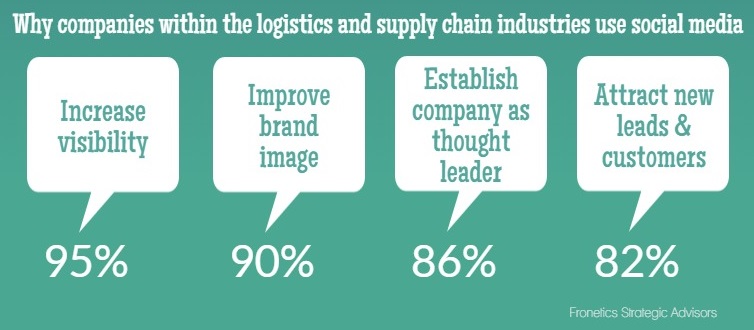
Social media is a strategic tool. The benefits companies can realize by using social media are immense. Which benefits are motivating companies within the logistics and supply chain to use social media? Even more broadly, why are companies using social media?
A recent survey conducted by Fronetics Strategic Advisors found that the predominant reasons companies within the logistics and supply chain industries use social media are to: increase the visibility of their company; to improve their brand image; establish their company as a thought leader; and to attract new leads and customers.
To learn more about the use, motivations, benefits, and challenges of social media and the logistics and supply chain industries, download our report: Social media and the logistics and supply chain industries.
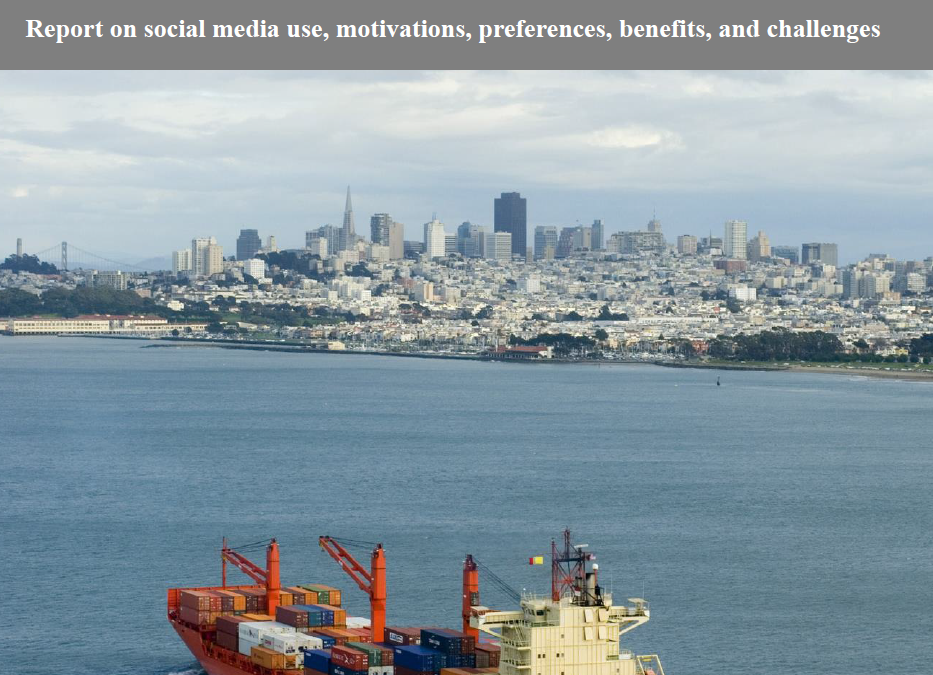
by Elizabeth Hines | Oct 9, 2014 | Blog, Logistics, Marketing, Social Media, Strategy, Supply Chain
Report on social media use, motivations, preferences, benefits, and challenges.
Within the past five years companies within the logistics and supply chain industries have begun to see social media as a strategic tool and have begun to actively use and leverage social media.
A survey conducted by Fronetics Strategic Advisors looks, broadly, at the use of social media within the logistics and supply chain industries. The report discusses use, motivations, preferences, benefits, and challenges.
Key findings include:
- 68% of survey respondents report that their company has realized benefits by participating in social media.
- Increased engagement with customers, market intelligence, and business intelligence are primary benefits realized by companies.
- Companies are turning to social media to establish and advance their brand and image.
- The majority of companies are currently managing their social media strategy in-house.
- Twitter, LinkedIn and Facebook are the social networks most commonly used by companies.
- Twitter and LinkedIn are perceived to have the greatest business impact.
- Time constraints, budget constraints, and a lack of an identified strategy are the key challenges identified by respondents.
To learn more about social media and the logistics and supply chain industries, download the report.

by Elizabeth Hines | Sep 23, 2014 | Blog, Marketing, Social Media, Strategy

The number of social media channels is astounding –and is growing daily. Which of these channel(s) should your business leverage? Here is what you should consider when determining which social media channels you should use for your B2B business.
Your ideal customer
Who is your ideal customer and on which social media sites are they active? Taking time to understand who your customer is and understanding where they spend their time is invaluable. If you want to reach potential and current customers you need to be where they are – you need to make it easy for them to find you and to engage with your business.
Competition
Identify which social media channels your competition is using. Do these align with the channels your ideal customers are using?
Don’t be follower. If your research has shown that your potential customers are using a social media channel that your competitors are not using, don’t assume your competition knows something you don’t. Play where your potential customers play.
Content
What type of content do you have, and what type of content do you feel will best attract and engage potential customers? Video, for example, is better suited for YouTube than Twitter.
Finally, it is essential that your business is an active participant on social media. Only take on what your business can handle and/or consider outsourcing.