by Elizabeth Hines | Sep 15, 2015 | Blog, Data Security, Data/Analytics, Marketing, Social Media, Strategy
Personal connected devices – our laptops, cell phones, and tablets – are arguably the most complicit tools in the recent blurring of the parameters between personal and work life. And while most businesses have generally recognized the benefit of allowing employees to use their personal devices for work purposes, the bring-your-own-device (BYOD) revolution has certainly thrown a curve ball to those responsible for safeguarding company data. Although corporate finance groups are singing the praises of the trend due to its inherent reduction in costs, it’s not all rosy in the BYOD world. That’s why it’s crucial to format a corporate strategy policy that will protect your company from a potentially dangerous data-leak train wreck.
Here’s why: Employees are now widely accessing corporate data from their own computer, a tablet, even their mobile phone. With so many of us bringing more and more smart devices inside our office environments and hooking them to our corporate networks, the potential for data leakage grows exponentially. When anti-virus and digital security software company BitDefender set out to explore the connectedness of typical American workers last year, they found that over half stored work-related data on their personal devices. Shockingly, almost 40 percent of them had nothing in place to prevent unauthorized access to their device. Further, in a study conducted by the University of Glasgow, 63 percent of used smart devices purchased through second-hand stores and eBay-like marketplaces still had data on them. This data included personal information as well as sensitive business information.
The problem is there’s no chain of custody in the BYOD world. Think about it. When the corporations owned your cellphone and your PC or laptop, they controlled its issue to you, how you used it, what software you put on it, and when and how it was turned in and destroyed. A solid internal tracking of electronic assets coupled with a solid electronic asset disposal solution provider meant that, for the most part, the corporate digital assets were safe. In the BYOD world, the corporation does not own the IT equipment. Personal smart devices are being linked to corporate IT environments. This mating of personal and professional equipment and data is happening everywhere. Your corporate data is being commingled with secure and non-secure access points to the Web, cloud, etc. Not to mention the fact that those devices metaphorically walk in and out of your office every day, and you have no control.
Companies are scrambling to address this issue in a number of ways. Some have addressed the problem via software solutions at the enterprise level (think Blancco or BlackBerry enterprise), some at the device level (think solutions like Apple Find My Device, etc.), and some at the human resources and legal levels with policies and procedures that prohibit users’ use of corporate information. But the truth is, without a chain of custody model incorporated with these solutions, once the corporate data is accessed or downloaded, it’s already gone — you just don’t know it yet.
The reality is that it’s going to take some time for the corporate world to catch up with what some have called the “semi-private information revolution” like the cloud, Facebook, or social media. Secure file sharing, essential for an organization’s BYOD guidelines, is one of the best options available. Services are now available to help with cloud encryption and it’s changing the way we share and monitor files. Encrypting data is crucial and minimizes the risk of sharing sensitive data and having it tampered with. Rely on your electronic asset disposal provider to help your company develop a strategy and process that is aligned with your corporate information sharing guidelines. Right now, your corporate data is only as safe as the process that you create.
Fronetics Strategic Advisors is a leading management consulting firm. Our firm works with companies to identify and execute strategies for growth and value creation.
We advise and work with companies on their most critical issues and opportunities: strategy, marketing, organization, talent acquisition, performance management, and M&A support.
![Unlocking Your Marketing ROI with Analytics [infographic]](https://fronetics.com/wp-content/uploads/2015/09/Fronetics-Marketing-ROI-800x675.png)
by Elizabeth Hines | Sep 9, 2015 | Blog, Content Marketing, Data/Analytics, Marketing
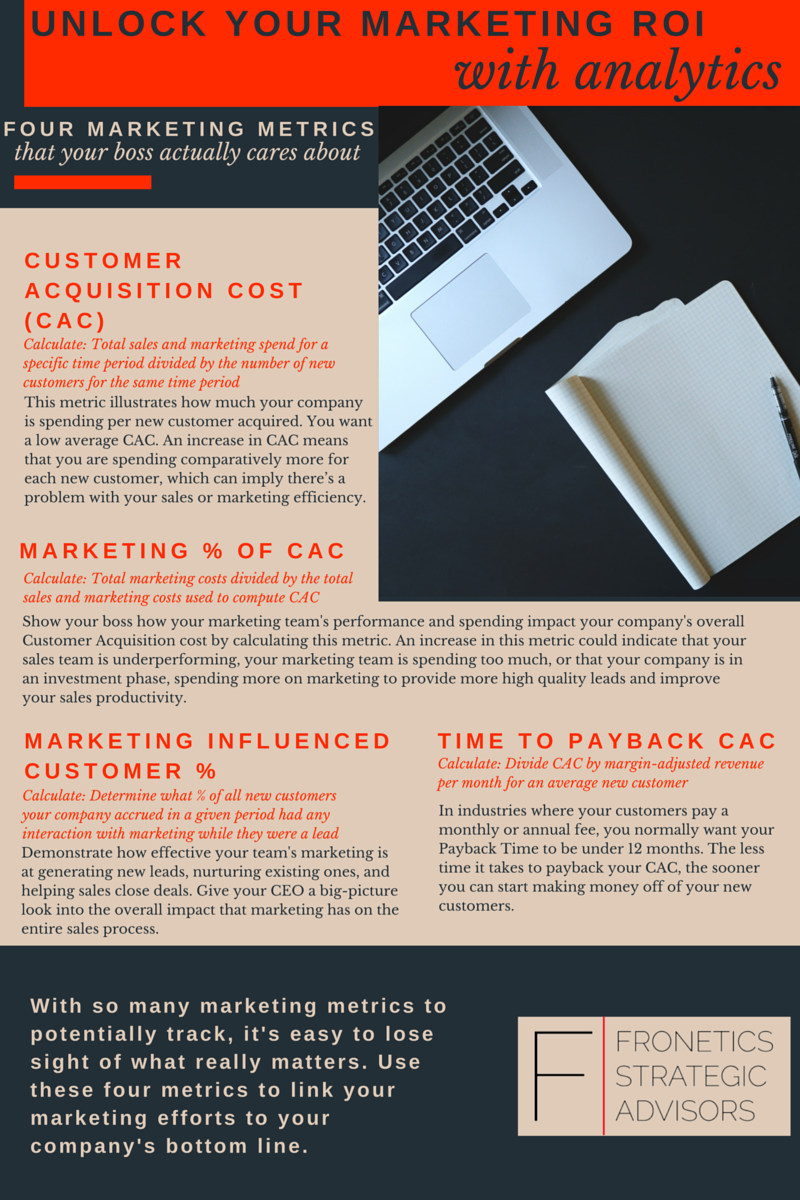
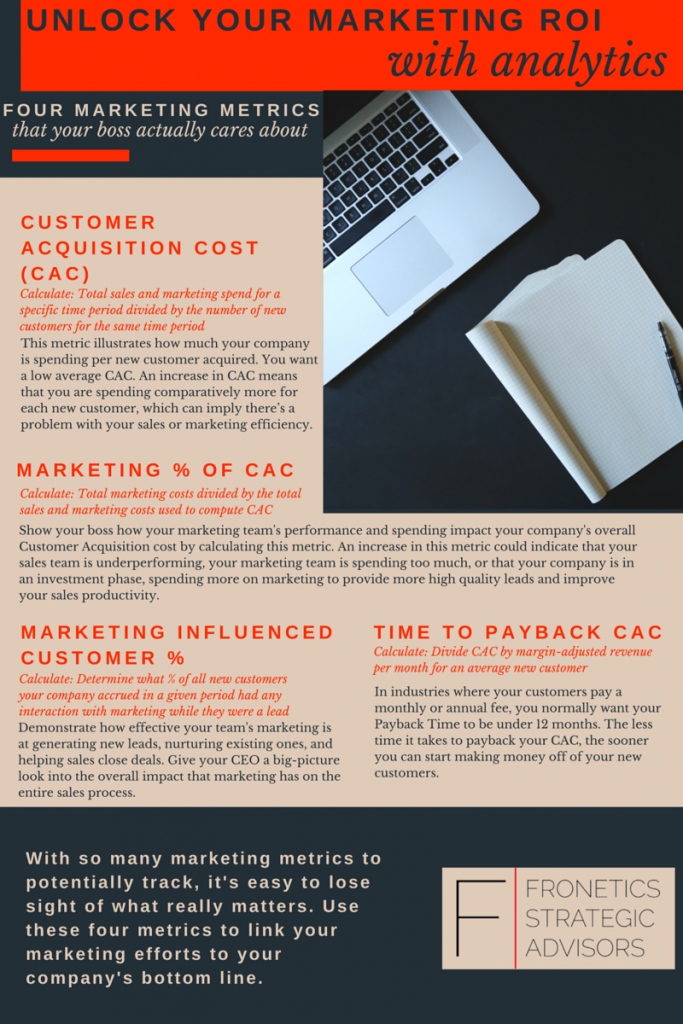
In the age of big data, everything in marketing is measureable – and that’s not necessarily a good thing. As Dimitri Maex of Ogilvy Consulting puts it, “marketers are drowning in numbers because they are focused on what they can measure rather on what they should measure.” Unfocused efforts to evaluate the success of your marketing activities can lead to a host of problems. Central to these problems, though, is the failure to measure and report activities in a way that clearly demonstrates the link between marketing and your company’s bottom line. Check out our infographic that details four marketing metrics guaranteed to resonate with your CEO (and our guide to the 6 marketing metics your boss really cares about).
You might also be interested in:
When it comes to marketing we work with our clients to create and execute strategies that drive success and elevate their brand position within the industry. Unlike other firms, we align marketing programs with business objectives and, through a data driven approach, are able to deliver results with a targeted ROI. Our team is comprised of strategists, marketing professionals, writers, designers, and experts in social media. Together we leverage our experience to increase brand awareness, position our clients as thought leaders, drive meaningful engagement with prospects and customers, and help businesses grow.


by Elizabeth Hines | Aug 27, 2015 | Blog, Content Marketing, Marketing, Social Media, Strategy
Content marketing has become a key marketing strategy for many businesses. Statistics show that content marketing generates three times more leads than traditional marketing methods – and those leads cost an average of 62% less. At Fronetics, we’ve built our content marketing services around one goal – helping our clients grow. We’re harnessing the power of content to help our clients connect and engage with leads and prospects in meaningful ways. And our clients are enjoying faster growth and higher profits because of it.
How do we use content to support our clients in their business growth?
We create quality content that helps our clients connect with leads and customers in a number of ways. First, we appeal to and engage potential customers by creating relevant content that’s aligned with the needs of our client’s target audience. Then, we nurture those leads into customers by proving the value of our clients’ products and services. Even after they become customers, we work to create positive customer experiences that make it easy for them to recommend our clients to others.
Services offerings
Here’s a quick breakdown of some the service offerings included in our comprehensive approach to content marketing:
Content strategy
Research has shown that B2B and B2C companies with a documented content strategy in place are more effective than those without one.
At Fronetics, we work with our clients to create a content strategy individualized for their specific situation and needs. We learn about our client’s business, target customers, industry, and competition. We also conduct an audit of current content and digital assets. All of this information is used to create an effective content strategy.
Content creation
There is a lot of content out there. If you want your content to stand out and drive profitable customer action you need quality content. At Fronetics, we create quality content that is keyword-optimized. Also, unlike other firms, we don’t outsource content creation. By keeping all content creation in-house we are able to ensure a quality product.
Lead generation
Once we’ve helped our clients draw visitors to their website, we work to identify potential customers and manage their leads. We create and couple high-value content like white papers and eBooks, with strategic calls-to-action that direct visitors to landing pages expertly designed to convert website visitors into leads.
Lead nurturing and customer acquisition
We work closely with our clients to develop a lead nurturing strategy to convert leads into paying customers using email and marketing automation. By segmenting leads and sending them targeted content designed to catalyze engagement, we help our clients build relationships – and importantly, trust.
Social media
Social media is an incredible tool; however, for it to be effective it must be driven by strategy, be consistent, and must have someone managing the execution. At Fronetics, our social media strategists distribute content, curate content, engage your target audience, and monitor your social networks. We develop a social media strategy that aligns with your company’s goals. We analyze your competition, classify your target audience & cultural attributes, identify the influencers in your industry, recommend platforms, detail best engagement practices, create social media schedules, and identify specific tactics that deliver results. Through the proper execution of social media, your brand is given a voice and personality, and becomes more accessible to your target audience.
Analytics and reporting
At Fronetics we take a comprehensive data driven approach to marketing. Metrics measure success, drive strategy, and demonstrate ROI. We provide our clients with monthly marketing reports.
In short, our content marketing strategies drive success for our clients. The Fronetics team is comprised of strategists, marketing professionals, writers, designers, and experts in social media. Together we leverage our experience to increase brand awareness, position our clients as thought leaders, and drive meaningful engagement with prospects and customers – all with the goal of helping our clients grow.
Get in touch with us today for a free consultation to find out if our retainer services, full or half day workshops, or a personalized service offering is right for your business. See how Fronetics can help your business grow.
![Content marketing for the logistics and supply chain industries [Download]](https://fronetics.com/wp-content/uploads/2024/10/About-Fronetics.jpg)
by Elizabeth Hines | Aug 25, 2015 | Blog, Content Marketing, Logistics, Marketing, Supply Chain
Earlier this year, when Fronetics Strategic Advisors set out to explore the role of content within the logistics and supply chain industries, a full 86% of the companies we surveyed reported using content as a marketing tool – their primary goals being to build brand awareness and generate leads. Remarkably, more than three quarters of these companies told us that content was an effective tool for their business. However, a top challenge identified by respondents was the execution of a structured and effective content strategy.
In response, we’ve developed a content marketing guide specifically for companies within the logistics and supply chain industries. This guide has been designed to not only get your content strategy off the ground, but also to supercharge your route to success. In it you’ll find step-by-step instructions, templates, lists, and samples that’ll walk you through building your own content strategy – from proven best practices to advanced techniques. Download your free content marketing guide to get started today.
When it comes to marketing we work with our clients to create and execute strategies that drive success and elevate their brand position within the industry. Unlike other firms, we align marketing programs with business objectives and, through a data driven approach, are able to deliver results with a targeted ROI. Our team is comprised of strategists, marketing professionals, writers, designers, and experts in social media. Together we leverage our experience to increase brand awareness, position our clients as thought leaders, drive meaningful engagement with prospects and customers, and help businesses grow.
We have deep expertise and a proven track record in a broad range of industries including: supply chain, real estate, software, and logistics.


by Elizabeth Hines | Aug 18, 2015 | Blog, Leadership, Marketing, Social Media

In one of the most infamous social media gaffes, the insurance giant Aflac fired its widely-recognized spokesman Gilbert Godfrey after he tweeted insensitive comments about the Japanese tsunami in 2011. The rapid growth of social media has created a gray area for employers and employees alike in the space where personal and professional meet, to be certain. But, social media has also presented some of the greatest opportunities for marketing growth since the introduction of the internet. Even so, companies have been slow to relinquish control and absolute authority of their brands on social media. Those that have embraced employees as brand ambassadors, though, have seen mighty returns on their efforts.
A few years ago when Sodexo set out to transform the way it uses social media, no one could have foreseen how successful the initiative would eventually become. Through a series of intentional moves, the company empowered its employees to use social media to extend its brand. In short, Sodexo shifted its social media efforts from strictly marketing to the education and empowerment of employees. Its expanded marketing efforts engaged and mobilized its entire workforce as brand ambassadors. As an example, to find and attract top talent using existing employee connections, Sodexo crafted a targeted social strategy. The company identified employees who were frequent social media users with many connections and tasked them with social job sharing – in other words, employees were asked to use their personal social media accounts to advertise job openings to their collective social connections. In just three years, Sodexo grew their average job opening pageviews per month by over 1,100%.
So how can your company foster a similar online community of connected and engaged employees? To begin, listen and observe. Monitoring the activity of both your company’s social profiles and that of your employees will help you to understand how employees are currently using social media to interact with your brand. From there, you’ll be able to identify employees that are heavy users of social media and which employees are online community influencers. Note what topics and social networks drive the most engagement. Use this initial research to set benchmarks and goals for progress. After you’ve completed the review of your company’s social landscape, you’ll have a clear picture of where the greatest areas of opportunity lie and who to tap for help.
Successfully reframing your employees as brand ambassadors through an intentional social strategy requires creating a culture that empowers and incentivizes employee participation. It’s important to clearly articulate your company’s overall social strategy, but much more important to link its goals and objectives to employee job functions. Employees are much more likely to participate if what you’re asking them to do is seen as complementary, not supplementary to their workload. To encourage informed participation, provide training for your social media brand ambassadors. For example, you could invite a local college professor to present at an internal workshop outlining how to write content specifically for social media. Or, mine existing internal resources by tapping your communications department to lead an introductory corporate digital communications webinar for social brand ambassadors. Creating an informative and sustaining dialogue with your employees will be key in determining whether or not your efforts will be successful.
Once you’ve empowered your employees with the appropriate resources and knowledge, motivate them to participate online. Ask brand ambassadors to follow your company pages, promote company events or initiatives, and share company-posted content. Assign them as group moderators of online communities. Request their contribution as subject matter experts for blog posts. Whatever it is you decide to ask of them, it’s critically important that you regularly engage them. Companies that consistently treat employees as partners in social media by marrying the personal and professional growth of employees stand to gain significant benefits.
Back at Sodexo, a quick glance at the company’s social media profiles reveals a thriving online community driven by employee participation. The Sodexo Facebook page shows a wealth of employee comments and posts, links to employee blogs, and corporate posts highlighting employees. The company’s Twitter account is populated by dedicated hashtags for employees and tweets about employee participation in one of the company’s social initiatives. It’s clear Sodexo’s employees are enjoying the perks that come along with engaging online with their employer. Meanwhile, Sodexo itself is expanding brand awareness, enjoying improved internal communication, increasing sales, and attracting top talent – simply by empowering its own employees to become ambassadors of the brand.