Take a moment to let that sink in. After Google, people are searching YouTube for content. Strike that: Over one billion people are searching YouTube for content.
This has raised the eyebrows of content marketers across many industries, including B2B businesses, who recognize the enormous potential for reaching customers through this medium.
If you haven’t considered distributing content through YouTube, you may soon find yourself scrambling to catch up with your competitors who are. For those who don’t know much about YouTube or are clueless about how it can work for business, here are a few basics to get you started.
What is YouTube?
YouTube is a free video-sharing website and social media platform that allows users to view, upload, share, rate, and comment on content. It was launched in 2005 by three former Paypal employees and purchased by Google in 2006. It now operates as a subsidiary of Google.
You do not have to be a registered user to view content, but you must be registered to upload content. Registered users can also subscribe to content providers’ channels to receive updates when something new is available, and can create playlists of favorite videos to view at any time.
In addition to being available on the YouTube website, YouTube videos can be embedded, shared, or uploaded to other sites (such as Facebook).
Why is it good for business?
YouTube has massive potential for businesses. Here are just five reasons to participate.
Users watch around 3.25 billion hours of video every month.
Videos with over 1 billion views: 10,113
80% of views are from outside the U.S.
More than half of views are from mobile devices.
You can navigate YouTube in 76 different languages.
2) Improved search rankings
YouTube videos are included in Google’s search results, ranking above web pages in certain searches. Potential customers searching for products and services like yours will be more likely to find you in such instances.
3) User experience
Video has become so popular for a reason: People like consuming it. By producing content in this medium, you are offering a user experience that is in high demand.
4) Build your brand
Video is the ideal storytelling platform, and it’s also perfect for how-tos, product demonstrations, and other content that demonstrates your company’s expertise. Show your brand personality and engage your audience while building your reputation as a thought leader in your industry.
5) Track performance metrics
YouTube Analytics makes it easy to see who is watching your videos and how they are engaging with them. Run reports on audience demographics, revenue, engagement, traffic sources, and more.
How do I get started?
There are two avenues for businesses who are looking to reach YouTube’s more-than-3-billion users.
For one, businesses can buy ads that run before other videos, beside playing videos, and in search results. Video ads are not covered in this post, but you can learn more about them here.
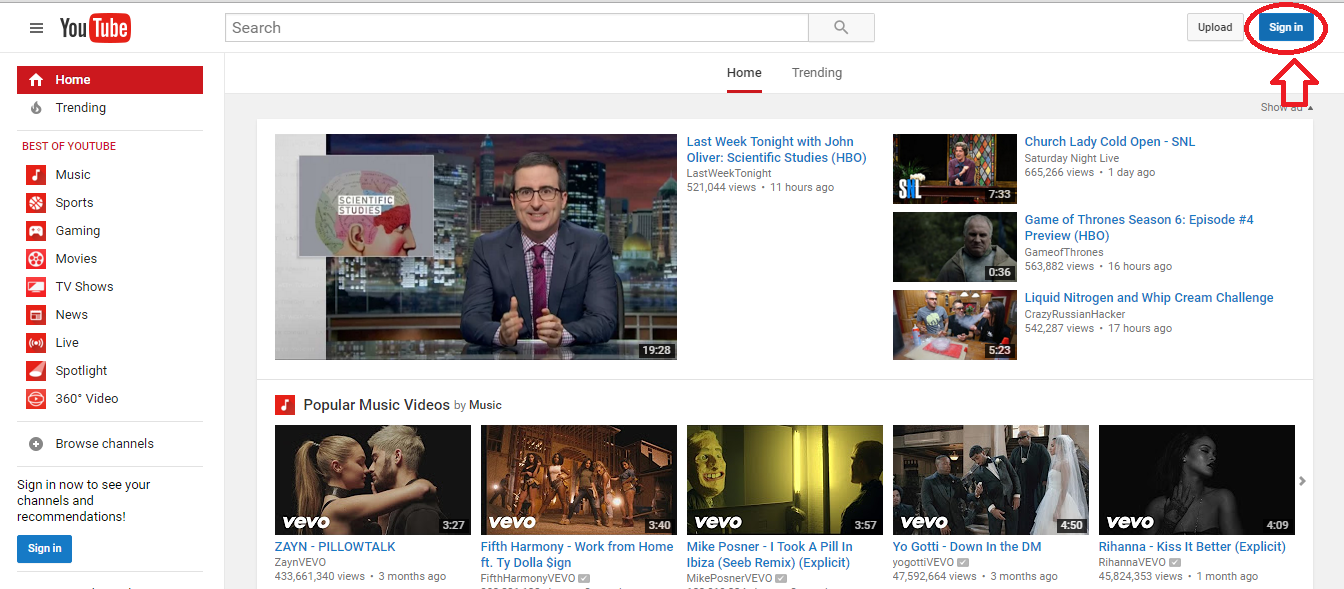
Secondly, businesses can create their own YouTube channel and upload original content as part of their inbound marketing programs. To get started, you will need to sign into your business’ Google account or create one. Find the sign in button at the top-right corner of the YouTube homepage.
With your account, you will own your very own “channel,” on which you will post your content. Branding your channel is an important step, as this will be the face of your company on this platform. Below are some tips.
Anatomy of a branded YouTube channel
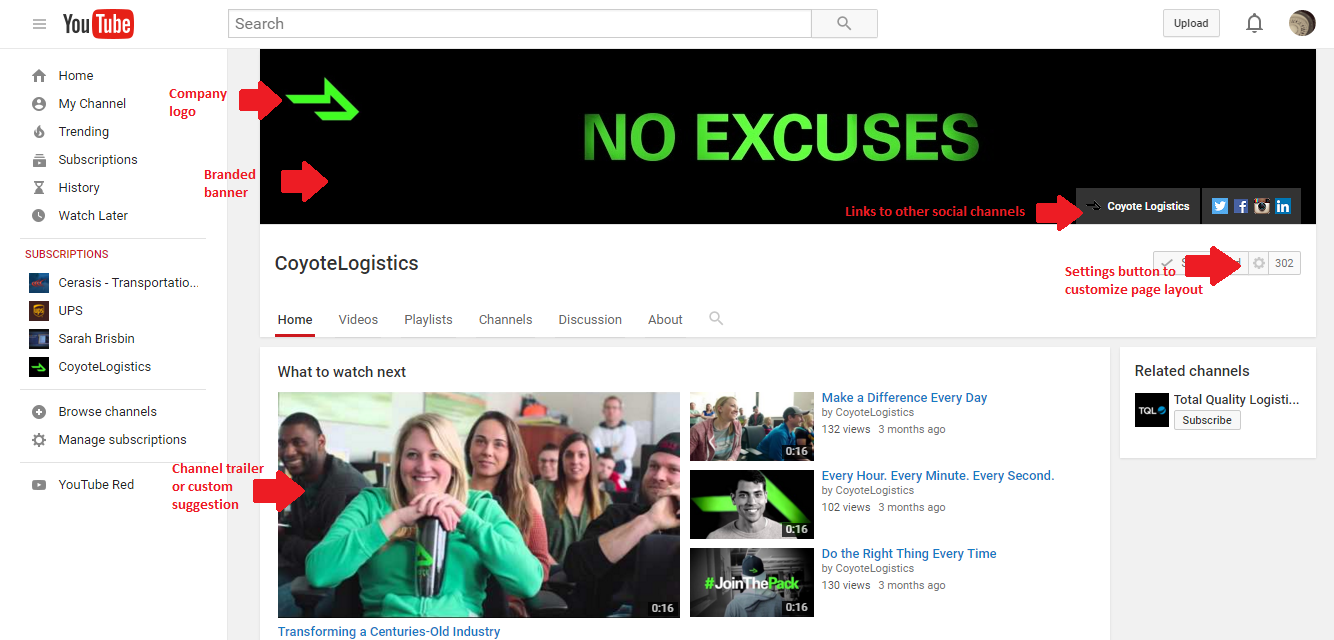
Coyote Logistics, a 3PL provider, has done an excellent job of branding its YouTube channel.
Company Logo
Upload your company’s logo by hovering over the channel icon and clicking the pencil icon when it appears.
Branded Banner
Upload an image that represents your brand and what users will find on your channel. Hover over the channel art, click the “Add channel art” button or the pencil icon in the upper-right corner and select “Edit channel art.” Coyote Logistics makes a bold statement (very representative of its brand personality) here. For the best results on all devices, YouTube recommends uploading a single 2560 x 1440 px image.
Social Icons
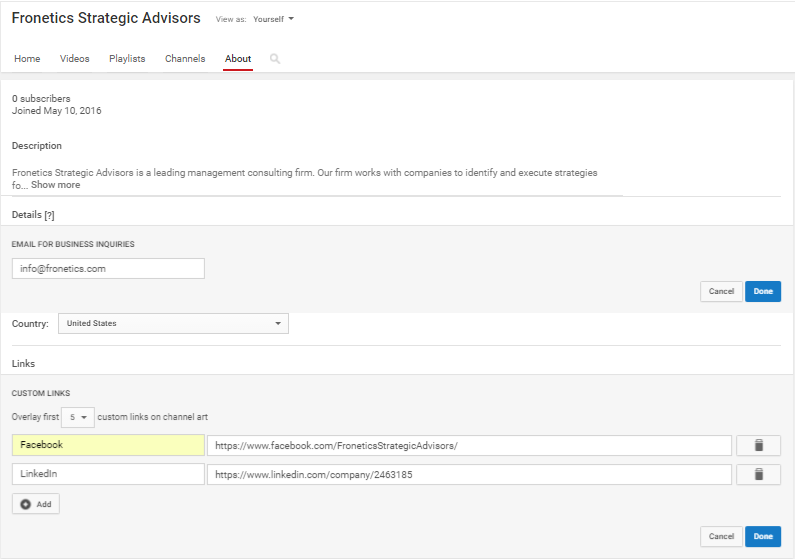
Provide links to your other social channels by hovering over the channel art, clicking the pencil icon in the upper-right corner, and selecting “Edit links.” Add the URLs for each of your channels under “Custom links.”
Customize Layout
Click the customize button to create a layout for your channel. You can add up to 10 “sections,” which allow you to group videos in a particular way. For example, you could add sections of recent uploads, popular uploads, playlists, etc.This helps visitors to decide what to watch — and lets you promote content you wish for visitors to see.
About
Navigate to the About section to add a channel description, business email address, country, and social links (if you haven’t already).
Uploading videos
Once you have your channel set, you’re ready to start adding your original content. YouTube Help has a wealth of resources to help you get started, problem-solve, and learn more. The below video offers an introduction to uploading videos in just a few quick steps.
Other terms to know
Playlist: Playlists let you organize your videos into different categories, like interviews, tips, product demonstrations, etc. Learn more.
Channel trailer: A short video, like a movie trailer, that gives visitors an idea of the kinds of videos they’ll find on your channel. Learn more.
YouTube Red: This is the premium subscription option that allows you to view videos without ads, watch videos offline, and more.
There is no easy answer to the burning question why the onshoring movement refuses to truly take off.
The issue of onshoring is frequently painted in black and white. While the media often likens the return of companies to the United States from overseas to a stampede, skeptics may be too quick to downplay the positive impact of the recent movement in manufacturing.
Nevertheless, those who were looking for a true Renaissance of American manufacturing have reason, at least so far, to be disappointed. Even among some high-profile companies — most notably Apple and GE — that announced their return with great fanfare, reality has set in. GE has battled high turnover rates at its re-opened Kentucky plants, as workers reportedly refused to perform certain tasks, while Apple has been stumped by the shortage of engineers.
Although the number of companies bringing production back home has risen significantly in recent years — from 64 in 2011 to 300 in 2014 — they are still outnumbered by those going in the opposite direction.
However, the issue is more complex than net gains or losses. According to new research by Morris Cohen, a Wharton School professor of operations and information management, and Hau L. Lee at Stanford University, “There is an unprecedented amount of restructuring going on.” In some cases, departments within the same company are onshoring and outsourcing at the same time, each weighing the perceived pros and cons differently.
In a Knowledge@Wharton interview, Cohen elaborated on the trend: “I’m going to go to China. I’m coming back from China. The same company simultaneously is making what seemed to be opposing decisions. And when you asked them why, they would give the same reasons. It’s because of labor costs. It’s because of market access. It’s because of this and that.”
In fact, they found there appears to be no dominant reason why companies make one decision or another in favor of onshoring or staying put.
And barriers seem to remain the same as when the onshoring movement began to gain momentum: The lack of skilled workers, coupled with an aging workforce, still rank high on the list of negatives. The rapid pace of offshoring in 1990s and early 2000s made younger generations lose faith in the viability of a manufacturing career.
Patrick Van den Bossche, the Americas lead partner at A.T.Kearney’s Strategic Operations Practice — which released its inaugural Reshoring Index last year — explained the problem on Manufacturing.net: “Think about it — if you have a kid in school, with everything that happened in the last few years, with manufacturing moving overseas as fast as it did, would you feel comfortable to tell your kid to develop a career in manufacturing? I don’t think so.”
At the same time, countries like China, Brazil, and Eastern Europe, previously known for their low-skilled labor, are quickly improving and investing in high-tech industries. With a greater pool of skilled workers abroad, a move back to the United States will seem less urgent. And with the arrival of robotics, the issue of labor costs will likely take on even less significance.
So the big question is, how should the United States stand up to the competition? What do you think?
A version of this article previously appeared on EBN Online.
A blog post not only stays around longer than a print ad, it can better engage potential customers.
The 24-hour news cycle has evolved into the 24-second news cycle with the rise of online media outlets and social media. So, when it comes to advertising your business, generating leads, making sales, and being perceived as a thought leader, you must consider the lifespan of your print ad and its purpose, versus the lifespan of a well-orchestrated blog and its potential.
Though often confused, there is a distinct difference between advertising and marketing. With a print ad, you are obviously advertising your business concisely, with a limited number of words and images. But, this form of advertising has a limited lifespan (only as long as that piece of print media is in the hands of a reader). So, it should be only one small piece of your marketing puzzle.
In contrast, a blog bridges advertising with progressive marketing techniques. It reaches your target demographic in a different way by conveying knowledge and building trust. It works on improving your “image” as well as branding your company as a thought-leader. A blog makes a more personal connection with the reader, while an ad is very obviously trying to sell something — and consumers gravitate toward knowledge rather than a simple sales pitch.
Looking at Longevity
A blog can live on indefinitely. What you post today may still be relevant and a popular read several months from now. Because of this, your company can reach a larger number of consumers within its target demographic for a long period of time, surpassing a print ad’s capacity for results. A blog also reaches consumers in a more relevant, memorable way. Marketing experts would agree: Getting your clients or customers to remember you is half the battle.
Your company’s advertising can include the placement of an ad in print media like newspapers, magazines, or direct mail. Print ads through community newspapers or direct mail flyers are useful for specific purposes, like targeting customers in a localized area.
But, you will find that advertising of this kind comes with a sizable price tag and has limited benefits. According to a Marketing Profs digital report, print advertising ranks as the largest expense of most marketing plans, with public relations and marketing strategies rounding out the important trio.
So how long will a print ad live? According to a marketing study published by Fast Company, a newspaper ad has a maximum lifespan of 2-3 weeks, and an ad placed in a monthly magazine may live up to three months.
In contrast, when a blog post goes live, it may generate the most hits within the first week, but it will continue to serve as available content that consumers will access for months, or even years, down the road. If the blog is well constructed, you may find that a year later it is still ranking in the top five search results for certain targeted long-tailed keywords.
So, it is important to consider the “quality of life” of your blogs and print ads. A blog feeds consumers’ need for more information before they commit. In fact, prior to contracting your services or buying your product, your potential customers will research the topic online and read blogs posts that present information in a vendor-neutral format.
Successful businesses react to this by creating a constant stream of this fresh content, organized into a library of posts (that stand the test of time), then use that content as bait to attract potential prospects. One study revealed that when it comes to blogs, the combination of proper timing and useful insight can result in a 33% higher lead conversion rate and a 38% increase in revenue over the prior year.
Blogs’ Benefits and Social Media
When you publish a print ad, you’ll never really know what your readers think about it. With a blog, you get feedback and you engage the reader, who is also a potential customer. It creates a more viable connection and provides greater insight that you can leverage to garner more customers through:
Tracking and analytics: Feedback is a powerful tool. Google Analytics can tell you what types of articles are capturing your readers’ attention. You can learn how much time they spend on a page and how they share it. You can leverage this information to determine what sort of content you need to create to reach more customers and generate more leads.
Shares and comments: Readers love to interact with online content, reading and commenting to express their opinion or thoughts. The comment section of your blog can become a community of readers. If a reader found your blog insightful or inspiring, they may also share it with their contacts or friends through social media. Your business becomes a part of a larger community that is connected through dialogue.
Advertising in any form, digital or print, is only a single component of any complete, multi-level marketing process. Innovative marketing today must include several different components, like well-articulated blog posts that utilize SEO, and connect potential customers to your company by offering information they can use. Blogs are a long-lasting porthole to your business, the product or the services you offer, and your professional insight or vision.
Improve your content marketing strategy in 2016 by following these six tips.
We know that content marketing is a highly effective tool for companies of all shapes and sizes, be they B2C or B2B. (If you’re not using inbound marketing, here are five reasons why you should be.) But, considering this strategy takes considerable time, effort, and resources, are you getting the most out of your efforts?
Long gone are the days when a weekly blog and vague presence on social media will cut it — 2016 is calling for a diversified content marketing strategy that speaks to today’s sophisticated consumer base.
Here are 6 ways to improve your content marketing strategy in 2016:
A blog for which you provide regular, original content is an excellent start . But, unfortunately in this day and age, it’s not enough. Offering content in different formats provides a richer experience for your leads, adds depth to your brand identity, and allows you to reach and connect with more consumers. There are a dizzying number of options out there, including podcasts, slideshares, videos, graphics, ebooks, and whitepapers, to name a few. Choose a couple that fit your brand best, and see where they take you. Which leads me to…
3) Do video.
Video is not just for funny cats and cover artists anymore — it’s the most popular form of content being consumed online. YouTube is the second largest search engine in the world, with more than one billion users conducting over 3 billion searches per month. What’s more, the number of videos uploaded to Facebook has increased by 94% over the last year, with more than 50% of Americans who use Facebook daily viewing at least one video per day. Some brands have capitalized on this trend. (See the Budweiser puppy commercial, viewed over 30 million times.) But there is a lot of potential there for businesses in all industries — a little creativity and some time and effort adding video to your content marketing suite could really pay off.
4) Tug at the heartstrings.
There’s a reason the Budweiser puppy video has enjoyed so much success: we love a feel-good story. An ad that evokes strong emotions makes us associate those feelings with the brand. Studies show that emotions play a leading role in B2B purchases, too, and your content marketing should leverage that idea by telling great stories and by promoting the value you offer. Content that tells a great story connects people to your brand on an emotional and intellectual level, helping earn their trust and loyalty. Similarly, by touting figures that illustrate the value your company offers its customers — like money saved, convenience, or top-of-the-line performance — you remind people what it is you can do for them. And there’s no better way to win hearts (and leads) than reminding them what they’ll get out of your relationship.
5) Focus on relationship marketing.
HubSpot identifies relationship marketing as the #1 game-changing marketing trend to tackle in 2016. While this term largely falls under the CRM umbrella, it can play an important role in your content marketing strategy as well. Providing existing customers with custom-tailored content and information shows that you understand their needs, and it makes communications infinitely more personal. You’re not just blasting out some mass communication that ignores the facts that you know about your client — for example, a mass email titled “Baby it’s cold outside!” to a client based in Florida. Modern technologies like geo-targeting and CRM software make personalizing content and communications much easier, but it will still take extra time and resources. That’s the (absolutely worth-it) cost of long-term, loyal customers earned through relationship marketing.
When it comes to marketing we work with our clients to create and execute strategies that drive success and elevate their brand position within the industry. Unlike other firms, we align marketing programs with business objectives and, through a data driven approach, are able to deliver results with a targeted ROI. Our team is comprised of strategists, marketing professionals, writers, designers, and experts in social media. Together we leverage our experience to increase brand awareness, position our clients as thought leaders, drive meaningful engagement with prospects and customers, and help businesses grow. Learn more about what we do.
Recruiting and retaining top talent is one of the largest issues the supply chain faces today. It has, in many ways, become an industry of gaps: skills, talent, and gender, to name a few. How can companies secure their future by acquiring, developing, and keeping employees with the potential to undertake future leadership roles?
While the number of full-time women in the workforce is up 15% since 1979, the number of women in the manufacturing sector is the lowest it has been since 1971.The gender gap extends more broadly to the supply chain, as well, with 70% and 80% of positions held by men. This article examines the talent crisis within the industry as an opportunity to help close the gender gap, and offers suggestions for building that bridge. Read the full article.
This interview with Rodney Apple, founder of the SCM Talent Group and supply chain recruiter for the majority of his 19-year career within the staffing industry, examines the challenges facing the industry and opportunities to address the talent crisis moving forward. Read the full article.
The outlook seems dire: by 2025, 60 million baby boomers will exit the workforce, leaving a gigantic gap when 40 million millennials take their place. What’s more, as few as 20% of the workforce will possess the broad range of skills required of 60% of all new supply chain jobs. The good news is that this looming crisis represents an ideal opportunity for recent college grads and mid-level supply chain management. Companies hoping to appeal to top candidates in the future should be proactive about meeting their professional needs through initiatives like competitive salaries and cross-functional training — or else, they might miss out. Read the full article.
Zappos offers new hires a $4,000 bonus to quit after an initial training program — and it actually has helped them retain top talent. Offering an early out to employees can be an effective method to detect personnel issues up front and ultimately can save your company from a major financial loss in the future. Read the full article.
When it comes to your career, connections matter. This article lists five reasons why building a strong network is crucial to your professional success. Read the full article.
Millennials — or, those born after 1981 — potentially could breathe new life into the graying supply chain industry. This article examines who millennials are and how companies might attract and retain talent within this oft-misunderstood generation. Read the full article.
Promising employees expect more from their employers when they outperform their peers — and not just in terms of compensation (though that is very important). When those expectations are met with disappointment, the company is at risk for losing top talent. This article discusses strategies for mitigating the loss of talented employees. Read the full article.
According to one study, only 12.5% of companies in the supply chain industry engage in formal succession planning, or the process of identifying top internal performers with the potential to fill key leadership positions. With the dearth of talent facing the supply chain, employers would be wise to invest in succession planning (and their most promising employees) — particularly through these three aspects of the process. Read the full article.
Focusing on education and training, employee retention and growth, and rethinking the talent pool itself does not address the bigger issue in the supply chain skills gap: the industry just isn’t perceived as sexy. What can companies do to overhaul their image and attract new and qualified talent? Read the full article.
Replacing employees is extremely costly — anywhere from 50 to 400% of their annual salaries, it is estimated — yet more than 2 million people voluntarily leave their jobs each month. Companies who are not tending to their human resource assets may be taking a major financial hit. Here are five employee retention strategies to help create a culture where employees are satisfied and interested in working for you long term. Read the full article.
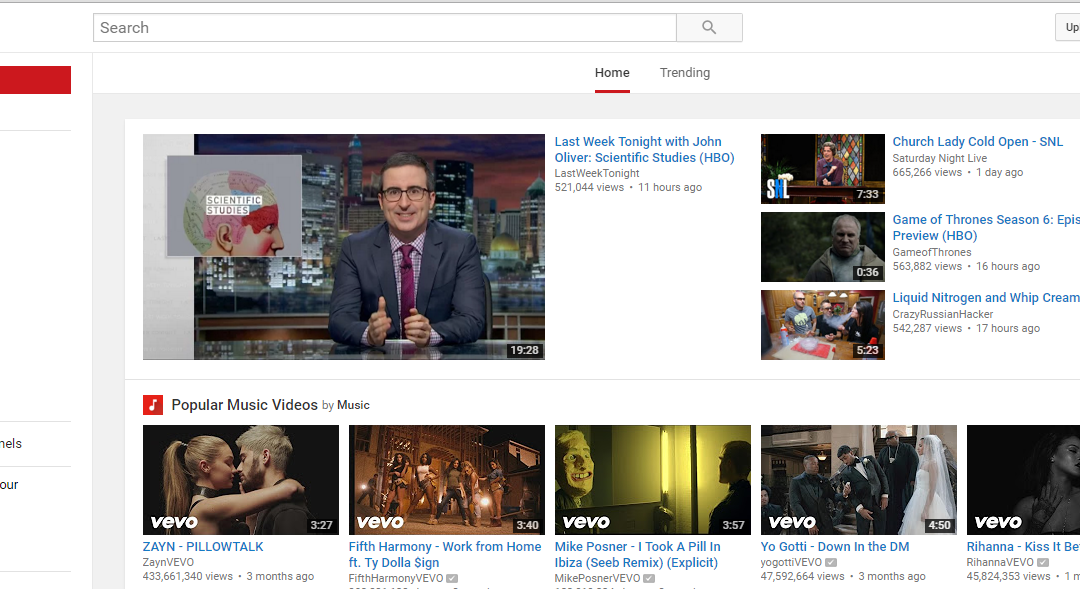
 Video is not just for funny cats and cover artists anymore — it’s the most popular form of content being consumed online. As such, YouTube has become the second largest search engine in the world, with more than one billion users conducting over 3 billion searches per month.