by Jennifer Hart Yim | May 6, 2014 | Blog, Content Marketing, Marketing, Social Media, Strategy
This is the first in a series of blog posts written by Adam Robinson, Director of Marketing at Cerasis. Founded in 1997, Cerasis is a top freight logistics company and truckload freight broker.
The purpose of this series of blog posts is to give others in our industry and especially those in the manufacturing industry, a guide to create an effective digital, social media, and content marketing strategy which will produce results for your company. If you have followed the Cerasis blog since its launch in March 2013, you have noticed that we work really hard at executing our strategy. The reason we work so hard is because we are passionate about educating the marketplace on information that matters to them. In that way, we want to be the de facto expert in the manufacturing and logistics industries. If we can help those who are our customers and potential customers (manufacturers and distributors) with best practices around logistics and freight, as well as manufacturing industry news, we are continuing our mission of driving long term value (even if we give the information away for free). The result (we hope and have seen) is that people view us as the expert and will want to engage us in a long term relationship as their logistics services provider. We hope this is helpful and you learn something from it!
Background of Cerasis use of Content Marketing and Social Media
- Company started formal marketing for the first time in October 2012, its 16th year.
- Little brand awareness, not thought of as a thought leader, but company still grew well by referral.
- It was important for us to establish our messaging, our target audience, and how we were going to best market the company.
- We didn’t have any budget for advertising, and with the rise of content marketing, we knew it was important to use social media and content as a way to start marketing and fine tuning the messaging of the company.
- We finished our market research phase (tips below on how to conduct one), and knew the content and who we wanted to reach.
- We then looked at all the social media channels and decided which platforms to use and what online communities to join.
- We built a strategy and started executing our content by simply posting one piece of content every business day.
Digital Marketing Strategy Approach for Cerasis
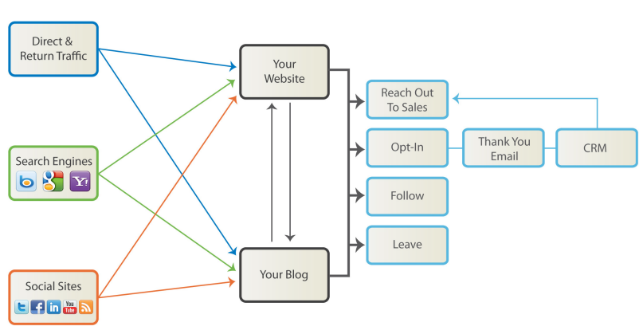
There is a process to strategic planning in order to lead towards sustainable marketing programs which yield a tangible return-on-investment (ROI). The process starts with understanding where social, digital, content, and traditional marketing fits in the world of inbound lead generation and increased brand awareness.
The goal of any strategic plan should be to find and acquire new customers and to grow existing customer relationships. The map on the next page shows how customer engagements happen online and in general. This map to the left helps us determine Cerasis’s route, analyze where we currently are, and hone in on where we should focus our attention to keep the strategy on track.
So, what are all the results from our social and digital marketing you ask?
Cerasis Quick Stats (Sept 12 to March 14)
- All Visits to Cerasis.com: 4,476 to 34,461 (669.91% Increase)
- Blog Visits: 0 to 28,271 (notice how without our content and social media, we would not have grown our website visits to where they are today)
- Social Media Visits: 4 to 8,546 (214,550% Increase)
- Search Visits: 711 to 16,275 (2,189.03% Increase)
- Social Community: 175 users total to 9,635 users total
- Twitter: 0 to 2,760 Followers
- FB: 0 to 492 Likes
- LinkedIn Group Members: 0 to 3,550
- LinkedIn Profile Connections: 120 to 1,456
- LinkedIn Company Page Followers: 51 to 529
- Google Plus Followers: 0 to 662 and over 310,000 views of the Company Page
- Pinterest Followers: 0 to 188
- Engagement Numbers:
- Twitter Mentions/RTs: 14,825/5,721
- LinkedIn Group Comments: 12,766
- Facebook Comments, Likes, Shares: 1,484
- LinkedIn Page Impressions/Interactions/Clicks: 247,359/566/1,560
- Pinterest Impressions/Repins: 73,698/327
- Blog Comments: 841
- Google Plus +1s: 2,976
- Conversion data (note, leads vary based on industry; 1 sale for us can mean a lot of revenue)
- Leads From Search Engines: 71
- Leads From Social Media: 65
- Leads From Webinars: 52
- Total Customers Gained: 35
Conclusion
Social media, content, and digital marketing are much like the Pareto Principle: Focus on the platforms and entities which yield the highest results, don’t just do something or be somewhere to do it! It all comes down to strategy! Now, if you have the resources to be on every social media platform, you should, but only if you do it well!

by Elizabeth Hines | Apr 10, 2014 | Blog, Marketing, Social Media
Return on investment (ROI) is not a metric which is well suited to measuring the value participating in social media can bring to a company. And, unfortunately, there is no distinct metric or formula that can completely capture the impact, value, and ramifications of participating. Because of this, many companies choose not to participate in social media. This is a mistake. While measuring social media ROI may not be as easy as pie, it can be done. And, more often than not, participating in social media will yield a positive ROI.
Investing just six hours a week in social media can yield a positive ROI
According to the 2013 Social Media Marketing Industry Report, 92 percent of respondents reported that spending as little as six hours a week on social media increased exposure to their business. Sixty-four percent of respondents reported that by spending as little as six hours a week on social media they were able to see lead generation benefits. In addition to increased business exposure and lead generation benefits, respondents also reported that participating in social media reduced marketing costs. Specifically, 38 percent of companies with 1,000 employees or more reported that social media decreased marketing expenses and 62 percent of businesses with 10 or fewer employees reported a decline in marketing expenses. Social media was also found to benefit companies with respect to gaining marketplace intelligence–71 percent of respondents who spent at least six hours per week on social media reported an increase in marketplace intelligence.
More exposure, more traffic, more leads, more customers
Turning to an example, SFJ Material Handling Equipment, a family-owned company established in 1979, is the largest stocking distributor of new and used material handling equipment in the United States. The company has more than 53,000 followers on Twitter (and is gaining 200 to 400 followers per week), more than 38,000 Facebook likes, and has more than 2,000 Google+ followers. The company reports that nearly 20 percent of their website traffic is driven by social media. Stafford Sterner, President, notes “If you’re trying to reach out to totally new markets, then you might want to do Facebook and Twitter. If you’re comfortable building that relationship with people or companies you’re close to, then it’s LinkedIn.”
Another example is that of Kinaxis, a supply chain management company. Kinaxis launched an online social media campaign with the objective of doubling leads and web traffic numbers. The campaign included two online comedy series (Suitemates and The Late Late Supply Chain Show) and the launch of the company’s 21st Supply Chain Blog. The campaign was successful–web traffic increased by 2.7 times and leads increased by 3.2 times.
When executed correctly, your company can realize a positive ROI on your investment in social media.
Not participating in social media is a mistake your company can not afford to make.

by Elizabeth Hines | Jan 29, 2014 | Blog, Marketing, Social Media
There is much more than meets the eye when it comes to social media marketing. From expanding corporate communications to learning valuable information about consumers, social media has benefits that help businesses grow and expand their reach. Here are four powerful reasons why your business needs to incorporate social media into your marketing strategy:
1. Sharing Educational Content with Consumers
Leveraging social media as a tool for educating customers is a B2B marketing strategy that many businesses miss out on. Build your social media channels and develop thought leadership by providing objective, educational content that is relevant to your customers’ business problems. Become a resource of industry-related information through your original content and content curated from across the Internet. When potential customers are beginning their buying process, they gravitate towards companies with whom they are familiar and perceive as industry experts. According to Sirius Decisions, 70% of the buyer’s journey is complete before they ever contact a sales representative. Socially sharing educational content will increase your visibility to buyers during the sales process. Buyers are more informed than ever before, and businesses need to strive to be a resource for their customers on social media.
2. Improve Your SEO Ranking
Inbound links and social shares are two key performance indicators (KPIs) to be mindful of throughout the SEO process. Inbound links and social shares are two increasingly important factors that are taken into consideration during website indexes. These increase what Google refers to as Author Authority, and the more authority, the more SEO weight your website gains. Bottom line: the stronger your presence on social media, the higher your search engine page rank will be.
3. Generate New Leads
Social media can be used to help businesses build robust marketing campaigns to support lead generation, often with little to no cost. The plethora of social media networks and websites can seem overwhelming, but popular networks like LinkedIn and Twitter are a great place to start using social media to generate qualified leads.
LinkedIn is an ideal space for businesses; the community of professionals is a great resource for networking. LinkedIn supports businesses with community pages, company pages, groups and discussion boards for users to share ideas, content and talk to like-minded professionals. LinkedIn is also a useful tool for leads by gauging interest in products and services based on conversations. Additionally, Twitter is another free platform that users can use to drive lead generation efforts. According to Inside View, B2B marketers who use Twitter generate twice as many leads as those that do not.
4. Stretch Your Marketing Dollars
Even if you do chose to upgrade your social media toolkit and pay for premium benefits and services, the cost of implementing a social media marketing campaign is significantly lower than using many traditional mediums. The real-time data and analytics received through different social platforms provide users with valuable insights and the opportunity for businesses to pivot campaigns and tactics as needed in order to have the highest possible impact. Moreover, you be flexible with your marketing strategies, campaigns and tactics.
What have been some of the biggest benefits that your organization has seen as a result of their social media practices?
For more information on the benefits of social media, check out our white paper.

by Elizabeth Hines | Nov 12, 2019 | Blog, Strategy, Supply Chain
Organizations implementing sustainable supply chain practices face increased expenses associated with upfront investments. But new strategies are emerging to change that.
Highlights:
- 93% of supply chain organizations have implemented environmental initiatives. Still, more plan to do so in the next five years.
- Unlike some sustainability initiatives that require large upfront investment, other strategies synergize with business interests.
- A holistic vision is key to initiating sustainable practices.
Sustainability is on-trend in the business world. But, how do you view sustainable initiatives — a debilitating upfront investment or an exciting opportunity to enhance your company’s bottom line? Many small businesses find themselves in the former camp. However, new strategies are emerging that may change that.
What does sustainable practice mean?
A recent study conducted by Llamasoft and the Economist Intelligence Unit surveyed 250 senior executives from manufacturing and retail companies worldwide. The report showed that 93% of supply chain organizations have implemented environmental initiatives. Still, more plan to do so in the next five years.
Regulatory standards and consumer priorities are making it increasingly urgent for companies of all sizes to rethink their operations in terms of sustainability. A 2018 Nielsen study found that 81% of global consumers are convinced that companies have a responsibility to employ policies that prevent further harm to the planet. The U.S. has seen increased regulation related to environmental protection, including emissions standards and the recovery/reuse of packaging material. In the U.K., companies employing more than 500 people are required to report on their sustainability practices, and, according to Nielsen, 71% of Europeans place a high value on maintaining ethical and sustainable lifestyles.
Whether this means costs or benefits for your organization depends a great deal on what exactly you understand sustainability to mean. While it’s easy to associate sustainability with hard-to-achieve environmental goals, industry experts are starting to think a little more capaciously about how companies can participate in a sustainable supply chain. If we think about sustainability as “meeting the needs of today without compromising the ability of future generations to meet their own,” then organizations can find more flexible strategies for achieving sustainability that suit their needs and abilities.
Organizations implementing green initiatives face increased expenses associated with upfront investments. New equipment, more expensive sourcing costs, and the personnel required to oversee these changes make the early stages of investing in sustainable practices a daunting prospect for many companies. And the obstacles don’t end there. According to Llamasoft’s study, significant challenges facing sustainability initiatives include the difficulty of monitoring complex supply chains and the need for organizational structures that can implement new policies. Interestingly, 38% of executives surveyed cite the costs associated with these challenges as a deterrent to implementing further initiatives.
Yet 33% reported that their companies had initiated sustainability drives because of the benefits to their bottom line. What accounts for the difference?
Sustainable practices: the bottom line
As the survey indicates, sustainability and profitability are not actually mutually exclusive options. Unlike some sustainability initiatives that require large upfront investment, other strategies synergize with business interests.
Efforts aimed at increasing the efficiency and agility of supply chain organizations can yield sustainability benefits as a rewarding side-effect. Consolidating shipments, efficient route design, and multi-echelon inventory optimization serve both profitability and sustainability goals. Intelligent product design that allows for efficiency of shipping and storage also contributes to carbon footprint reduction. Just think of Costco’s switch from round to square pistachio jars that enhanced supply and storage capacities and reduced the emissions of its truck fleet at the same time! Additionally, periodically overhauling operations with sustainability in mind has proven to be a good tactic for efficiency, as well, leading to more precise inventory levels and more accurate predictive management.
Upfront costs can often be quickly recouped not only through improved efficiency, but also through the brand identity enhancement associated with companies that effectively publicize their sustainability practices. Integrating green initiatives into marketing and branding strategies offers an intangible advantage beyond measurable profits or benefits to the planet.
Many businesses are looking to brand themselves as leaders in sustainability. Many large organizations successfully do this by engaging with suppliers to encourage sustainable practices throughout the supply chain. In the past, large organizations used environmental criteria as a tie-breaker in awarding contracts to smaller supply companies. But, sustainable practices are increasingly becoming a requirement in order for supply chain companies to bid in the first place. In fact, 88% of executives surveyed by Llamasoft indicated that their organizations keep track of supplier sustainability ratings, often developing their own evaluations, such as:
- Supplier scorecards that allow companies to rate the practices of other businesses in their supply chain, facilitating comparison among potential suppliers
- Public targets, which some companies require suppliers to meet in order to retain their contracts (Hewlett Packard, for instance, has launched a campaign requiring 80% of their suppliers to set certain emissions reduction targets by 2025.)
- Awards that allow companies to recognize suppliers that successfully initiate green policies
Sustainable practices for small companies
These benefits, however, are predominantly available to large global companies that have the capital, scale of operations, and leverage with trading partners to make sustainable practices practical. So, what can small businesses do to rate highly for sustainability — not to mention, gain the same branding advantages enjoyed by large organizations?
A holistic vision is key to initiating sustainable practices. Your company’s sustainability doesn’t ride solely on internal practices, such as the management of your fleet. It is just as important to consider how sustainable your suppliers are, for example.
From this perspective, selecting off-shore suppliers with lower per-unit costs can often incur longer-term disadvantages. Companies risk increasing their carbon footprint due to the greater shipping distance. Further, longer lead times necessitate holding more inventory, which equates to higher holding costs and storage facility energy emissions.
In short, the best way for any business — large or small — to practice sustainability is to optimize practices throughout the supply chain. Regulatory standards and consumer preferences are increasingly bending that way, and soon you’ll be in the minority if you’re not an active advocate for a sustainable supply chain.
This post originally appeared on EBN Online.
Related posts:
by Elizabeth Hines | Nov 5, 2019 | Blog, Content Marketing, Logistics, Marketing, Social Media, Supply Chain
LinkedIn has released a new guide to using video on its platform. Here’s what supply chain companies need to know to get the most out of video on LinkedIn.
Highlights:
- Effective B2B marketing videos start with an analysis of your prospects’ unique purchasing journey and needs.
- Videos for the awareness stage of the buyer’s journey should be concise and geared to forging an emotional connection.
- Bottom-of-the-funnel video types include product demonstrations, welcome videos, webinars, and FAQ sessions.
Visual content, particularly video, is the future of social media marketing. And video on LinkedIn is no exception. A recent report from Kleiner Perkins indicates that 62% of B2B marketers rate video as an effective content-marketing tactic. Not only that, but, according to internal data from LinkedIn, users are 20 times more likely to share a video on the platform than any other type of content.
Thanks to a recent guide published by the platform, leveraging video on LinkedIn for the supply chain has never been more attainable. The Tech Marketer’s Guide to B2B Video is an invaluable resource. Whether you’re relatively new to B2B video marketing, or a seasoned video creator, the guide contains useful nuggets of information, as well as examples of effective video on LinkedIn, for marketers at any stage.
We’ve pulled out key points for you.
6 steps to approaching video on LinkedIn
It’s worth pointing out that the six steps that LinkedIn identifies to building an effective video strategy are applicable elsewhere as well. Your strategy for video on LinkedIn should likely also apply to your strategy for video content across your digital assets.
1) Analyze your buyer’s journey
Consider the unique buyer’s journey for your company. What content do prospects want to see at each stage, and what actions do you want them to take?
2) Set your marketing strategy
What medium is optimal for delivering content at each stage? Which stages are particularly conducive to video content?
3) Establish metrics and KPIs
Choosing the right key performance indicators (KPIs) and metrics will allow you to determine how your content is performing.
4) Create video content
At the stages where video content is the best way to deliver, what type of video is most effective?
5) Target your content
Use your understanding of your target audiences, in combination with the targeting capabilities of LinkedIn, to ensure that your video is reaching the right people at the right times.
6) Optimize your campaign
Keep track of your data. Note what’s working. Adjust what isn’t performing.
Using video on LinkedIn throughout the buyer’s journey
Awareness
The first stage of the buyer’s journey, the awareness stage, is particularly opportune for video on LinkedIn. At this point, your goal is to tell a story, evoke a response, and introduce your brand and products.
Videos at this stage should be concise and geared to connecting with your audience, demonstrating an understanding of their challenges, and how your company is positioned to address those challenges.
LinkedIn’s guide points out a major advantage of video: its measurability. As opposed to text-based marketing, where your knowledge of audience behavior is limited to downloads and time on page, video on LinkedIn comes with richer data. You can tell, for example, when someone has watched your video and when they stopped. This means you can adjust your video length suit the preferences of your audience.
At the awareness stage, important video metrics include how many times your video was viewed, how much of the video was watched, and how many viewers responded to your call to action.
Consideration
Using video on LinkedIn for the second stage of the buyer’s journey, the consideration stage, is about introducing your products and their features, as well as giving a sense of what it’s like to work with your business. Ideal video formats at this stage include explainers, case studies, webinars, how-to videos, and virtual tours. Your foremost goal is to be authentic and to represent your business and the solutions it offers.
Key metrics at this stage are about engagement. Keep track of the number of interactions your videos get (comments, likes, clicks, shares, etc.), compared to the number of views. Also keep an eye on your estimated cost per view (eCPV) to track the efficacy of your video budget.
Decision
Because the decision phase of the buyer’s journey is all about personalization, video has traditionally been used less here. But that’s starting to change. Authentic, trust-building videos can be a powerful asset for the decision stage, reassuring your prospects that they’re making the right decision, using testimonials from existing customers. Welcome videos, FAQ sessions, and webinars are also effective in the decision phase, as well as full-length product demonstrations.
If you’re using lead-generation forms with your video on LinkedIn, keep track of which generate the most leads, as well as the quality of those leads. Otherwise, track click-through rates to gain insights into your estimated cost per click (eCPC).
Metrics for video on LinkedIn
LinkedIn offers a robust set of metrics for videos on its platforms:
- Views: At least one second of playback while the video is at least 50% on screen on desktop, or 300 milliseconds on mobile
- Views at 25%: The number of times your video was watched at 25% of its length, including watches that skipped to this point
- Views at 50%: The number of times your video was watched at 50% of its length, including watches that skipped to this point
- Views at 75%: The number of times your video was watched at 75% of its length, including watches that skipped to this point
- Completions: The number of times your video was watched at 97-100% of its length, including watches that skipped to this point
- Completion Rate: Completions divided by views as a percentage
- View Rate: Number of views divided by impressions, multiplied by 100
- eCPV: Estimated cost per view
- Full Screen Plays: Total number of clicks to view video in full screen
Do you use video on LinkedIn for your business? Let us know your experience in the comments.
Related posts: