by Elizabeth Hines | Feb 7, 2017 | Blog, Content Marketing, Manufacturing & Distribution, Marketing, Supply Chain
Here are four key takeaways from the manufacturing content marketing report.
The Content Marketing Institute (CMI) has released the results of its annual manufacturing content marketing survey, and there have been some big changes since last year.
Like many businesses in the logistics and supply chain industries, manufacturing companies have been slow to adopt modern marketing principles. Many are hesitant to undertake a content marketing program, whether from lack of time or lack of knowledge about how it works and the benefits.
But that is beginning to change. Manufacturing companies are realizing how much there is to gain from inbound marketing strategies. They’re practicing content marketing, and it’s paying off. In fact, CMI has been conducting the survey among manufacturing operations for the last four years, and never before have the results indicated such progress.
We’ve summarized four of the things you need to know.
4 takeaways from the CMI manufacturing content marketing report
1. Marketers are improving at content creation.
Compared to one year ago, 59% of manufacturing marketers report more success with content marketing for their organizations. A whopping 82% of that group credits this increased success with improved content creation. This means that marketing professionals are getting more efficient at producing higher-quality content.
Related resource: Check out our guide on writing good content.
2. A documented strategy gets results.
This year’s study showed a 72% increase in companies’ documenting their content marketing strategy. Documenting your strategy allows you to set goals, identify benchmarks, and follow through on your objectives. It’s also easier for your organization to come together with a unified, well-rounded marketing and sales strategy.
Related resource: Start crafting your strategy with our content strategy template.
3. Content marketing is becoming a greater priority.
It may seem obvious, but for greater content marketing success, your business must prioritize your content marketing efforts. Of marketing managers who reported increased success last year, 62% credit putting content marketing higher on their priority list. This means communicating with leadership to ensure ample time to produce quality content.
Related resource: Show your bosses these 6 marketing metrics they really care about.
4. Manufacturing marketers are becoming more seasoned with content marketing.
The manufacturing world is gaining experience with content marketing. According to CMI’s survey, more than half (56%) of respondents report that their organizations’ content marketing maturity level is either sophisticated, mature, or adolescent — as opposed to young or “first steps.” That’s an 8% jump from last year. Gaining experience creating, documenting, and implementing a strategy is what ultimately allows marketers to determine what works for their business — and to see sustainable success.
Related resource: See how companies in the logistics and supply chain industries are using content marketing.
Going forward
CMI identified some areas for improvement for manufacturing marketers. Consider these recommendations as goals for your business as 2017 progresses:
- Fully commit to content marketing. It’s time to go all in.
- Focus on clarity in setting goals and documenting results.
- Have a real vision of what success means for your business.
Manufacturing operations have come a long way in the past year with content marketing. As the supply chain industry gets more and more comfortable with this kind of marketing, the possibilities for business development continue to grow.
Related posts:

by Elizabeth Hines | Jan 16, 2017 | Blog, Content Marketing, Logistics, Marketing, Supply Chain
Keep these four trends in mind when planning out your marketing efforts in 2017.
Marketo recently revealed its predictions for upcoming marketing trends for 2017. It’s a list of technologies, strategies, and tactics that the marketing software automation company believes will be important to focus on over the next year.
We culled through these predictions to highlight what the supply chain industry needs to know. Below are four trends marketers should have on their radars.
4 marketing predictions to watch out for
1. Customer-Centric Marketing
For B2B companies, customer-centric marketing means buyer-centric marketing. Because the cost of switching vendors is increasingly low, and the buyer is faced with endless choices, it’s likely that 2017 will see “an aggressive shift in attention toward increasing customer spend.”
This means increasing your focus on building and cultivating relationships. Marketo suggests that companies balance their marketing spend to “invest in building engagement, brand loyalty, and advocacy with current customers rather than just finding new ones.”
It’s likely that technology will play a big role in this 2017 trend. Your company needs marketing team members who are tech-savvy and who know how to analyze and respond to customers’ digital signals.
Focusing on the customer also means building authentic connections and a move toward “giving as much as you get, if not more.” We’ll see more and more customer advocacy, which means that marketers need to focus on taking relationships beyond the transactional. Marketo recommends “providing them with opportunities to showcase their expertise and be recognized by their peers as leaders and innovators.”
The key takeaway: 2017 is the year of building quality relationships.
2. A New Generation of Marketers
We used to live in a marketing climate where specialization was the key to success — no longer is that the case. Your business needs leaders who are “full-brain marketers,” multi-talented generalists who are comfortable handling challenges from the creative design to demand generation — and beyond.
It’s time to abandon thinking in silos. Marketo recommends that your marketing team be in constant connection with other teams within the company. “B2B marketers can now use technology to ensure their sales team have visibility and participation in programs — versus being isolated from critical activities.”
This kind of structural shift requires openness and humility. Marketers need to be willing to take questions and ask them, and to be open to making changes based on increased intra-business collaboration.
Marketo predicts that 2017 will see the perfect storm hit the marketing world, bringing an intersection between fulfilling customer needs, storytelling, and digital interactions. Your company needs to look at its organization and build deep expertise across these three functions. “Any marketing organization that’s missing one of these three functions is destined for failure,” warns Marketo.
This new generation of marketers means that top-performing B2B companies will be making optimal use of technology and data. You need to be investing in resources and technology to drive data enrichment and data governance activities to set a good foundation for your account-based marketing strategy. This also means working closely with sales to understand their thought process for lead prioritization and acceptance.
Here, the key to success is open communication within your organization.
3. Techniques
Marketo has laid out a new equation for how marketers will incorporate techniques to engage buyers at every stage of the cycle:
Inbound + Broad-based lead generation + Account-based marketing + Paid media personalization + Direct marketing = Successful customer engagement
What does this mean for the supply chain? Your company can use a combination of these strategies to engage prospects. For example, combining account-based marketing (ABM) strategies with broad-based strategies will allow marketers to build long-term customer relationships, while bridging their advertising and marketing technologies to demonstrate ROI.
All this focus on ABM solutions will allow marketers to become more efficient, taking advantage of cutting-edge technologies. Marketo suggests creating a detailed ABM plan for all departments, which includes creative marketing ideas to test, as well as new technologies.
It’s time to harness the technology at your fingertips.
4. Content & Channels
2017 is likely to usher in a return to value over volume, both in content assets and in content distribution channels. It’s time to stop creating content for the sake of creating content and to shift toward “deeply listening to and understanding the customer.” This will allow you to cull some of the content and channels that aren’t benefitting your business.
It’s easier than you might think to put this trend into practice. Marketo suggests starting by “deeply understanding the content you already have, and taking the time to evaluate what resonates and what doesn’t.” Next, you can create a plan to keep your content strategy going forward in a meaningful way.
As far as channels go, user experience, particularly for mobile, is going to be increasingly important. You can prepare for this by adding structured data to your site, and by providing valuable content. It’s important to keep a watch on the changing user behavior and expectations, as it will be the biggest driver of change in SEO.
As algorithms continually change, and chronological timeline updates increasingly being phased out, social media channels will put more focus on individuals over brands — this means an absence in brands showing up in feeds organically. You can rise to this challenge by making real-time engagement a priority.
We’ll also see ad inventory becoming tighter and more expensive across social platforms. This means you’ll need to become more specific about the audiences you target, and make your offers increasingly personalized and relevant. Marketo adds the hopeful prediction that “advertisers will benefit from more ways to track offline conversions and non-immediate revenue.”
As email technology advances, email campaigns will begin to predict the content you want and really need. The end result here is “targeted, personalized communications optimized for each person, based on their online and email behaviors.”
The takeaway for content in 2017 is: quality over quantity.
Related posts:

by Elizabeth Hines | Nov 28, 2016 | Blog, Content Marketing, Marketing, Social Media
Supply chain companies can use influencers in their prospects’ network as a strategic tool to gain new business.
The term “influencer marketing” often brings to mind celebrities endorsing their favorite brand of bottled water or jeans — not an image that is particularly useful for B2B businesses. However, B2B marketers should be taking this powerful trend in content marketing seriously.
While your supply chain may not benefit from an endorsement by Jennifer Aniston, you likely have brand influencers at your fingertips, which you may not even realize. Effectively leveraging these endorsements is a strategic tool for gaining new business.
Developing an influencer marketing strategy
Once you’ve identified your natural influencers, here are three important steps for building an influencer marketing strategy for your company.
1) Know your target buyer.
Rather than a scatter-shot approach, making the effort on the front end to identify your target buyer personas allows you to strategically target your customers. Understanding their needs, challenges, and purchasing structures is the key foundation to any content marketing effort, and influencer marketing is no exception.
2) Identify your industry influencers.
Industry influencers aren’t just the big names, though those people are certainly influential. It comes down to how your buyers make their purchasing decisions. The 2016 B2B Buyer’s Survey Report found that nearly half of B2B buyers use peers and colleagues as a major information resource when choosing a vendor.
Who are those peers and colleagues whom your target buyers turn to? Use every resource at your disposal to determine how they get their information. Connecting on LinkedIn, Twitter, and other social networks is a great way to do this.
3) Use the right tools for your business.
Any effective content marketing strategy depends on using the most effective tools. In a post for CMS Connected, Leah Kinthaert makes a strong pitch for Twitter. She cites the ease of plugging in a hashtag or keyword in giving you “volumes of information — from who the influencers are in that industry to what today’s breaking news is on the topic.” Furthermore, clicking on a hashtag shows you what your competition is doing as well.
The bottom line is that influencer marketing can be an extremely effective aspect of a B2B business’ content marketing strategy. Knowing your buyers, finding your influencers, and effectively leveraging this information will help boost your social credibility, as well as generating new business.
Related posts:

by Elizabeth Hines | Sep 28, 2016 | Blog, Content Marketing, Logistics, Marketing, Strategy, Supply Chain
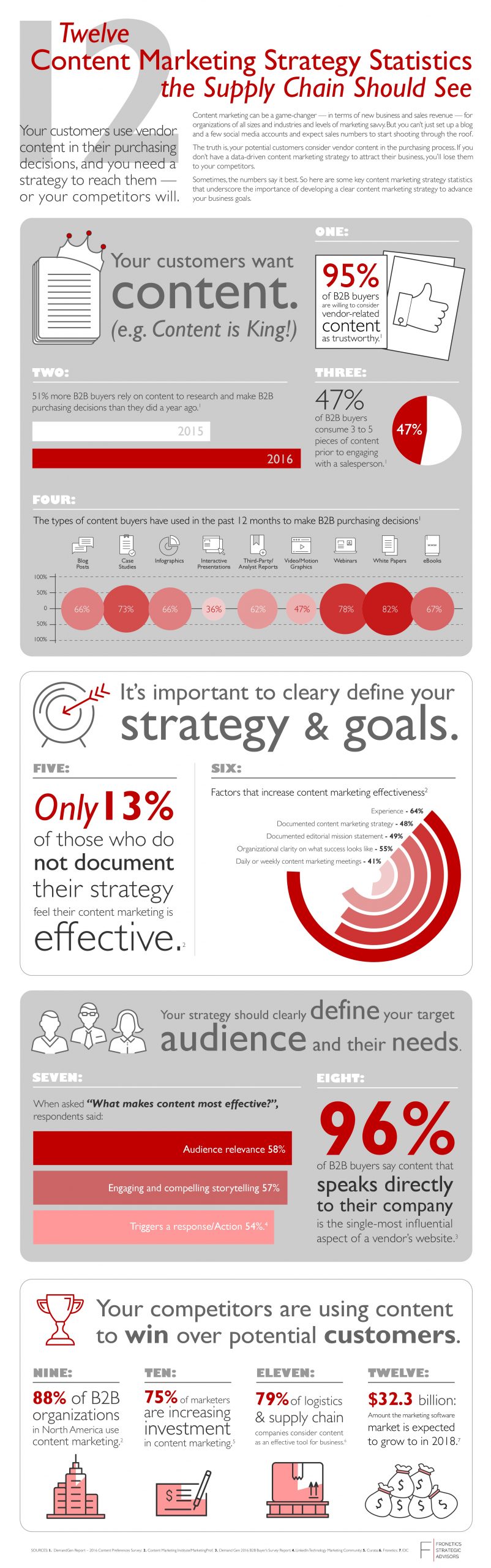
Companies in the logistics and supply chain industries should take a look at this content marketing infographic.
Content marketing is a form of inbound marketing in which vendors publish digital content to attract customers who are searching for products and services like theirs. If done right, it is highly effective in growing brand awareness, generating and converting leads, and driving sales and repeat business.
If your organization is exclusively using traditional outbound marketing techniques, like advertisements in print publications, you’re missing out on growth opportunities. We rounded up some of the most telling facts about the role of content marketing in today’s B2B purchasing environment for you to consider.
Here are 12 facts about content marketing that your business should keep in mind.

by Elizabeth Hines | Aug 3, 2016 | Blog, Content Marketing, Marketing
Here are some guidelines on what content marketing might cost your business and why you need each element to be successful.
Content marketing can be a game-changing strategy for companies looking to increase brand awareness, improve lead-generation efforts, and grow their business. But sticker shock can prevent some from pulling the trigger — especially when an organization is unsure how to measure ROI.
Content marketing will require an investment in services that are not cheap (writing, design, social media management, etc.) or a major time commitment from your own human resources. That being said, the more dollars or resources you throw at it will not necessarily ensure greater success.
To find the right pricing for your content marketing, it’s important to understand what you are paying for. Here are some guidelines for how much content marketing should cost (if you’re doing it right).
A pricing breakdown
The right content, published at the right time, reaches buyers who are looking for products or services like yours and informs them about your business. That, in turn, entices them to become customers.
Here’s the rub: You cannot just throw any old content out there and expect it to work. Here is what you need:
1) A data-driven inbound marketing strategy
This initially may cost around $20k. That sounds like a lot, but here’s why it is so important.
Research proves that content marketing is drastically more effective when it is 1) backed by a strategy, 2) the strategy is documented, and 3) a designated person is leading the strategy. Whether created by an in-house team or an outsource partner, your strategy should be driven by data, and should include these vital components:
- Buyer personas and journey: Who your potential customer is and what steps they take to research, evaluate, and decide to buy
- Content mapping and demand generation: What topics appeal to your customers? How and when should you deliver content? What channels reach customers best?
- Conversion and scoring leads: How to optimize lead-conversion rates and evaluate leads throughout the buyer journey; identifying optimal timing for sales calls
- Goals and KPIs: Define what success looks like and how to measure progress
2) Content marketing talent
Human resources may cost $5K-$10K per month. You need a team of skilled writers, graphic designers, and social media managers who can produce quality content, on a regular basis, and distribute it effectively.
Why can’t you just have the intern do it and save some cash, you ask? When it comes to content, you get what you pay for. Consider that 27 million pieces of content are shared every day. That means consumers can afford to be picky about the media they consume. If they find your content lacking in quality, substance, or appearance, they simply won’t read it. You might as well not have written it.
For your content to be effective — meaning your content attracts your target audience and drives profitable customer action — it must stand out, really stand out, among the masses. For that, you need a professional hand.
3) Lead management, marketing software and analytics
This may cost about $10k per month. It includes marketing automation software, like HubSpot, as well as a skilled manager(s) to provide insight and reports on content performance. This way your organization can effectively track leads, evaluate what is working, and adjust your strategy as necessary to ensure optimal performance.
Return on investment
If you’re still uncomfortable with these numbers, keep these in mind: Content marketing costs 62% less than traditional marketing and generates about 3 times as many leads.
Content marketing is valuable in growing any business. But remember that getting your return really does require making that investment.
Related posts: