by Elizabeth Hines | Jul 13, 2016 | Blog, Content Marketing, Marketing
Using search marketing as part of your content strategy can increase web traffic and, thus, visibility for your business.
Search marketing, formerly “search engine marketing,” uses both paid (SEM) and unpaid strategies (SEO) to increase traffic to your business’ website. These two efforts work together to improve the likelihood that potential customers searching the internet will find your content.
Let me explain. When an individual searches for something on a search engine like Bing, Google, or Yahoo, the query brings him/her to a Search Engine Results Page, or “SERP.” Since we read from top to bottom, the person first sees the results that fall at the top of the SERP. Studies overwhelmingly show that the further down on the page that a link falls, the less likely someone will click it. What’s more, people rarely click on results beyond the first page. Thus, it is critical to rank as highly as possible on SERPs to entice potential customers to click through to your site.
So, how do you rise to the top? This is where search marketing fits into your content strategy.
SEO (Unpaid)
SEO (search engine optimization) is optimizing your content to improve how it ranks in search engine listings. This requires gaining a basic understanding of how and why search engines classify webpages and then catering to those factors where possible.
The search engine’s goal is to bring the most relevant results to someone who enters a search query. They use complex algorithms to determine how relevant a website is based on the query. So, if you type “best restaurant in Boston,” the search engine will scan the entirety of the internet to bring you a list of websites, in order, that are most likely give you an idea of the best Boston restaurants.
Each engine’s algorithm is slightly different, highly sensitive, and a closely held secret to keep websites from maliciously optimizing their content. Google, for instance, uses about 200 factors in its search algorithm, some of which are public knowledge, and most of which are not. This makes SEO somewhat of an art.
The best bet for optimizing your content is to consider those known factors while remaining true to your content. You want the people who are looking for you to find you. Here are some tips.
1) Use keywords throughout your content.
Algorithms crawl the internet to scan text of all kinds (websites, PDFs, documents, etc.) to find content that matches search queries. Identify several keywords that someone who is looking for products or services like yours might use in a search query, and use them throughout your content. It is likely even more effective when you use keywords in URL titles, headings and subheads, and paragraphs near the beginning of the page.
2) Use keywords in meta tags.
Webpages contain data, called meta tags, that search engines read to understand the main idea of the page. These are invisible to the average reader (unless you know where to look). Most important for SEO are the title tag and the meta description.
3) Distribute content through social media.
Social media is increasingly important to search algorithms because these platforms help determine what content people are using and engaging with organically. Post on your social media channels with links back to your website to improve your social media referral traffic metric and, thus, your SEO.
4) Encourage inbound links.
To understand how trustworthy and authoritative a particular website is on a certain subject, algorithms consider inbound links, or other sites linking to the website. HubSpot has some excellent advice on how to grow inbound links.
5) Make your site mobile-friendly.
As web traffic increasingly derives from mobile devices, search engines are rewarding websites that are mobile-friendly. If your website is not responsive or, at least, optimized for mobile, your search ranking will suffer.
6) Create frequent, quality content.
When you regularly publish content that is valuable to your target audience, search engines will “learn” that you are a trustworthy publisher with up-to-date information. Also, the more your content resonates with your target audience, the more they will post and share it, which means more referral traffic and inbound links, which likewise increase SEO.
SEM (Paid)
Search marketing through paid methods like pay-per-click (PPC) or paid advertising helps get your content in front of your target audience, regardless of how it would rank organically. Google AdWords is the most popular paid search platform used by marketers, followed by Bing Ads.
Google AdWords will show your advertisement to people who search with predetermined keywords. You pay per click, meaning you pay a fee for every person who clicks on your advertisement, regardless of how many people Google shows your ad to.
You can imagine that a number of advertisers vie for the same keywords. Google actually auctions off ad space with each search, ranking ads by bid (how much you are willing to pay per click) and quality score (does your content answer the searcher’s need?). To increase the success of your PPC you should:
- Identify relevant keywords that potential customers might use when searching for your products or services.
- Conduct comprehensive research of keywords with tools like Keyword Planner.
- Speak your audience’s language with dynamic keyword insertion.
- Determine which words you wish to bid on, and create groupings of these words to pair with ads.
- Identify and eliminate irrelevant words unlikely to appear in keyword searches.
Remember, search engines cater to the searcher. So, the more relevant your content is to someone who is searching for you, the more likely they will find you and want to do business with you.
Related posts:

by Elizabeth Hines | Jul 12, 2016 | Blog, Marketing, Strategy
Editor’s note: Sarah Collins is a summer intern at Fronetics Strategic Advisors. She is a rising sophomore at James Madison University, College of Business studying Marketing. You can find her on LinkedIn.
Aligning Sales and Marketing helps companies achieve 20% higher annual growth rates and improves deal closings by 67%.
“What do you think you’ll do with that?” is the question that, more often than not, succeeds me stating that I’m a marketing major. Uh, market? I guess? I’m the kind of student that usually has it all figured out. There’s always a game plan, so to speak, but this time around I had some figuring out to do.
That’s where Fronetics came into play for me. I went into my first intern experience looking at it as a giant learning opportunity. As I began, one of the first things that surprised me was that there were sales people in a marketing office. Little did I know, this is the ideal situation in the industry. Finally, the advice that a mentor gave me — “Take sales classes. You’ll thank me later.” — made sense. Marketing and Sales are like the Batman and Robin of the business world: Results are best when they’re working together.
What’s the reasoning behind aligning Sales and Marketing?
Through my research, I’ve learned that aligning Sales and Marketing goes back to a basic business concept, the buyer process: awareness, consideration, decision. The ultimate goal in business is essentially the same across the board. Sell and provide your product or service to your target audience. In order to achieve this, it’s best to focus on what the buyers’ immediate needs are at each individual stage of the buying process, and Marketing and Sales excel at different stages of this process.
It relates back to my economics class. Countries will always specialize in what they have the comparative advantage in because, when those two countries trade, they both end up with more than what they would have produced on their own. So Marketing and Sales specialize in their own stages of the buying process, and, in the end, they’re both better off.
HubSpot gives a great example. It wouldn’t make any sense for Sales to try to sell the product to a lead that has entered the awareness stage. At that point, the lead is only looking for specific information. It’s a strength to know where the customer is at and who is best fit to assist.
Why should you believe me?
According to ZoomInfo, only 8% of companies have strong alignment between their sales and marketing departments. Those that are aligned correctly statistically achieve a 20% higher annual growth rate and are 67% better at closing deals. As Articulate Marketing puts it, people are too informed in this day and age to tolerate even the slightest gap in what different departments tell them. The sales process has changed because the internet has given people access to so much information, and companies need to adapt accordingly.
Marketing and Sales are still two different entities.
While the two departments desperately need to be aligned well, there is no denying that they are, in fact, different. Sales generally has short term, tangible goals — such as new-client generation — while marketers are looking farther ahead at goals that aren’t quite as easy to measure.
The movie The Wolf of Wall Street offers a fantastic demonstration of how Sales works. Jordan Belfort (Leonardo Dicaprio) asks his friend Brad to sell him a pen. Brad simply says, “Write this down.” Mr. Belfort now has an immediate need for the pen. Salespeople have the ability to create this need for the buyer.
In an article by the Tronvig Group titled The Difference Between Sales and Marketing, James Heaton states that, in contrast to Sales, “Marketing should put forth an offer that meets the buyer’s needs right at the place and time of the sales opportunity. The most effective marketing is therefore about communication, not manipulation.” It’s when these differences between Sales and Marketing finally begin to work together that all the bases are covered, and the magic begins to happen.
How should companies align Sales and Marketing?
There are two main ways: strategically and physically.
Strategic Alignment
You can ask Sales and Marketing to collaborate in defining a lead generation strategy. This way the two departments aren’t getting frustrated with each other. Marketo highlighted three ways to do so.
- Lead Scoring can be incredibly helpful in understanding which leads are most interested and how good of a fit their company is for your business. These scores are only helpful if Sales and Marketing have worked together to create mutual understanding of the system.
- Lead Generation Metrics need to be understood by both. It won’t work if marketing doesn’t understand what is qualified as a SAL (Sales Accepted Lead) and SQL (Sales Qualified Lead), or if Sales doesn’t understand what makes up an MQL (Marketing Qualified Lead). A mutual understanding will increase efficiency because each department knows exactly what the other is looking for.
- Service Level Agreements can ease the process by outlining each phase of the cycle. For example, when an MQL is handed off to the Sales team, how long does the Sales team have to get in contact? What if they don’t at all? If the system becomes automated enough, you can expect a higher level of performance because the system will provide documentation on how someone became an MQL, and sales will have a record off their contact.
Physical Alignment, aka the Office
The physical layout of the office is also crucial. A study done in 2015 by CEB found that when employees are satisfied with their physical work space, they are 16% more productive and 18% more likely not to quit. Harvard Business Review found the open-concept office, having Sales and Marketing in the same space, resulted in more successful communications. One pharmaceutical company even found that the sales jump was more than 20%, $200 million in revenue.
The statistics are all there showing how detrimental or incredibly helpful aligning Sales and Marketing teams can be.
So have I exactly figured out the answer to my question? Not completely, but there’s still time. What I have learned is that the only choice to make regarding Marketing and Sales is that there is no room for competition between them, and I should definitely be mixing a sales class into a semester or two. Learning early that Sales and Marketing are both essential to each other and gaining experience in both skillsets could be just the competitive edge I need for my future. Lucky for me, there’s three more years of learning to be had.
Related posts:
by Elizabeth Hines | Mar 1, 2016 | Blog, Content Marketing, Marketing, Strategy
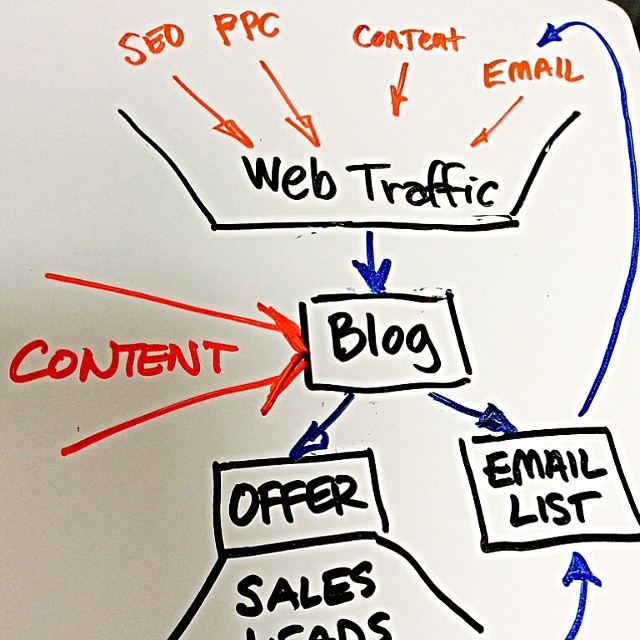 A new digital marketing program helped one firm reinvent itself after traditional methods proved ineffective.
A prominent marketing firm was experiencing an all-too-familiar predicament: They had a great product that, for some reason, was not selling. They had been following their traditional marketing regimen; however, something about the purchasing landscape seemed to have shifted, and in a way that rendered their methods ineffective.
Then, a new content marketing program changed everything in just a few months. For the better.
The firm’s business was real estate marketing, and their great product, a community of new homes in a highly desirable location. Real estate, like so many other sectors, has experienced a major shift in buyer behavior in just the last two decades, with the majority of research being conducted online. The firm realized that a digital marketing strategy, unlike traditional print ads, could better reach a wider audience of potential homebuyers.
In less than 90 days after implementing the new content marketing program, sales increased by nearly 40%. Within the year, social reach grew by 325%, web traffic by 250%, and sales by 300%.
Download this case study to learn how the firm achieved such remarkable results.

Related articles:

by Elizabeth Hines | Feb 22, 2016 | Blog, Content Marketing, Current Events, Marketing, Strategy
Content marketing grew one real estate marketing firm’s sales by 300% in less than a year.

Consumers are increasingly going online to conduct research before making a purchase. And that holds true for even the largest investments.
The National Association of Realtors reports that a whopping 94% of Millennials who recently purchased a home relied on websites in their search process. And that’s not just a generational phenomenon — the majority of Baby Boomers (84%) and 69 to 89 year olds (65%) did online research while seeking a new home as well.
Real estate marketers have an enormous opportunity to get their properties in front of more potential buyers through content marketing. With an inbound marketing strategy, customers who are looking for a property like yours will come to you through their own online research.
Take, for example, this case study about a prominent real estate marketing firm in one of the most competitive markets in the U.S. When traditional tactics weren’t bringing in the kind of business needed to sell 1,500 new-construction homes in a new planned community, the firm turned to a new content marketing program to increase web traffic and build brand awareness.
The results were almost immediate. The new digital and content marketing efforts drastically increased web traffic, conversions, and sales. In just 90 days, sales had increased by 37%, and in less than a year, a whopping 300%. At least one-fifth of buyers were sourced directly from the website.
Download this case study to learn more about how content marketing helped the real estate marketing firm drive traffic to their website and increase sales.
by Elizabeth Hines | Jan 21, 2016 | Blog, Marketing, Social Media
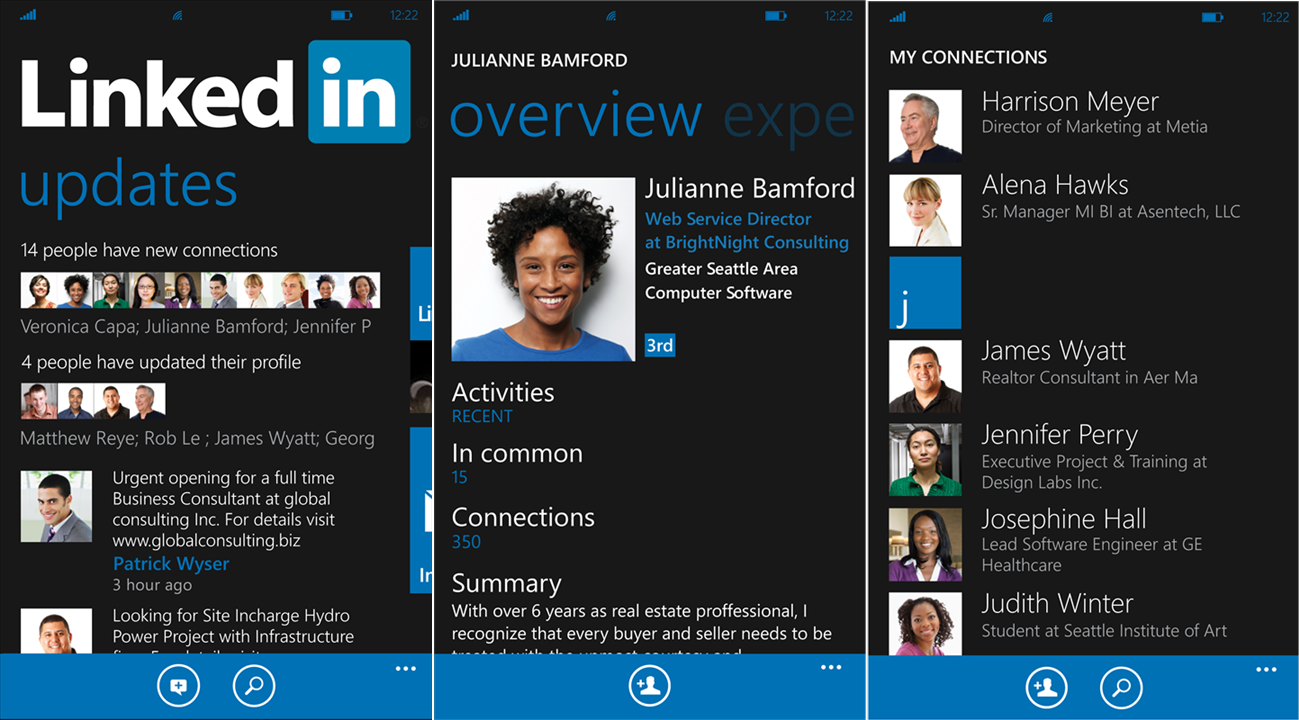
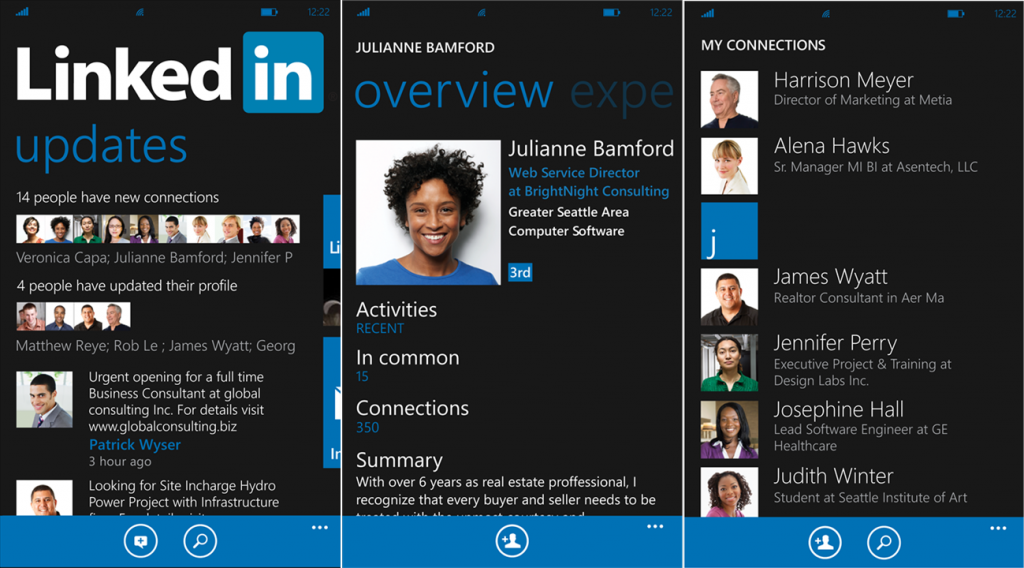
The LinkedIn Mobile App can help you grow your marketing program from the comfort of your phone.
Increasingly people are on the move, and smart phones are on the rise. In 2015, 64% of adults had a smartphone, up from 35% in 2011. Worldwide there are 3.7 billion unique mobile users. Those numbers are growing rapidly.
With the rise of mobile access and technology, people use phones in many of the same ways they use computers. You can scan, email, write, research, talk, bank, and — thanks to the LinkedIn Mobile App — apply for jobs, post articles, communicate, and engage with peers.
LinkedIn believes the app is “a faster way to tap into your professional world. Get news and info that matter for your professional day, a daily brief on what’s happening in your network, and a quick way to reach out and keep in touch.” Sounds good for those of us who rely heavily and increasingly on our phones.
Here are some ways in which you should be using the LinkedIn Mobile App to help your marketing efforts:
1. Update
A cornerstone of inbound marketing, writing updates and engaging daily (or hourly) with connections is important. Within an update you can include text, links, and photos and mention other LinkedIn members. You can also choose to share your update with your entire LinkedIn network and/or first-degree connections and/or your Twitter feed.
2. See who’s looking
Discover who has viewed, liked, or commented on your profile and content. The app lets you reply directly if you’d like.
3. Engage
Keep up with your network by finding, commenting, liking, and sharing. Repeatedly, we hear of the importance of engaging with connections and truly trying to value their posts, especially before sharing your own agenda.
4. Edit your profile
Notice a mistake on your company profile? Make an immediate change, even without your computer. Maybe you’re at a business meeting or out to dinner, and you notice that something hasn’t been updated on your company profile. You can fix it immediately.
5. Send & receive messages
This is a staple, and one that is critical. Again, if you’re at a business meeting, at a conference, or just without your computer and you need quick access to someone who you don’t have in your smartphone address book, you can find them and contact them through the LinkedIn Mobile App.
You can also access Lynda.com to watch tutorials and get training, get daily updates from LinkedIn Pulse, use LinkedIn Lookup to find connections, and use LinkedIn SlideShare to access over 18 million tutorials, infographics, and professionals.
There’s no need to cease connecting or marketing when you’re without your computer. The newly updated LinkedIn Mobile App can help you get the job done efficiently.