by Fronetics | Jun 13, 2019 | Blog, Content Marketing, Leadership, Logistics, Marketing, Supply Chain, Talent
A new LinkedIn post takes a refreshing look at achieving a work-life balance for working parents. The article has been shared all over social media begging the question: does your office need to know?
The New York Times reported that more and more couples are choosing to have smaller families due to economic factors. Let’s face it: kids are expensive. Most families have to balance wages with the exorbitant cost of childcare.
And that doesn’t even begin to look at finding harmony between your career and your family. In a recent post on LinkedIn, Ian Sohn, a single father and president of Wunderman Chicago, takes a clever and honest look at creating a work-life balance, a juggling act many of us know all too well.
“You should never apologize for having a life.”
The post was a list of things this Chicago-based boss ‘never needs to know’ about his employees, including:
- I never need to know you’ll be back online after dinner.
- I never need to know that you’re working from home today because you simply need the silence.
- I never need to know why you chose to watch season 1 of “Arrested Development” (for the 4th time) on your flight to LA instead of answering emails.
- I never need to know you’ll be in late because of a dentist appointment. Or that you’re leaving early for your kid’s soccer game.
- I never need to know why you can’t travel on a Sunday.
- I never need to know why you don’t want to have dinner with me when I’m in your town on a Tuesday night.
The sentiments of Sohn’s post hit home with a lot of working parents — the post has almost 2,000 comments to date. So why does this list ring true for so many working mothers and fathers?
“Like any modern business … there’s an additional need to respect other people’s lives and environment you work in, and everyone is accountable for getting their job done,” says Sohn in USA Today.
As businesses have become more digital, the ability to do you work remotely has increased. Ask any employee who works remotely, and they’re very likely to tell you that working from home makes them happier and more productive. And they aren’t necessarily wrong. There’s certainly evidence to suggest that with today’s technology, there’s essentially no downside to working from home, and it does often enhance productivity.
Here at Fronetics, we believe, much like Sohn, in the balance between work and home life. As individuals, we strive to excel at our jobs through accountability. Have a doctor’s appointment? Need to attend a school performance? We don’t need to know.
Has your office implemented policies to encourage flexibility? Has it been successful?
Related posts:

by Fronetics | Jun 6, 2019 | Blog, Content Marketing, Leadership, Logistics, Marketing, Supply Chain
Here are 5 books for supply chain professionals to gain insights about the industry and leadership practices.
Highlights:
- There’s no substitute for the in-depth analysis and explanation made possible by the long-format of a book.
- Leadership and professional growth means learning from the perspectives and insights of others.
- This year’s list includes works by Richard J. Sherman, Steven Bowen, and Edward H. Frazelle.
There’s no question that we live in a digital age, with information on almost any topic quickly accessible at our fingertips. But even in this age of short soundbites and reductively simplistic explanations, there’s no substitute for the value of sustained analysis and critical insight. To that point, we’ve put together a list of five books for supply chain professionals.
The supply chain leaders and analysts whose books are on this list each bring unique skills, perspectives, and approaches to the table. Being your best professional self means learning from the successes, failures, and insights of others. Add these five books to your summer reading list, and let us know how they make an impact on your professional life.
5 books for supply chain professionals
1) Strategic Supply Chain Management: The Five Core Disciplines for Top Performance, Second Edition
Co-authored by Shoshanah Cohen and Joseph Roussel, this classic guide to supply chain strategy has been re-created to help business leaders gain an advantage in today’s volatile, globalized arena. The global landscape has changed dramatically since the first edition of Strategic Supply Chain Management established itself as the authority on creating value and achieving competitive advantage from the supply chain.
This second edition is your answer to gaining a strategic advantage in the face of these challenges. Drawing on dozens of new company examples as well as cutting-edge benchmarking research, it shows you how to make your supply chains more agile, flexible, and resilient.
2) Supply Chain Transformation: Practical Roadmap to Best Practice Results
Much is being written about global supply chain and sourcing options emerging in today’s marketplace. Transforming supply chain management to achieve operational excellence is a mandate for many companies globally. Supply Chain Transformation, written by Richard J. Sherman, walks you through this potentially difficult process and gets you started on the journey.
Much more than just a how-to book, it’s a why-to book that is as compelling for any business person as it is for supply chain management professionals. This book provides an invaluable road map to companies looking to transform their supply chains and organizations to achieve best practice results, beginning with guidance on how to make the case for change. Change is inevitable; growth is optional.
3) Total Value Optimization: Transforming Your Global Supply Chain into a Competitive Weapon
Today’s corporate leaders are under increasing pressure to deliver differentiated, lasting performance, fast. New business models are continuously cropping up, with competitors becoming more numerous, more formidable, and more global. This puts profitability at risk as whole supply chains shift in industries.
Steven Bowen provides a clear pathway to transforming supply chains into the ultimate competitive weapons. Bowen’s method, which he calls Total Value Optimization, places customer value at the heart of the business-model, through a demand-driven digital supply chain. Grounded in data analytics, Total Value Optimization is essential for companies looking to survive and thrive in today’s fast-paced and ever-changing business environment.
4) Designing and Managing the Supply Chain – Third Edition
Designing and Managing the Supply Chain provides state-of-the-art models, concepts, and solution methods that are important for the design, control, operation, and management of supply chain systems. In particular, authors David Simchi-Levi, Philip Kaminsky, and Edith Simchi-Levi attempt to convey the intuition behind many key supply chain concepts and to provide simple techniques that can be used to analyze various aspects of the supply chain.
Topical coverage reflects the authors’ desire to introduce readers to those aspects of supply chain management that are critical to the success of a business. Although many essential supply chain management issues are interrelated, the authors strive to make each chapter as self-contained as possible, so that the reader can refer directly to chapters covering topics of interest.
5) Supply Chain Strategy, Second Edition: Unleash the Power of Business Integration to Maximize Financial, Service, and Operations Performance
The industry standard in supply chain management, Supply Chain Strategy’s Second Edition is fully revised and updated to provide today’s logistics solutions. The proven pillars of success in logistics and supply chain management introduced in the first edition of Supply Chain Strategy now guide the supply chains of many of the world’s most successful organizations.
Written by Edward H. Frazelle, Supply Chain Strategy includes up-to-date case studies showing how some of the world’s most successful companies meet supply chain goals and helps you overcome your own challenges with the latest supply chain innovations, including big-data analytics, supply chain command and control centers, large-scale supply chain optimization, integrated supply chain planning, and real-time global supply chain visibility.
Bonus read: “First: Sandra Day O’Connor”
No, Evan Thomas’ bio of Justice Sandra Day O’Connor doesn’t specifically relate to the supply chain. But if you’re looking for inspiring reading on leadership, overcoming adversity, and empowering women in the workplace, this newly released biography of the first female Supreme Court Justice is an excellent read.
What books for supply chain professionals have you read recently?
Related posts:

by Fronetics | Feb 6, 2019 | Blog
Digital marketing has become essential to creating brand awareness, educating audiences and building credibility with customers. Here are the latest trends for 2019.
Highlights:
- Digital marketing has become essential to creating brand awareness, educating audiences and building credibility and trust with customers.
- Video is currently the most popular form of content being consumed online today.
- Peers and colleagues are the third most influential source of information for business to business (B2B) purchasing, right behind online searches and your website.
Video transcript:
Hi I’m Stacia Pathiakis. I’m an account manager at Fronetics and today I’ll going to be talking to you about six trends in digital marketing for the supply chain in 2019.
Digital marketing has become essential for creating brand awareness, educating audiences and building trust and credibility with your customers. Supply chain and logistics companies increasingly see the value in digital marketing. They’re increasing their budgets and it’s important to understand what the trends are for the upcoming year.
Here are six trends to consider when planning your 2019 strategy.
First, video. Video is currently the most popular form of content being consumed online today, and video marketing will continue to add substantial value in the upcoming year. Use video to teach your audience something that is worthwhile for them to know.
- Chatbots. Chatbots are automated messaging apps that simulate human conversation. They’ve become more popular in the past year than social networks.
- Voice search. Voice search is becoming an increasingly prevalent. It’s a means for people to search for the content they’re looking for using voice recognition. A good content marketing strategy should consider how your customers will be using voice search for information about in your industry.
Next is long-form content. Long form content includes such things as white papers, case studies, and longer form blog posts. Many industries, including supply chain and logistics industries, are saturated with short form content. Long form content provides a means of getting more in-depth information to your customers.
- Brand ambassadors. Peers and colleagues are the third most influential source of information for business to business (B2B) purchasing. And there’s nothing more credible than a friend who speaks highly of their company’s services and products.
- Market influencers. Market influencers is a form of marketing that focuses on individuals rather than the market as a whole. Basically, marketers identify individuals who would have influence over a larger group and target them specifically in their digital marketing campaign.
The beginning of the year is a great time to review your marketing strategy to make any changes for the upcoming year. For more tips on boosting your digital marketing strategy in 2019, visit us at fronetics.com.
Related posts:


by Fronetics | Jan 17, 2019 | Blog, Content Marketing, Logistics, Marketing, Supply Chain
Blogging should be a central part of your content marketing strategy. Here are our top tips for creating and sustaining a successful supply chain blog in 2019.
Highlights:
- Blogging needs to be a central part of your content marketing strategy.
- Focus on quality over quantity.
- Make all posts mobile-friendly.
It’s the start of a new year and the perfect time to start setting goals and strategizing how to achieve them. Hopefully, blogging is a big part of your strategy for 2019 — after all, supply chain companies should make blogging a central part of their content marketing strategy for all kinds of reasons.
[bctt tweet=”At last count, users share 27 million pieces of new content on social media every single day. Twenty-seven million!” username=”Fronetics”]
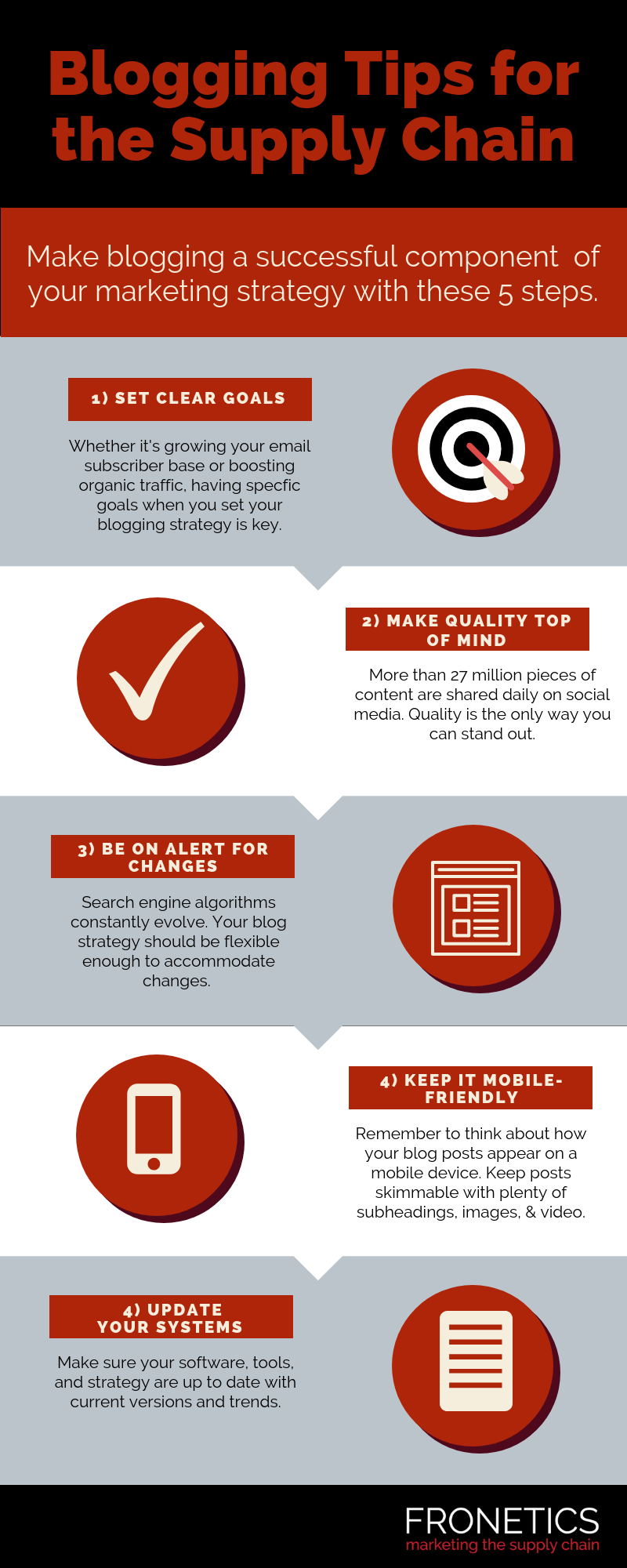
Making your supply chain blog stand out from the pack isn’t always easy. That’s why we created the infographic below. Read on for our top 5 supply chain blogging tips for 2019.
5 tips for your supply chain blog
(Made with Canva)
1. Set clear goals
We know, this one sounds obvious. But you’d be surprised how often marketers overlook this seemingly simple step or settle for general, vague goals. It’s true that blogging can have all kinds of positive impacts for the supply chain, but that doesn’t mean that you should just be blogging without a clear, documented set of goals specific to your business.
Whether it’s growing your email subscriber base, boosting organic traffic, or generating more qualified leads, having specific goals in mind when you set your blogging strategy is key. For one thing, it lets you target your efforts and generate content that is focused on achieving a specific result or set of results. Furthermore, having objectives allows you to be far more effective in evaluating your results, including measuring blogging ROI, and tweak your strategy accordingly.
What are your top three goals for your supply chain blog in 2019? Let us know in the comments!
2. Make quality top of mind
Ponder this for a minute: At last count, users share 27 million pieces of new content on social media every single day. Twenty-seven million. In a world of skyrocketing quantity, quality is ever-more important. There’s a huge amount of pressure on supply chain marketers to produce a constant stream of content, but the sad truth is, if you’re not producing high-quality, substantive content, you’re wasting time and energy.
For supply chain companies in particular, it’s crucial that every piece of your content be well-researched, clearly written, focused, and trustworthy. We know that producing consistently high-quality content isn’t easy, but, trust us: if you invest the time and energy to make your content stand out, you will see the results. To get you started or keep you focused, check out our guide to creating good content for logistics and supply chain marketers.
3. Be on the alert for changes
Particularly when it comes to search engine optimization (SEO), changes happen fast these days. In August of 2017, Google updated its algorithm, continuing a set of changes we’ve been watching for a while now. Voice searches are becoming increasingly prevalent, and researchers estimate that by 2020, 50% of all searches will be voice queries.
As these changes continue to happen, it’s crucial that your strategy is lithe and flexible, ready to adapt to a quickly shifting climate. This means keeping abreast of conversations going on in the industry, following blogs you trust and respect, as well as tracking your own results, and being alert to changing trends.
4. Keep it mobile-friendly
You don’t need researchers to tell you: people are increasingly receiving and reading content on their phones. Whether it’s social media, emails, or blogs, mobile usage continues to skyrocket as devices become more and more ubiquitous and user-friendly.
What does this mean for supply chain blogs? Of course, your website needs to have a visually attractive and accessible mobile version, but it’s also helpful to think about your blog posts in terms of how they appear on a phone. Keep your posts skimmable, with plenty of subheadings to orient the reader, and absolutely include video whenever possible.
5. Make sure your systems are up to date
We keep coming back to the reality of the rate of change these days. It can be exhausting and overwhelming for marketers to keep pace. Take the opportunity of the new year to make sure all your blogging-related tools are updated and running the current software.
As you’re keeping your tools fresh, it’s also a good time to make sure your procedures are running smoothly and are at a pace with the current marketing climate. This means evaluating responsibilities and results within your team, ensuring that your editorial calendar is serving you well, and taking a look at your data collection and reporting methods.
Bonus: What not to do in 2019
These might seem obvious, but again, you’d be surprised how may marketers fall victim to these blogging “don’ts.” We figured it bore repeating.
- Don’t: attempt to post content that doesn’t reflect your business’ “comfort zone.” Stick to what you know, and do it well.
- Don’t: copy and paste text or images from other blogs. Using other content for ideas is great. Copying it verbatim is verboten.
- Don’t: post at irregular intervals. Creating a content schedule and sticking it is key to establishing a loyal following and boosting your credibility.
What goals do you have for your supply chain blog this year?
Related posts:

by Elizabeth Hines | Jan 16, 2019 | Blog, Content Marketing, Logistics, Marketing, Supply Chain
Updated February 4, 2025
Digital marketing for the supply chain has become necessary to position your company to not only be found online, but also to be researched and to be compared to your competition.
Highlights:
- Digital marketing uses your website, related social media, and other online industry channels to showcase your industry knowledge and experience.
- Thought leaders are the informed trusted sources in their field of expertise.
- Supply chain and logistics industries need content marketing to achieve confidence and relationship-building with buyers.
Today’s B2B buyers are researching, evaluating, and coming to conclusions about companies without a single contact with a team member or salesperson.
This kind of B2B buying landscape requires cutting edge marketing strategies to showcase nut-and-bolt industries that have survived without them for many years.
Digital marketing for the supply chain
Digital marketing for the supply chain uses your website, related social media, and other online industry channels to showcase your industry knowledge and experience (rather than trying to convince people of it with a marketing message).
With inbound digital marketing, you publish relevant, informative information to adds value to every stage of a potential customer’s buying journey.
It is the content that you publish that walks them through the initial stages of the sales process.
What should you publish? A good content marketing strategy is about understanding the questions and concerns that are particular to your customer base, and offering quality information and analysis that answers those needs.
Showcasing thought leadership through digital marketing
Discovering and meeting the needs of your customers that go beyond your products and services will catapult you in their minds as a knowledgeable, helpful “thought leader” in your industry.
Thought leaders are the informed trusted sources in their field of expertise. They have innovative ideas, can showcase their thinking, and can replicate their successes again and again.
Consider it: Your business has so much more to offer than its primary product or service. You have a team of people with a tremendous aggregate of experience, expertise, and perspectives.
Allowing your customers this sort of access to your team’s experience and knowledge provides them with tremendous value outside the sales funnel, which builds trust and cultivates lasting, fruitful relationships.
Why digital marketing?
In this B2B buying landscape, supply chain and logistics industries need content marketing to achieve a level of confidence and relationship-building with buyers that used to come from face-to-face meetings. Potential and current customers will view your company as a valuable resource for everything related to not only your products and services but to the industry as a whole.
No time to execute?
The downside? Content marketing requires significant time, labor, and resources, and it can take quite some time to start reaping benefits. Feeling overwhelmed and like you and your team can’t possibly add on more marketing? Outsourcing certain key marketing tasks allows insourcing your core competencies while delegating specialized tasks to external experts.
This post originally appeared on EBN Online.
Related posts: