
by Fronetics | Oct 30, 2014 | Blog, Marketing, Social Media, Strategy, Supply Chain
The use of third-party logistics providers are on the rise. As many as nine out of ten 3PLs surveyed by Inbound Logistics reported their client base grew by 5 percent this year, continuing the unabated expansion of recent years.
And there’s good reason for it.
In an interesting article on SupplyChain 24/7, Adam Robinson, the marketing guru at Cerasis, lists seven reasons companies should outsource non-core transportation management functions to 3PL providers. Surprisingly, perhaps, many of the same arguments can be applied to companies debating who should be in charge of their content creation.
As the number one reason to outsource, Robinson cites “Time and Money.”
He writes:
“3PL providers are able to reduce the amount of infrastructure investments in equipment, software, facilities and personnel… These 3PLs are like having non-paid employees on your staff and allow shippers to focus resources on areas where they are the expert (i.e. manufacturing, product sales).”
Time and money – or lack thereof – are similarly common issues among companies with respect to social media. In a new Fronetics report on social media use in the supply chain and logistics industries, nearly half of the respondents cited time and budgetary constraints as their top two challenges. Such companies may, as a result, participate only sporadically or not at all.
Since consistency is crucial to online lead generation, anything but a fulltime commitment to the company blog, content curation, and social media outreach is doomed to fail. An outside provider can, just like a 3PL, take these tasks off your hands, allowing you to focus on your core competencies.
Robinson also argues:
“As shippers rely on 3PL partners to provide more strategic oversight, and help catalyze business process change within the organization, the relationship is growing more fluid, and less analytical. Service providers are becoming an extension of the enterprise.”
In short, 3PL providers should not be perceived as outsiders but as partners who know their stuff. They contract with thousands of carriers and know the fastest and most reliable routes to move product from point A to point B.
A marketing company, especially one specialized in content creation for the logistics, transportation and supply chain industries, works the same way, drawing on a wealth of industry knowledge. In essence, you hire experts equipped with the right strategic tools to leverage their market expertise to your advantage.
Finally, Robinson writes visibility of loads gives 3PLs a leg up on the competition:
“Many 3PLs are able to integrate tracking into shipper IT systems, provide integration into ERP and WMS automated notices or even real-time delivery notifications by e-mail.”
Losing track of a shipment equals chaos. 3PL providers are there to ensure it never happens. In the same vein, companies need to track the metrics of their content strategy or risk wasting resources on something that yields no results. They need to know which social media outlets work for their business and what types of content draw traffic to their site. It takes time and resources – and as our survey revealed, both tend to be in short supply.
Your content marketing partner, on the other hand, knows metrics is as important as a shipment is to a 3PL provider.
Outsourcing content creation may be your strategic advantage over your competition.
by Fronetics | Oct 30, 2014 | Blog, Marketing, Social Media, Strategy, Supply Chain
The use of third-party logistics providers are on the rise. As many as nine out of ten 3PLs surveyed by Inbound Logistics reported their client base grew by 5 percent this year, continuing the unabated expansion of recent years.
And there’s good reason for it.
In an interesting article on SupplyChain 24/7, Adam Robinson, the marketing guru at Cerasis, lists seven reasons companies should outsource non-core transportation management functions to 3PL providers. Surprisingly, perhaps, many of the same arguments can be applied to companies debating who should be in charge of their content creation.
As the number one reason to outsource, Robinson cites “Time and Money.”
He writes:
“3PL providers are able to reduce the amount of infrastructure investments in equipment, software, facilities and personnel… These 3PLs are like having non-paid employees on your staff and allow shippers to focus resources on areas where they are the expert (i.e. manufacturing, product sales).”
Time and money – or lack thereof – are similarly common issues among companies with respect to social media. In a new Fronetics report on social media use in the supply chain and logistics industries, nearly half of the respondents cited time and budgetary constraints as their top two challenges. Such companies may, as a result, participate only sporadically or not at all.
Since consistency is crucial to online lead generation, anything but a fulltime commitment to the company blog, content curation, and social media outreach is doomed to fail. An outside provider can, just like a 3PL, take these tasks off your hands, allowing you to focus on your core competencies.
Robinson also argues:
“As shippers rely on 3PL partners to provide more strategic oversight, and help catalyze business process change within the organization, the relationship is growing more fluid, and less analytical. Service providers are becoming an extension of the enterprise.”
In short, 3PL providers should not be perceived as outsiders but as partners who know their stuff. They contract with thousands of carriers and know the fastest and most reliable routes to move product from point A to point B.
A marketing company, especially one specialized in content creation for the logistics, transportation and supply chain industries, works the same way, drawing on a wealth of industry knowledge. In essence, you hire experts equipped with the right strategic tools to leverage their market expertise to your advantage.
Finally, Robinson writes visibility of loads gives 3PLs a leg up on the competition:
“Many 3PLs are able to integrate tracking into shipper IT systems, provide integration into ERP and WMS automated notices or even real-time delivery notifications by e-mail.”
Losing track of a shipment equals chaos. 3PL providers are there to ensure it never happens. In the same vein, companies need to track the metrics of their content strategy or risk wasting resources on something that yields no results. They need to know which social media outlets work for their business and what types of content draw traffic to their site. It takes time and resources – and as our survey revealed, both tend to be in short supply.
Your content marketing partner, on the other hand, knows metrics is as important as a shipment is to a 3PL provider.
Outsourcing content creation may be your strategic advantage over your competition.

by Elizabeth Hines | Aug 20, 2014 | Blog, Leadership, Strategy, Supply Chain, Talent

Losing an employee is costly — very costly. Yet, many organizations don’t know how to ensure that its human resource assets don’t just walk away.
The US Department of Labor Bureau of Labor Statistics reports that more than 2 million people voluntarily leave their jobs each month. The Society of Human Resources Management has found that the cost of replacing an employee ranges from 50 percent of the employee’s annual salary to 400 percent of their annual salary. What do these numbers mean? They mean that the cost of replacing an employee with an annual salary of $45,000 could be between $16,000 and $160,000. And the cost of replacing your employee with an annual salary of $150,000 could range from $60,000 to $600,000. Not inexpensive.
In July 2013, Tompkins Supply Chain Consortium released its Supply Chain Talent Report. According to the report, the supply chain industry is expected to experience an increase in turnover within the next 18 months. Most impacted will be positions in planning, procurement, and manufacturing. Reasons include plant closures, outsourcing, and the need for specialized skillsets. There are other reasons as well. Accenture conducted a study (across industries) and found the top four reasons why employees quit their jobs are: a lack of recognition (43 percent), internal politics (35 percent), a lack of empowerment (31 percent), and because they don’t like their boss (31 percent).
For managers, several lessons are there to be learned. Let’s start with the simple lessons. These lessons involve flipping the negatives (the reasons for leaving) to the positive (creating reasons for staying). That is: recognize employees, empower employees, and take steps to remove from the work environment as much bureaucracy and internal politics as possible. By taking these steps the employee who is considering a move may change their tune. If not, it is reasonable to talk with an employee and determine what the issue is. If the issue is something that cannot be addressed and if it is impacting productivity and team morale, explore transferring the employee within the company.
Other keys to employee retention include buy-in and success. Specifically, it is important to gain buy-in from your employees. If an employee is going to be motivated to not just do their job, but to excel at their job — they need to buy-in. They also need to, regularly, succeed and realize progress. A great resource on achieving buy-in and enabling success is The Heart of Change by John P. Kotter and Dan S. Cohen.
While the time and expense of retaining an employee may seem daunting, the cost of losing an employee is much greater.
Want to learn more about improving employee retention and hiring top talent? At Fronetics we work with clients to understand and execute on talent acquisition, performance management, learning and development, and succession management. Additionally, we offer management and leadership solutions to organizations within the supply chain and logistics industries during times of transition.
A version of this post previously appeared on EBN.
by Fronetics | Aug 19, 2014 | Blog, Content Marketing, Leadership, Marketing, Strategy, Talent

By consistently creating, curating, and distributing valued and trusted content you can position your company as an industry leader.
What is valued and trusted content?
“Peer-power”
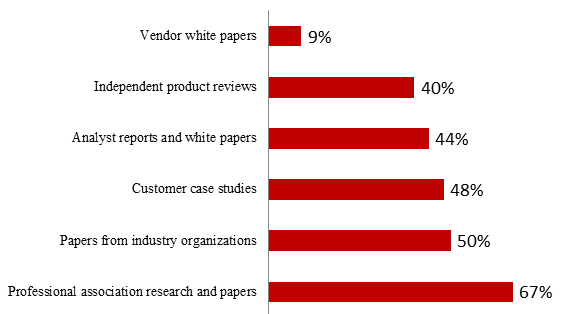
A survey by the CMO Council found that all content is not viewed equally by B2B buyers. “Peer-powered content” is more valued and trusted than non-peer content.
The survey found that professional association research and papers are the most valued and trusted content. Papers from industry organizations, case studies, and analyst reports and white papers were also reported to be valued. In contrast, vendor white papers were not found to be valued highly.
What type of content do you most value and trust?
Source: CMO Council
Depth not promotional
The characteristics that were found to be valued the most by B2B buyers were depth of the content (47 percent) and ease of access and readability (44 percent). Respondents reported that they do not like content that has too many requirements to download (50 percent) or is promotional or self-serving (43 percent).
Good content is shared
B2B buyers report that they share good content. Fifty-nine percent of survey respondents share content with 25 or more peers and associates, and 28 percent of survey respondents forward content on to 100 or more people.
Position yourself
To position your company as an industry leader you need to provide valued and trusted content. This means creating, curating, and distributing content that educates, informs, and addresses specific needs.
It also means avoiding the trap of self-promotion. Valued and trusted content is not content that is self-serving or promotional, rather valued and trusted content provides customers with answers, solutions, and education.
Blogging is essential, but additional content is necessary as well. Case studies and white papers are two go-to content solutions that can help you position your company as a trusted leader within your industry.
Remember that you don’t need to go it alone. More than 44 percent of B2B marketers report that they outsource content creation.
by Fronetics | Aug 19, 2014 | Blog, Content Marketing, Leadership, Marketing, Strategy, Talent
By consistently creating, curating, and distributing valued and trusted content you can position your company as an industry leader.
What is valued and trusted content?
“Peer-power”
A survey by the CMO Council found that all content is not viewed equally by B2B buyers. “Peer-powered content” is more valued and trusted than non-peer content.
The survey found that professional association research and papers are the most valued and trusted content. Papers from industry organizations, case studies, and analyst reports and white papers were also reported to be valued. In contrast, vendor white papers were not found to be valued highly.
What type of content do you most value and trust?
Source: CMO Council
Depth not promotional
The characteristics that were found to be valued the most by B2B buyers were depth of the content (47 percent) and ease of access and readability (44 percent). Respondents reported that they do not like content that has too many requirements to download (50 percent) or is promotional or self-serving (43 percent).
Good content is shared
B2B buyers report that they share good content. Fifty-nine percent of survey respondents share content with 25 or more peers and associates, and 28 percent of survey respondents forward content on to 100 or more people.
Position yourself
To position your company as an industry leader you need to provide valued and trusted content. This means creating, curating, and distributing content that educates, informs, and addresses specific needs.
It also means avoiding the trap of self-promotion. Valued and trusted content is not content that is self-serving or promotional, rather valued and trusted content provides customers with answers, solutions, and education.
Blogging is essential, but additional content is necessary as well. Case studies and white papers are two go-to content solutions that can help you position your company as a trusted leader within your industry.
Remember that you don’t need to go it alone. More than 44 percent of B2B marketers report that they outsource content creation.