by Elizabeth Hines | May 14, 2019 | Blog, Content Marketing, Logistics, Marketing, Strategy, Supply Chain
As the performance gap between high and low digitally achieving companies widens, taking steps toward digital maturity is increasingly important.
Highlights:
- Increasingly, digital maturity is a predictor of overall market success.
- Benefits include reduced costs and time to market and improved product quality and customer satisfaction.
- Companies at any stage of digital maturity can take steps to improve.
Digital maturity, or the process of a company’s learning to respond appropriately to the emerging digitally competitive environment, is increasingly accounting for a widening performance gap among B2B businesses. And the gap will continue to widen: Companies who are adapting well to the digital age will increasingly outperform those who lag behind.
Boston Consulting Group’s second annual survey of nearly 2,000 companies in the United States and Europe found that while 25% of the companies surveyed qualified as “digital champions,” nearly one-third are significantly behind in their digital maturity. The study found that “increased levels of digital maturity significantly improved competitive advantage along multiple performance indicators, such as time to market, cost efficiency, product quality, and customer satisfaction.”
BCG’s study used the company’s respected Digital Acceleration Index (DAI) to make comparisons among companies. And it offers some hopeful takeaways for businesses at any point on the spectrum. For example, “an increase in digital maturity of 25 DAI points improves the likelihood of reaching a superior performance for time to market, and cost efficiency doubles.”
These are powerful numbers. And BCG also points out that very few companies have achieved full digital marketing maturity — which means that essentially everyone should be taking note. Our infographic below looks at why digital maturity is important, and how companies can take steps toward achieving it.
The benefits of digital maturity
(Made with Canva)
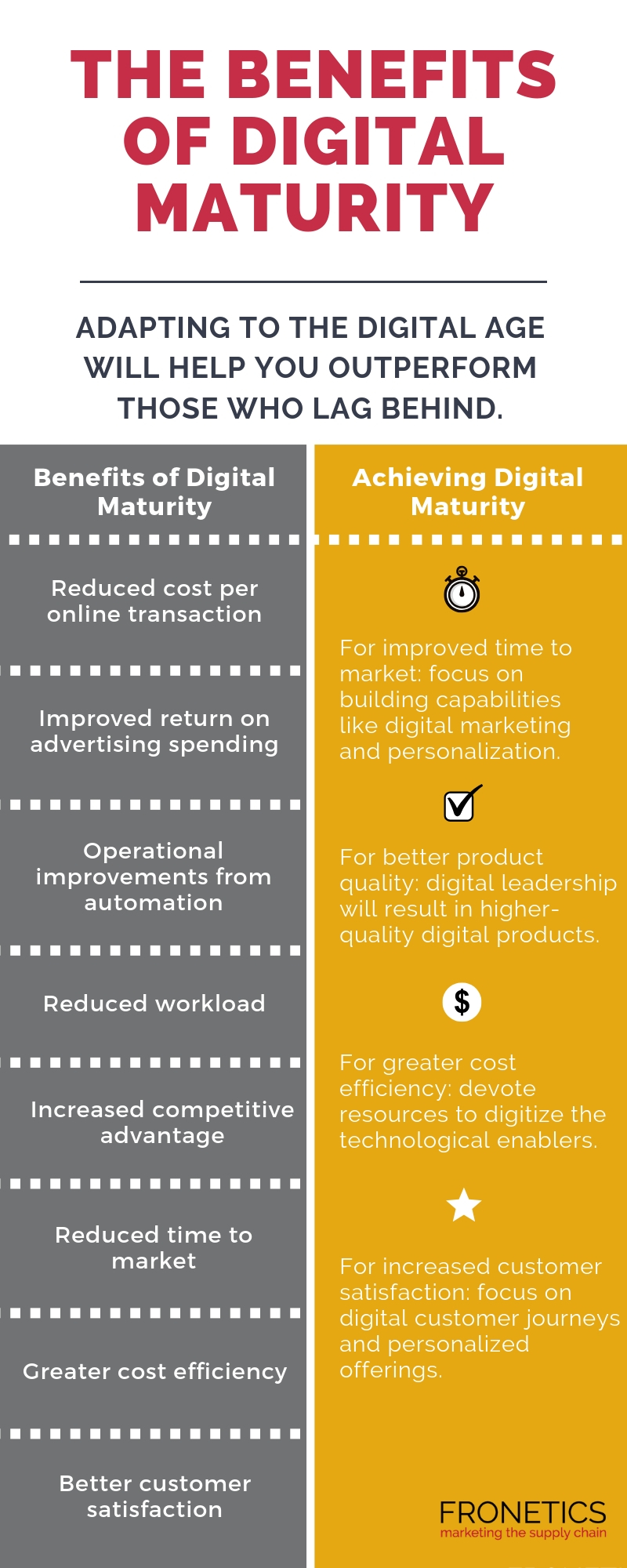
BCG’s study aimed to quantify the value of improving digital maturity to impressive results. Some of the most significant benefits the study found were:
- Reduced cost-per-action in online transactions
- Increased online transactions
- Improved return on advertising spending
- Operational improvements from automation
- Reduced workload
- Increased competitive advantage
- Reduced time to market
- Greater cost efficiency
- Improved product quality
- Better customer satisfaction
Achieving digital maturity
No matter where they are in the process of achieving digital maturity, companies can improve and accelerate their progress. In particular, companies should focus their efforts to reap the benefits of digital marketing maturity:
- For improved time to market: Focus on building capabilities like digital marketing and personalization.
- For greater cost efficiency: Devote resources to digitize the technological enablers, such as increased automation in everything from production to marketing.
- For better product quality: Digital leadership is key. Fostering a strong digital culture company-wide and investing in digital talent will result in higher-quality digital products.
- For increased customer satisfaction: Focus on digital customer journeys and personalized offerings.
The bottom line
Digital maturity will increasingly separate the herd. Digital drives performance across B2B industries. It’s time for the supply chain to stop looking at technology as a cost center and start seeing it as a profit driver and competitive advantage in the market.
Related posts:


by Elizabeth Hines | May 13, 2019 | Blog, Content Marketing, Marketing, Social Media, Supply Chain
Instagram Stories offer an on-trend platform for delivering targeted content to B2B buyers, and we’re joining the fun.
We’ve written extensively about the benefits of using Instagram as a part of your social media strategy. And, though we’ve been active on Instagram for over two years, we’re now taking on Instagram Stories.
Instagram Stories are sequences of content that a user (or business) posts to Instagram over a 24-hour period. Besides photos, Stories can include videos, live and prerecorded. The content plays as a continuous feed, creating a narrative about the user’s day — hence the term “Stories.”
Audiences can view the Stories of the users they follow within the 24-hour window after they are posted. They can find users with active Stories by scrolling the user icons at the top of the app. Or users can tell their followers that they’ve posted a story by tagging them, which notifies them through a direct message.
Fronetics’ Stories will be a fun mix of breaking news, highlights of upcoming events, and live video on the latest industry trends. Ideas for Stories you’d like to see us cover? Email me at [email protected].
Related posts:


by Elizabeth Hines | May 7, 2019 | Blog, Content Marketing, Logistics, Marketing, Social Media, Supply Chain
When it comes to social media, timing is everything. These 5 tools will help you determine the best time to post on social media for your business.
Highlights:
- Social media is playing an increasing role in B2B purchasing decisions.
- Even if you’re posting great content, if you’re doing it at the wrong times, you’re losing out.
- Social media management tools can help you understand your audience and make informed decisions about post timing.
If you’re a B2B marketer, chances are, you’re well aware of the importance of social media. But since, as BuzzFeed’s Jonathan Perelman famously put it, “Content is king, but distribution is queen, and she wears the pants,” simply posting your content is only half the battle. Knowing the best time to post on social media is nearly as important as what you post.
It’s difficult to overstate importance of an effective social media strategy. Not only do 78% of marketers who have used social media for 2 years or more report increased traffic to their websites, but B2B decision-makers increasingly report that they are influenced by social media when purchasing. According to Demand Gen’s 2018 B2B Buyers Survey Report, more than half (54%) of all B2B buyers rely on social media to research vendor solutions.
These are powerful numbers, and all signs point to social media playing an ever-increasing role in the B2B buyer’s journey. For your social media content to pack the biggest punch, you need to be posting at the optimal times. Luckily, there are a plethora of social media management tools that can help you refine your strategy. Here are our 5 favorite tools for determining the best time to post on social media for B2B brands.
5 tools for determining the best time to post on social media
1) Google Analytics
This robust analytical tool is among the most popular all-around web tools for B2B businesses, and for good reason. Google Analytics can help you determine how your audience is interacting with all your digital assets, and it offers some great insights about social media in particular. You can create various types of custom reports based on your business’ goals and results. We recommend three in particular to help you find the best time to post on social media:
- Best Days to Post on Social Media
- Best Time to Post on Social Network by Hour
- Social Media Traffic by Date and Hour
2) Buffer
A company with an impressive record when it comes to social media management, Buffer’s platform lets you easily manage all your social media platforms. Like its biggest rival, Hootsuite (more on that soon), Buffer offers among its features some useful insights for determining ideal post timing and frequency. For example, it analyzes follower activity and suggests the perfect moments to post on each social media platform.
3) Hootsuite
Hootsuite has been one of our favorite tools for a long time, and it truly offers a rich variety of features and insights to maximize the effectiveness of your digital assets. Not only is it effective at scheduling social media posts, it’s an excellent tool for measuring social media ROI — no easy task! Hootsuite’s AutoSchedule feature is one of its best assets. For each piece of content you plan to post on social media, it analyzes when similar content performed best in the past and determines the optimal post time. In addition, it considers the platform and publishes based on audience engagement on each network.
4) Followerwonk
Followerwonk is new to our list, and it’s different from most social media management tools. While it doesn’t offer the kind of scheduling and management features as the other platforms on our list, what it does do extremely well is help you gain valuable insights and understanding of your audience. For example, Followerwonk lets you analyze your current Twitter followers by things like location, post timing, engagement, accounts they follow, and more, as well as contrast those relationships with your competitors. Understanding your followers at this level will not only help you determine when your business should post on social media, but will allow you to analyze and adjust your strategy in all kinds of ways.
5) SproutSocial
Another perennial favorite, SproutSocial offers the whole menu of social media management tools: everything from monitoring to scheduling to analytics. The customized dashboard gives you a bird’s eye overview of how your social media channels are performing. You can find deeper insights, including individual statistics on each post, and customer data like gender, age, and location demographics. The platform’s ViralPost technology boasts impressive results at finding the best time to share your content.
Figuring out the best time to post on social media for your business is no easy task, but it’s key to getting your content to reach your target audience. There’s no one-size-fits-all solution, and any one, or a combination, of these tools can help you understand your audience better and get your content out to them at the right times.
Related posts:

by Elizabeth Hines | May 2, 2019 | Blog, Content Marketing, Logistics, Manufacturing & Distribution, Marketing, Strategy, Supply Chain
As automation technologies become increasingly sophisticated, companies throughout the supply chain are realizing the beneficial impact of automation on materials handling.
Highlights:
- Manufacturers of automation technologies are predicted to grow significantly over the next 5 years.
- Automating the “first mile” of the supply chain helps reduce labor challenges and leads to increased productivity.
- Robotics technologies offer greater capacity for data collection, facilitating informed process decisions.
While the impact of automation on the “last mile” of the supply chain is often the subject of public interest, automation in the “first mile” deserves just as much attention. Advanced robotics are increasingly ensuring accuracy — while minimizing or even eliminating human involvement in various processes — at every stage of the supply chain. Industry experts are predicting an ever-growing impact of automation on materials handling, with companies reaping the benefits up and down the supply chain.
Particularly in the materials-handling sector, human capital is increasingly difficult to recruit and maintain. Additionally, labor costs in global markets such as India and China are rising. Naturally, companies are increasingly inclined to replace or redeploy human labor, with the help of automated material-handling systems.
Not to mention, the increasing sophistication of machine-learning capabilities or AI within available automation technologies allows for even greater productivity. And there’s strong reason to believe that we’re only seeing the beginning of what automation can do. Vendors who create these technologies are investing heavily in R&D, aggressively attempting to expand their product offerings to meet specific industry demands while complying with the complex standards and regulations in place.
Quantifying the costs and impact of automation on materials handling
The robust growth in the robotics-equipment-manufacturing sector demonstrates that the materials-handling industry is investing in automation. Thanks to the demand for high-performance robotics systems, New Equipment Digest (NED) predicts that within the materials-handling-equipment sector, the robotics segment will grow by over 8%, reaching $20 billion by the year 2024. The overall material-handling-equipment market is expected to surpass $190 billion by the same year, according to a growth forecast report by Global Market Insights, Inc.
“Growing automation capabilities in the manufacturing space coupled with increasing penetration of advanced technologies, such as IoT, RFID, and AI, are expected to drive the material-handling-equipment market growth,” predicts the NED. These technologies are already increasing productivity and throughput in the materials-handling sector and reducing the potential for human error. The predicted growth in the manufacturing of robotics equipment points to the increasingly positive impact of automation supply chain-wide.
Of course, automation is not without its challenges. Companies face technical issues involved in implementation, not to mention the large capital outlay required to invest in costly equipment and technologies. With increased technical sophistication and network utilization, there are threats to cybersecurity, requiring companies to invest in measures to protect their technology.
Robotics-equipment manufacturers recognize that while automation offers significant benefits for materials handling, companies need to study potential impact before making these costly investments.
Many manufacturers are offering tools for quantifying the impact of automation on materials handling. OTTO Motors, a manufacturer of self-driving-vehicles, offers an ROI calculator, allowing potential buyers the opportunity to receive an easy ROI estimate. Manufacturers are also increasingly offering simulations of materials-handling systems, allowing potential customers to determine efficacy, test designs, and study new procedures without disrupting operations.
Realizing the benefits of automation for materials handling
Beyond the well-known benefits, such as decreased costs and increased productivity, automating materials-handling processes can offer a variety of additional advantages to companies’ first-mile operations. In fact, streamlining these processes and reducing costs has its own positive repercussions throughout a company’s operations, as it allows for increased speed, productivity, and accuracy operation-wide.
Additional benefits of automating materials handling include:
- The access to real-time data provided by automated technologies allows for more complete Key Performance Indicators (KPIs).
- Labor shortages and high turnover are some of the primary challenges in materials handling – automation shields manufacturers from these challenges, while allowing human labor to be repurposed into more intricate tasks.
- Implementing technology in the materials-handling phase of the supply chain can connect to other automated processes within the factory.
- The availability of data and the ability to leverage it allows adjustments to be made in real time, meaning more flexible manufacturing.
The bottom line is that, while it can be costly at the outset, automation at the front end of the supply chain, namely materials handling, offers rich and diverse benefits sector-wide.
Related posts:
by Elizabeth Hines | Apr 30, 2019 | Blog, Current Events, Marketing, Social Media, Video Marketing
Also, this month in social media news: LinkedIn adds a “Teammates” option to facilitate connections among colleagues, and Facebook is testing a Stories-like newsfeed.
Highlights:
- Facebook is giving users increased access to what information advertisers have on them.
- Instagram is considering joining Facebook in promoting communal video experiences.
- LinkedIn’s “Teammates” feature helps users prioritize content from close connections.
This month in social media news, Facebook is continuing to combat user privacy concerns by introducing a tool to provide greater transparency about the content they see on their Newsfeeds, both from connections and from advertisers. The platform is also continuing to explore the Stories trend, as it conducts early-stage testing of a layout that resembles the Stories feature more than it does the existing Newsfeed.
Both Instagram and LinkedIn are promoting greater community among users. Instagram is testing a group video viewing option, joining Facebook’s Watch Party, introduced last year. LinkedIn is rolling out a feature which allows users to prioritize content from their closest connections. Read on for a round-up of social media news.
Facebook Introduces a Feature to Assist Users in Understanding the Context of Content Appearing on the Newsfeed
Having been embroiled in ongoing privacy-related scandals, Facebookis making users’ safety and comfort using the platform a priority. To that end, the company has announced that it will be giving users greater control over the content that appears on their Newsfeeds, through the “Why am I seeing this post?” feature.
In 2014, the social media giant launched its similar feature, “Why am I seeing this ad?” which was geared toward projecting transparency in the company’s embattled relationship with users and their advertising content. Facebook announced simultaneously that it will be “making improvements” to the older feature. The new “Why am I seeing this post?” feature aims to help users understand the context for what shows up in their Newsfeeds, and it also allows them to control and manage content.
Marketers should be aware that users will now be able to find out when their profile information matches with the information on an advertiser’s list, as well as when an advertiser “saves their personal information in their database and other details such as if they (the users) were targeted by the advertiser through another marketing partner of theirs (advertisers).”
Instagram Tests a Communal Video Viewing Option
Social media platforms are continuing to push the boundaries of social experiences that are possible for users not in physical proximity. Back in 2018, Facebook rolled out its “Watch Party” option, and now Instagram is exploring jumping on the bandwagon, testing a similar function in its app.
The feature would allow users to view video content on Instagram with a friend, while simultaneously seeing their reactions on screen, using the phone’s camera, in a split-screen view. Users can also apply face filters and other visual tools to the personal feed. Instagram and Facebook’s features are part of a larger trend toward “multi-participatory consumption.”
LinkedIn Adds a New “Teammates” Option to Maintain Connections Among Colleagues
In an ongoing attempt to boost on-platform engagement, LinkedIn has introduced a new feature called “Teammates.” It enables users to put a priority on updates from immediate connections, content with which LinkedIn has found that its users are 60% more likely to engage than more distant connections. As users place a priority on updates from teammates, it will appear higher in their feeds.
The network is pushing the feature as promoting community within the workplace: “95% of working professionals think it’s a good idea to have friends at work, and 63% say they have relationships with their co-workers outside the office. Based on a recent study we shared last month, having friends at work can also help you advance your career.”
Marketers should take note, since it’s not immediately clear what the impact of this feature will be on branded content. Nonetheless, it emphasizes the value of cultivating meaningful connections on the platform, as potential clients will be more likely to mark these types of connections as “teammates,” placing a higher priority on their content.
Facebook is Testing a Stories-Like Swipeable Newsfeed
Stories features across the social media landscape continue to grow in popularity. In keeping with the trend, Facebook is experimenting with a Newsfeed layout which allows users to side-scroll or swipe between posts in their feed, rather than scrolling down. This is a potential significant re-design for the platform, and points to the fact that the Stories trend is here to stay.
If Facebook adopts the design, it would merge Stories and Newsfeed content into a single stream. The network emphasized to TechCrunchthat it is “in the very early stages of development,” and “still needs to conduct a lot more user research before any public experimentation can take place.”
Therefore, while it’s unlikely that a new Newsfeed is coming soon, what is clear is that social media platforms are experimenting with increasingly integrating Stories-style content into every aspect of the user experience.
Related posts: