by Jennifer Hart Yim | Jun 26, 2014 | Blog, Internet of Things, Logistics, Manufacturing & Distribution, Marketing, Social Media, Strategy, Supply Chain

This article is part of a series of articles written by MBA students and graduates from the University of New Hampshire Peter T. Paul College of Business and Economics.
Supply Chain Management will use the Internet of Things to improve factory workflow, increase material tracking, and optimize distribution to maximize revenues.
“Clap on “(clap, clap), “Clap off” (clap, clap), “the Clapper”!!
When introduced in 1986, “The Clapper” light switch was considered a significant breakthrough in home automation. Today, with advances in communication, sensors, and internet-connected devices, you can change the temperature of your home, your lights, appliances, and security system all from your smartphone — from anywhere in the world. This is just one simple example in the growing “Internet of Things” technology. The potential is enormous, not just in home automation but in industrial applications like manufacturing and distribution.
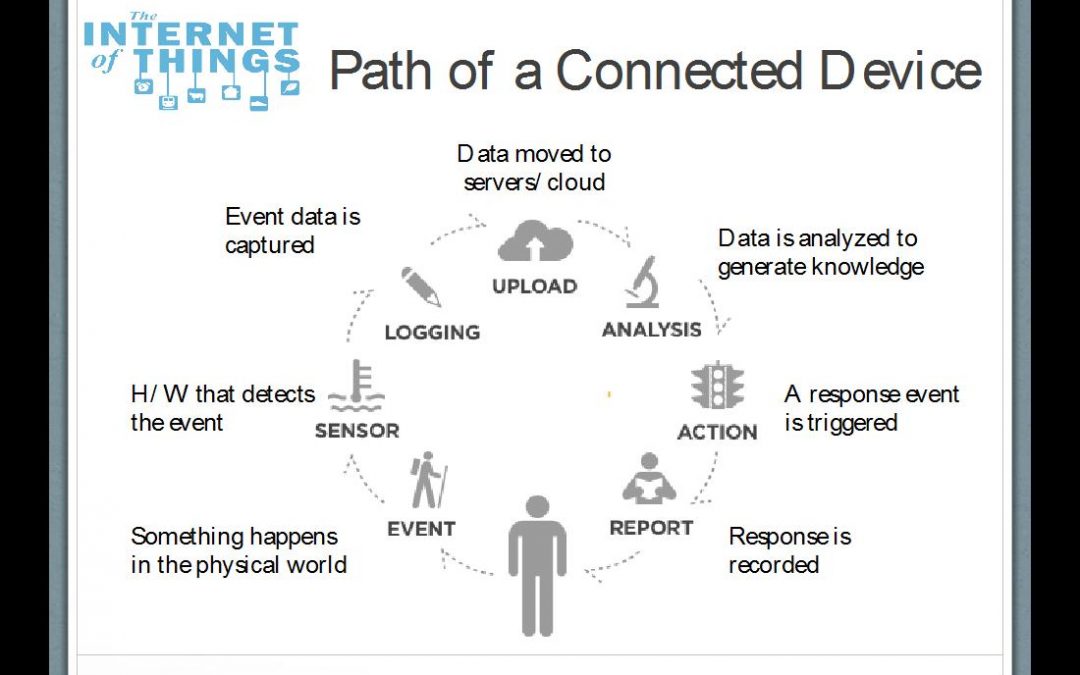
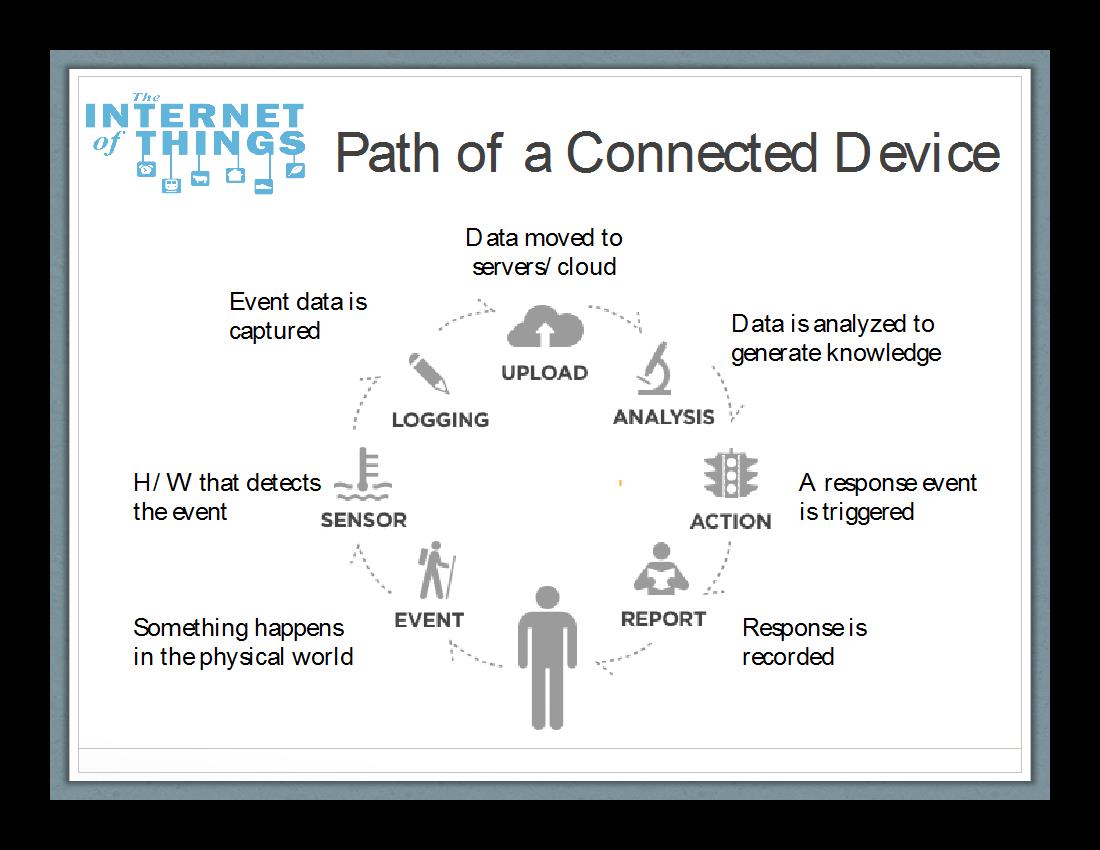
The Internet of Things (IoT) is broadly defined as the merging of the physical and digital worlds. It’s a scenario in which people and/or objects can be uniquely identified with the ability to share information over a network without any actual conscious intervention. The data is automatically transferred, analyzed, and used to trigger an event. Figure 1 below demonstrates how one of these devices functions and interacts with the Internet and other devices.
Figure 1.
The IoT and Supply Chain Management
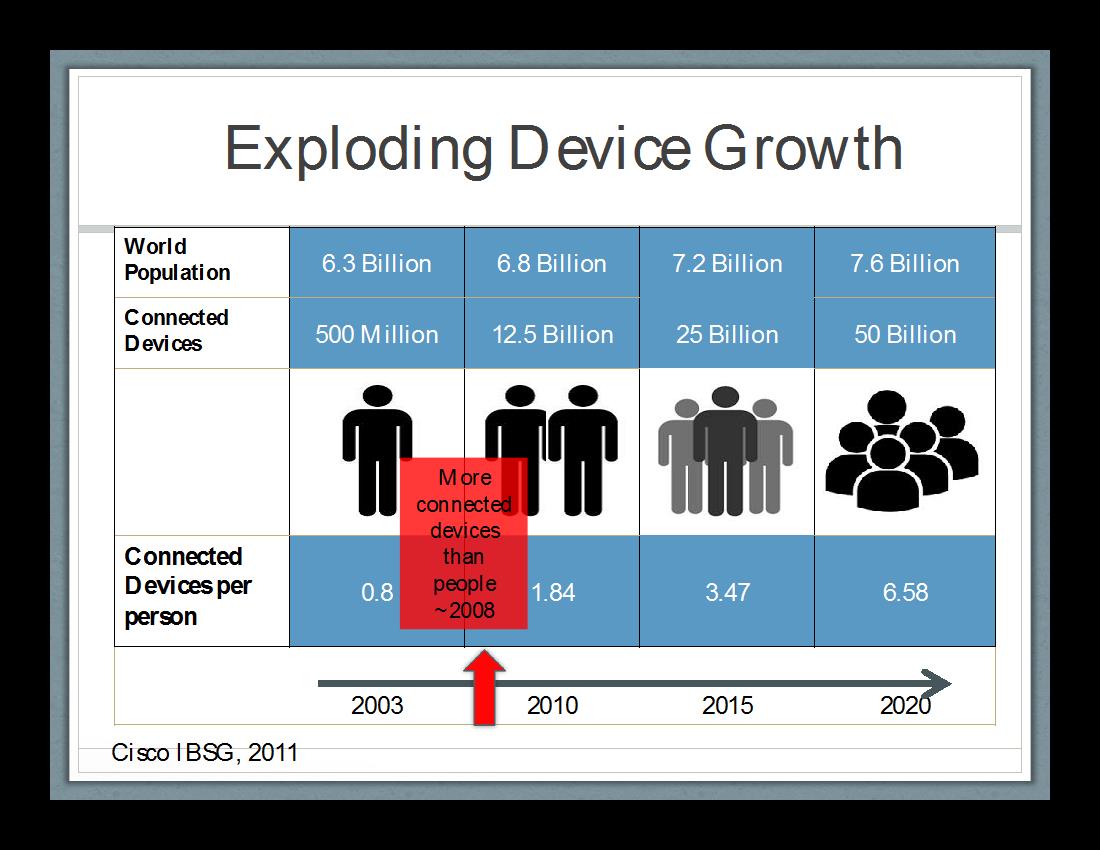
While many of us may be familiar with recent advancements in home automation, like the Nest thermostat, the real impacts of IoT will be in Supply Chain Management. Recent reports by Cisco, IDC and Gartner all claim that a significant increase in the number of devices making up the Internet of Things will have a profound impact on how future supply chains will operate. The 2011 Cisco report predicts there will be 50 billion connected devices globally by 2020, or about 6.5 devices for each person, up from only approximately 2.5 today (see figure 2). More active devices means more available data — to the point where they will be ubiquitous and transparent in our every day lives.
Figure 2.
Impacts to supply chain will be broad and far-reaching, utilizing Big Data to gather and analyze information across the entire process.
Some IoT devices have been in place for some time, such as commercial telematics now used in trucking fleets to improve logistics efficiency. Other commercial type applications — like fabrics that use sensors within clothing and industrial fabrics to monitor human health or manufacturing processes — are just being developed now.
Mark Morely of GSX, a leading provider of monitoring and management solutions, recently discussed three key impacts he believed IoT would have on the Supply Chain industry: Pervasive Visibility, Proactive Replenishment, and Predictive Maintenance. This is a great way to explain the immediate benefits, so I will summarize Mark’s description and expand with some real-world examples.
Three key impacts the IoT will have on the supply chain industry
1) Pervasive Visibility
Mark describes this as the ability to track and monitor a shipment in real time using a combination of sensors (RFID), connected devices, and communication channels (3G/4G, GPS, internet). It provides the ability to have real-time transit status, including location, temperature, and diagnostics — far more information than legacy infomatics provided.
One great example I found is from a company called Purefresh, who are at the cutting edge of Supply Chain IoT technology. They offer not only real-time shipment condition tracking, but also the ability to model and develop transit routes to optimize freshness in perishable cargo — taking into account environmental elements, such as ozone, atmospheres, and temperature. They indicate that an estimated “30% to 50% (or 1.2-2 billion tons) of all food produced on the planet is lost before reaching a human stomach.” IoT advancements will not only better optimize transit flow but also better serve humanity.
2) Proactive Replenishment
It’s the capability to automatically recognize the need to order and restock a product on a “machine-to-machine” basis, reducing the need for human interaction. The most common example is that vending machines will know when it’s out of or low on a Snickers bars and immediately trigger an alert to reorder them, instead of waiting for a service person to check on the vending machine and reorder products manually. The result is less human intervention, quicker replenishment, better sales forecasting and ultimately increased revenues. Oh, and many more happy office workers who really need a mid-afternoon sugar rush!
Opportunities for this technology go far beyond the candy vending machine though. Industries with time critical inventories like hospitals and pharmacies can better maintain supplies by supplementing human inventory control with real time use tracking. A much less critical but more broadly used application comes from Coke’s Freestyle fountain soda machine. It’s about the same size as the existing vending machines but it can dispense 126 kinds of flavors, offering an almost infinite amount of combinations. It uses Radio Frequency ID (RFID) cartridges that store the concentrated syrups in the machine. The RFID chips detect how much of each syrup it has and what combinations are being used. When it detects that it needs supplies, it transmits the information to both Coca-Cola and the storeowner including what has been sold, a record of when sales occurred, troubleshooting information, and service data. As a result, soda sales and customer satisfaction increases, all with less effort by the storeowner.
3) Predictive Maintenance
This application is closer to the true machine-to-machine communications the IoT was intended for. From large-scale manufacturing to diagnostics on the family minivan, predictive maintenance utilizes sensors and connected devices to monitor and react to issues. This self-diagnosis capability can detect a potential issue before there’s a failure, order a replacement part, and even schedule maintenance to avoid costly downtime.
Not only does predictive maintenance help keep factories running longer and the family minivan from unexpectedly breaking down, it can improve efficiency throughout the whole supply chain. If equipment manufacturers constantly receive service data from factory equipment, they can better trend problems and focus on those issues for future products. Parts depots can better forecast inventories and determine consistent safety stock levels. IoT, in this example, is a true B2B (business to business) — automating the communication between businesses on every link of the chain.
In relation to home automation, predictive maintenance will become integrated into our everyday lives. Appliances will become smarter, more efficient, and easier to monitor. Internet-connected sensors will be embedded into everything from refrigerators to washers/dryers and HVAC systems. So much so that companies like GE are investing heavily into these technologies, in both commercial and industrial applications. These connected appliances will perform self-diagnosis, determine the most cost-efficient time to operate, and even automatically order maintenance parts like furnace filters when needed. Imagine getting an alert on your smartphone that your forced hot air furnace needs a new air filter, and it has already been ordered through your Amazon account. It just saved you effort in remembering to check the filter and ordering it — leading to a cleaner, longer-lasting, and more efficient furnace.
So, why isn’t IoT here yet?
It’s close but there are still hurdles to overcome. In recent years, advances in sensor technologies, 4G communications, and cloud computing has made achieving Internet of Things capabilities even more possible. But for companies in the Supply Chain to leverage these opportunities, they will need to expand investment into cloud-based platforms that can support scalable devices and data-analysis services.
Critical to IoT’s success will be the necessary “middleware” software communication protocols to link all these devices. Companies like ProSyst and open-source SW projects like OPENIoT are pioneering these capabilities. But even with this progress, agreements on industry standards will be key to long-term platform success.
Having a common IoT protocol will be necessary to link the physical and digital worlds on a consistent and economical basis. Understanding the need for standards and common architectures, Intel has led the way by recently creating the not-for-profit Industrial Internet Consortium (IIC) with other vested companies like AT&T, Cisco, GE, and IBM. The connected Supply “Chain” will become exponentially longer once these common standards are in place.
The Internet of Things trend is quickly approaching and will impact the way we live and work through increased productivity and efficiency. Supply Chain Management will continue utilizing these advanced technologies to improve factory workflow, increase material tracking, and optimize distribution to maximize revenues.
In 1986, I recall how innovative I thought the Clapper was — I couldn’t have imagined how connected we would become only 28 years later. And the next 28 will be sure to amaze.
Steve Mondazzi is a Principal Master Planner in the Defense Contracting industry. After 20 years’ experience in project management and schedule development, he decided to further his education by recently earning a Masters in Technology Management at the University of New Hampshire. He’s a certified PMI Project Management Professional, an entrepreneur, and an avid lover of all things technology. He currently resides in Massachusetts with his wife, two teenagers, and an excessive collection of headphones. Steve can be contacted via his Twitter account @schedulepro or through LinkedIn.
Related posts:
by Elizabeth Hines | Jun 23, 2014 | Blog, Logistics, Marketing, Social Media, Strategy, Supply Chain
Many companies within the logistics and supply chain industries are stuck on the social media starting line. The reason – “they can’t get past the word ‘social’ and the perception it creates.” The reality is that social media is a tool that can be utilized to create value and grow your business.
This is the fourth in a series of articles that provides examples of companies within the logistics and supply chain industries who have moved beyond the social media starting line and have realized the business value of participating in social media.
Cerasis is a top freight logistics company and truckload freight broker. During the company’s first 15 years it focused on traditional sales and marketing strategies and relied heavily on referrals. This strategy worked. Cerasis acquired new customers, retained current customers, and realized positive growth. However, Cerasis was not viewed as an industry leader, and brand awareness was low.
In 2012 Cerasis decided to participate in social media and launch a content marketing strategy.
Cerasis began actively blogging, and began using Twitter, LinkedIn, Facebook, Pinterest, and Google+. The company quickly became seen as a leader within the industry, and brand awareness increased dramatically.
Within 15 months the company received 71 leads from search engines, 65 leads from social media, and 52 leads from webinars. Even more impressive, within 15 months the company gained 35 customers (one customer within the freight logistics industry can mean a lot of revenue).
The results show that Cerasis is no longer on the social media starting line – rather, Cerasis is now a leader, not only in the freight logistics industry, but also in using social media as a business tool.

by Jennifer Hart Yim | Jan 29, 2025 | Logistics, Paid Advertising
Having a strong digital presence is no longer optional. Pay-Per-Click (PPC) advertising is a powerful tool for logistics companies looking to quickly generate quality leads and expand their client base.
Here, we walk you through everything you need to know about implementing a successful PPC strategy for your logistics business.
Why PPC Matters for Logistics Companies
The logistics industry operates in a highly competitive space where timing and visibility are crucial. PPC advertising offers several unique advantages for logistics companies:
- Immediate visibility in search results when potential clients are actively searching for logistics services
- Precise targeting capabilities to reach specific industries, locations, and decision-makers
- Measurable ROI through advanced tracking and analytics
- Flexibility to adjust campaigns based on seasonal demands and market changes
Key PPC Strategies for Logistics Companies
1. Strategic Keyword Selection
Success in PPC begins with targeting the right keywords. For logistics companies, focus on:
Transportation-specific terms:
- “freight forwarding services”
- “international shipping solutions”
- “supply chain management”
- “warehousing and distribution”
Location-based keywords:
- “[city] logistics company”
- “shipping services in [region]”
- “local freight forwarding”
Service-specific terms:
- “temperature-controlled shipping”
- “hazmat transportation”
- “last-mile delivery solutions”
2. Creating Compelling Ad Copy
Your ad copy needs to address the specific pain points of your target audience while highlighting your unique value proposition. Consider these elements:
- Include relevant certifications and compliance standards
- Emphasize your experience and track record
- Highlight specialized services or equipment
- Showcase your geographic coverage
- Include clear calls-to-action (CTAs)
3. Landing Page Optimization
The success of your PPC campaigns heavily depends on your landing pages. Ensure they:
- Load quickly and are mobile-responsive
- Feature clear value propositions above the fold
- Include trust indicators (certifications, client logos, testimonials)
- Offer multiple contact options
- Contain relevant content that matches the ad’s promise
4. Advanced Targeting Techniques
Maximize your ROI by utilizing advanced targeting options:
Geographic Targeting:
- Target specific service areas
- Adjust bids based on location performance (this one has proven to be particularly successful for our clients)
- Focus on high-value markets
Audience Targeting:
- Create custom audiences based on website visitors
- Target similar audiences to your existing clients
- Depending on your services, you may be able to use in-market audiences to target
Device Targeting:
- Optimize campaigns for both desktop and mobile users
- Adjust bids based on device performance
- Create device-specific ad copy
Measuring and Optimizing Your PPC Campaigns
Key Performance Indicators (KPIs)
Track these essential metrics to measure campaign success:
- Click-Through Rate (CTR)
- Conversion Rate
- Cost Per Lead (CPL)
- Return on Ad Spend (ROAS)
- Quality Score
- Average Position
Optimization Strategies
Continuously improve your campaigns by:
- Regularly reviewing search term reports to identify new keywords
- A/B testing ad copy and landing pages (even changing one word could improve your CTR)
- Adjusting bids based on performance data
- Optimizing for mobile experience
- Refining audience targeting based on performance data
Common PPC Mistakes to Avoid
Please, don’t do these. These things waste your budget:
- Neglecting negative keywords
- Using overly broad match types
- Ignoring mobile optimization
- Not tracking conversions properly
- Failing to test ad variations
- Overlooking quality score optimization
Budget Planning and Management
Effective budget management is crucial for PPC success:
- Start with a conservative budget to gather data
- Allocate more budget to top-performing campaigns
- Consider seasonal trends in the logistics industry
- Set aside budget for testing new approaches
- Monitor and adjust bids regularly
Future Trends in Logistics PPC
Wanna be with the cool kids? Stay ahead of the curve by testing these emerging trends:
- AI-driven automation in campaign management (yes, even daily budget management)
- Voice search optimization
- Enhanced audience targeting capabilities
- Integration with CRM systems
Conclusion
Remember that PPC is not a “set it and forget it” solution. Regular monitoring, testing, and optimization are essential for maintaining and improving campaign performance over time.
Need help with your logistics company’s PPC campaigns? Contact our team.
Read more:

by Jennifer Hart Yim | Jan 9, 2025 | Logistics
Trying to figure out which logistics trade shows and events you should attend in 2027? You’re in the right place! Whether you’re a logistics veteran or planning your first industry event, this list will help you choose the conferences that are actually worth your time (and budget). Below you’ll find all the major shows happening across North America, Europe, and Asia, complete with dates, locations, and an insider’s look at what makes each one special.
One note before you start planning: 2027 looks different from recent years. Several major shows have moved quarters, changed cities, or changed venues. Read carefully before you book.
Q1 2027 conferences
BGSA Supply Chain Conference
- Date: January 20-22, 2027
- Location: Palm Beach, Florida
- Why attend: This invite-only, CEO-level conference brings together senior executives from across transportation, logistics, and supply chain. Smaller and more selective than most events on this list, BGSA is built for candid strategic discussion rather than exhibit hall browsing. If you’re at the executive level and looking for depth over breadth, request an invitation early.
Learn more about BGSA >>
SMC3 Jump Start 2027
- Date: January 25-27, 2027
- Location: Atlanta, Georgia
- Why attend: Jump Start sets the tone for the freight year. Carriers, shippers, logistics service providers, and technology providers gather for market forecasting, pricing insight, and relationship building before the calendar gets crowded. A practical first stop if you want a read on market conditions heading into Q1.
Learn more about SMC3 Jump Start >>
Manifest 2027
- Date: February 8-10, 2027
- Location: The Venetian, Las Vegas, Nevada
- Why attend: The first major logistics trade show of 2027, Manifest brings together supply chain technology leaders and innovators to showcase the latest in logistics automation, robotics, and AI solutions. Expect 7,000+ attendees and heavy startup and investor presence. Particularly valuable if you’re tracking emerging technology or looking for partnerships outside the usual vendor set.
Learn more about Manifest Vegas >>
RILA LINK 2027 Retail Supply Chain Conference
- Date: February 21-24, 2027
- Location: Gaylord Palms Resort, Orlando, Florida
- Why attend: Essential for retail supply chain professionals, LINK focuses on retail-specific logistics challenges and solutions, featuring senior executives from major retailers sharing their insights and strategies. The LINK Connect program pairs solution providers with retail and CPG buyers through pre-scheduled meetings, which makes this one of the more efficient shows if you’re selling into retail.
Learn more about RILA LINK >>
2027 Food Shippers of America Conference
- Date: February 28 – March 2, 2027
- Location: JW Marriott Desert Springs, Palm Desert, California
- Why attend: The 71st annual conference focuses exclusively on food logistics and transportation, addressing cold chain management, food safety compliance, carrier capacity, and sustainable food transportation. Worth noting that attendance is invitation-based, so request your invite early.
Learn more about Food Shippers of America >>
TPM27
- Date: February 28 – March 3, 2027
- Location: Long Beach, California
- Why attend: The premier conference for international container shipping, TPM provides unparalleled networking with ocean carriers, ports, and international logistics providers. This is where annual contract relationships get built. TPM Tech, TPM Cold Chain, and TPM Academy run alongside the main program, so check the full agenda before locking in your travel dates. Registration is already open with early bird rates.
Learn more about TPM >>
LogiMAT 2027
- Date: March 16-18, 2027
- Location: Messe Stuttgart, Stuttgart, Germany
- Why attend: Europe’s largest intralogistics exhibition showcases the latest innovations in material handling, warehouse automation, and supply chain software. The last edition drew more than 61,000 trade visitors and 1,600 exhibitors. Particularly valuable if you’re tracking European market trends and automation technologies.
Learn more about LogiMAT >>
SITL 2027
- Date: March 23-25, 2027
- Location: Paris Expo Porte de Versailles, Paris, France
- Why attend: France’s premier logistics event brings together European logistics professionals to discuss innovations in transportation, warehouse management, and supply chain optimization. Heads up: SITL alternates venues, and the 2027 edition is at Porte de Versailles rather than Paris Nord Villepinte. Note also that SITL moves earlier in 2027, landing in Q1 rather than Q2.
Learn more about SITL >>
LogiChem EU 2027
- Date: March 2027, dates to be confirmed
- Location: Rotterdam, Netherlands
- Why attend: The leading chemical logistics and supply chain conference in Europe, LogiChem focuses on challenges specific to chemical industry logistics, including safety regulations, sustainability, AI adoption, and specialized transportation requirements. Check the organizer site for confirmed 2027 dates before booking travel.
Learn more about LogiChem EU >>
Q2 2027 conferences
TIA 2027 Capital Ideas Conference
- Date: April 5-7, 2027
- Location: Gaylord Palms Resort, Orlando, Florida
- Why attend: The Transportation Intermediaries Association’s annual conference is essential for freight brokers and 3PLs, offering insights into transportation market trends, fraud prevention, and brokerage best practices.
Learn more about the TIA 2027 Conference >>
The Logistics World Summit & Expo 2027
- Date: April 7-8, 2027
- Location: Centro Banamex, Mexico City, Mexico
- Why attend: The largest logistics event in Latin America, offering insights into regional markets and connecting professionals across the Americas. Particularly valuable for understanding Mexican and Central American logistics trends, nearshoring dynamics, and cross-border opportunities.
Learn more about The Logistics World Summit & Expo >>
ProMat 2027
- Date: April 19-21, 2027
- Location: McCormick Place, Chicago, Illinois
- Why attend: One of North America’s largest manufacturing and supply chain trade shows, ProMat features more than 1,000 exhibitors across 670,000 square feet of manufacturing, distribution, and supply chain equipment. Two changes to know: ProMat has moved from four days to three, and it shifts from March to April this cycle. ProMat takes MODEX’s place on the calendar in 2027.
Learn more about ProMat >>
Intermodal Asia 2027
- Date: April 21-23, 2027
- Location: Shanghai, China
- Why attend: Asia’s leading intermodal and container transport event, expected to draw 7,250+ global professionals. A useful complement to TPM and Intermodal Europe if your container business extends into the Asia Pacific market.
Learn more about Intermodal Asia >>
transport logistic 2027
- Date: April 26-29, 2027
- Location: Messe München, Munich, Germany
- Why attend: One of the world’s largest transport and logistics trade fairs, with comprehensive coverage of global logistics trends across all transport modes. Expect 80,000+ attendees and 2,600+ brands. Air cargo Europe, the world’s largest air freight event, runs concurrently. Note that transport logistic moves from June to April in 2027.
Learn more about transport logistic >>
The 2027 IWLA Convention & Expo
- Date: May 2-4, 2027
- Location: El Conquistador Resort, Fajardo, Puerto Rico
- Why attend: The International Warehouse Logistics Association’s annual event brings together warehouse operators and 3PLs to discuss industry trends, technology innovations, and operational best practices. New destination this year, so book flights early.
Learn more about the IWLA Convention >>
Gartner Supply Chain Symposium/Xpo 2027
- Date: May 3-5, 2027
- Location: Walt Disney World Swan and Dolphin Resort, Orlando, Florida
- Why attend: The largest gathering of chief supply chain officers and senior supply chain executives in North America, drawing 5,000+ attendees. Content skews strategic rather than operational, with heavy focus on AI ROI, margin protection, and navigating volatility. If your goal is reaching or learning from decision-makers rather than evaluating equipment, this is one of the highest-value events on the calendar. A European edition follows in Barcelona, May 24-26, 2027.
Learn more about Gartner Supply Chain Symposium/Xpo >>
Breakbulk Europe 2027
- Date: May 11-13, 2027
- Location: Rotterdam Ahoy, Netherlands
- Why attend: The leading international exhibition and conference for project cargo and breakbulk, and considerably larger than most people expect. The 2026 edition drew more than 12,800 professionals and 740+ exhibitors from 134 countries, making it the largest in the event’s history. Essential if you’re moving oversized, heavy-lift, or industrial freight, and a strong fit for manufacturers with complex outbound shipping requirements. The 2027 edition adds a new exhibition hall.
Learn more about Breakbulk Europe >>
ISM World 2027
- Date: May 16-18, 2027
- Location: Washington, DC
- Why attend: ISM World serves the procurement and supply management side of the house rather than logistics specifically. Worth attending if your work touches sourcing, supplier relationships, or category management, and useful for anyone selling into procurement organizations.
Learn more about ISM World >>
LogiSYM Asia Pacific 2027
- Date: May 2027, dates to be confirmed
- Location: Singapore
- Why attend: The premier logistics and supply chain conference in Asia Pacific, offering insights into regional markets and connecting professionals across the APAC region. Recent editions have run mid-May at Singapore EXPO.
Learn more about LogiSYM Asia Pacific >>
Home Delivery World 2027
- Date: May 25-27, 2027
- Location: Orange County Convention Center, Orlando, Florida
- Why attend: Focused on last-mile delivery and e-commerce logistics, this conference addresses the growing challenges and opportunities in retail delivery operations. Big changes for 2027: the event moves from Nashville to Orlando and expands from two days to three, with 3,000+ attendees and 200+ speakers expected.
Learn more about Home Delivery World >>
TMSA ELEVATE 2027
- Date: June 2027, dates to be confirmed
- Location: To be announced
- Why attend: Focused on marketing and sales strategies in transportation and logistics, ELEVATE helps professionals better position and promote their services. Recent editions have used role-based tracks for marketers, sellers, and company leaders. If you’re on the commercial side of a logistics business, this is the one built specifically for you.
Learn more about TMSA ELEVATE >>
Q3 2027 conferences
CeMAT South East Asia 2027
- Date: July 20-22, 2027
- Location: Marina Bay Sands, Singapore
- Why attend: The trade show for intralogistics, robotics and automation, warehousing, and materials handling in Southeast Asia. Moving to Marina Bay Sands for 2027. Worth a look if you’re evaluating warehouse automation vendors with an APAC footprint.
Learn more about CeMAT South East Asia >>
IANA Intermodal EXPO 2027
- Date: September 13-15, 2027
- Location: Long Beach, California
- Why attend: North America’s leading intermodal freight event, bringing together roughly 1,800 professionals from railroads, ocean carriers, ports, terminals, equipment providers, and technology firms. Recent editions have tackled cargo theft, tariffs, rail mergers, and AI adoption. This is the domestic counterpart to TPM and Intermodal Europe.
Learn more about IANA Intermodal EXPO >>
ASCM CHAINge North America 2027
- Date: To be announced
- Location: To be announced
- Why attend: The Association for Supply Chain Management’s flagship North American conference focuses on supply chain transformation and innovation through interactive, scenario-driven sessions rather than a traditional lecture format. Recent editions have run in September.
Learn more about ASCM CHAINge >>
North American Supply Chain Executive Summit 2027
- Date: To be announced
- Location: To be announced
- Why attend: A premier gathering of Chief Supply Chain Officers, Chief Procurement Officers, and senior supply chain leaders focused on strategic planning, digital transformation, and industry leadership. Recent editions have run in September.
Learn more about the North American Supply Chain Executive Summit >>
Q4 2027 conferences
Council of Supply Chain Management Professionals (CSCMP) EDGE 2027
- Date: To be announced
- Location: To be announced
- Why attend: CSCMP’s annual conference is one of the industry’s largest events, featuring comprehensive educational sessions, impressive keynote speakers, and extensive networking. Recent editions have run in early October. CSCMP has also launched EDGE Europe, with a 2027 edition planned for Rotterdam, if you want European coverage.
Learn more about CSCMP EDGE >>
Intermodal Europe 2027
- Date: To be announced
- Location: To be announced
- Why attend: The leading exhibition and conference for companies associated with container and intermodal industries worldwide, essential for understanding global container logistics trends. The 2026 edition runs November 10-12 in Rotterdam, and 2027 details should follow.
Learn more about Intermodal Europe >>
FreightWaves F3: Future of Freight Festival 2027
- Date: To be announced
- Location: Chattanooga, Tennessee
- Why attend: A two-day event combining technology demonstrations, market insights, and networking focused on the future of freight transportation, capped by the FreightTech Awards dinner. Recent editions have run in late October at The Signal at Chattanooga Choo Choo. While you’re in Chattanooga, you must eat a Moon Pie. You can thank me later.
Learn more about FreightWaves F3 >>
Frequently asked questions
Which are the biggest logistics conferences in 2027?
The largest events by attendance are transport logistic Munich (April 26-29, 80,000+ attendees), ProMat (April 19-21, 50,000+ attendees), and LogiMAT Stuttgart (March 16-18, 61,000+ attendees). For executive-level audiences specifically, Gartner Supply Chain Symposium/Xpo (May 3-5) draws the highest concentration of chief supply chain officers in North America.
What are the best European logistics conferences in 2027?
Key European events include LogiMAT in Stuttgart (March 16-18), SITL in Paris (March 23-25), and transport logistic in Munich (April 26-29). If you’re moving project cargo or oversized freight, add Breakbulk Europe in Rotterdam (May 11-13). Note that Europe front-loads heavily in 2027, with the biggest shows landing between mid-March and mid-May.
Which conferences focus on supply chain technology?
Manifest (February 8-10) and ProMat (April 19-21) are particularly strong in showcasing new supply chain technologies. Both feature extensive exhibits of robotics, automation, and software solutions, with Manifest skewing toward startups and investment and ProMat toward equipment and systems you can walk through.
Is MODEX happening in 2027?
No. MODEX and ProMat run on alternating cycles. MODEX took place in Atlanta in April 2026, and the next edition is scheduled for 2028. ProMat in Chicago is the 2027 show.
Are there any virtual attendance options?
Many conferences offer hybrid attendance options combining in-person and virtual experiences. Check individual conference websites closer to the event dates for specific virtual attendance offerings and registration details.
Tips for attending logistics conferences
1. Plan your conference schedule early
Start planning at least three to four months in advance to take advantage of early bird registration rates and ensure accommodation availability. This matters more in 2027 than usual: ProMat and transport logistic fall within a week of each other, and hotel inventory in Chicago and Munich will move fast.
2. Watch the May crunch
May 2027 is unusually dense. IWLA, Gartner, Breakbulk Europe, ISM World, LogiSYM, and Home Delivery World all land within a four-week window across four countries. Pick your priorities before registration opens rather than after.
3. Maximize networking opportunities
Most conferences offer dedicated networking sessions and mobile apps to connect with other attendees. Download the conference app in advance and set up your profile. Several shows now run double opt-in meeting programs (LINK Connect, HDW Connect) that fill your calendar before you land. Here’s how to make the most of networking opportunities.
4. Budget realistically
Conference costs typically include:
- Registration fees ($1,000 to $3,000 on average, with premium events like Manifest running closer to $2,000)
- Travel and accommodation
- Additional workshop or certification fees
- Entertainment and networking events
5. Verify venue and city changes
More shows than usual are moving in 2027. Home Delivery World relocates to Orlando, IWLA heads to Puerto Rico, CeMAT South East Asia moves to Marina Bay Sands, and SITL switches Paris venues. Confirm the location before you book anything.
See you all out and about this year!
The 2027 logistics conference calendar offers something for everyone. Whether you’re interested in technology, retail logistics, procurement, or international shipping, there’s a conference tailored to your needs. Register early for the best rates and check back regularly as we confirm the remaining Q3 and Q4 dates.
Did we miss your favorite one? Let us know and we’ll add it to the list!
Need help with your trade show strategy? Let us know.
Read more:
Last updated: August 2026. Conference details subject to change. Please verify dates and locations with event organizers before making travel arrangements.
Important note: MODEX has no event scheduled for 2027. MODEX next takes place in 2028.
by Jennifer Hart Yim | Sep 13, 2024
A SUPPLY CHAIN marketing agency Don’t waste time getting a general agency up to speed We’re a supply chain marketing agency focused solely on marketing for the supply chain industry. Get thoughtful, compelling campaigns created by a team who understands your...