by Elizabeth Hines | Jul 20, 2017 | Blog, Content Marketing, Marketing, Social Media
Recent surveys show video platforms are the next big focus for marketers in terms of content distribution channels.
Social media marketing can seem a bit like keeping up with the Joneses. Which content distribution channels are your competitors using? Where are they getting the most engagement? How often are they posting and when?
We’re big advocates of social benchmarking against your competitors. But, just as much, we are always thinking ahead, trying to figure out where the industry is going next. It’s important to get ahead of the trends so that you can be right there leading the pack.
The State of Inbound has been tracking global marketing and sales trends for the last eight years, with a particular focus on inbound marketing. (Content marketing is a form of inbound marketing.) The 2017 survey included more than 6,300 professionals at from 141 countries, so it offers a very comprehensive view of current trends in content marketing.
One part of the survey of particular interest involves which distribution channels marketers are planning to invest in next. It gives us an idea of where companies will be putting their time and money in terms of social media marketing. Let’s take a look at the results.
Content distribution channel investment
The more than 6,300 marketing professionals surveyed answered the following question: “What content distribution channels do you plan to add to your marketing efforts in the next 12 months?” The chart below shows responses from 2016 and 2017 surveys for comparison.
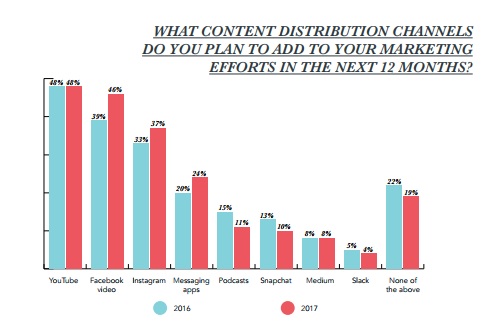
Source: State of Inbound 2017
Marketers will maintain or increase their investment on YouTube and Facebook video — focus on the latter jumping a significant 7% over 2016. Interest in Instagram and messaging apps has also grown significantly over the last year, while marketers’ investment in podcasts, Snapchat, and Slack has decreased.
I also want to note quickly that investment in Medium has remained steady at 8%. I plan to write more about Medium as an opportunity for supply chain and logistics businesses in the near future, so stay tuned!
Misaligned priorities
Another noteworthy aspect of this survey question is how respondents at various levels of the corporate ladder answered. Do the people who set company goals have the same priorities as those tasked with social media management and content distribution on a daily basis? Of course not! Take a look.
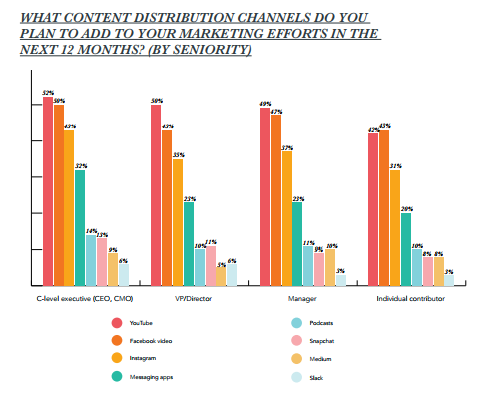
Source: State of Inbound 2017
Broken down by respondents’ roles, the data shows a division in the priorities of C-level executives versus individual contributors. Executives show a higher preference to expand to new channels of distribution such as messaging apps. The individual contributors responsible for the day-to-day oversight, however, offer a more conservative approach, favoring more tried-and-true distribution channels.
It is also interesting to note that individual contributors consider Facebook video a top priority slightly over YouTube, while executives, directors, and managers uniformly prefer YouTube.
Our takeaway: Video, video video
Across the board, companies are turning their content distribution focus to video platforms, and the supply chain should be, too. If you haven’t heard me say it before, I’ll tell you now: Yes, video can work for the supply chain.
Why? In a nutshell, YouTube reaches more adults ages 18-34 in the U.S. than any cable network. Users browse the platform for entertainment purposes, but also for tips, information, and ideas. And anywhere people are seeking solutions, businesses should be providing answers.
Live video, too, is a trend that is not going away anytime soon. According to the 2017 Social Media Marketing Industry Report, 61% of marketers plan on using live video services such as Facebook Live and Periscope, and 69% want to learn more about live video.
Live video helps businesses promote transparency, good communication, and relatability. It’s something that will do your business a world of good in the supply chain and logistics industries.
Related posts:

by Elizabeth Hines | Jul 19, 2017 | Blog, Content Marketing, Marketing
Personalizing marketing emails increases open rates, click-throughs, and revenue, but it takes so much more than addressing recipients by name.
B2B buyers are increasingly expecting vendors to provide personalized experiences throughout the buyer’s journey. Marketers know this to be true — especially when it comes to email marketing. For example, emails with personalized subject lines are 26% more likely to be opened.
Marketers can use information they have about subscribers to tailor email content for individuals, based on who they are or where they are in the buyer’s journey. Personalization techniques, such as list segmentation, help to drive opens rates and increase revenue by as much as 760% because it helps marketers give subscribers more relevant, individualized content.
So, aside from addressing someone by name, how can you personalize your marketing emails and, in turn, make them more effective?
7 personalization techniques for marketing emails
1. Use list segmentation
As I’ve written about before, email list segmentation is one of the most powerful tricks in an email marketer’s book. Not all customers are the same, nor should their emails be. By segmenting your email lists, you can create individualized content for smaller sub-groups, based on customer needs, interests, demographics, and more. Gathering information about your customers allows you to match content to their specific interests.
2. Use dynamic content
Also referred to as “smart content”, dynamic content is a term for the fields of an email body that change based on the interests or past behavior of the recipient. Sounds time consuming, right? In reality, one email can have several images or content fields that change based on your customers’ preferences, and you can have them autofill, so you don’t have to set each manually.
3. Watch send times
There is no perfect science to discover when your best send times are, but data suggests Tuesday at 10:00 a.m. is an optimal time to send out B2B marketing emails. Trial and error is the best way to find out when customers are most likely to open and click through your emails.
But remember — particularly if you serve customers across the globe — it’s never Tuesday at 10 a.m. (or whenever) everywhere in the world at once. Segmenting your list by time zone to deliver emails at a time customers in each zone are most likely to open them is another step toward personalization that will increase engagement.
4. Optimize your emails for mobile devices
Many marketers create and design marketing emails thinking they’ll be read on laptops or desktop computers. But, the truth is 56% of users read emails on their mobile devices. If you’ve ever read an email designed for desktop on your phone, you know what a poor user experience it is. And the worse the user experience, the less likely recipients will read or engage with your emails.
This means you need to personalize your marketing emails based on the kind of device on which they are being read. It’s actually less complicated than it sounds. A responsive email design — available through many email clients — changes the look of the email based on device. Also, any landing pages should be mobile-friendly, and so should your website.
Here are some more tips for keeping your marketing emails mobile-friendly.
5. Match landing pages with emails
Even if you create custom content for various segments of your email list, driving them all to the same landing page may undo all that hard work. Landing page copy, design, and calls-to-action should all match the emails driving users there to ensure a unified experience. A unified experience increases the chances a lead will convert. That means, you’ll need to create unique landing pages that reflect the personalization in your emails.
6. Create automated behavioral trigger emails
Haven’t logged onto Facebook for 5 days? They’ll email you to let you know, and it’s surprisingly effective. Trigger emails have a 152% higher open rate than traditional emails. Trigger emails give your business a level of personalization with the ease of automated responses that can be sent for multiple purposes, including re-engagement, up-selling, etc.
7. Personalize your end of the business
Personalization doesn’t have to stop with your customer’s information. Humanizing your company will work to strengthen your relationship with recipients and can soften the edges of big business.
How do you do this? Firstly, make sure your emails always come from a person, not a generic business address. HubSpot goes a step further by sending marketing emails from particular members of the marketing team, including their name, contact information and even a picture. Anything you can do to let the recipient know that there’s an actual person on the other end of the email will work to personalize their experience and increase engagement rates.
Related posts:

by Elizabeth Hines | Jul 17, 2017 | Blog, Content Marketing, Marketing
Outsourcing doesn’t have to be an all-or-nothing thing. Considering parsing off these marketing tasks based on internal resources and expertise.
Everyone needs a little help sometimes. That’s particularly true when it comes to B2B marketing. In fact, 52% of B2B marketers attribute stagnancy in success to not having enough time devoted to their marketing programs, and 49% attribute stagnation to content creation challenges.
Outsourcing marketing allows you to focus on insourcing your core competencies while delegating specialized tasks to external experts. And it’s important to note that you don’t have to outsource ALL of your marketing. Choosing several areas beyond your staff’s expertise or that are particularly time-consuming can help you improve your marketing efforts and take stress off an overworked internal marketing team.
Here are seven areas where you might consider outsourcing.
7 marketing tasks to outsource
1) Website development and design
Sure, you could build a perfectly functional website from a template, or have your techy nephew Chris put something together while interning with your company over summer break from college. But this is one area we feel strongly is best left to the pros.
A sleek, modern website that’s easy to navigate makes a big statement about your company. The overwhelming majority of buyers will visit vendors’ websites while researching and making purchasing decisions. The experiences they have while browsing contribute to their overall perception of the companies. Imagine how poor site organization, outdated functionality, or technical problems reflects on your brand.
In addition to creating a well-functioning site, the right developer/designer brings niche specializations to the table as well, such as usability engineering, search engine optimization, and more. Capitalizing on a professional’s knowledge in these areas can make a big difference in web traffic, visitor engagement, and, ultimately, lead generation and sales.
2) Social media management
Social media management sounds easy and fun. But if this task has ever fallen on your plate, you know the exact opposite is true. It can be one of the most time-consuming, frustrating tasks your business faces — and that’s before you realize you have to keep up with all the latest trends and platforms to be effective.
Outsourcing social media management to a knowledgeable partner can free up hours of your day and improve your social engagement and reach. These firms know what works and what doesn’t because they’re active every day on multiple platforms managing accounts for multiple clients.
And it’s not just posting every now and then. A good social media partner will craft and publish original content, but they’ll also curate great content from relevant sources, like industry partners. Outsourcing these tasks to the pros helps build a strong following and brand awareness for your company.
3) Content creation
Blog posts, emails, case studies, white papers, ebooks, webinars, marketing collateral, newsletters — how much content is your staff responsible for creating on a weekly, even daily, basis? Is it the kind of informed, quality material you’re proud of?
Content creation is one of the easiest marketing tasks to outsource. It will immediately give your staff back hours into their days. And the right outsource partner will produce high-quality, SEO-optimized content that will drive traffic, build trust with leads, and persuade buyers.
4) Videography
Video is the hottest content platform right now. I’ve written extensively about the opportunity supply chain and B2B businesses have with video, even if it’s just point-and-shoot iPhone video interviews with subject-matter experts. But professionally produced videos open another level of potential.
There are many firms and individuals that specialize in videography, and you’d be surprised how affordable and quick they can be. Or, some content creation partners also do video or can find a third-party videographer and manage the process for you.
5) Graphic design
This is one area where you really can’t fake it. Professional designers are worth their weight in gold, particularly when you need a professional document or graphic in a crunch. They can turn your documents into beautiful, easy-to-read brochures, or make dry technical data into eye-catching infographics. You may be savvy with Word templates, but they’ve got nothing on the pro designers.
6) E-commerce
Any sort of back-end system will work more smoothly if you are able to outsource the project to an agency already familiar with implementing and running specialized platforms. A smooth and well-thought out e-commerce process without any hiccups leaves customers happy and more likely to return.
7) Strategy and execution
Did you know you can leave marketing strategy to the experts? The right partner will work closely with you to develop a strategy that closely aligns with your business and marketing goals. They can even execute the strategy for you, as well, and then provide you with regular updates on how it’s working. This kind of results-driven approach will ensure you’re stretching your marketing dollars to the fullest extent and getting the kind of results that will grow your bottom line.
Related posts:


by Elizabeth Hines | Jul 12, 2017 | Blog, Content Marketing, Logistics, Marketing, Social Media, Supply Chain
Here are our 10 most popular articles covering supply chain and digital marketing, based on our mid-year analysis.
If you ever read this blog, or are familiar with Fronetics, you know we’re big advocates of regularly measuring and analyzing metrics that help you assess your marketing efforts. We don’t just say that: We actually practice what we preach. In fact, I was recently a mid-year audit of our blog content for this very reason.
That’s why I know which articles have been the most read this year. And I know (from past analysis) that our readers really appreciate having curated lists of popular content, so I wanted to share with you our top 10 supply chain and digital marketing articles in 2017… so far.
Top 10 supply chain and digital marketing articles of 2017 (as of 7.1.17)
These are our picks for the best blogs in the logistics and supply chain industries. They cover a range of topics, from technology to strategy, and feature thought leadership by some of the brightest minds in the field. Read post
This guest post from Argentus Supply Chain Recruiting, a boutique recruitment firm specializing in Supply Chain Management and Procurement, includes an infographic shedding light on the differences between these often-confused functions. Read post
Buzzsumo’s Steve Rayson used data to analyze patterns the most popular content posted on LinkedIn in 2016. He identified headlines and topics that were most successful. The results are really interesting and say a lot about what content resonates with the general LinkedIn community. Read post
With social media networks changing daily, it’s hard to keep up with where to distribute content, much less how often. Countless studies have attempted to solve the social-media-frequency equation. And while audiences vary across industries, best practices give us some general guidelines. Here’s our assessment of social media posting frequency. Read post
Ellen Voie is successfully breaking down barriers and changing the perception of the trucking industry. As founder and president of Women In Trucking (WIT), Voie and her team work to promote the organization’s mission “to encourage the employment of women in the trucking industry, promote their accomplishments, and minimize obstacles faced by women working in the industry.” I interviewed her about her path to success. Read post
Every year we ask our readers to vote for the best industry blogs. The results are always interesting — there’s really a lot of great supply chain and logistics content out there, plus it’s great to see where our readers are finding value. This year, they voted Morai Logistics, Women in Trucking, and the Oracle Supply Chain Management Blog as the top 3 logistics and supply chain blogs of 2017. Read post
There is a lot of research out there that highlights the optimal time to post on various social media platforms. But, the truth is, there is no one-size-fits-all social media posting solution. You need to know the best time for your business to post content. You want more than just a general idea of when to post. You want specific information about your target audience — when they’re actively scrolling, reading, watching and liking your content. These tools can help. Read post
Instagram’s recently launched feature, Instagram Stories, offers marketers a new platform for content delivery that is wildly popular with millennials (who are shaping B2B buying). But unlike other networks with short-term video-sharing opportunities (ahem, Snapchat), Stories can have a polished, professional feel that well suits B2B brands. Here’s what they are and some ideas for how to use them. Read post
This article is part of a series of articles written by MBA students from the University of New Hampshire Peter T. Paul College of Business and Economics. Jacob Rossman discusses the inevitable rise of autonomous trucks and the social and economic factors driving the progression of their technology. Read post
Another article by an MBA student, Meghan Sargent looks at Starbuck’s often-studied supply chain management practices, which, according to some, make Starbucks’ coffee and customer experience superior to those of its competitors. She asks: What exactly is Starbucks doing differently than other international coffee retailers? Is its coffee truly better? Read post
Honorable mentions
I couldn’t leave out these posts, which almost cracked the top 10!
We strive to be a go-to resource for all things digital and content marketing for the supply chain and logistics industries. If there’s a topic you’d like us to cover, please let me know in the comments below, or feel free to email me directly.
And — shameless plug warning — subscribe to our blog to get the latest content delivered to your inbox on a weekly basis! (Sign up on the right.)
Related posts:

by Elizabeth Hines | Jul 11, 2017 | Blog, Content Marketing, Marketing, Social Media, Strategy
Take an honest assessment of these 6 areas to see if outsourcing your marketing might be a smart move.
Supply chain companies are increasingly open to outsourcing their logistics because it allows them to focus on their core competencies while improving productivity. So why not apply the same rationale to bolster your marketing efforts? Don’t be afraid to look outside the box for the marketing tools you need to succeed.
As your competitors’ marketing budgets continue to climb, your company needs expertise on your side to get the most out of your marketing dollars — and that’s especially true in the digital space. Content marketing can be very challenging for novices and seasoned marketers alike. Blogging, paid search and social advertising, email marketing, social media management: there’s a lot to juggle. That’s why many companies are outsourcing some — or all — of their marketing programs.
Have you considered outsourcing as an option? Maybe it’s time you did. Parsing out certain projects on an as-needed basis to an outside firm can help you comfortably navigate and succeed in the marketing world.
6 signs you should outsource your marketing
Assess your staff in these six areas to determine if it’s time to explore outsourcing your marketing efforts.
1) “Wait, what’s going on with social media now?”
Do you feel like your company is always reacting to marketing trends instead of planning for them? You need to be one step ahead of what’s coming, especially in fast-changing spaces like social media, in order to meet your customers where they are.
Learning best practices and new tools can be challenging, especially if you’re time strapped. Using an outside firm with expertise across the spectrum — and whose job depends on knowing the newest platforms and media — will give you an edge over competitors.
2) Everyone is at capacity.
Is your current marketing team able to take on new projects easily, without compromising existing responsibilities? If your staff has great ideas but not the resources to initiate them or follow through, you need to find a way to fix that.
Consider breaking off projects to an outside firm, even on a trial basis to test the waters. Plus if you outsource to experts, you won’t have to reinvent the wheel in-house or risk being off trend.
3) You lack time for proper strategizing and assessment.
Do you have a unified marketing strategy in place with a way to measure objectives and results? If you’re too busy keeping up with day-to-day work to step back and plan, then regularly assess how things are going, consider outsourcing.
Creating a strategy with short- and long-term goals is essential to marketing success. Using an agency to create a roadmap for you — and then to track progress — will free you up to focus on running your business. Also, an objective audit of your practices can be truly beneficial and will only improve your strategies.
3) You only have time to focus on one or two platforms/areas/ideas.
Are your marketing channels diversified? Your marketing reach needs to extend to all avenues, particularly in the digital world. Outsourcing SEO, paid search and social advertising, blogging and social media projects is a relatively easy task to manage and is absolutely essential for success in the current world.
4) You can’t afford another hire.
Are you on a tight budget? If your budget doesn’t allow for hiring and training key staff, outsourcing your marketing needs is a way to grow your reach and accomplish your goals without generating overhead such as training costs, benefits or payroll expenses. It’s also a way to try out new projects and programs to see if they stick.
5) You don’t have time for professional development.
Is there a skillset you and your employees want to advance? Gauge the temperature of your existing staff to ensure everyone’s needs are being met. Retaining top talent isn’t easy, so keep in mind that you don’t want existing employees to be concerned about their job security.
Identity each in-house staff member’s strengths and interests, and cultivate them. For example, encourage a designer to add a new skill to his or her portfolio, or an analyst to take a webinar or class to become even savvier. Strength what you have but look to complete your marketing toolkit with the available expertise.
Related posts: