by Elizabeth Hines | Apr 21, 2016 | Blog, Marketing, Social Media, Strategy, Supply Chain
Fronetics’ new report explores the adoption of social media within the logistics and supply chain industries. Learn why your company is at a disadvantage if you are not participating.
It is estimated that over $1 trillion annually could be realized across the value chain through the use of social technologies. Yet companies in the logistics and supply chain industries have lagged behind when it comes to social media participation. The question is: why?
In short, many companies within these industries did not realize that their customers, employees, and competitors were leveraging social media to conduct business. In today’s world, the exponential growth of social media platforms is largely fueled by commercial activity. Consumers and corporations alike are increasingly turning online to do research and make purchases. This holds true for both the B2C and B2B sectors. In fact, a dominant 88% of B2B marketers are using social media in their marketing programs.
Companies within the supply chain and logistics industries, however, have begun to recognize the value of social media — and are starting to reap the benefits. Both large and small businesses alike can profit from the use of social technologies as part of their marketing strategy, and they can reduce their marketing costs by doing so.
About the report
This report offers an overview of social media and social technologies. It identifies users and usage patterns, and describes some of the benefits which companies within the logistics and supply chain industries can realize through participation. Further It offers insight into how businesses are using social media and some strategies for measuring ROI.
Learn more about how your company can benefit by participating in social media by downloading the report below.


by Elizabeth Hines | Apr 13, 2016 | Blog, Content Marketing, Marketing, Social Media, Strategy
You can help your company grow by using social media. Here’s how.
If your business is not utilizing the marketing power of social media, then you are at a severe disadvantage. In this digitally focused world, the fundamentals of marketing have evolved. Everyone, from business to consumer, is online, and you need a solid grasp on social media in order to position your company for growth.
Fronetics Strategic Advisors developed a training on social media, specifically designed for business owners, marketers, and employees who are seeking to expand their social media horizons. The training explains what social media can do for your business and describes the basics of each platform. What do each of these platforms do? What are the benefits of each? How can LinkedIn help your business?
Consider it Social Media for Business 101. Here is a sneak peek:
Why is being on social media so important?
Social media offers an opportunity to build brand awareness and establish your company as a leader within the industry. It is one way that potential customers or clients get to know you and see examples of your business knowledge. Dialogue about your business engages the public, makes them feel a connection to the business, and, if you do it correctly, builds a level of trust between your audience and your company.
What, exactly, can I do with it?
- Engage with/share your company’s content across your social networks
- Invite others within the industry to “like” and “follow” your company on all social channels
- Engage in conversations online and share feedback
- Subscribe to your company’s blog
- Invite others within the industry to subscribe to the blog
- Forward relevant blog content as appropriate
- Optimize your social media profile
How do I begin?
On Twitter
From your Twitter homepage, search for your company using the search bar in the upper-right corner of the page. This will take you to the company’s Twitter feed. Start by “following” the company. After this, you’ll be able to interact by retweeting and favoriting tweets. Retweeting will display a post to your followers. You’ll have the option to add your own comment before the retweet.
On Facebook
From your Facebook homepage, search for your company using the search bar in the upper-left corner of the page. This will take you to the company’s Facebook page. From here, you can “like” your company by selecting the thumbs up “Like” button in the bottom-right corner of the cover photo. As you scroll down the page, you’ll find posts that have been shared by your company. You can “like” and/or “share” each individual post. When you share a post, it is displayed on your profile page and will show up in your friends’ news feeds.
On LinkedIn
From your LinkedIn homepage, search for your company using the search bar at the top of the page. This will take you to the company’s page. “Follow” your company to start receiving the company’s posts and updates in your news feed. From your newsfeed you can “like,” “share,” and “comment” on posts. Use Groups to help connect and engage with potential prospects and industry peers. Find LinkedIn groups by selecting “Groups” from the dropdown box under the main category “Interests.” Get recommendations and discover new LinkedIn groups by using the “Discover” feature. Join a group by requesting membership.
Social media is an opportunity for engagement. Participating across multiple platforms is an ideal way to build brand awareness and establish your company as a thought-leader in its industry. To learn more, download the Fronetics Social Media Training below.
Download training
Related posts:

by Elizabeth Hines | Apr 11, 2016 | Blog, Content Marketing, Marketing, Social Media
What is the ideal frequency for posting to Twitter? We did the experiment.
 I came across an article on Socialbakers that suggested that posting to Twitter three times per day is the ideal frequency for brands. Intrigued by this statistic, I looked further and found that Buffer posts to Twitter 14 times per day.
At Fronetics we typically post content to Twitter an average of 40 times per day. That’s an average of 40 times per day for Fronetics, and an average of 40 times per day for each of our clients. That’s a lot of time on Twitter. Given this, the numbers given by Socialbakers and Buffer caught my attention. Could we reduce the frequency to which we post to Twitter and keep (or even increase) engagement and ROI? We decided to do the experiment.
The results
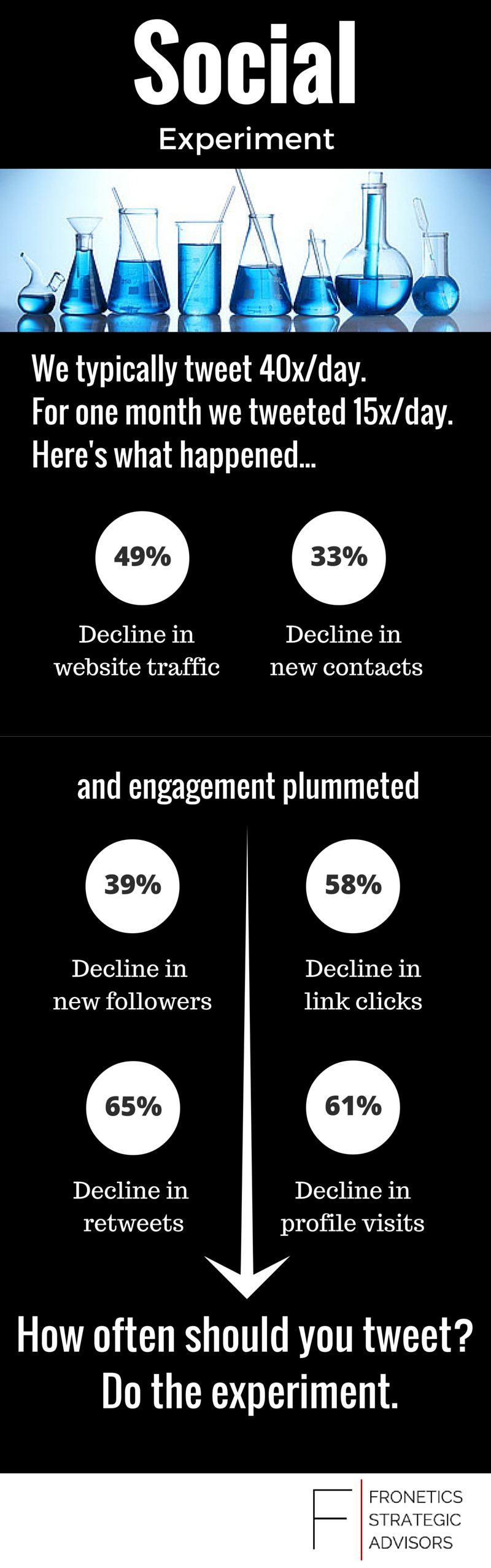
As shown in our social experiment infographic, when we reduced the number of times we post to Twitter from 40 times per day to 15 times per day, our engagement and ROI plummeted.
Not only did we realize close to a 50% decline in traffic to the website, we also realized a 33% decline in new contacts. That’s a 33% decline in our lead pipeline.
We also realized a decline in link clicks (58%), profile visits (61%), retweets (65%), and new followers (39%). In short, our engagement numbers took a dive – off a cliff.
So, how often should you tweet?
Although the numbers were abysmal, the experiment was a good one. It showed that, for Fronetics, posting to Twitter at a frequency of around 40 times per day is right for our company.
Does that mean the frequency is right for each of our clients? No. Does it mean that the frequency is right for your business? No. What it means is that there is no magic number when it comes to the ideal frequency for posting to Twitter.
Your company, or your marketing partner, should conduct due diligence and determine what the right frequency is for your business. Yes, you may realize a significant decline in engagement in ROI during your experiment. On the other hand, you may realize an increase in engagement and ROI — captured with lower output in terms of time and resources.
Do the experiment. I’d love to hear your results, and learn what frequency works for your business.
Not tracking your metrics on a monthly basis? Start now. Metrics enable you to measure success, drive strategy, and demonstrate the ROI of your marketing efforts.
Related posts:

by Elizabeth Hines | Apr 7, 2016 | Blog, Leadership, Logistics, Strategy, Supply Chain
 As part of our series on trailblazing women in the supply chain industry, I interviewed Barbara Jorgensen, co-founder and managing editor, Electronics Purchasing Strategies (EPS). Jorgensen has more than 20 years’ experience as a journalist, working for leading electronics industry publications such as Electronic Business, Electronic Buyers’ News, and EDN.
As a freelance writer, Barb wrote and managed an award-winning custom publication for Sager Electronics; was a leading contributor to Avnet Global Perspectives magazine; was a regular columnist for the National Electronics Distributors Association monthly newsletter; and wrote for industry associations such as IPC. Barb was also a featured blogger on the B2B Website Allbusiness.com and helped launch Electronics Sourcing North America, a start-up magazine serving purchasing professionals in the Americas.
Prior to her freelance career, Jorgensen was a senior editor at Electronic Business, the pre-eminent management magazine for the electronics industry, featuring world-class manufacturing companies such as Dell, Hewlett-Packard, Cisco and Flextronics International. Before joining EB for the second time, Barb spent six years with Electronic Buyers’ News as managing editor, distribution, winning several awards for coverage of the distribution beat. A graduate of the University of Binghamton, Barb began her journalism career with the Gannett newspaper chain. She has worked for a number of local newspapers in the Greater Boston area and trade journal publishers Reed Business Information and UBM.
How long have you worked in the supply chain industry?
I’d measure my specific supply chain experience with the publication of my first feature on electronics distribution in 1989. After copy editing for a leading electronics industry magazine for a couple of years the editors suggested I use my journalism experience to do some writing. I profiled Marshall Industries, a top-tier distributor at that time, and its founder, Gordon Marshall, who passed away last year.
How did you choose (or end up) working within the industry?
In high school and college, I specialized in journalism and had been writing features and covering town government for a Boston-area daily newspaper. The schedule was grueling, so I applied for work at a trade magazine publisher. This eventually led to being assigned the electronics distribution beat. I made it my goal to understand the business inside and out, and that expertise helped establish my credentials in the industry.
Two of the leading distributors now generate revenue in excess of $20 billion per year; I was calling on them before they reached their first $1 billion.
Although I never expected to become an expert in the electronics supply chain, the growth of the industry and my expertise has enabled a solid career path.
Let’s talk about EPS. How did EPS come about?
Electronics Purchasing Strategies – soon to be called EPSNews – was driven by several external events taking place in trade publishing. A few years prior to EPS, which started publishing online in 2013, the last purchasing publication in the industry closed its doors. Trade publishers were also laying off editors as they moved more content online. My two colleagues and I – Gina Roos and Bolaji Ojo – found ourselves unemployed all at the same time.
Given the under-representation of purchasing in the trade media, we decided to come together and start an online publication. Our reputation in the electronics industry helped us secure our first advertisers. We have been fortunate enough to support the publication primarily through advertising and newsletters since.
Where is EPS today?
While we were assessing our business model after three years we discovered we weren’t keeping pace with some of the dynamics of online publishing. Although our content has always been well received we weren’t getting as much ‘bang for the buck’ as we should have vis-a-vis SEO because of the way we developed our site. Although our content won’t change—we are focused on deep analysis of the entire supply chain from design through recycling – emphasizing the news aspect of our coverage will attract a wider audience and result in better organic growth.
Revenue-wise we have grown every year since our inception; 2015 was our best year so far, growing in the mid-double-digits.
What goals do you have for the company?
We’d like to expand. Our audience has largely been based in the U.S. because that is the market we know best, but clearly electronics procurement in the Far East continues to expand. The electronics markets in Europe remains steady and, let’s face it, the supply chain is global. So EPSNews would like to devote resources toward building an audience in the EU, the Far East, and relevant geographies in between.
Have you seen a change in the number of women entering the industry and/or contributing to the industry?
Absolutely. When I began my writing career in the tech industry there were fewer women in trade publishing – most of the women I networked with then were in marketing and PR. But that changed pretty rapidly at least on the media side during the 1990s. I’d say by then there was a 50-50 split between women and men in key editorial positions. In the electronics industry, however, there were few women executives. The first woman CEO of a major distribution company was Harriet Green, named CEO of Premier Farnell in 2006. Prior to that there were a handful of women in C-level positions – I know if I mention names I will forget someone – which was extremely encouraging. These days I see more women at industry forums such as EDS and at the ECIA conference than ever before, and they are in management positions.
Have you seen a change in the positions women hold within the supply chain industry?
Again, absolutely. Women are holding higher positions in management within my ‘world’—electronics distribution – but even more so within the online/social media companies such as Yahoo that have become so important to all of us. I also recently attended a presentation by a woman who headed the high-tech entrepreneurial business within Foxconn – a Chinese EMS company – who has since moved to Flex.
Any advice for women considering entering the industry?
My advice would be the same for anyone—learn as much as you can upfront. In business journalism, I had to interview CEOs and MBAs and at the beginning that was intimidating. I finally overcame that fear by reading everything I could about the company, the industry and the executive in advance, and I also asked ‘dumb’ questions of people I trusted. I also found that admitting what I didn’t know never hurt me: even the highest executives in the industry were willing to take the time to explain many of the things that make this industry unique. I think in general people are always willing to give someone a ‘hand up.’ I also found that companies like to work with writers that took the time to learn about their business. Knowledge and professionalism are guidelines I’d recommend for anyone.
On a broader level, what trends do you see within the industry?
I think right now there is a lot of turmoil regarding the supply chain as we know it and the implications of conducting business digitally. This applies to how companies work internally and how they are going to market. The supply chain has done a pretty good job at adopting technology to improve internal operations – we haven’t had an inventory glut since 2001. Externally it’s another matter. E-commerce unintentionally set off huge problems in counterfeiting. We are still trying to figure out where social media fits: it looks like ‘free’ advertising – you can generate a lot of attention with a tweet – but you don’t always control your message. Look at the mistakes people make that go viral.
Then there is managing the supply chain online. Business practices within the electronics supply chain haven’t kept up with technology. For example, supplier franchises are still granted on a regional basis – less so than before – but online business doesn’t have any boundaries. I think we are going to see common supply chain practices change as technology accelerates. Geographic boundaries are already crumbling, and there are practices such as ship-from-stock-and-debit; inconsistent global pricing; and demand-creation compensation that are simply inefficient. There’s little room for inefficiency in the digital supply chain.
You may also be interested in:

by Elizabeth Hines | Mar 31, 2016 | Blog, Content Marketing, Marketing, Social Media, Supply Chain
Employ a content and social marketing strategy to nurture leads you meet during MODEX.
Hundreds of potential customers will be heading to Atlanta next week for MODEX, and you’re gearing up to gain lots of new business. That is, you and over 800 other exhibitors are hoping to gain lots of new business. So how do you plan to stand out among the competition?
Using content and social marketing to nurture leads surrounding the event will help maximize the benefits of attendance. You can bring more attention to your presence, which will help you find more new potential customers, and then you can increase your chances of converting them if you use these tools properly.
Here are some tips for before, during, and after MODEX for using content and social media to gain new business.
Before the show
1) Define your goals.
A trade show represents an opportunity to spread brand awareness, find new leads, and, of course, make sales. Decide what is most important to your business, and strategize around those goals. For example, if one of your goals is to increase your social following, make sure every handout, landing page, and face-to-face interaction includes a request to like you on Facebook (or elsewhere).
2) Promote your attendance.
With the trade show hashtag (#MODEX2016), use Facebook, Twitter, and LinkedIn to let your followers know that you will be attending and when and where they can find you. Engage with other attendees who are using the event hashtag. Offer teasers — such as photos of the freebies you’re bringing — to entice visitors, and provide any longer-form information (e.g., an excerpt from a presentation you’ll be giving) in a blog post, distributing it through your social channels.
3) Set up a landing page/landing pages.
Create an event-specific landing page that includes a call to action (CTA), like reserving a time to speak with you at the conference or downloading a coupon to redeem a free sample. Make sure to ask for some information (such as a name, company, or contact information) in exchange. Monitor traffic and keep a running list of leads who visit and provide their information.
4) Research the attendees.
Perform prospect research using the list of attendees, paying special attention to those who have provided their information on your landing page or connected with you on social media about the event. Check out their social pages to see what they’re saying about the event, and like or follow them. Connect with high-value prospects on LinkedIn and try to arrange a time to meet up during the show.
5) Prepare to nurture.
Draft content that you can distribute during and after the show. Examples include lead-nurturing email templates, slides from presentations you are giving, and other offers you plan to provide visitors. Create another landing page, which includes a special offer or specific information you’ll be providing during the show, to drive attendees to during and after the event.
During the show
6) Keep chatting.
Reach out to the people you meet during the show on their social media handles. A nice-to-meet-you tweet and/or an invitation to connect on LinkedIn shows that you remember and appreciate the potential customer. Send the lead-nurturing emails you prepared in advance.
7) Monitor social media.
Continue using the show’s hashtag to monitor the conversations that are happening online, and see if anyone is talking about your company. Like or reply to anyone who does to show you’re listening.
8) Generate content.
Trade shows are a great place to generate content. Post photos of your booth and attendees from your company, and create videos of product demonstrations, presentations, or customer testimonials. Share your thoughts on the issues being discussed, and keep track of those themes, as well as any recurring questions that attendees ask, for future content.
After the show
9) Plan out your editorial calendar.
Develop posts for your company’s blog over the coming months around the questions and issues that were raised during the show.
10) Keep up the conversations.
Continue to engage the people you met on Facebook, Twitter, and LinkedIn. Follow and like their pages, and invite them to connect.
11) Offer your leads something of value.
Make event presentation or speaking materials part of your lead nurturing activities by sharing them with prospects using Slideshare or email. Remind leads with whom you shared your special-offer landing page to visit. Make sure to segment your contacts based on their interests and send them only relevant offers.
How do you nurture leads around trade shows? Will you be attending MODEX this year?
Related posts: